By Theon Alleyne · 30 August 2026
Ernest Mwebaze needed a model that could speak Uganda.
Not English. Uganda, which has dozens of languages, most of which appear in almost no training data anywhere.
He tried the American models and then he tried Alibaba's, and Alibaba's was better at the job.
What did the Ugandan developer actually find?
That the Chinese model handled his languages better, cost less, and could be modified.
The New York Times reported on 5 August, in a piece by Paul Mozur, Adam Satariano and Aaron Krolik, that Mwebaze found Alibaba's model handled Uganda's dozens of languages better than anything available from Meta or Google. It was also inexpensive and customisable.
The system he built is called Sunflower. It runs across Uganda, and among its users are farmers who receive weather information and crop advice in their own dialects.
That is a working deployment, in a low-resource language environment, delivering agricultural extension advice. It exists because a model was good enough, cheap enough and open enough to be adapted by someone local.
The Times headed its report with the observation that this should worry Silicon Valley. For a developer in Kampala, or in Georgetown, the same facts read differently. A tool arrived that did the job.
How widely are these models being used?
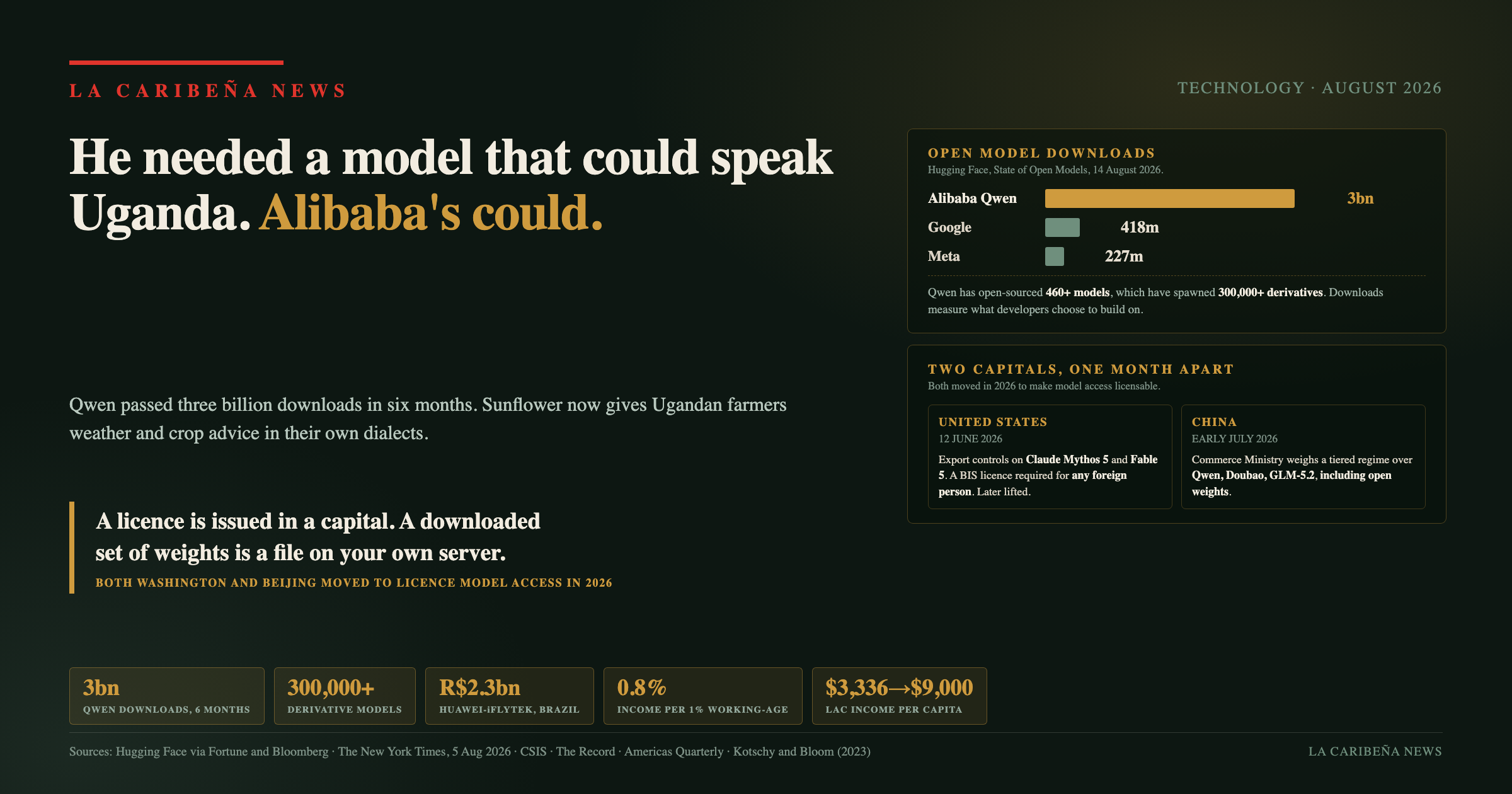
Three billion downloads in six months, against 418 million and 227 million.
Hugging Face published its State of Open Models report on 14 August 2026. Alibaba's Qwen family passed three billion downloads over the preceding six months, overtaking Meta, Google and its domestic rivals to become the most downloaded open model family in the world.
Google recorded 418 million downloads across 2026. Meta recorded 227 million.
Qwen has open-sourced more than 460 models and those have spawned more than 300,000 derivatives.
| Open model family | Downloads |
|---|---|
| Alibaba Qwen | 3 billion, six months |
| 418 million, 2026 | |
| Meta | 227 million, 2026 |
Downloads are not revenue and they are not quality. What they measure is what developers choose to build on when nobody is making them choose. Three hundred thousand derivative models is a count of people who took the weights and made something else.
Why does an open model matter more to a small state?
Because the alternative can be switched off by a government that is not yours.
On 12 June 2026 the United States Department of Commerce wrote to Anthropic and imposed export controls on two of its models, Claude Mythos 5 and Claude Fable 5. The letter went from Commerce Secretary Howard Lutnick to the company's chief executive, Dario Amodei, and cited cybersecurity capability.
The effect was that a licence from the Bureau of Industry and Security became necessary for any foreign person, inside or outside the United States, to access those models. That included the company's own foreign-national employees.
The authority cited was the Export Control Reform Act's power to impose interim controls on emerging and foundational technologies. There is no established regulatory framework in the Export Administration Regulations for that power, and it had not previously been used as the basis for a control. It was the first time a frontier model itself, rather than the chips underneath it, was treated as a controlled item.
The controls were subsequently lifted after the company reached a series of agreements with the government.
The episode lasted weeks and it settled a question. Access to an American frontier model is a licensable privilege, and the licence is issued in Washington. A downloaded set of open weights is a file on a server in Port of Spain or Kingston, and no letter can retrieve it.
Is Beijing about to do the same thing?
It has been discussing exactly that since July.
China's Ministry of Commerce convened sessions with Alibaba, ByteDance and Z.ai in early July 2026 on restricting foreign access to the country's most advanced models. The discussions covered proprietary systems and open-weight ones, naming Qwen, ByteDance's Doubao and Z.ai's GLM-5.2.
The framework floated was tiered. Basic open-source tools would need a simple filing. More advanced technologies would face security reviews. The most sensitive frontier models would be barred from public release or confined to domestic use. Officials also discussed making the leak or theft of proprietary Chinese AI technology an offence under national security law.
So both capitals moved in the same direction within a month of each other. Washington controlled a frontier model in June and released it. Beijing began designing a regime to control its own in July.
For a Caribbean ministry or a Caribbean firm, that is the planning assumption. The weights available today are available today. Neither government has undertaken that they will stay that way.
What is Latin America building?
Its own model, in its own languages, on its own hardware.
Latam-GPT is a Spanish and Portuguese language model for the region, to be trained on a supercomputer installed at the University of Tarapacá in northern Chile, at an investment of close to US$5 million. Its content is principally Spanish and Portuguese, with a stated aim of incorporating indigenous languages.
Brazil has gone larger and taken Chinese partners. A contract worth 2.3 billion reais pairs Huawei, supplying the underlying computing infrastructure, with iFlytek, developing Portuguese-language large language models. It includes training for 3,000 Brazilian professionals and is expected to launch in July 2027.
Huawei Cloud is expanding AI compute in Brazil and Mexico, and has said its Ascend AI chips are under consideration for the region.
Americas Quarterly framed the choice plainly in an assessment of what DeepSeek's arrival means for the region.
None of this is a Caribbean programme. The Caribbean has no Latam-GPT and no 2.3 billion reais contract. What it has is the same linguistic problem as Uganda, in a smaller market.
Where are the region's meteorologists being trained?
In Nanjing, in numbers, and increasingly alongside an artificial intelligence faculty.
The Nanjing University of Information Science and Technology was founded in 1960 and carried the name Nanjing Institute of Meteorology until 2004. Its meteorology programme ranks first in China. Since 1993 it has hosted a World Meteorological Organization Regional Training Centre, and it has trained participants drawn from 160 WMO members.
More than 260,000 students have graduated from it in meteorology and related disciplines, among them over 6,000 international alumni. The NUIST-WMO Fellowships Education Programme, run jointly with the organisation, funds master's and doctoral study in meteorological fields for students from developing countries, alongside places under the Chinese Government, Confucius Institute and Jiangsu Government scholarships. The university holds cooperation agreements with more than 100 institutions across over 30 countries.
That pipeline now runs through an AI faculty. The university's School of Artificial Intelligence houses the State Key Laboratory of Climate System Prediction and Risk Management and the Jiangsu Key Laboratory of Intelligent Weather Forecasting and Applications Based on Big Data. Its researchers published NUIST-WE in 2026, a foundation architecture for weather and energy forecasting that pairs meteorological physics with generative pre-training, and are building TianJi, an autonomous system intended to find physical mechanisms in atmospheric science.
The city around it is being built for the same purpose. Nanjing was China's first designated Software City and holds Jiangsu's only National Pilot Zone for Artificial Intelligence Innovation and Application. Its cluster spans more than 6,900 software companies and over 600 artificial intelligence firms, and a provincial talent zone of roughly 38 square kilometres is targeting 130,000 industry professionals within three years.
For the Caribbean the relevance is not abstract. The region's sharpest need for machine forecasting is weather: hurricanes, drought and the rainfall that decides harvests and canal transits. Forecasters have put a 69 per cent chance on a record El Niño, the last comparable one cut Guyana's rice crop by 37 per cent, and the Panama Canal is rationing transits on rainfall 34 per cent below its historical average. A Ugandan farmer receiving crop advice in a local dialect and a Caribbean meteorologist trained under a WMO fellowship in Nanjing are two ends of the same supply chain.
Why does the Caribbean need this particularly?
Because the population is about to stop doing the work that productivity now has to do.
Income per capita in Latin America and the Caribbean rose from US$3,336 to just over US$9,000 across recent decades, lifted substantially by a growing working-age population. The economist Eduardo Levy Yeyati set out the mechanism in Americas Quarterly: as fertility fell, the working-age share rose, so more workers supported relatively fewer dependants without anyone becoming more productive.
The magnitude is measured. A 2023 study by Rainer Kotschy and David Bloom, drawn from a panel of 145 countries between 1950 and 2015, found that a 1 per cent rise in the working-age share lifts income per capita by about 0.8 per cent.
That tailwind is fading. The World Bank places Brazil, Chile, Costa Rica, El Salvador, Colombia, Uruguay and most Caribbean states at an advanced stage of demographic transition, with fertility near replacement level.
When the working-age share stops rising, output per person only grows if output per worker grows. That is the whole of the argument for why cheap, adaptable, multilingual tooling is not a technology story for the region. It is a growth story.
The Caribbean's linguistic position makes the point sharper than Latin America's. English, Spanish, Dutch, French, Kreyòl, Papiamento, Sranan Tongo and a range of creoles are not well represented in models trained overwhelmingly on English. Uganda's problem is the region's problem, and Uganda now has a working answer to it.
Where does this leave the region?
Holding a choice it has not yet made, with the terms set elsewhere.
Chinese economic weight in the region is already documented. Folha de S.Paulo, reporting research by Francisco Urdinez, records that ten of South America's twelve countries have moved into Beijing's economic orbit, a displacement Urdinez traces through his book Economic Displacement: China and the End of US Primacy in Latin America. The analyst Oliver Stuenkel has observed that even governments aligned with Washington resist surrendering Chinese trade ties, because the market is difficult to replace.
The Caribbean has met the hardware side of this already. A Patagonian power cooperative chose Huawei equipment and Washington issued visa warnings to the directors who took the decision. Trinidad has signed memoranda for up to 800 megawatts of data centre capacity whose compute will run on somebody's chips. Argentina's currency swap with China reads at US$19 billion, of which under US$700 million was ever drawn, which is a reminder that headline figures and delivered value are different things.
The region has also already met the software side, in a courtroom. Chile's courts absorbed 38,477 AI filings, and Caribbean jurisdictions had a rule for it.
Ernest Mwebaze did not resolve a geopolitical question. He needed something that worked in Luganda and he found it. The models that will be used across this region will be chosen the same way, by people with a job to do, and the choice is being made now while the weights are still there to download.
Text equivalent of the title card
Every data point shown on the title image, with its source.
- Alibaba Qwen: 3 billion downloads over six months. Google: 418 million in 2026. Meta: 227 million. Qwen has open-sourced 460+ models, spawning 300,000+ derivatives. Source: Hugging Face, State of Open Models report, 14 August 2026, reported by Fortune and Bloomberg.
- Uganda: developer Ernest Mwebaze found Alibaba's model handled Uganda's dozens of languages better than Meta's or Google's, and was inexpensive and customisable. His system, Sunflower, delivers weather and crop advice to farmers in local dialects. Source: The New York Times, 5 August 2026 (Mozur, Satariano, Krolik).
- 12 June 2026: United States Commerce Department imposed export controls on Claude Mythos 5 and Claude Fable 5, requiring a BIS licence for any foreign person to access them, including Anthropic's own foreign-national staff. First time a frontier model itself was treated as a controlled item. Later lifted.
- July 2026: China's Ministry of Commerce discussed with Alibaba, ByteDance and Z.ai a tiered regime restricting overseas access to Qwen, Doubao and GLM-5.2, covering open-weight models.
- Latam-GPT: Spanish and Portuguese model, supercomputer at the University of Tarapacá, Chile, about US$5 million.
- Brazil: 2.3 billion reais, Huawei on infrastructure and iFlytek on Portuguese language models, training 3,000 professionals, launch expected July 2027.
- Latin America and Caribbean income per capita rose from US$3,336 to just over US$9,000. A 1 per cent rise in the working-age share lifts income per capita by about 0.8 per cent (Kotschy and Bloom, 2023, 145 countries, 1950 to 2015). Most Caribbean states are at an advanced stage of demographic transition.
Two capitals, one month apart
| United States | China | |
|---|---|---|
| When | 12 June 2026 | Early July 2026 |
| What | Export controls on two Anthropic models | Ministry of Commerce sessions on restricting overseas access |
| Models named | Claude Mythos 5, Claude Fable 5 | Qwen, Doubao, GLM-5.2 |
| Open weights covered | Not applicable, models are closed | Yes, explicitly |
| Status | Imposed, then lifted | Under discussion |
About the author
Theon Alleyne is the proprietor of EICCIO Advisors, a corporate compliance and brand visibility consultancy registered in Guyana, and the publisher of La Caribeña News. He holds the CRCP and CCEP compliance credentials.
He also holds office in two Guyanese business support organisations, and readers should weigh this article accordingly. He is Vice President and Public Relations Officer of the Essequibo Islands-West Demerara Chamber of Commerce and Industry (R3CCI), whose executive is led by President Bhabita Albert and which represents businesses across Region Three from Leonora. He is also a Director of the Guyana Manufacturing and Services Association (GMSA) and Chair of its Services Sub-Sector.
A direct interest is disclosed here. The author attended an artificial intelligence seminar at the Nanjing University of Information Science and Technology, the institution described in this article. Readers should weigh the section on that university in that light.
Neither business body named above is a subject of this article, and neither has any commercial relationship with the technologies or companies named in it.
Frequently Asked Questions
Why did a Ugandan developer choose a Chinese AI model?
The New York Times reported on 5 August 2026 that Ernest Mwebaze found Alibaba's model handled Uganda's dozens of languages better than anything from Meta or Google, and that it was inexpensive and customisable. His system, Sunflower, is used across Uganda, including by farmers receiving weather and crop advice in local dialects.
How widely used are Chinese open AI models?
Hugging Face's State of Open Models report of 14 August 2026 recorded Alibaba's Qwen family passing three billion downloads in six months, against 418 million for Google and 227 million for Meta across 2026. Qwen has open-sourced more than 460 models, which have produced over 300,000 derivatives.
Can access to AI models be restricted by governments?
Both have moved to do so in 2026. On 12 June the United States Commerce Department imposed export controls on two Anthropic models, requiring a licence for any foreign person to access them, before lifting the controls after agreements with the company. In early July China's Ministry of Commerce discussed a tiered regime restricting overseas access to Qwen, Doubao and GLM-5.2, explicitly including open-weight models.
What is Latin America building of its own?
Latam-GPT, a Spanish and Portuguese model to be trained on a supercomputer at the University of Tarapacá in northern Chile at an investment of close to US$5 million, with a stated aim of incorporating indigenous languages. Separately, a 2.3 billion reais contract in Brazil pairs Huawei on computing infrastructure with iFlytek on Portuguese-language models, including training for 3,000 professionals, expected to launch in July 2027.
Why does this matter for Caribbean growth?
Because the demographic dividend is ending. Income per capita in the region rose from US$3,336 to just over US$9,000, lifted substantially by a rising working-age share, and a 2023 study across 145 countries found each 1 per cent rise in that share lifts income per capita by roughly 0.8 per cent. The World Bank places most Caribbean states at an advanced stage of demographic transition. When the working-age share stops rising, growth in output per person depends on output per worker.