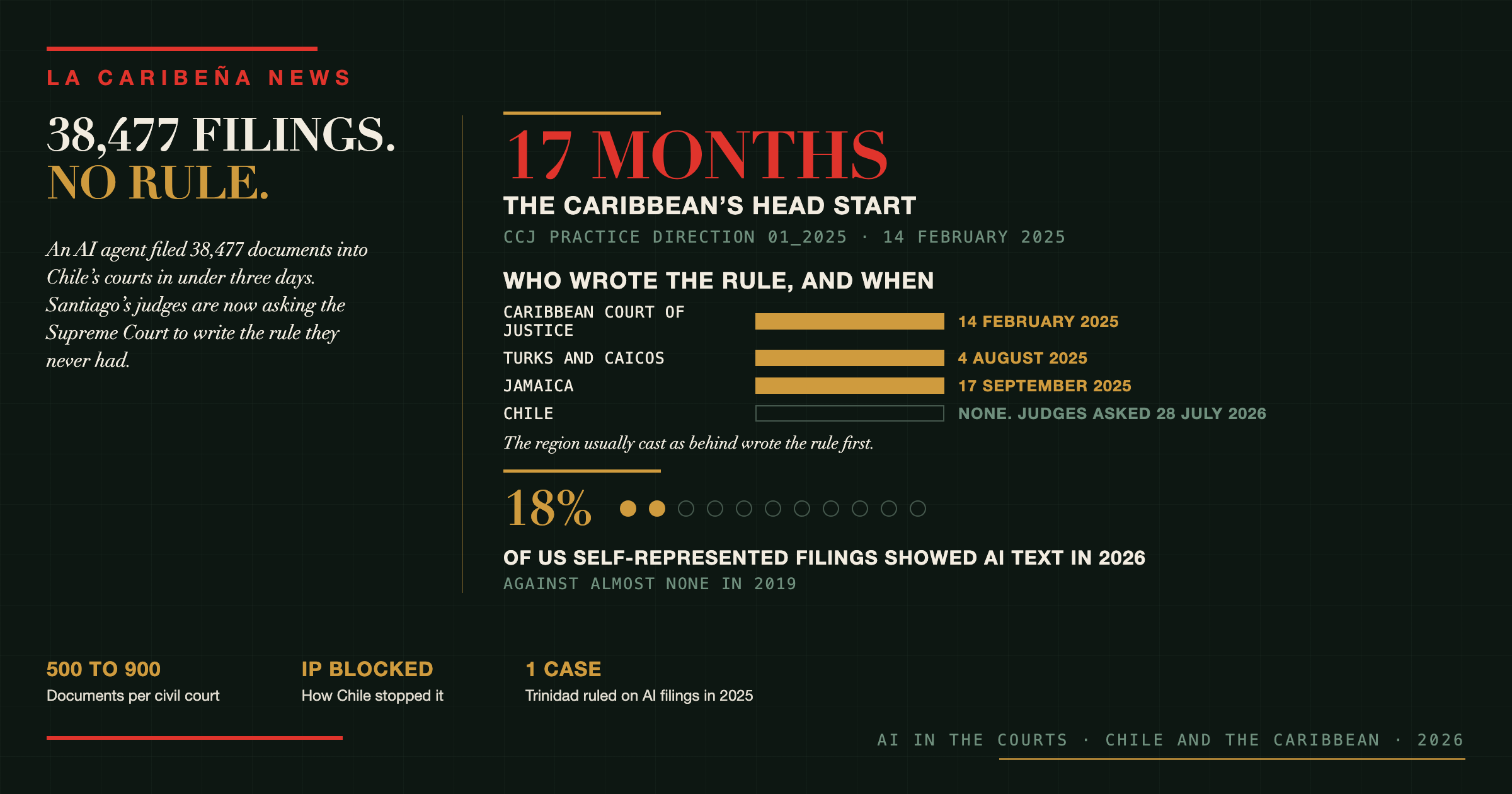
Santiago's civil judges are asking their Supreme Court to ban AI filing because no policy exists. The Caribbean Court of Justice issued one in February 2025.
BY LA CARIBEÑA NEWS
Quick summary: A lawyer used an external AI agent to file 38,477 documents into Chile's Virtual Judicial Office in under three days from 25 July 2026, collapsing the platform. Santiago's civil judges have asked the Supreme Court to prohibit AI filing until an institutional policy exists. Caribbean courts wrote theirs eighteen months ago.
What happened in Chile?
The load began on Saturday 25 July 2026. By 11.30am on Monday 27 July the count had reached 38,477 submissions, Emol reported, enough to bring down the Oficina Judicial Virtual, the platform through which Chilean lawyers file electronically.
The filings were not complex litigation. They were overwhelmingly desarchivo requests, asking that closed files be retrieved from archive, and renuncia de patrocinio y poder, withdrawals of representation, spread across civil courts nationwide. That worked out at between 500 and 900 documents per court, according to Diario Constitucional. The volume came from an external artificial-intelligence agent driving the filing interface.
The Corporación Administrativa del Poder Judicial blocked the originating IP address, and the platform returned to normal, T13 reported.
What the title card shows
Every data point on the article's title card, in text.
- 38,477. Documents filed by 11.30am on Monday 27 July 2026, from a start on Saturday 25 July. Source: Emol, Diario Constitucional.
- 500 to 900. Documents per civil court across Chile. Source: Diario Constitucional.
- 4 requests. The measures Santiago's civil judges asked the Supreme Court to adopt. Source: La Tercera.
- Feb 2025. The Caribbean Court of Justice issued Practice Direction 01_2025 on generative AI in court proceedings. Source: Caribbean Court of Justice.
- 3 more. Turks and Caicos (4 August 2025), Jamaica (17 September 2025), and a decided Trinidadian case (30 April 2025).
- 18 per cent. Share of self-represented complaints in United States federal courts in 2026 showing AI-generated text, against almost none in 2019.
What have the judges asked for?
The Committee of Civil Judges of Santiago put four requests to Supreme Court president Gloria Ana Chevesich. Keep the lawyer's IP address blocked. Commission a report on possible disciplinary and criminal responsibility. Install CAPTCHA-type barriers to stop automated access and data extraction. And, most consequentially, prohibit the use of artificial intelligence for filing documents until a clear institutional policy regulating it exists.
That last request is the tell. The judges are not asking the court to enforce a rule. They are asking it to write one, in the middle of an incident, because there was nothing on the books to apply.
The Supreme Court convened an extraordinary plenary session and requested a technical report from the judiciary's information-technology department to evaluate sanctions and establish security protocols on judicial platforms.
La Caribeña News is not naming the lawyer. No disciplinary or criminal finding has been made, and the significance of this story lies with the institution, not the individual.
Is Chile an outlier?
No. It is an early, visible case of a documented pattern.
In United States federal courts, AI-generated text appeared in more than 18 per cent of complaints filed by self-represented litigants in 2026, against virtually none in 2019, according to research examining 4.5 million federal civil cases. The share of suits brought by people without a lawyer rose from 11 per cent in 2022 to 16.8 per cent in 2025. A staff attorney reviewing such filings in Minnesota's federal district court reported roughly a 50 per cent increase from non-prisoners beginning in March 2025.
Chief Judge Patrick J. Schiltz of Minnesota's federal district court put it plainly: "There's just no end in sight, and no satisfactory solution in sight either."
The difference in Chile is one of mechanism rather than kind. Elsewhere the pressure is thousands of individuals each filing a little more. In Santiago it was one authorised account, automated, filing at machine speed against a system that assumed a human typing.
Where does the Caribbean stand?
Ahead, which is not the usual direction of this story.
The Caribbean Court of Justice issued Practice Direction 01_2025 on the use of generative artificial intelligence in court proceedings on 14 February 2025, five months before Chile's incident. The Turks and Caicos Islands issued its Guide to the Use of Generative AI in Court Proceedings on 4 August 2025. Jamaica's judiciary followed with Practice Direction No. 1 of 2025 on 17 September 2025, the first CARICOM member state to codify ethical AI use in proceedings.
The regional directions share a governing principle: the court user carries responsibility for verifying the accuracy of anything placed before the court, whatever tool produced it. That places the Caribbean ahead of much of the hemisphere on conduct, at a moment when regional institutions are actively building AI into public policy.
Trinidad and Tobago has gone further still, in the only way that ultimately counts. Nexgen Pathology Services Ltd v Darceuil Duncan, CV2023-0439, decided 30 April 2025, is the first reported Caribbean case dealing with AI-generated court filings. The region has not only written rules, it has applied them.
None of this makes Caribbean court platforms immune to what happened in Santiago. A practice direction governs conduct; it does not rate-limit an API. Chile's judges asked for CAPTCHA barriers precisely because the gap was technical as well as regulatory, and no Caribbean judiciary has published equivalent controls on automated submission volume.
Theon Alleyne, Managing Director of EICCIO Advisors and Chairman of the Services Sub-Sector at the Guyana Manufacturing & Services Association, said the exposure runs well beyond the courts.
"Every services firm in this region is now building automated workflows into someone else's platform, whether that is a court registry, a customs system or a bank portal. Chile is the first time we have watched one of those platforms fall over. The lesson for our sector is that authorisation is not capacity, and if you have not asked what your automation does at volume, you have not finished the risk assessment."
It is an argument he made before the incident. Speaking to the Guyana Chronicle in June 2025, Alleyne warned that established local approaches would erode "because the entities coming in are more regional and global in nature, and they're leveraging different tools for success." Santiago is the first Latin American case in which one of those tools, pointed at a public platform, took the platform down.
Disclosure: Theon Alleyne is the publisher of La Caribeña News.
What should regional firms and regulators take from it?
Three things follow, and none of them require a new law.
The first is that the exposure sits with the platform, not the profession. Chile's rules on who may file and what they may file were never breached. One authorised user did in seventy-two hours what the system assumed would take years. Any e-filing platform in the region that authenticates users but does not throttle them carries the same risk today.
The second is that a practice direction is necessary and not sufficient. The Caribbean's directions are ahead of much of the hemisphere on conduct, and they say nothing about submission rates, automated agents or API access. That is the gap Chile just illustrated.
The third is that services firms adopting AI agents are now operating inside institutions that may restrict them without notice. For firms already discovering that compliance reaches well past tax and NIS filings, automation risk is the next line on the same register. Chile's judges asked for a prohibition on AI filing while a policy is written. A firm that has built an automated workflow into a court platform has no standing to object.
Frequently Asked Questions
What exactly happened to Chile's judicial platform?
A lawyer used an external artificial-intelligence agent to submit 38,477 documents to the Oficina Judicial Virtual between Saturday 25 July and 11.30am on Monday 27 July 2026, mostly archive-retrieval requests and withdrawals of representation, at 500 to 900 per civil court. The platform collapsed and was restored after the Judicial Administration Corporation blocked the originating IP address.
What did Chilean judges ask the Supreme Court to do?
Keep the IP address blocked, commission a report on possible disciplinary and criminal responsibility, install CAPTCHA-type barriers against automated access, and prohibit AI-assisted filing until an institutional policy exists.
Does the Caribbean have rules on AI in court?
Yes. The Caribbean Court of Justice issued Practice Direction 01_2025 on 14 February 2025. The Turks and Caicos Islands issued guidance on 4 August 2025 and Jamaica issued Practice Direction No. 1 of 2025 on 17 September 2025. Trinidad and Tobago decided the region's first case involving AI-generated filings on 30 April 2025.
Do those rules prevent what happened in Chile?
Not by themselves. The Caribbean directions govern how court users may rely on generative AI and place responsibility for accuracy on the filer. They do not limit submission volume, automated agents or programmatic access, which is the technical exposure Chile's incident revealed.
Is this part of a wider trend?
Yes. AI-generated text appeared in more than 18 per cent of self-represented complaints in United States federal courts in 2026, against almost none in 2019, and self-represented filings rose from 11 per cent of suits in 2022 to 16.8 per cent in 2025.