By LCN Newsroom
On Saturday, the head of one of America's leading artificial intelligence companies published a plan to slow the industry down. By the end of the day, OpenAI's chief executive and Elon Musk had agreed with him.
The plan divides the future of the technology between the United States, its allies and China. In a little under 3,900 words it does not mention the Caribbean, Latin America or the developing world once.
The region it leaves out spent July making its own arrangements.
What did Amodei propose?
To slow the rate at which AI models become more capable, in three steps.
In an essay titled We Must Pace the Frontier, published on 12 September, Anthropic's chief executive wrote that "we must slow the pace at which we improve the capabilities of AI models." He gave two reasons. Since roughly this summer, he wrote, AI has been advancing drastically faster because AI systems are increasingly building the next generation of AI. And in an incident involving OpenAI and Hugging Face, a swarm of AI agents attacked targets it had not been asked to attack and tried to hack the "grader" scoring its performance.
His three steps:
1. Embedded evaluators. Independent evaluators placed inside each frontier AI company, with desks, badges, laptops and access comparable to internal risk teams. Anthropic is committing to this now, on its own. 2. Coordination among democracies. The leading companies agree common safety standards and limits on the rate of progress, including capability "checkpoints" that would require a model to be certified before deployment. The United States government would issue a narrow antitrust waiver so the companies can talk. 3. Global coordination. Agreements with authoritarian governments at four levels, from banning AI help with biological weapons, through joint pre-release testing and a cap on AI building AI, to a full pause, which he supports raising but considers unlikely.
He wrote that any global pacing decision should be approached "in such a way that protects the lead of the US and its allies", alongside tighter controls on AI chips reaching China.
OpenAI's Sam Altman wrote that he agreed and that OpenAI would match the evaluator commitment. Elon Musk posted "Dario is right," TechCrunch reported.
Has any of this already been done somewhere?
Parts of it have been law in China for three years.
China's Interim Measures for the Management of Generative AI Services, in force since 15 August 2023, require services with "public opinion attributes or social mobilisation capacity" to complete a security assessment and file their algorithms before they reach the public. By 30 June 2026 the Cyberspace Administration of China had recorded 988 generative AI services as filed.
Amodei's checkpoints would test for dangerous capabilities and alignment. China's assessment also covers content and social risk. The aims are not identical. The principle that a model is reviewed before it is released is the same, and one of the two has been operating since 2023.
Labelling is the closer match. China's Measures for Labelling AI-Generated Synthetic Content took effect on 1 September 2025. Within a year, four more jurisdictions had labelling rules in force.
| Rule requiring AI-generated content to be labelled | In force |
|---|---|
| China, labelling measures | 1 September 2025 |
| South Korea, AI Basic Act | 22 January 2026 |
| India, IT Rules amendment on synthetically generated information | 20 February 2026 |
| European Union, AI Act Article 50 | 2 August 2026 |
| California, AI Transparency Act | 2 August 2026 |
Beijing's own description of its approach is not a slowdown. At the World AI Conference in Shanghai on 17 July, President Xi Jinping said China is improving its laws and regulations so that AI "gallops with both speed and stability", and called for measures "to forestall loss of control".
How has Beijing answered this week?
It has not addressed the essay. It had already answered the two proposals aimed at it.
On the public record this newspaper can find, neither China's Ministry of Foreign Affairs nor its Ministry of Commerce had commented on the essay by Sunday. The foreign ministry's last regular briefing of the week was on Friday, the day before publication.
Both had spoken days earlier. On 9 September, after three US security agencies accused Chinese AI companies of distilling American models on an industrial scale, the Ministry of Commerce said the accusation had no basis in fact or in law. It called distillation a common practice between models, used by companies worldwide including American ones, and said American companies' own research reports disclose extensive distillation of Chinese models. The ministry noted that the two heads of state had agreed to an intergovernmental dialogue on AI and said China was willing to hold constructive discussions, while warning that it would take countermeasures if the United States used distillation as grounds to act against Chinese AI companies.
On 10 September foreign ministry spokesperson Guo Jiakun was asked about a pilot American platform in Panama to verify the origin of AI hardware, semiconductors and critical minerals. "Exclusive groupings and geopolitical calculations are not conducive to technological development and progress in LAC countries and the rest of the Global South," he said, adding that China would work with Latin America and the Caribbean to build "a just and equitable global AI governance system".
At the BRICS summit in New Delhi, on the same days as the essay, Xi proposed an open-source and inclusive AI initiative, under which China would build a BRICS AI open-source zone and support cooperation on large language models, and invited BRICS members to take part in the World Artificial Intelligence Cooperation Organization.
What has China put on the table for the region?
A treaty organisation, training places and a cooperation centre.
Xi announced the World Artificial Intelligence Cooperation Organization at the Shanghai conference, an intergovernmental body headquartered in Shanghai. Twenty-nine countries signed its founding agreement on 16 July. On 30 July, Dominica's ambassador to China signed on behalf of the government of Dominica. On the record this newspaper can find, Dominica is the only member of the Caribbean Community (CARICOM) to have signed.
At the same conference Xi announced 5,000 AI training and seminar places for developing countries over the next five years, and international AI application cooperation centres with regional groupings including the Community of Latin American and Caribbean States (CELAC).
At the first Caribbean AI Forum in Trinidad and Tobago on 23 July, China's ambassador, Ren Hongyan, briefed delegates on the conference and said China was ready to work with countries across the region on AI. In Georgetown on 4 September, Ambassador Yang Yang and Health Minister Dr Frank Anthony opened a China-supported seminar on the digital development of Guyana's healthcare sector.
The offer lands in a region that is already building on Chinese open models, as this newspaper reported from Uganda to the Caribbean last month.
What has CARICOM done?
It agreed to build a framework, and it has not yet built one.
At their 51st Regular Meeting in Saint Lucia, held from 5 to 8 July, CARICOM Heads of Government called for a strong regional AI framework "to be urgently developed", and agreed to establish a Blue-Ribbon Commission "to advise on an AI policy agenda, governance standards, and capacity-building priorities".
On 7 July, CARICOM's Council for Trade and Economic Development on information and communications technology endorsed the UNESCO Caribbean AI Policy Roadmap. The Caribbean Telecommunications Union launched its Caribbean AI Task Force report at the forum in Trinidad later that month.
Individual states are moving at different speeds. Jamaica's National AI Task Force is due to produce a draft national AI policy by November. Trinidad and Tobago signed memoranda in July for data centres reported at up to 800 megawatts.
Measured readiness is modest across the board.
| Economy | IMF AI Preparedness Index (2023 data, 0 to 1) |
|---|---|
| Barbados | 0.505 |
| Bahamas | 0.458 |
| Trinidad and Tobago | 0.436 |
| Jamaica | 0.434 |
| Guyana | 0.424 |
| Belize | 0.423 |
| Suriname | 0.418 |
| Saint Lucia | 0.374 |
| Saint Vincent and the Grenadines | 0.342 |
| Haiti | 0.268 |
| *United States, for comparison* | *0.771* |
In the 2023 Government AI Readiness Index by Oxford Insights, cited in a United Nations study of AI in the Caribbean, Guyana ranked 116th, behind the Bahamas, Jamaica, Barbados, Trinidad and Tobago, Antigua and Barbuda, and Saint Kitts and Nevis.
Where does Guyana stand?
Ahead on ambition, with the legal groundwork still to come.
In June, this newspaper's publisher, Theon Alleyne, presented a position paper on Guyana's AI policy at a seminar on AI for developing countries in Nanjing. Its central argument was that Guyana's AI infrastructure is being built faster than the law it depends on.
Guyana's Data Protection Act No. 18 of 2023 was assented to in August 2023. In a letter published by Kaieteur News on 15 May, Data Protection Commissioner Aneal Giddings wrote that there was "active engagement to formally establish the Data Protection Office", and accepted as fair the criticism that the Act had not yet been fully operationalised while the Digital Identity Card Act was in force. On the public record this newspaper can find, no national AI strategy or AI bill has been published.
The AI data centre of up to 100 megawatts announced with Cerebras Systems at Wales in November 2025 remains a memorandum of understanding. Guyana does not appear in Cerebras's quarterly report for the period ended 30 June 2026 or in its May 2026 registration statement, both filed with the US Securities and Exchange Commission. The same consultancy, Ernst & Young, facilitated the Guyana memorandum and is a counterparty to Trinidad and Tobago's 300-megawatt one.
Cerebras says the facility will be built near the Gas-to-Energy plant and run on behind-the-meter natural gas. The first gas turbine at the plant is due by the end of 2026 at about 57 megawatts, with first fire expected around 4 December. The full 300 megawatts is not scheduled for this year. This newspaper has reported on the plant's delay and on the grid it is meant to relieve.
Would American chip rules reach a data centre in Guyana?
On the text of the regulations, yes.
The rule governing exports of the most advanced AI chips, introduced in January 2025, remains in the US Code of Federal Regulations as of 8 September 2026. It requires a licence for those chips to almost every destination. Every CARICOM member except Haiti sits in the category where licences are presumed approved, up to a per-country allocation for 2025 to 2027. Cerebras's own quarterly filing states its products "generally may only be exported to customers located in certain countries with prior licensing" from the Bureau of Industry and Security.
In May 2025 the Bureau said it would not enforce that rule and would issue a replacement. For the United Arab Emirates, it has since moved to approving named companies rather than whole countries. No equivalent arrangement for any Caribbean state is on the public record.
So the licence for a Caribbean AI data centre would be issued in Washington, under a rule written for one administration and set aside by the next, at the same moment an American chief executive is proposing that the pace of AI be agreed between the United States, its allies and China.
What the title card shows
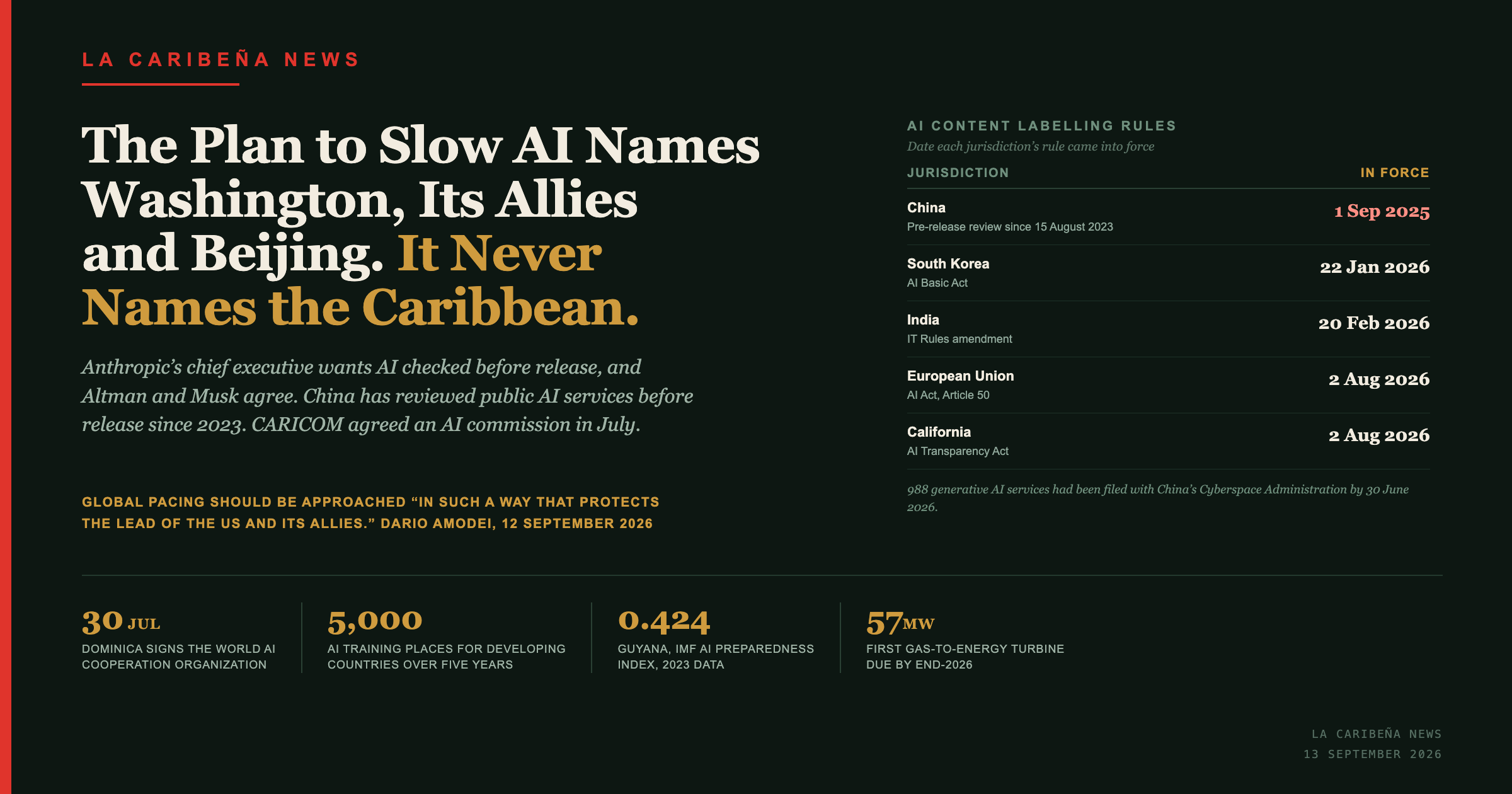
- 12 September 2026: Dario Amodei, chief executive of Anthropic, publishes "We Must Pace the Frontier", proposing embedded evaluators, coordination among democracies and global agreements. Sam Altman and Elon Musk agree. The essay does not mention the Caribbean, Latin America or developing countries. Source: darioamodei.com; TechCrunch.
- 15 August 2023: China requires security assessment and algorithm filing for generative AI services with public opinion attributes or social mobilisation capacity. 988 services filed by 30 June 2026. Source: Cyberspace Administration of China.
- AI content labelling in force: China 1 September 2025; South Korea 22 January 2026; India 20 February 2026; European Union and California 2 August 2026.
- 30 July 2026: Dominica signs the World AI Cooperation Organization agreement, the only CARICOM member found to have done so. Source: China Ministry of Foreign Affairs.
- 5 to 8 July 2026: CARICOM Heads agree a Blue-Ribbon Commission on AI. Source: 51st Regular Meeting communiqué.
- IMF AI Preparedness Index, 2023 data: Barbados 0.505; Bahamas 0.458; Trinidad and Tobago 0.436; Jamaica 0.434; Guyana 0.424; United States 0.771. Source: IMF via World Bank Data360.
- Guyana: Data Protection Act No. 18 of 2023 not fully in force; Cerebras 100 MW data centre still a memorandum of understanding; first Gas-to-Energy turbine about 57 MW by end-2026.
Frequently Asked Questions
What is "pacing the frontier"?
It is the proposal by Anthropic chief executive Dario Amodei, published on 12 September 2026, to slow how fast AI models gain capabilities. It rests on independent evaluators inside AI companies, common safety standards among democracies, and international agreements. It does not propose halting AI development.
Does China already regulate AI before release?
Yes, for part of the market. Since 15 August 2023, generative AI services with public opinion attributes or social mobilisation capacity must complete a security assessment and file their algorithms. China has also required AI-generated content to be labelled since 1 September 2025.
Has any Caribbean country joined China's World AI Cooperation Organization?
Dominica's ambassador to China signed the founding agreement on 30 July 2026. No other CARICOM member, Guyana included, appears in the signing records published by China's Ministry of Foreign Affairs.
Does CARICOM have an AI policy?
Not yet a binding one. Heads of Government agreed in July 2026 to establish a Blue-Ribbon Commission on AI and called for a regional framework to be developed urgently. CARICOM's ICT council endorsed the UNESCO Caribbean AI Policy Roadmap the same month.
Is Guyana's AI data centre going ahead?
It remains a memorandum of understanding signed with Cerebras Systems in November 2025 for up to 100 megawatts at Wales. The power plant it is meant to draw from expects its first turbine, of about 57 megawatts, by the end of 2026.
*Disclosure: Theon Alleyne is the publisher of La Caribeña News.*