By LCN Business Desk
Georgetown was without electricity on Friday 12 September. It is the second capital-wide outage this newspaper has recorded in six days.
Five days earlier, Guyana Power and Light held a news conference at which it said its generating capacity was sufficient, located the problem in the distribution network, and asked customers to use less electricity at peak. The day after that, it held a second news conference about the electricity it cannot account for.
What did GPL tell the country on 7 September?
That generation was adequate, distribution was not, and customers should ease the load.
Team Leader of the Executive Management Committee Kesh Nandlall asked Guyanese to set air conditioners to 25 degrees Celsius rather than 16, and not to raise the amperage rating of their fuses without permission. "Putting your AC at 16 degrees makes a big difference on to the load. I don't want you to practice that. For every degree you go up, you save 5% consumption on that unit."
He also gave an undertaking about what happens when a customer needs more power.
That undertaking is examined in a companion report, because it runs counter to information reaching this newspaper and to the regulator's own record.
Deputy Chief Executive Officer Bharat Harjohn set out the mechanism. Customers have been increasing breaker sizes to run air conditioning, raising demand on transformers and low voltage circuits until protection equipment trips. "What we found is that most of our feeders are tripping right now because of overloading conditions."
| Measure | Value |
|---|---|
| Peak demand, last year | 221 MW |
| Peak demand, 4 September 2026 | 257 MW |
| Available capacity | 265.6 MW |
| Headroom at peak | about 8.6 MW, roughly 3.3 per cent |
| Being added "by Wednesday" | 5 MW |
GPL has named the Kingston Substation in connection with its latest major shutdown, and puts its pressure window at 7 PM to 9 PM, after dark.
What did the second news conference say?
That about a quarter of the electricity GPL generates is never paid for.
Divisional Director of Engineering Services Ryan Ross said on 8 September that of the 24 overall losses, 13 to 15 per cent is commercial, meaning diversion and theft, and the remainder technical. He priced it: "It's in excess of $200 million for 1 percent. The last time this was calculated is about GY$200 million, a million U.S. dollars for 1 percent."
At that rate a 24 point loss book is worth about US$24 million a year. Theft alone accounts for more than GY$3 billion, the figure the company gave. Nandlall said he has written to Police Commissioner Clifton Hicken seeking help to arrest and charge electricity thieves. After weeks of disconnection exercises, no one has been reported charged.
The Public Utilities Commission put total system losses at 24.71 per cent in 2024 and 25.43 per cent in 2025, against a target of 22.43 per cent.
Who is modernising the network?
A Dominican Republic company, on a US$15.6 million consultancy signed in October 2025.
GPL contracted InterEnergy Group for Supervisory, Engineering, and Project Management Consultancy Services. HGP Nightly News, which reported the signing, described it as done quietly. The published scope is oversight of infrastructure projects, technical advisory on operating and maintaining generation assets including system audits, and leading grid integration work.
InterEnergy reported its own progress at a presentation to President Irfaan Ali on 3 June 2026, marking the opening of a Georgetown office: more than 350 kilometres of transmission lines supervised, 240 kilometres of distribution networks, 16 new or expanded substations, and 20,000 smart meters deployed, against a customer base GPL put at 244,000 at the close of 2025. Chairman and Chief Executive Rolando González Bunster pointed to the group's Dominican utility CEPM, which the company describes as one of Latin America's most advanced smart grids.
Each of those is a measure of activity. Neither GPL nor InterEnergy has published a loss-reduction target, a savings figure or a tariff effect attributable to the contract. GPL separately puts about US$800 million of projects underway, including substations, transmission upgrades and smart-grid integration by 2030.
What happens in December?
The first turbine at Wales is scheduled to fire.
Minister of Public Utilities Deodat Indar said on 8 September that the gas-to-energy plant should reach first-fire "some time around December 4th," when gas comes through and fires the first turbine for testing before it is handed to government. The government hopes for 57 megawatts from a US$759 million facility that also includes a natural gas liquids plant producing cooking gas for the local and Caribbean markets.
"So far, the media have been largely excluded from visits to the facility at Wales," that report noted. "Only government officials, members of the private sector organisations and foreign visitors have been taken on guided tours of the works." It is not the first time this newspaper has asked what the power sector publishes.
Fifty-seven megawatts would roughly double the headroom that existed on 4 September. It would not touch the 24 points.
What does the household solar programme cover?
Five thousand households, against a national total of 271,946.
The policy framework is in place. Grid-tied rooftop has been permitted since 27 June 2025, with net billing for any customer under 100 kilowatts alternating current, a VAT exemption on renewable equipment, import duty exemptions and a two-year corporation tax holiday for solar importers. The National Grid-Connected Solar Programme announced in April 2026 targets 5,000 households, at about GY$1.2 million for a five kilowatt system.
Guyana had 271,946 households at the 2022 census. The programme's target is about 1.8 per cent of them.
The costs sit on the record beside the alternatives. Fitting a rooftop system to every household in Guyana was costed at between US$486 million and US$1.27 billion. The gas programme at Wales is budgeted at no less than US$1 billion. The loss book, at GPL's own valuation of a million dollars a point, runs at about US$24 million a year. On those three published figures, the low estimate for universal rooftop is about twenty years of losses.
Two qualifications belong with those figures, and this newspaper has made both before. Neither sum buys firm capacity from solar. And rooftop generation peaks in the middle of the day, while GPL puts its own pressure window at 7 PM to 9 PM, after dark. Reaching that peak needs storage, which Guyana has procured at utility scale at the Linden farm, where 15 megawatts-peak came with 22 megawatt-hours of it. Costa Rica rewrote the law that had capped private and household generation for three decades.
Neither September news conference mentioned household generation.
Why does a Guyanese outage matter across the region?
Because GPL runs on imported fuel, and a quarter of what it burns is never billed for.
GPL has run almost entirely on imported heavy fuel oil since January 2025, with a base fuel bill around GY$47 billion a year, about 93 per cent of it heavy fuel oil. The Caribbean Private Sector Organisation's chief executive Dr. Patrick Antoine, setting out what simultaneous disruption at the Panama Canal and the Strait of Hormuz does to CARICOM, said that for petroleum-importing states it "compounds pressure on electricity, transport and food prices at the same time."
The Bahamas has been working through what new load does to a small island grid already near its limits. A three per cent reserve is not a Guyanese peculiarity.
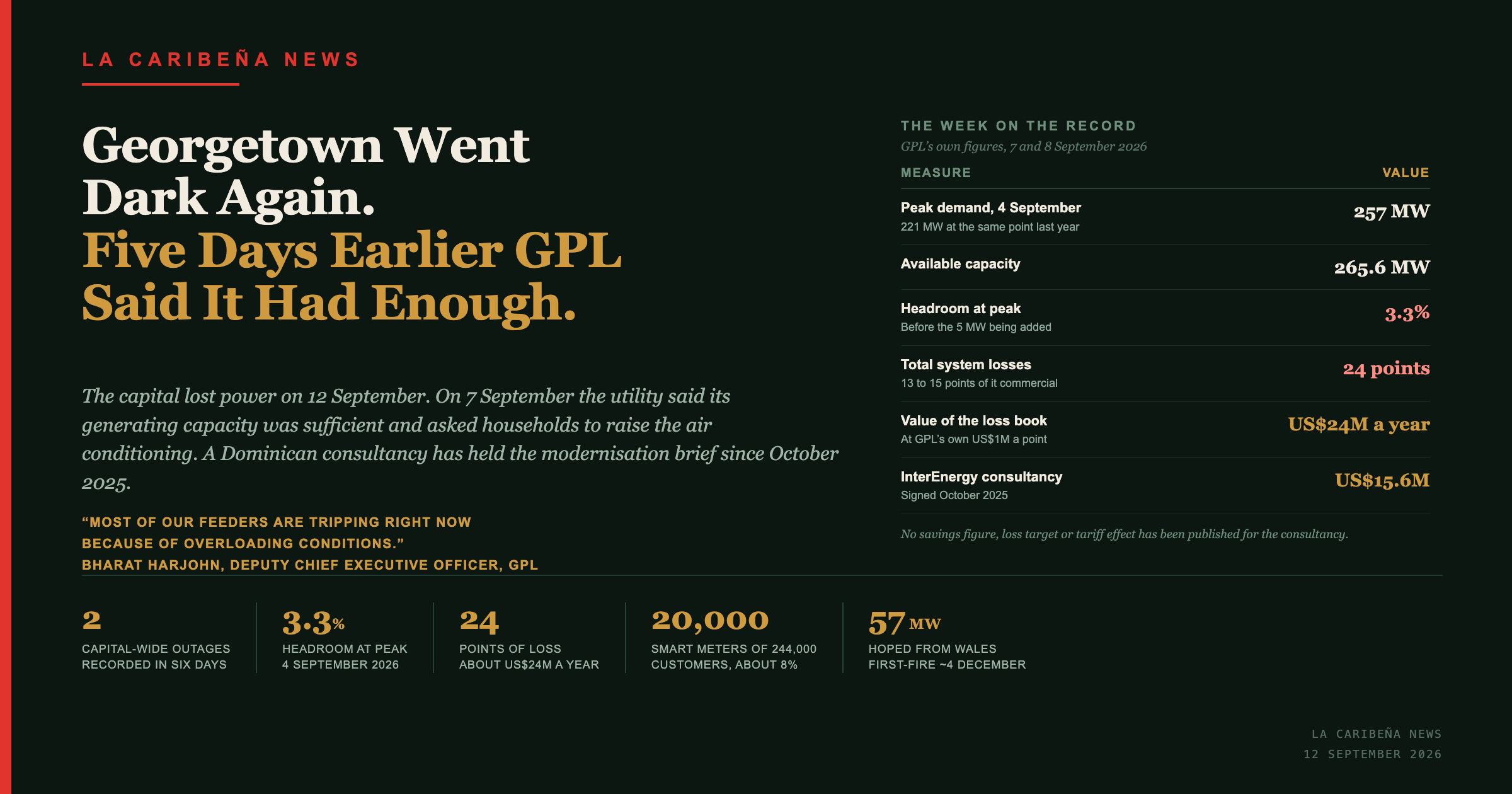
What the title card shows
- Georgetown without power on 12 September 2026, the second capital-wide outage recorded by this newspaper in six days.
- Peak demand 221 MW last year, 257 MW on 4 September 2026; available capacity 265.6 MW; headroom about 3.3 per cent; 5 MW being added. Source: GPL news conference, 7 September 2026.
- Total system losses 24, of which 13 to 15 per cent commercial, priced by GPL at about US$1 million a percentage point, so about US$24 million a year. Source: Ryan Ross, GPL, 8 September 2026.
- InterEnergy Group, Dominican Republic, US$15.6 million consultancy signed October 2025. Progress to 3 June 2026: 350 km transmission, 240 km distribution, 16 substations, 20,000 smart meters of a 244,000 customer base. No published savings figure, loss target or tariff effect.
- Household solar: grid-tied rooftop permitted since 27 June 2025; National Grid-Connected Solar Programme targets 5,000 households of 271,946 at the 2022 census, about 1.8 per cent, at about GY$1.2 million for a 5 kW system. Universal rooftop costed at US$486 million to US$1.27 billion.
- Wales gas-to-energy: first-fire around 4 December, 57 MW hoped, US$759 million facility. Media largely excluded from site visits.
Frequently Asked Questions
Did GPL say it had enough power?
On 7 September the company said it had sufficient generating capacity and located the difficulty in the distribution network. Peak demand had reached 257 megawatts on 4 September against 265.6 megawatts available.
How much electricity is unaccounted for?
GPL cites 24 points of total system losses, 13 to 15 of them commercial. On the company's own pricing of about US$1 million a point, that is roughly US$24 million a year.
What is the Dominican company doing?
InterEnergy Group holds a US$15.6 million consultancy signed in October 2025 covering project oversight, technical advisory and grid integration. Its reported progress is measured in kilometres supervised, substations and meters installed.
Would household solar reduce the load?
In daylight, at the point of use. Rooftop generation peaks in the middle of the day, while GPL puts its pressure window at 7 PM to 9 PM, so reaching the peak needs storage. The National Grid-Connected Solar Programme targets 5,000 households of 271,946, about 1.8 per cent.
When does Wales deliver power?
The first turbine is scheduled to fire for testing around 4 December, with 57 megawatts hoped for. Testing precedes handover, so December is the start of commissioning rather than the date power reaches customers.