By LCN Business Desk
The Panama Canal Authority reduced the number of transit slots it will sell each day, and the Caribbean's regional private sector body has now put a figure on what that costs the region.
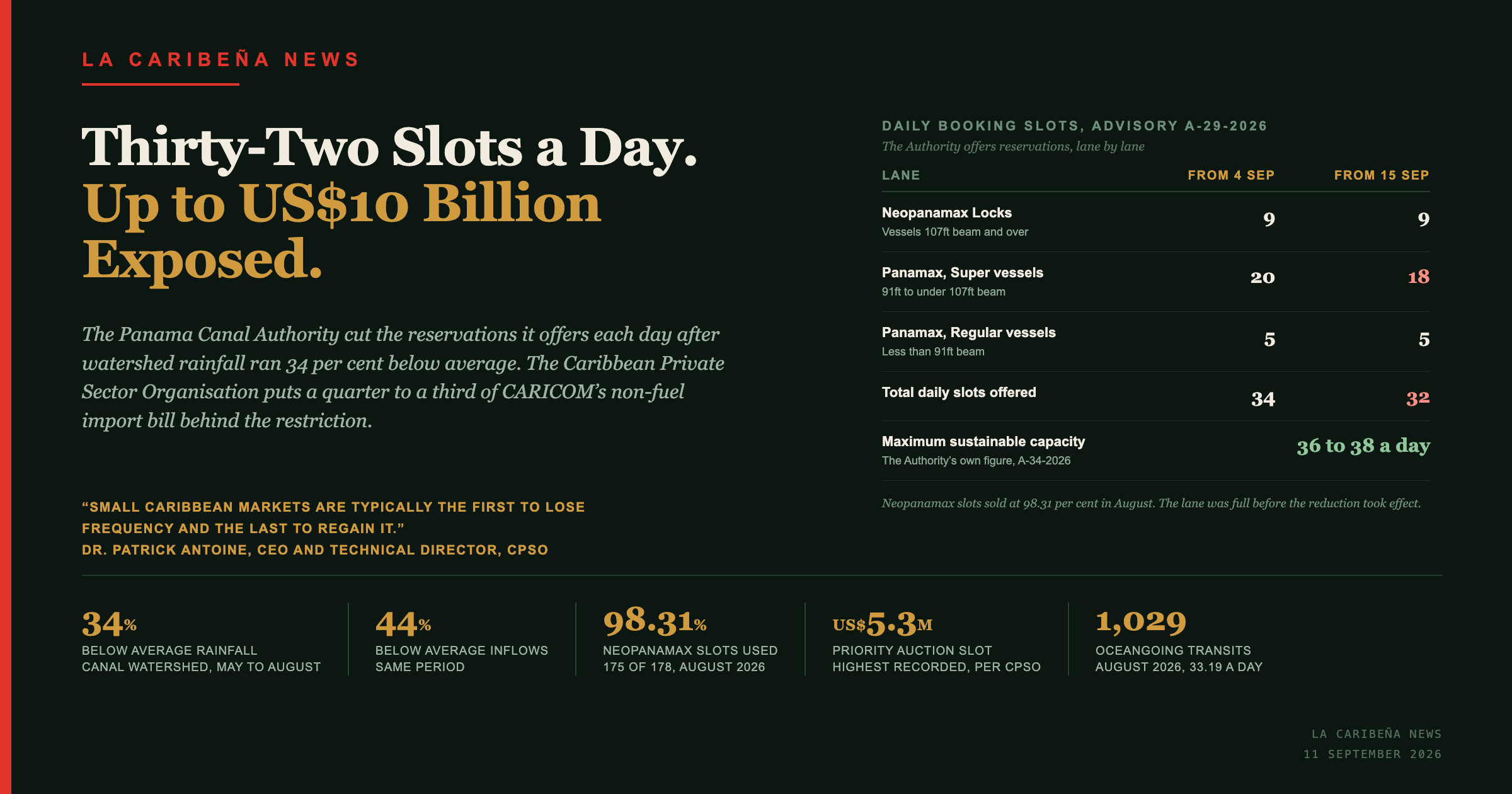
In Advisory to Shipping No. A-29-2026, issued on 20 August and signed by Vice President for Operations Boris Moreno Vásquez, the Authority set daily booking slots at 34 for booking dates beginning 4 September, falling to 32 for booking dates beginning 15 September. The Caribbean Private Sector Organisation (CPSO), an associate institution of the Caribbean Community (CARICOM), said in a statement reported on 10 September that between US$8 billion and US$10 billion of the region's annual imports are exposed to those restrictions.
What did the Panama Canal Authority actually decide?
A-29-2026 changes how many reservations the Authority sells, lane by lane.
From 21 August, for booking dates beginning 4 September, daily slots at the Neopanamax Locks were set at nine and slots at the Panamax Locks at 25, a total of 34. From 1 September, for booking dates beginning 15 September, Panamax Locks slots fell to 23, taking the total to 32. The advisory also removed the conditioned slot in the Neopanamax category and limited Super vessels to no more than nine bookings per direction under the tighter condition.
The Authority gave its reasons in the document. Cumulative rainfall across the canal watershed over the current hydrological year, May through August, has run 34 per cent below the historical average, while watershed inflows have run 44 per cent below. The advisory states that the combination of those deficits and the forecast severity of the 2026 to 2027 El Niño event "raises concerns regarding water availability during the upcoming 2027 dry season (January to April)".
These are booking slots rather than a ceiling on traffic. The Authority's own monthly summary for August, Advisory A-34-2026, records oceangoing transits at a daily average of 33.19, and puts the maximum sustainable capacity of the canal at approximately 36 to 38 vessels a day. Measured against that figure, 32 slots is a reduction of roughly a sixth.
How much of the region's import bill is exposed?
The CPSO's preliminary analysis splits its estimate in two.
Between US$4.5 billion and US$7 billion of CARICOM's annual imports transit the canal directly. The remainder of the US$8 billion to US$10 billion range is canal-transited cargo consolidated through United States ports before onward shipment to the region. Together the organisation puts that at roughly one quarter to one third of the region's non-fuel import bill.
The reason the number is that large is structural. CARICOM economies are among the most import-dependent in the world, and food, manufactured goods and construction inputs reach regional shelves largely on transshipment networks routed through or priced off the Panama Canal. A Caribbean importer does not need to ship through the canal to pay for it.
Why does the cost show up in the large-ship lane first?
Because that lane was already full.
The Authority's August figures show Neopanamax booking slots running at 98.31 per cent utilisation, 175 of 178 sold. Supers ran at 84.14 per cent and Regular vessels at 82.67 per cent. Auctioned slots, of which the Authority offers three a day, ran at 89.87 per cent. Neopanamax vessels carried 28.96 per cent of August's 1,029 oceangoing transits.
A lane selling 98 per cent of its slots before a reduction takes effect has no slack to absorb one. The CPSO said a priority auction slot recently fetched US$5.3 million, which it described as the highest bid ever recorded, and that CMA CGM, MSC and Hapag-Lloyd have each announced surcharges per twenty-foot equivalent unit on canal-dependent routes.
Dr. Patrick Antoine, Chief Executive Officer and Technical Director of the CPSO, set out where those costs land.
"Auction premiums and low-water surcharges do not stay on the carriers' books. They are passed down the chain to importers, to distributors, and ultimately to the Caribbean consumer. When slot scarcity forces carriers to reroute or rationalise port calls, small Caribbean markets are typically the first to lose frequency and the last to regain it."
That last point is the one with a Caribbean precedent behind it. Carriers decide which calls survive a capacity squeeze, and the region has watched those decisions go the other way when capacity is plentiful: MSC moved its newest flagship onto a Southern Caribbean itinerary for winter 2027 and took MSC Meraviglia off the route, a reminder that route frequency here is set in head offices rather than in the ports it serves.
Has the squeeze kept tightening?
Not in every instrument. One measure announced in A-29-2026 has since been pulled back.
A-29-2026 scheduled the maximum authorised draft at the Neopanamax Locks to fall to 14.48 metres, 47.5 feet Tropical Fresh Water, on 1 October. On 4 September the Authority issued Advisory A-33-2026, which postponed that reduction and stated that the maximum authorised draft of 14.63 metres, 48.0 feet, "will remain in effect in the Neopanamax Locks until further notice". The Authority gave the current Gatún Lake level and the latest weather projections as its basis.
That draft reduction has now been deferred twice. Advisory A-25-2026 of 5 August set it for 3 September, A-29-2026 moved it to 1 October, and A-33-2026 postponed it indefinitely. A deeper draft means a ship may load more cargo per voyage, so the postponement removes, for now, a second cost that would have stacked on top of slot scarcity.
The slot reductions themselves remain in force. A-25-2026 is worth reading beside them: on 5 August the Authority wrote that capacity at both lock complexes "remains stable, and no reduction in available transit slots is being implemented at this time". Fifteen days later it cut slots to 34, and then to 32.
Why is a Panama water level a Caribbean trade story?
Because the region's import bill is priced on it, and because the instruments that move it are published.
Three of them carry dates the region can plan against. The watershed deficit is measured over May to August. The slot reductions took effect on booking dates of 4 and 15 September. The Authority's stated concern is the dry season from January to April 2027, and its own forecast basis is the 2026 to 2027 El Niño event. This newspaper reported in August that the National Oceanic and Atmospheric Administration put a 69 per cent chance on a record El Niño, and that the last comparable event cut Guyana's rice crop by 37 per cent. The canal is the second channel through which the same weather reaches a Caribbean shelf price.
Antoine placed the canal alongside a second chokepoint.
"The Canal is not the only constraint. With shipping through the Strait of Hormuz also disrupted, two of the world's critical maritime trade corridors are under pressure simultaneously, one by climate and one by conflict, lifting freight rates, war-risk premiums and fuel costs globally. For petroleum-importing CARICOM states, that compounds pressure on electricity, transport and food prices at the same time."
Fuel is where that compounding becomes visible to a household fastest, and the region has already seen a government reach for the blunt instrument when it does: Guatemala capped fuel at Q39 a gallon in September after truckers sealed the Mexico and El Salvador routes.
What is the CPSO asking importers and governments to do?
Two things, on two timescales.
In the immediate term the organisation is urging importers to engage carriers and logistics providers now on routing, surcharge exposure and inventory planning for the fourth quarter of 2026 and the 2027 dry season. It frames the risk to consumers as twofold: availability, through longer lead times and thinner inventories, and price, as surcharges and longer voyages feed into landed costs.
In the longer term it is pushing substitution. The CPSO presented its derisking CSME imports methodology to the CARICOM Heads of Government Breakfast Meeting in Saint Lucia in July 2026. The framework maps the Community's exposure to extra-regional supply shocks and identifies, product by product, where intra-regional production and alternative supply corridors can substitute for vulnerable long-haul imports.
"Every percentage point of import demand we can shift to regional supply is a percentage point insulated from canal auctions, low-water surcharges and chokepoint conflict," Antoine said.
Alternative corridors are not hypothetical for this region. CARICOM signed a partial scope trade agreement with Colombia covering industrial tariffs, a route that does not pass through Panama at all. The organisation says it continues to advance the region's connectivity agenda with CARICOM leaders, the World Bank's Caribbean Reconnect Programme, and support for the regional ferry service initiative now before Caribbean heads of government.
Antoine's closing line is the argument for doing any of it before January.
"Regional resilience is not built during a crisis. It is built before one."
The Authority has told the shipping industry in writing that it expects to be watching Gatún Lake through the 2027 dry season, and it has already revised three advisories in five weeks. Booking slots are sold 730 days to two days ahead. The region's fourth-quarter shelf prices are being set in those auctions now.
What the title card shows
- Panama Canal Authority daily booking slots, Advisory A-29-2026: 34 for booking dates from 4 September 2026, 32 from 15 September 2026. Source: ACP Advisory to Shipping No. A-29-2026, 20 August 2026.
- Composition at 34 slots: Neopanamax 9, Supers 20, Regulars 5. At 32 slots: Neopanamax 9, Supers 18, Regulars 5. Source: A-29-2026 slot availability tables.
- Maximum sustainable capacity of the canal: approximately 36 to 38 vessels per day. Normal Panamax Locks capacity 34 to 36 per day; Neopanamax Locks 9 to 11 per day. Source: ACP Advisory A-34-2026, 10 September 2026.
- Canal watershed rainfall, May to August 2026: 34 per cent below the historical average. Watershed inflows: 44 per cent below. Source: A-29-2026.
- Neopanamax booking slot utilisation, August 2026: 98.31 per cent, 175 of 178 slots. Supers 84.14 per cent. Regulars 82.67 per cent. Auctioned slots 89.87 per cent, 204 of 227. Source: A-34-2026.
- Oceangoing transits, August 2026: 1,029 total, daily average 33.19, high 37, low 26. Source: A-34-2026.
- CARICOM annual imports exposed: US$8 billion to US$10 billion, of which US$4.5 billion to US$7 billion transits the canal directly. Roughly one quarter to one third of the non-fuel import bill. Source: Caribbean Private Sector Organisation statement, reported 10 September 2026.
- Priority auction slot: US$5.3 million, described by the CPSO as the highest bid ever recorded. Source: CPSO statement.
- Maximum authorised draft, Neopanamax Locks: 14.63 metres (48.0 feet) Tropical Fresh Water, retained until further notice after the 14.48 metre reduction was postponed. Source: ACP Advisory A-33-2026, 4 September 2026.
Frequently Asked Questions
Did the Panama Canal cap the number of ships that may transit each day?
No. Advisory A-29-2026 sets the number of daily booking slots the Authority sells, at 34 for booking dates from 4 September and 32 from 15 September. Vessels transited at a daily average of 33.19 in August, and the Authority puts maximum sustainable capacity at approximately 36 to 38 a day.
How much of CARICOM's imports are affected?
The Caribbean Private Sector Organisation estimates US$8 billion to US$10 billion of annual imports, roughly one quarter to one third of the region's non-fuel import bill. Between US$4.5 billion and US$7 billion of that transits the canal directly, and the rest is canal-transited cargo consolidated through United States ports.
Why would a Caribbean importer who does not ship through Panama still pay more?
Because much of the region's cargo is consolidated through United States ports that are themselves served by canal transits, and because freight rates on connecting services are priced off canal costs. The CPSO also warns that when slot scarcity pushes carriers to rationalise port calls, small markets lose sailing frequency first.
Has the Authority reversed any of the measures?
One. Advisory A-33-2026 of 4 September postponed the draft reduction to 14.48 metres that A-29-2026 had set for 1 October, leaving 14.63 metres in effect until further notice. The slot reductions remain in force.
What happens after April 2027?
The Authority has not published a measure that expires on a date. A-33-2026 keeps the current draft "until further notice" and says the ACP will continue to monitor Gatún Lake levels and announce future adjustments in a timely manner, so the next change will arrive as a further advisory rather than at the end of the dry season.