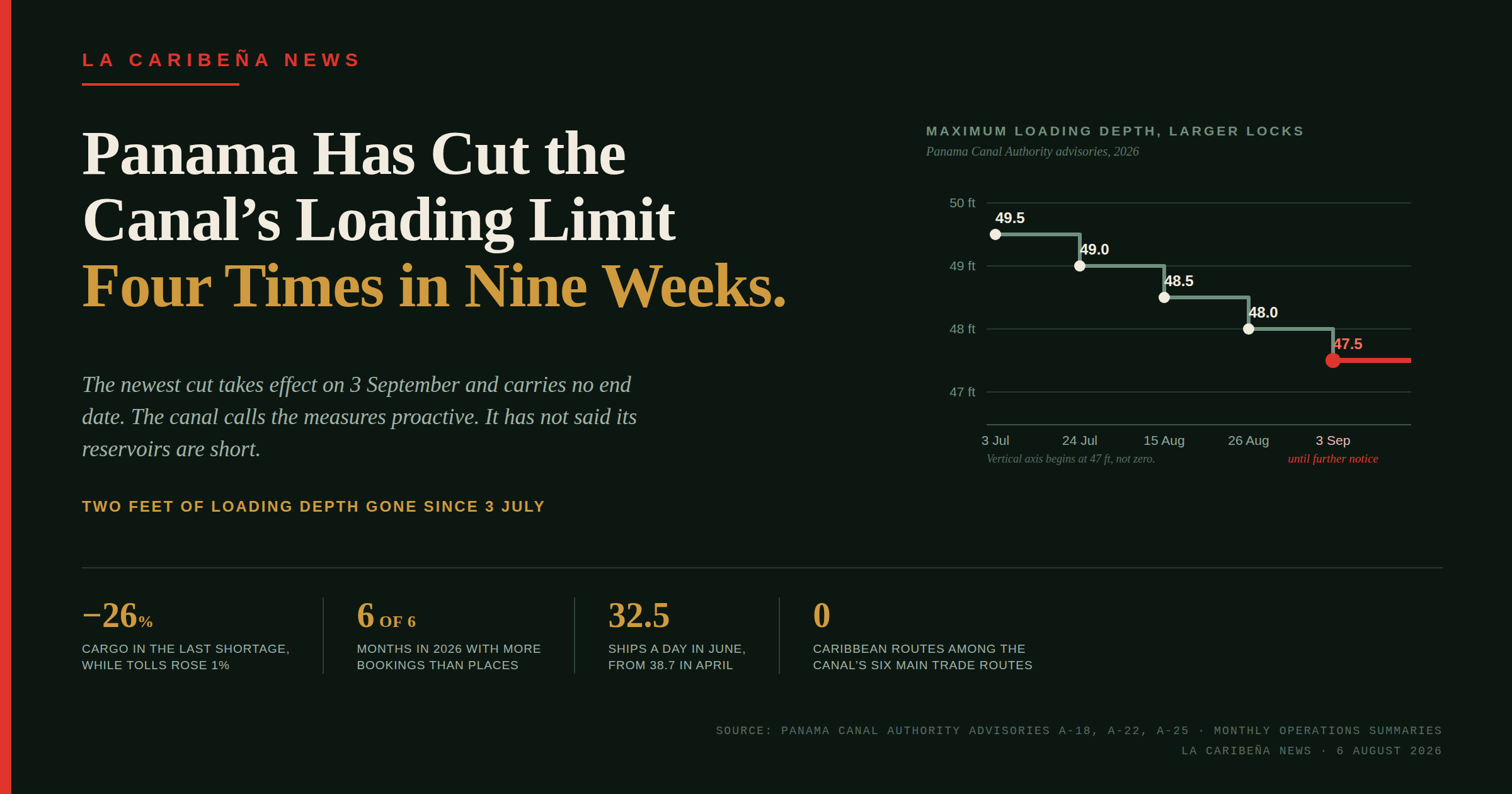
Four times since June, Panama has lowered how deeply a ship may be loaded to cross. In June it cited weather that might come. Yesterday it cited weather it says has arrived, and set no date for when the limits end. The last time the canal restricted, it moved a quarter less cargo and earned more money.
BY LCN NEWSROOM
Quick summary: On 5 August 2026 the Panama Canal Authority ordered a fourth cut to how deeply loaded a ship may be to cross the canal, taking the limit to 47.5 feet from 3 September with no end date attached. For any ship that was loading to the limit, less depth means less cargo per sailing. In the last shortage, in 2024, canal cargo fell 26 per cent while tolls collected rose.
What the title card shows
Every data point on the article's title card, in text.
- Four cuts, nine weeks. Reductions to the loading limit ordered between 4 June and 5 August 2026. Source: Panama Canal Authority Advisories A-18, A-22 and A-25 of 2026.
- 47.5 feet. The loading limit for the largest ships from 3 September 2026, with no end date. Source: Advisory A-25-2026.
- Two feet. How much the limit has fallen since 3 July. Source: La Caribeña News calculation on the published advisories.
- Six months out of six. Months in 2026 where more big ships wanted a booked crossing than there were places. Source: Advisories A-03, A-04, A-09, A-14, A-19 and A-23 of 2026.
- 32.5 a day. Ships crossing in June, down from 38.7 a day in April. Source: Advisories A-23-2026 and A-14-2026.
- Minus 26 per cent, plus 1 per cent. Change in cargo carried and in tolls collected between the 2023 and 2024 financial years, the last shortage. Source: La Caribeña News arithmetic on Panama Canal Authority statistics.
- Zero. Caribbean routes among the six main trade routes the canal lists. Source: Panama Canal Authority.
- 49.5, 49.0, 48.5, 48.0 and 47.5 feet. The five successive limits charted on the card, effective 3 July, 24 July, 15 August, 26 August and 3 September 2026. The chart's vertical axis begins at 47 feet rather than zero. Source: Advisories A-18, A-22 and A-25 of 2026.
What has Panama actually done?
Lowered the most a ship may carry across it, four times since June, and this time without saying when it stops.
To understand the decision you need one idea, and it is not complicated. A ship sitting in water sinks lower the more cargo you put in it. Shipowners call how deep it sits the vessel's draft. The canal sets a maximum. So when Panama lowers that maximum, it is not slowing ships down or turning them away. It is capping how heavily they may arrive.
A depth limit is a cargo limit. That is the whole thing. It bites on any ship that was loading to the old maximum, and not at all on one that was sailing lighter anyway.
Since June the canal has lowered it four times:
| Announced | Takes effect | Loading limit |
|---|---|---|
| 4 June 2026 | 3 July 2026 | 49.5 feet |
| 1 July 2026 | 24 July 2026 | 49.0 feet |
| 1 July 2026 | 15 August 2026 | 48.5 feet |
| 5 August 2026 | 26 August 2026 | 48.0 feet |
| 5 August 2026 | 3 September 2026, until further notice | 47.5 feet |
Maximum loading depth for vessels using the canal's larger locks, as published by the Panama Canal Authority in Advisories A-18-2026, A-22-2026 and A-25-2026. The 3 July figure is the starting point; the four rows beneath it are the successive cuts, and together they remove two feet of loading depth in nine weeks.
Why can a canal run short of water at all?
Because it does not simply cut through Panama. It lifts ships over it.
This is the part most people get wrong, and it explains everything that follows. The Panama Canal is not a ditch at sea level. In the canal authority's own description, the locks "function as water lifts: they raise the ships from sea level (either Pacific or Atlantic) to the level of Gatun Lake (26 meters above sea level)." The ships cross the lake at the top and are lowered down the other side.
The water doing the lifting is fresh, and the authority says it "is obtained from Gatun Lake by gravity." So every crossing spends lake water.
Not all of it is spent. When the larger locks opened in 2016 they were built with 18 water-saving basins, and the canal authority said at the time that these allow it "to reuse 60 percent of the water used per lockage, saving 7 percent more than the existing locks do." The newer locks, the ones these restrictions apply to, are the more sparing of the two systems. What is not recovered drains away, and the lake is replenished by rain falling on the canal watershed.
That is why rainfall is not a background detail here. It is the supply. Explaining the last shortage, the authority described high Atlantic temperatures and El Niño as having "delayed the start of the rainy season, resulting in a significant decrease in the levels of freshwater in the reservoirs of the Panama Canal, essential for its operation."
And ships are not the only claim on that water. On the same page the authority says its water-saving measures serve "to supply 55% of the population and provide competitive and continuous service to global maritime trade." It describes managing fresh water for human consumption as a constitutional responsibility, held alongside its duty to shipping. The reservoir that floats the cargo also fills the taps.
So when the lake is low the authority has two levers: run fewer ships, or let each ship sit less deep. This year, so far, it has pulled the second.
What changed in yesterday's announcement?
The canal stopped calling El Niño a forecast and started calling it a present effect.
In June, the authority explained its cut by pointing to "the potential development of an El Niño phenomenon" in the months ahead. El Niño is a periodic warming in the Pacific that shifts rainfall patterns and has repeatedly brought dry weather to Panama. In June it was something that might happen. The 1 July advisory used the same cautious wording.
Yesterday's did not. It says: "While the rainy season has commenced across the Isthmus of Panama, current watershed conditions and the continued effects of El Niño phenomenon require additional actions to ensure the long-term sustainability of transit operations."
In June the canal called El Niño a possibility. Yesterday it called it a continuing effect. And for the first time, it did not say when the limits end.
Read that slowly, because two things moved. A maybe became a statement of present fact. And the authority added that the rains have already started and are still not enough.
That second point is the one to hold on to. A canal tightening restrictions in the middle of its wet season is doing more than riding out a dry spell. The authority has not said the reservoirs are short, and this newspaper has not established that they are. What it has done is decline, for the first time in this sequence, to say when the limits end.
Which leaves the question worth asking, and worth not answering prematurely: is this the start of a shortage, or the set of precautions that prevents one? The canal has not said, and on the published record neither can we. The 2024 comparison further down is there because it shows what the answer looked like last time, not because it forecasts this time.
Who is feeling this?
The biggest ships, which were already queuing for space before the cuts began.
The canal has two sets of locks: an older, smaller set, and a larger set opened in 2016 for bigger vessels. The loading cuts apply to the larger ones, and those are the ships carrying the containers, the gas and the fuel.
Ships reserve a crossing in advance, and the canal publishes how many places it offered against how many were taken. For the big-ship category, demand has beaten supply in every single month of 2026 the authority has published.
| Month 2026 | Ships crossing per day | Booked places taken, big ships |
|---|---|---|
| January | 33.8 | 117% |
| February | 35.0 | 117% |
| March | 37.0 | 114% |
| April | 38.7 | 106% |
| May | 37.1 | 114% |
| June | 32.5 | 106% |
Panama Canal Authority monthly operations summaries, Advisories A-03, A-04, A-09, A-14, A-19 and A-23 of 2026. Percentages count booked crossings only and exclude places sold at auction. All six published months of 2026 are shown, none omitted.
Anything above 100 per cent means more ships wanted a booked place than the canal had to give. It happened every month.
By the canal's own reckoning, published in the same documents, it can sustainably handle around 36 to 38 ships a day. In April it ran 38.7. So the waterway spent the spring at the ceiling of what it says it can manage, and the loading cuts are now landing on top of that.
One caution, because it would be easy to over-read the table. Crossings did drop in June, to 32.5 a day from 38.7 in April. That is not proof of water rationing. The same June report sets out a schedule of maintenance outages at the older Panamax locks running through that month, which takes lanes out of service and reduces capacity by design. Both explanations sit in the same document and the canal has not said how much of the fall belongs to each.
What does it cost?
Cargo left behind, and the canal has not put a number on it.
The arithmetic is simple to describe and surprisingly hard to pin down. A ship that would have sailed full now sails lighter. It leaves on time and arrives on time. It just carries less, which means more sailings, or the same sailings carrying less, for the same freight bill.
Here is the gap. The canal publishes the limit. It does not publish what the limit removes. Neither the advisories nor the monthly reports put a figure on how many containers or tonnes two feet of loading depth costs, and La Caribeña News did not find one from the authority for the 2026 cuts.
So any number you see quoted for what these four cuts cost per voyage is somebody's estimate, not the canal's. Read it that way. The organisation best placed to measure the commercial damage is not publishing it, and everyone downstream is guessing.
Is this the whale speed limit people have been posting about?
No, and the two keep getting confused.
There is a separate rule in force right now. Every year from 1 August to 30 November, ships approaching the canal from the Pacific side are asked to slow to 10 knots, to reduce the chance of striking whales during their migration. The canal reissued that reminder on 30 July as Advisory A-24-2026.
It is an annual notice, not news, and it has nothing to do with the lake. The canal issued the same reminder last year, word for word. Anyone presenting the speed limit as a new Panamanian restriction, or folding it into the water story, has misread a routine seasonal notice.
The only honest link is timing. Both rules apply at once this month, so a ship approaching from the Pacific today is lighter and slower than one that approached in May. Neither caused the other.
Is the Caribbean a big user of the canal?
On the canal's own accounting, no, and that is worth knowing before anyone panics.
The canal publishes the trade routes that carry its traffic. There are six main ones: the east coast of the United States to Asia, the east coast of the United States to the west coast of South America, coast to coast within South America, Europe to the west coast of South America, the east coast of the United States to the west coast of Central America, and Europe to the west coast of the United States.
Not one of them is a Caribbean route.
That does not mean no Caribbean cargo crosses. It means Caribbean cargo is not one of the flows the canal counts as principal, so the region is not exposed the way an exporter in Chile or a grain shipper in the American Midwest is exposed. Anyone telling Caribbean businesses that a Panamanian loading limit hits their shipments directly should be asked to show which route they mean.
The region's real exposure runs the other way, through prices and through ports, and that is a different argument with different evidence.
What happened last time the water ran low?
The canal moved a quarter less cargo, and its income went up anyway.
This is the most useful thing in the canal's published record, and it is barely discussed. Compare its own figures for the year before the last shortage and the shortage year itself.
| Financial year | Ship crossings | Cargo carried (long tons) | Tolls collected |
|---|---|---|---|
| 2023 | 14,080 | 285.8 million | USD 3.348 billion |
| 2024 | 11,240 | 210.3 million | USD 3.381 billion |
| 2025 | 13,404 | 262.3 million | USD 3.678 billion |
Panama Canal Authority, Statistics and Models Management Unit, published via the Panama Logistics Web Portal. Percentage changes below are La Caribeña News arithmetic on those figures.
Between 2023 and 2024, crossings fell by 20 per cent and cargo by 26 per cent. Tolls rose by 1 per cent.
The canal carried a quarter less cargo and collected slightly more money. Scarcity did not cost the canal. It cost whoever needed to get goods through it.
That is the mechanism worth understanding, because it is the one that reaches a Caribbean shelf. When crossings become scarce, the right to cross becomes valuable, and the canal sells scarce places at auction. The waterway's revenue is protected. The extra cost lands on shipping lines, and shipping lines pass what they can to the people paying freight.
By 2025 the canal had recovered to 13,404 crossings and 262.3 million long tons, and collected a record USD 3.678 billion. The recovery was real. So was the year in between.
So what should the region actually watch?
Two things it can see, and one it cannot.
What the canal carries. Its own list of main goods is containerised cargo, coal, grains including corn, soybeans and rice, minerals and metals, crude oil and fuels, and chemicals. Several of those are things Caribbean countries import rather than export. Whether disruption on those routes reaches regional prices, and by how much, is a real question, and this newspaper is not going to assert an answer it has not established.
The auction, not the depth limit. On the 2023 to 2024 evidence, the number that moves costs is not the loading limit itself but what happens to crossing slots when capacity tightens. If the canal starts cutting the number of daily crossings rather than how deep ships sit, that is the point at which the last shortage became expensive.
What we could not find. La Caribeña News looked for a published assessment of what canal restrictions do to Caribbean economies, from the canal, from regional development institutions, from CARICOM and from the region's own ports, and did not find one. That is a report of what this search returned. It is not a claim that no such work exists, and we would publish it if it were sent to us.
None of the underlying material is hidden. Panama publishes every one of these decisions and every one of these numbers, in English, free, on the day it makes them. Every document quoted in this article is public.
Frequently Asked Questions
What is the canal's loading limit now?
48.5 feet for the largest ships from 15 August 2026. It drops to 48.0 feet on 26 August, and to 47.5 feet from 3 September with no end date, under Advisory A-25-2026.
Why does less water mean less cargo?
Because ships are lifted over Panama in water-filled chambers, using fresh water from Gatun Lake. The newer locks recover 60 per cent of it; the rest drains away. When the authority judges lake levels or forecasts to warrant it, it guarantees less depth, and a ship that cannot sit as deep cannot be loaded as full.
Is this as bad as the 2023 drought?
On the published figures no, and nothing here forecasts that it will be. The Maritime Executive reported that in the 2023 and 2024 shortage the canal took loading limits down into the 43 to 44 foot range, and as low as 38.5 feet, before switching to cutting the number of daily crossings instead. So far in 2026 the canal is limiting how much ships carry rather than how many cross.
Does the Caribbean use the canal much?
Not as a principal route. The canal lists six main trade routes and none of them is a Caribbean route. Caribbean cargo does cross, but the region is not among the flows the canal counts as principal, so the direct exposure is smaller than the map suggests.
If cargo fell 26 per cent, why did the canal earn more?
Because when crossings become scarce the canal sells places by auction, and scarce places fetch high prices. On its own published figures, tolls in the 2024 shortage year came to USD 3.381 billion against USD 3.348 billion the year before, while cargo fell from 285.8 to 210.3 million long tons. The waterway's income held. The cost moved to whoever needed to get goods through.
Does the whale speed limit affect cargo?
No. It is a seasonal request to slow to 10 knots on the Pacific approach between 1 August and 30 November, reissued this year as Advisory A-24-2026. It changes approach speed, not how much a ship may load.
Where can I read the rules myself?
The Panama Canal Authority publishes every Advisory to Shipping at pancanal.com under Maritime Services. The 2026 advisories used in this article are A-18, A-22, A-23, A-24 and A-25.