By LCN Business Desk
One sentence at the Guyana Power and Light news conference of 7 September did more work than any other, and it was not about air conditioning. It was a promise about what the company does when a customer needs more power. The news of that week is reported separately. This is an examination of the promise.
Read plainly, that is an undertaking with two halves. Tell us, and we will build. It puts the first move on the customer and the delivery on the company.
What do the accounts reaching this newspaper say?
That the waiting starts after the notification, not before it.
Business operators in Region Three and Region Four have been waiting months for the infrastructure that notification is supposed to trigger, held in delay or in paperwork.
The two accounts do not describe the same company. On GPL's, telling it is the step that unlocks the build. On the one reaching this newspaper, it is the step after which the waiting begins.
What does the regulator's record show?
That GPL met two and a half of its eight performance targets last year.
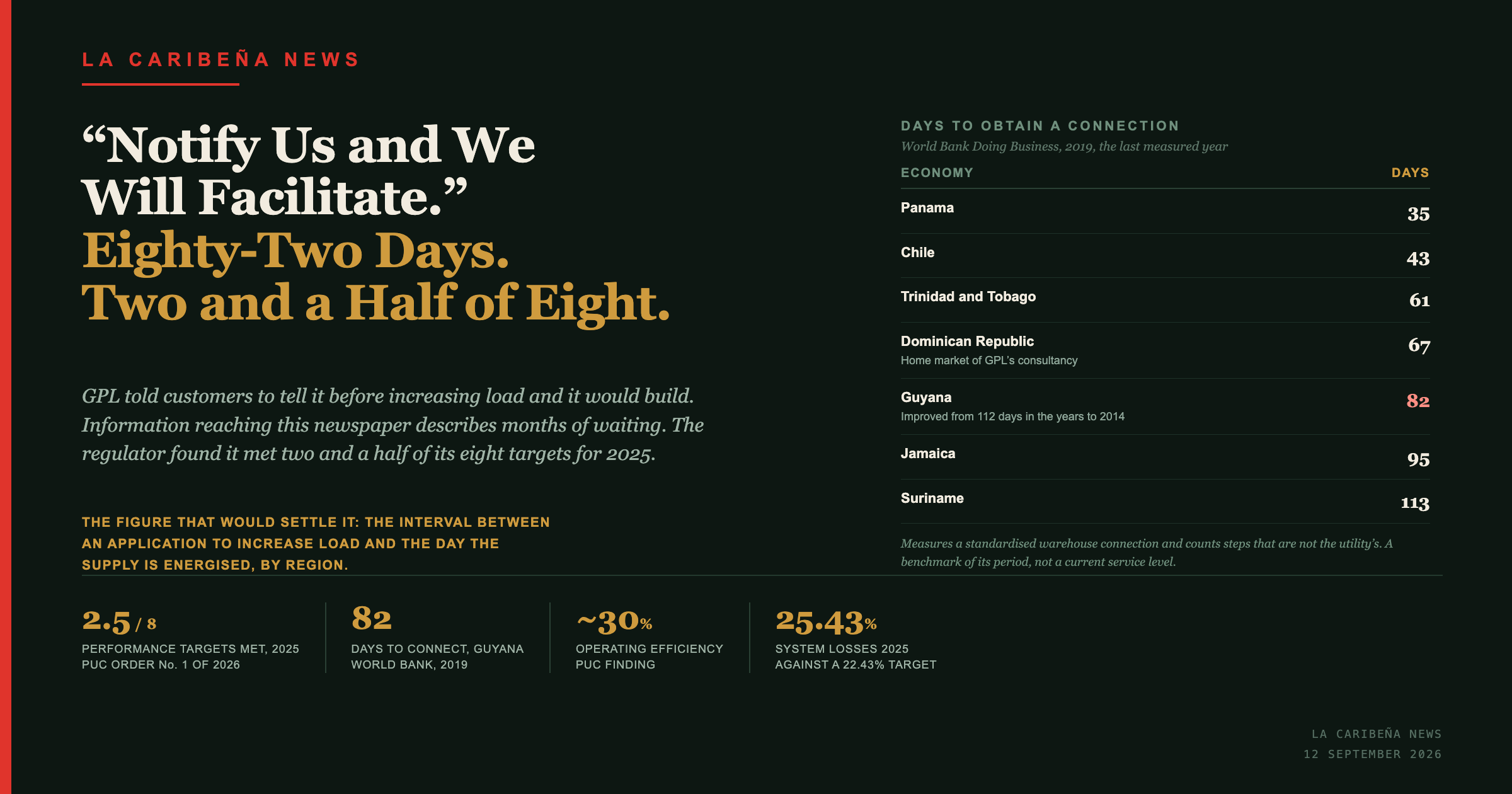
The Public Utilities Commission reviews GPL's Operating Standards and Performance Targets every year. In Order No. 1 of 2026, issued after a public hearing on 27 March 2026 at which the company presented its performance and stakeholders were invited to respond, the Commission found that GPL had met 2.5 of its 8 targets for 2025.
The same body has put the company's operating efficiency at about 30 per cent, and recorded total system losses of 24.71 per cent in 2024 and 25.43 per cent in 2025 against a target of 22.43 per cent.
A regulator's scorecard is not a measure of how long one customer waits for a transformer. It is a measure of whether the company meets what it has agreed to be measured on, and on the most recent published review it met slightly under a third of it.
How long does a connection take elsewhere?
The last internationally comparable measure put Guyana at 82 days.
The World Bank's Doing Business programme measured the time to obtain a permanent electricity connection for a standardised new warehouse, counting every step from application to supply. The figures below are the last measured year.
| Economy | Days to connect, 2019 |
|---|---|
| Panama | 35 |
| Chile | 43 |
| Trinidad and Tobago | 61 |
| Dominican Republic | 67 |
| Barbados | 78 |
| Guyana | 82 |
| Colombia | 88 |
| Jamaica | 95 |
| Suriname | 113 |
Guyana's own figure had improved, from 112 days in the years to 2014 to 82 from 2015 onward, on eight procedures against seven in the Dominican Republic and Jamaica.
Three things have to be said about that table or it should not be used at all. The last measured year is 2019, because the Doing Business programme was discontinued in 2021 and nothing comparable has replaced it. It measures a standardised warehouse connection, not a load increase for an existing customer. And it counts the whole process, including steps that are not the utility's.
So it is not a current service level and it is not proof about any individual case. What it gives is scale. Eighty-two days is under three months, it placed Guyana mid-table among its neighbours, and it is the yardstick the country was last measured against internationally.
What figure would settle it?
The interval between an application to increase load and the day the supply is energised.
That number, reported by region, would show directly whether Mr Nandlall's undertaking describes the service as delivered. It is the kind of measure the Operating Standards and Performance Targets process exists to set, it would be straightforward for a utility with 20,000 smart meters and a Smart Grid roadmap to produce, and it would put the matter beyond the reach of anonymous accounts and decade-old benchmarks alike.
Nearer comparisons exist on this newspaper's own record. Costa Rica rewrote the law that had capped private and household generation for three decades, which is one way a country reduces the number of customers who need the utility to build anything at all. Guyana's own household solar programme is sized at 5,000 homes against 271,946 households at the 2022 census, about 1.8 per cent.
Why does a connection queue matter beyond one utility?
Because it is where an economy's growth meets its infrastructure, and the meeting is recorded.
Guyana is adding load faster than it is adding network. Peak demand went from 221 megawatts to 257 in a year. A business that cannot get the supply it has applied for does not appear in the loss statistics or the outage figures. It appears in the investment that does not happen, and it is the least visible number in the sector.
The same question of what the power sector publishes runs through the Wales gas-to-energy project, where the media have been largely excluded from site visits.
What the title card shows
- Public Utilities Commission Order No. 1 of 2026, after a public hearing on 27 March 2026: GPL met 2.5 of its 8 Operating Standards and Performance Targets for 2025.
- PUC has put GPL's operating efficiency at about 30 per cent; system losses 24.71 per cent (2024) and 25.43 per cent (2025) against a 22.43 per cent target.
- World Bank Doing Business, time to obtain an electricity connection, 2019, the last measured year: Panama 35, Chile 43, Trinidad and Tobago 61, Dominican Republic 67, Barbados 78, Guyana 82, Colombia 88, Jamaica 95, Suriname 113 days. Guyana improved from 112 days in the years to 2014. Procedures: Guyana 8, Dominican Republic 7, Jamaica 7.
- Caveats on that series: 2019 is the last measured year, the programme was discontinued in 2021, it measures a standardised warehouse connection, and it counts steps that are not the utility's.
- Household solar programme: 5,000 households of 271,946 at the 2022 census, about 1.8 per cent.
Frequently Asked Questions
What exactly did GPL promise?
That customers increasing their load should notify the company, and it would facilitate the increase when it builds infrastructure. The undertaking puts the first move on the customer and delivery on the company.
What did the Public Utilities Commission find?
In Order No. 1 of 2026, issued after a public hearing on 27 March, the Commission found GPL met 2.5 of its 8 Operating Standards and Performance Targets for 2025. It has separately put the company's operating efficiency at about 30 per cent.
How long should a connection take?
There is no current published Guyanese service level. The last internationally comparable measure, the World Bank's Doing Business series for 2019, put a standardised commercial connection in Guyana at 82 days, against 35 in Panama and 113 in Suriname.
Why can't the 2019 figure settle the question?
Because it is seven years old, the programme that produced it was discontinued in 2021, it measures a standardised new warehouse rather than a load increase for an existing customer, and it counts steps that are not the utility's. It establishes scale, not current performance.
What would settle it?
The interval between a customer's application to increase load and the day the supply is energised, reported by region.