By La Caribeña News · 30 August 2026
Costa Rica generated 98.6 per cent of its electricity from renewable sources in 2025.
Solar accounted for about 0.4 per cent of it.
The Instituto Costarricense de Electricidad expects that figure to reach six per cent by 2027, and it expects to get there under a thirty-six-year-old law that the government tried to repeal in May and could not.
What does Ley 7200 actually say?
Twenty megawatts a plant, fifteen per cent of the system, and a Costa Rican ownership floor.
The Ley que autoriza la generación eléctrica autónoma o paralela, passed in 1990, is short and its limits are explicit.
Article 2 defines limited-capacity plants as hydroelectric and non-conventional plants "que no sobrepasen los veinte mil kilovatios", not exceeding 20,000 kilowatts. Article 5 allows the Servicio Nacional de Electricidad to grant concessions to that ceiling for no more than fifteen years, and requires an act of the legislature for anything above it, including where a holder's existing and new concessions would together exceed it.
Article 7 is the cap that gets quoted. ICE may declare a project eligible only so long as parallel generation "no llegue a constituir más del quince por ciento" of the capacity of the plants making up the national electrical system. Fifteen per cent, not thirty.
Article 3 sets the ownership rule, and it runs the opposite way to how it is usually described. ICE's purchase is of public interest where it buys from rural electrification cooperatives and from private companies in which "al menos, el sesenta y cinco por ciento (65%) del capital social pertenezca a costarricenses". Sixty-five per cent is a floor for Costa Rican ownership, which leaves foreign participation capped at thirty-five.
A second tranche arrived with Ley 7508, in force from 9 May 1995, which added the Chapter II regime covering build-operate-transfer purchases and set a maximum contract term of twenty years. The figure of thirty per cent that circulates in descriptions of the Costa Rican market is the two tranches added together, not a single provision.
What did the Assembly vote on?
A bill that would have repealed the law outright.
The Ley de Armonización del Sistema Eléctrico Nacional, expediente 23.414, restructures the relationship between the state utility, the cooperatives, the municipal companies and private generators.
Its article 63 repeals Ley 7200 in full, after a transition of eighteen months from the new law taking effect or once the new market and its regulations are fully operational. Its article 29 converts private generators into "agentes del Mercado Eléctrico Nacional".
On 26 May 2026, after six hours of debate, the Assembly approved it in first debate by 27 votes to 24. All twenty-seven came from the governing Pueblo Soberano.
La Nación's account of the text notes that while the bill repeals Ley 7200, it retains state control over the caps on private generation rather than removing the idea of a ceiling altogether.
Why did it stop?
Arithmetic. It needed thirty-eight votes and had twenty-seven.
A ruling by the Legislative Assembly's Departamento de Servicios Técnicos set the threshold for second debate at a qualified two-thirds: 38 of 57 deputies.
The day after the first-debate vote, the government withdrew the bill from the legislative session, citing the impossibility of assembling thirty-eight against the opposition of the Partido Liberación Nacional, the Frente Amplio and the Coalición Agenda Ciudadana.
The University of Costa Rica's University Council had asked deputies to reject the market opening. Semanario Universidad ran the counter-case under a plain heading: ICE's own figures contradict the hurry to open the generation market.
The expediente was not defeated. It was taken off the order paper, which leaves the 1990 law in force and the file alive.
How much solar is Costa Rica actually building?
More in the next two years than in the previous thirty-six.
ICE is promoting 412 megawatts of solar, wind and biomass, at an investment of about US$539 million, entering operation across 2025 and 2026. Separately, about 326 megawatts are to be incorporated over two years through contracts under Ley 7200, rural electrification cooperatives and distributed generation.
ICE's own projection takes solar from roughly 0.4 per cent of the matrix now to six per cent by 2027 and nineteen per cent by 2035. Towards 2030 it expects around 600 megawatts of new geothermal, solar and wind capacity, built by ICE and by private generators.
| Share of Costa Rica's electricity | |
|---|---|
| Renewable, 2025 | 98.6% |
| Solar, now | 0.4% |
| Solar, ICE projection for 2027 | 6% |
| Solar, ICE projection for 2035 | 19% |
Is the cap what has been holding solar back?
The build now under way is arriving through the capped law, which is the fact that sits against the argument.
The 326 megawatts are being incorporated through Ley 7200 contracts, cooperatives and distributed generation. The instrument the reform would have repealed is the instrument the current expansion is being delivered under.
That does not settle whether a different market design would produce more, faster, or at a lower price. It does establish that the fifteen per cent ceiling in Article 7 has not been the binding constraint on the capacity now being installed, because that capacity is being installed under it.
What Costa Rica's arrangement does determine is who owns the plants. A twenty megawatt ceiling per concession, a fifteen-year term, and a requirement that Costa Ricans hold at least sixty-five per cent of a qualifying company's share capital are ownership rules before they are capacity rules. They shape who earns from generation rather than how much generation exists.
Water is the reason the question has become pressing. A grid that is 98.6 per cent renewable and heavily hydroelectric is a grid exposed to rainfall, and forecasters have put a 69 per cent chance on a record El Niño. Solar is being pursued in part to reduce dependence on water.
Why does this read in the Caribbean?
Because the same question is open across the region, and it is being answered differently.
Costa Rica has an ownership statute with a numerical ceiling, a state utility that publishes projections, and a legislature that required a two-thirds majority to change any of it.
Guyana has taken the opposite approach at a far larger scale. Its Gas-to-Energy plant will not deliver the promised halving of bills until it runs at full capacity in mid-2027, and the two-year delay is costed at about US$884 million, while its utility's system losses rose to 25.43 per cent. Guyana can price its solar farms per watt and cannot price its gas plant at all.
Trinidad and Tobago has gone further still, signing memoranda for up to 800 megawatts of data centre load against a gas supply whose utilisation has fallen by a third since 2015.
Three states, three instruments, one question about who is allowed to build generation and on what terms. Costa Rica is the only one of the three where the answer currently sits in a statute with a number in it, and where changing that number failed by eleven votes.
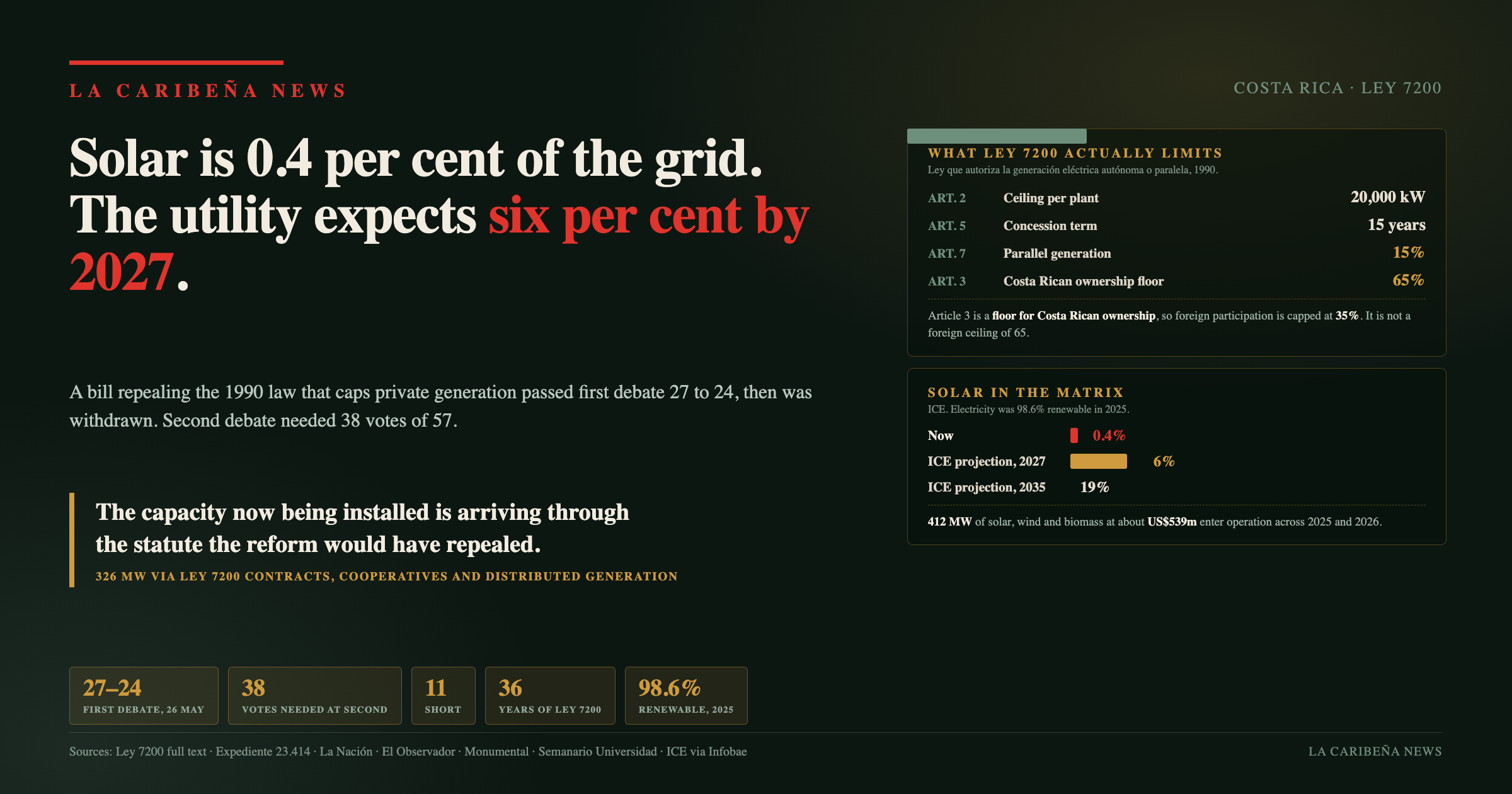
Text equivalent of the title card
Every data point shown on the title image, with its source.
- Ley 7200 (1990), Article 2: plants must not exceed 20,000 kW. Article 5: concessions up to that ceiling, maximum fifteen years. Article 7: parallel generation must not exceed 15 per cent of national system capacity. Article 3: at least 65 per cent of share capital must belong to Costa Ricans. Source: Ley 7200, full text.
- Ley 7508, in force 9 May 1995, added the Chapter II build-operate-transfer regime with a maximum contract term of twenty years.
- Expediente 23.414, Ley de Armonización del Sistema Eléctrico Nacional: approved in first debate 26 May 2026, 27 votes to 24, all 27 from Pueblo Soberano. Article 63 repeals Ley 7200 after an eighteen-month transition; article 29 makes private generators agents of the national electricity market.
- Second debate requires 38 of 57 votes, per the Assembly's Departamento de Servicios Técnicos. The government withdrew the bill on 27 May 2026 for want of those votes.
- Costa Rica generated 98.6 per cent of its electricity from renewables in 2025. Solar is about 0.4 per cent. ICE projects 6 per cent by 2027 and 19 per cent by 2035.
- 412 MW of solar, wind and biomass at about US$539 million enter operation across 2025 and 2026. 326 MW over two years via Ley 7200 contracts, cooperatives and distributed generation.
The limits in Ley 7200
| Provision | Limit |
|---|---|
| Article 2 | Plants must not exceed 20,000 kW |
| Article 5 | Concessions to that ceiling, maximum fifteen years |
| Article 7 | Parallel generation not more than 15% of national system capacity |
| Article 3 | At least 65% of share capital held by Costa Ricans |
| Ley 7508, Chapter II | Maximum contract term twenty years |
Frequently Asked Questions
What is Costa Rica's Ley 7200?
The 1990 law authorising autonomous or parallel electricity generation. It allows private companies and rural electrification cooperatives to build limited-capacity plants and sell to the Instituto Costarricense de Electricidad. Article 2 caps a plant at 20,000 kilowatts, Article 5 caps a concession at fifteen years, Article 7 caps parallel generation at 15 per cent of national system capacity, and Article 3 requires at least 65 per cent Costa Rican ownership of a qualifying company.
Does Ley 7200 cap private generation at 30 per cent?
Article 7 sets 15 per cent. The 30 per cent figure in circulation reflects that tranche plus a further one under the Chapter II regime added by Ley 7508 in 1995, rather than a single provision.
Is foreign investment capped at 65 per cent?
No, and the figure runs the other way. Article 3 requires at least 65 per cent of share capital to belong to Costa Ricans, which limits foreign participation to 35 per cent.
What happened to the electricity reform bill?
The Ley de Armonización del Sistema Eléctrico Nacional, expediente 23.414, passed first debate on 26 May 2026 by 27 votes to 24. Second debate required a qualified majority of 38 of 57 deputies. The government withdrew the bill from the session the following day, unable to reach that number against opposition from the Partido Liberación Nacional, the Frente Amplio and the Coalición Agenda Ciudadana. The file was not defeated and Ley 7200 remains in force.
How much solar does Costa Rica have?
About 0.4 per cent of electricity generation. ICE projects six per cent by 2027 and nineteen per cent by 2035, with 412 megawatts of solar, wind and biomass entering operation across 2025 and 2026 and about 326 megawatts to be incorporated over two years through Ley 7200 contracts, cooperatives and distributed generation.