By LCN Newsroom — Energy and Trade
La Caribeña News · 16 August 2026
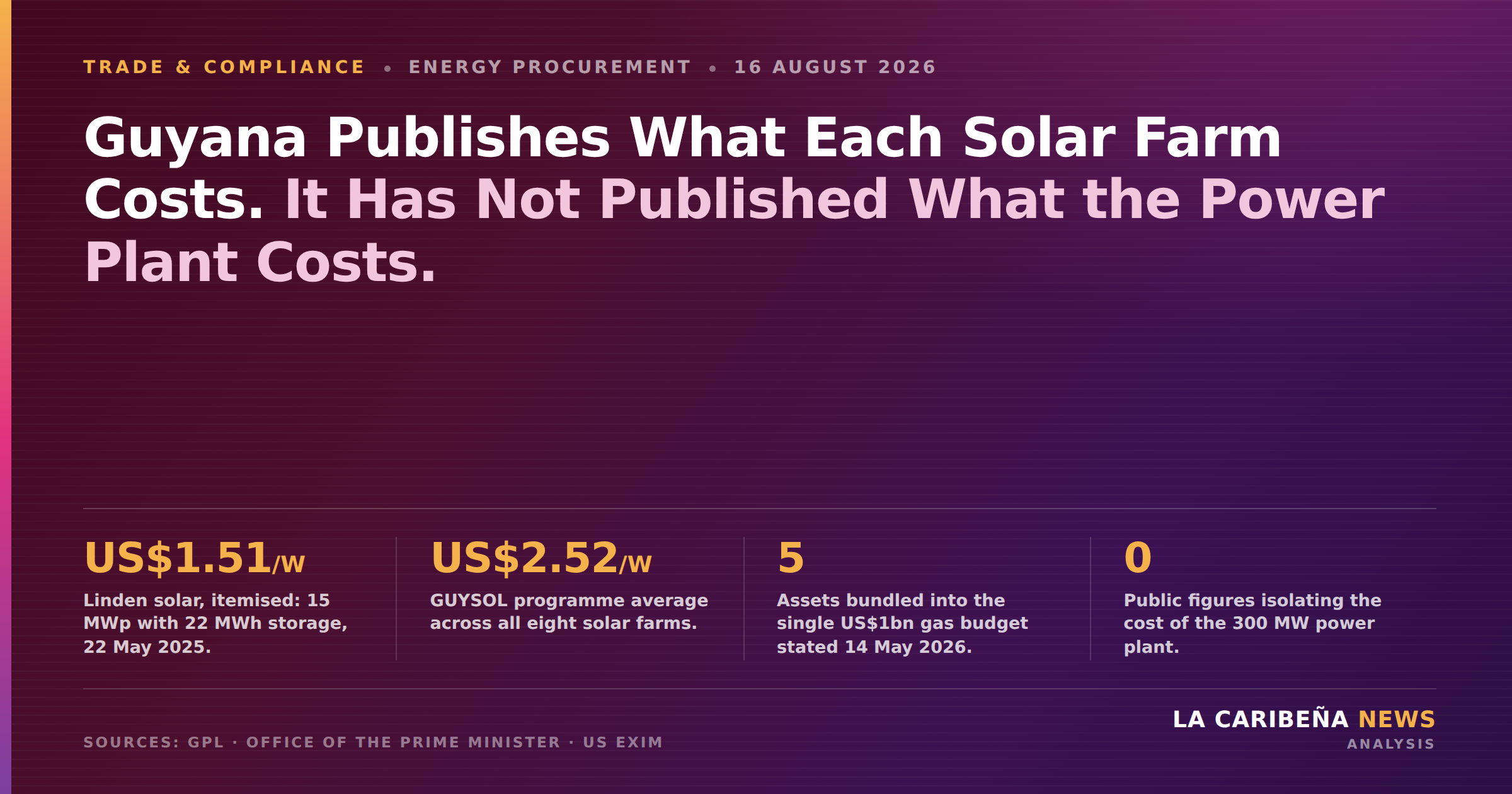
In short. Guyana’s Linden solar contract of 22 May 2025 is US$22.58 million for 15 MWp with 22 MWh of storage, or US$1.51 a watt. The Office of the Prime Minister budgets the Wales gas programme at US$1 billion, but that one figure covers the 300 MW power plant, the natural gas liquids facility, transmission, substations and a new national control centre. No public figure isolates the power plant, so it cannot be priced per watt.
What does Guyana pay for solar?
Between US$1.51 and US$1.84 a watt on the signed construction contracts, and US$2.52 a watt on the full programme budget.
The GUYSOL programme covers eight solar farms totalling 33 MWp, implemented by Guyana Power and Light. Guyana Power and Light states the programme is “administered by the Inter-American Development Bank” and puts the total programme value at US$83.3 million, which is US$2.52 a watt.
The construction contracts are smaller than that. Two were signed: US$38 million in March 2024 for 18 MWp at Onderneeming and Charity in Region Two and Trafalgar, Prospect and Hampshire in Regions Five and Six, and US$22.58 million in May 2025 for 15 MWp at Linden. Together that is US$60.6 million for 33 MWp, or US$1.84 a watt. The gap between the two figures is programme cost beyond construction.
The Linden package is the sharpest number in the portfolio. US$22.58 million buys 15 MWp with an 11 MW, 22 MWh battery system, projected to produce 20,210 MWh a year. That is US$1.51 a watt, storage included.
Five farms were commissioned between November 2025 and January 2026: Onderneeming at 5 MWp, Hampshire at 3 MWp, Prospect at 3 MWp, Trafalgar at 4 MWp and Charity at 3 MWp. Eighteen of the 33 MWp are operational. The three Linden sites remain under construction, with completion targeted for August 2027.
The builder is a joint venture of two Chinese state-owned firms, SUMEC Complete Equipment and Engineering Co. Ltd and XJ Group Corporation. SUMEC’s own corporate history names SINOMACH as its parent; XJ sits under China Electrical Equipment Group, having previously been held by State Grid Corporation of China.
The money is Norwegian, and the route matters. Guyana’s forest payments under its partnership with Norway are held in the Guyana REDD+ Investment Fund, for which the World Bank’s IDA arm is trustee. The Inter-American Development Bank is a partner entity providing operational services. Norway pays, the World Bank holds, the IDB administers, and Chinese state firms build.
Neither Guyana Power and Light’s own GUYSOL page nor the REDD+ fund’s project page names the contractor. The attribution rests on contemporaneous reporting by News Room Guyana and Stabroek News, and on a Department of Public Information release that identifies SUMEC as “a Chinese company.”
Guyana also runs the cheapest solar programme in its portfolio. The hinterland Solar Home Energy scheme, financed by a US$7.2 million line of credit from the Export-Import Bank of India, delivered 30,000 systems at US$240 each, or US$1.50 a watt, including a 160 W panel, a 48 Ah lithium battery, lamps, a fan, shipping and installation into remote riverine communities. More than 37,000 households have now received one.
What does Guyana pay for the gas plant?
Nobody outside government can say, and that is a finding rather than a gap in our research.
On 14 May 2026 the Office of the Prime Minister put the budget at US$1 billion, “not expected to exceed US$1.1 B, including the 10% contingency.” The release defines what that covers: “the 300 MW power plant, the Natural Gas Liquids facility, transmission works, substations, 230 kV and 69 kV lines, and the new National Control Centre.”
Five assets, one number. The transmission contract awarded to Kalpataru Projects International at about US$159.9 million in July 2023 sits inside that billion, not on top of it.
The original construction contract has the same problem. Lindsayca and CH4 were engaged in November 2022 for US$759 million to build what OilNOW describes as “the integrated facility at Wales” — the power plant and the gas separation plant together, with no itemisation published. TheUS Export-Import Bank approval of 26 December 2024bundles them the same way, financing “a natural gas separation plant, a 300 MW combined cycle gas turbine power plant and services related to the gas supply pipeline.”
Beyond that sits the pipeline, which ExxonMobil built and Guyana repays. Winston Brassington, who headed the gas-to-energy task force, told the International Energy Conference in February 2023 that “US$55 million is the amortized cost of US$1 billion for 20 years at a discount rate.”
Vice President Bharrat Jagdeo is reported to have put the all-in figure at about US$2 billion in December 2024. No primary transcript of that statement was located and no breakdown of what it includes has been published, so it is best read as an order of magnitude rather than a costed total.
The result is that the single largest capital project in Guyana’s history cannot be decomposed by anyone reading the public record. A business cannot benchmark against a bundle. Neither can a lender, a regulator, or the National Assembly. It is not the only place the record stops short: Guyana has approved local content plans for more than forty companies without publishing which ones, and the cost-oil audits behind the Stabroek agreement remain unresolved.
The plant is not generating. Prime Minister Mark Phillips said on 15 August 2026 that one 57 MW turbine would be spinning by the end of this year, with 228 MW in the first quarter of 2027 and the full 300 MW at the end of 2027. The original completion date was the end of 2024.
The promised halving of electricity bills arrives at 228 MW, not at 57 MW. “After the project, we said 50% reduction at the end of the project,” Phillips said, “and the project we’re talking about is phase one.” The baseline he gave is a residential tariff of GY$43.43 per kWh and a commercial tariff of GY$56.38.
Even with the numbers, why would a per-watt comparison mislead?
Because a solar watt and a gas watt do not do the same work, and any argument that ignores this is worthless. This matters even where the figures do exist, as they do on the solar side.
Solar produces when the sun is up. A combined-cycle gas plant runs on demand, including at 8pm when Guyanese households are cooking and cooling. Guyana’s own Linden project states the ratio plainly: 15 MWp produces 20,210 MWh a year, which is a capacity factor of about 15%. A gas plant of the same nameplate would produce four to six times as much energy in a year.
Storage narrows the gap and does not close it. The Linden battery is 22 MWh against a 15 MWp array, enough to shift an evening peak, not enough to carry a week of cloud.
So the honest comparison is not per watt installed. It is per unit of energy delivered over the asset’s life, and on that measure the picture splits in a way that matters.
Lazard, the New York investment bank, has published an annual Levelized Cost of Energy analysis since 2007. It prices what a megawatt-hour costs across an asset’s life rather than what the asset costs to build, and it is the reference lenders and regulators reach for.
Its June 2025 figures put utility-scale solar paired with storage at US$50 to US$131 per MWh and gas combined cycle at US$48 to US$109. Those bands overlap. Utility-scale solar and gas are, on current international costs, in the same competitive range.
Residential standalone storage is not. Lazard puts household four-hour storage at US$547 to US$860 per MWh, with residential battery capital cost at US$721 to US$1,338 per kWh.
What is actually available now?
Net billing, and it has been legal since June 2025.
Guyana Power and Light and the Guyana Energy Agencylaunched a net billing framework in June 2025. A household or business may install a system under 100 kWac of inverter rating with no consumption-based restriction. Above 100 kWac, approval is assessed against the customer’s maximum demand plus an interconnection study. Exports accumulate in an energy credits bank, and unused credits are cashed out annually at 90% of the prevailing tariff. A Certificate of Inspection from the Government Electrical Inspectorate is required, and unauthorised interconnection is illegal.
For a commercial customer paying GY$56.38 per kWh, that is the arithmetic worth running. Not because it is a national energy policy, but because it is a line item a firm controls without waiting for a turbine.
The scale question sits behind it. GPL’s development plan puts residential demand at 146 MW by 2030 against 307 MW of new load from major developments, data centres, a fertiliser plant and tracked commercial projects. On the utility’s own forecast, the growth is not in households.
That is the part of the original proposal that survives contact with the numbers. Taking households off the grid was never the cheap move. Letting businesses self-supply at the meter, while utility-scale solar and gas both carry the base, is a smaller idea that is already permitted.
What is the practical consequence?
That the country’s largest capital project cannot be benchmarked by anyone outside it, while its second largest can be benchmarked to two decimal places.
A private bottler, a lender assessing a power purchase agreement, a member of the National Assembly reviewing an estimate, or a business deciding whether to put panels on its own roof all face the same problem. There is a published unit cost for solar and there is not one for gas.
That asymmetry is not an accusation. It is a procurement fact with commercial consequences, and it is fixable by a single disclosure.
A second article puts numbers to what the alternative would have cost: the cost of putting rooftop solar on every Guyanese household.
Frequently asked questions
What does Guyana pay per watt for solar? US$1.84 a watt on the two construction contracts totalling US$60.6 million for 33 MWp, US$2.52 a watt on the full US$83.3 million programme budget, and US$1.51 a watt on the Linden tranche alone.
What does the Wales gas plant cost per watt? It cannot be calculated. The Office of the Prime Minister’s US$1 billion budget covers the power plant, the NGL facility, transmission, substations and a national control centre together.
Who is building Guyana’s solar farms? A joint venture of two Chinese state-owned firms, SUMEC Complete Equipment and Engineering and XJ Group Corporation, paid from Norway’s forest payments held in the Guyana REDD+ Investment Fund.
Is solar therefore cheaper than gas? Not on that comparison alone. Solar runs at about a 15% capacity factor on Guyana’s own Linden figures. Lazard puts utility-scale solar with storage at US$50 to US$131 per MWh and gas combined cycle at US$48 to US$109.
Can a Guyanese business install solar now? Yes. Net billing has been available since June 2025, with systems under 100 kWac requiring no consumption-based restriction and unused credits cashed out annually at 90% of the tariff.