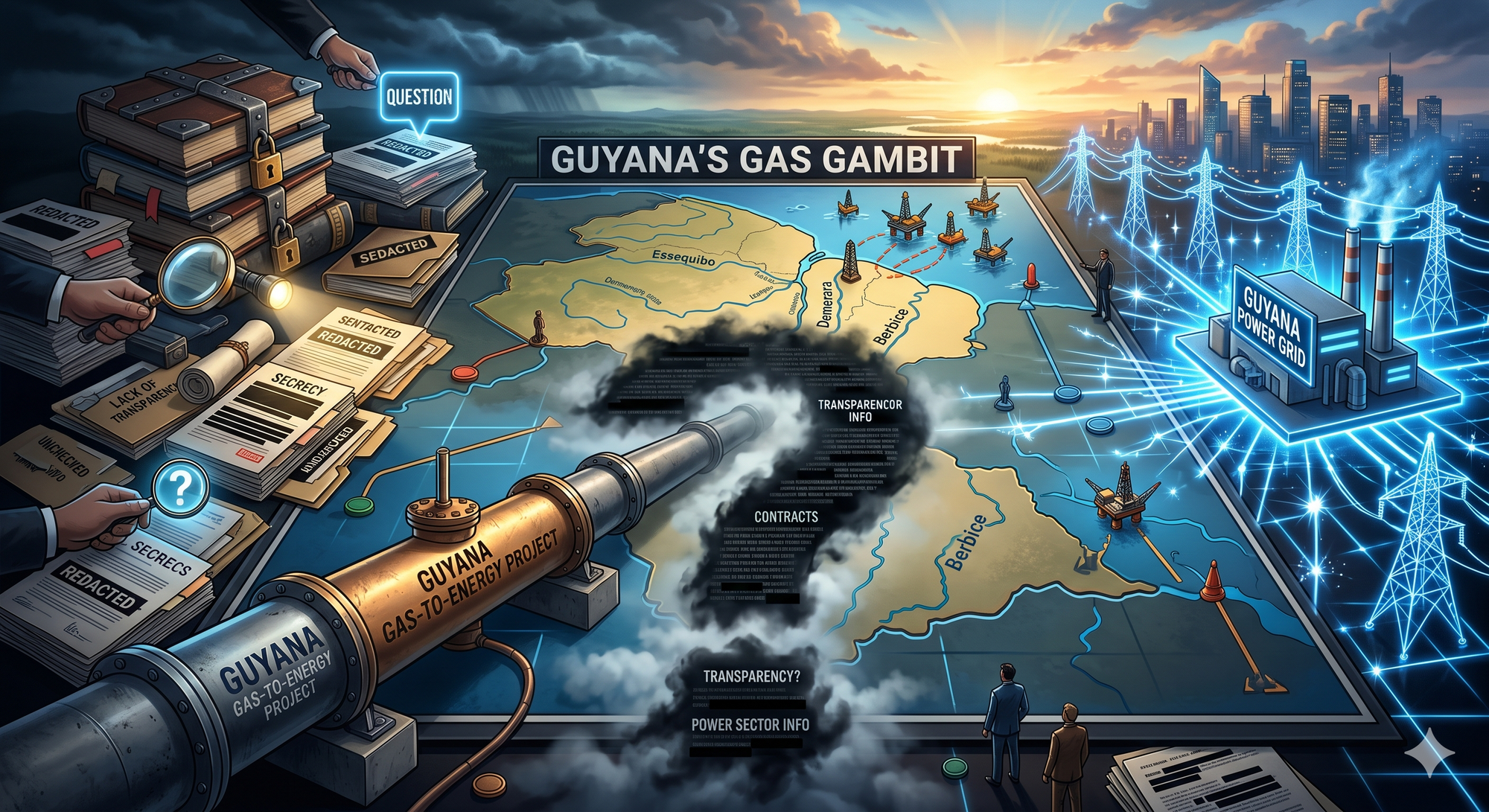
As CARICOM nations grapple with some of the world's highest electricity prices, Guyana's ambitious gas-to-energy pipeline raises a harder question: who actually benefits?
GEORGETOWN — Guyana is building energy infrastructure at a pace that would have seemed implausible a decade ago. Two gas-to-power plants planned for Wales on the West Bank Demerara, another earmarked for Berbice, and nascent liquefied natural gas ambitions underscore a government determined to convert its offshore oil windfall into domestic industrial capacity. Framed beneath the Low Carbon Development Strategy, the narrative is compelling: a small Caribbean nation threading the needle between fossil fuel development and sustainable growth.
But as the broader CARICOM region confronts electricity prices that routinely run twice the Latin American average—in some island states exceeding US$0.40 per kilowatt-hour—Guyana's trajectory demands scrutiny beyond the press release. The critical question is not merely whether the lights will be cheaper. It is whether ordinary Guyanese will participate as equity holders in what promises to be the most consequential energy buildout in the country's history or whether they will remain, as elsewhere in the region, simply consumers of someone else's infrastructure.
---
The Regional Backdrop
The Energy for Growth Hub's assessment of CARICOM power markets — excluding Trinidad and Tobago and Suriname, which benefit from domestic hydrocarbon access — paints a sobering picture. High tariffs are not accidental; they are structural, rooted in opaque power purchase agreements, sole-source contracting, and procurement frameworks that consistently favour incumbent utilities and foreign developers over competitive tension. When request-for-proposal processes do emerge, transparency around evaluation criteria, pricing benchmarks, and contract terms routinely falls short of international best practice.
This is the regional baseline against which Guyana must be measured. On that metric, the scorecard is mixed at best.
---
Transparency Gaps in Plain Sight
The Wales Gas-to-Energy Project, developed through the state-owned Guyana Power and Light and a newly restructured energy holding architecture, has advanced with limited public disclosure on power purchase agreement structures, tariff pass-through mechanisms, or the fiscal terms governing gas feedstock supply from the offshore Stabroek block. Investors and civil society organisations have raised pointed questions about whether gas transfer pricing between the upstream joint venture—in which ExxonMobil, Hess, and CNOOC hold operatorship—and the domestic energy offtaker reflects arm's-length commercial terms or implicit subsidy arrangements that skew project economics in ways the public cannot audit.
The LCDS, to its credit, establishes a principled framework for revenue stewardship and community investment. Yet frameworks are not contracts. The distance between a strategy document and a binding, auditable, publicly disclosed concession agreement is precisely where Caribbean energy governance has historically unravelled.
---
The Equity Question
Perhaps the sharpest edge of this debate concerns ownership access. Trinidad and Tobago's National Gas Company model, whatever its inefficiencies, embedded a concept of national participation in the energy value chain that shaped a generation of institutional capacity. Guyana has not yet articulated an equivalent mechanism for retail or citizen-level equity participation, beyond the private sector (including the economically disadvantaged), in its gas-to-power assets.
Regional comparators are instructive. Jamaica's pivot toward competitive renewable energy procurement, while imperfect, introduced independent power producer frameworks with disclosed tariff bands. Barbados has legislated net-metering rights that allow households to become micro-generators. Neither model is directly transferable to Guyana's scale, but both reflect deliberate policy choices to distribute the economics of energy transition beyond a narrow set of corporate and state actors.
For Guyana's emerging middle class — and for the diaspora capital increasingly eyeing domestic investment vehicles — the absence of a defined citizen-participation framework in gas-to-power is not a minor administrative gap. It is a governance choice with long-term distributional consequences.
---
Regional Implications
CARICOM's energy future will be shaped substantially by whether its largest emerging economy demonstrates that hydrocarbon wealth can be converted into affordable, transparently governed, broadly shared power infrastructure. If Guyana's gas-to-energy projects deliver cheaper electricity through closed contracts with opaque terms and concentrated ownership, they will confirm the region's longest-standing structural failure—not overcome it.
The infrastructure is being built. The governance architecture that determines who benefits remains, for now, conspicuously under construction.
---
Data references: World Bank GDP indicators (Guyana); Energy for Growth Hub CARICOM electricity sector analysis; Guyana Low Carbon Development Strategy 2030.