Bahamian dealers say 2,500 electric vehicles cannot be why the lights go out. Guyana has fewer than a tenth of that number, zero import duty on EVs, and a charging network being built now. The argument arrives here next.
BY LCN NEWSROOM
Quick summary: Electric vehicle dealers in the Bahamas have rejected the national grid company's suggestion that home chargers are straining the system, arguing the shortfall is decades of underinvestment. Guyana, with more than 280 electric vehicles and duty-free imports, is building charging capacity faster than the Bahamas did.
What the title card shows
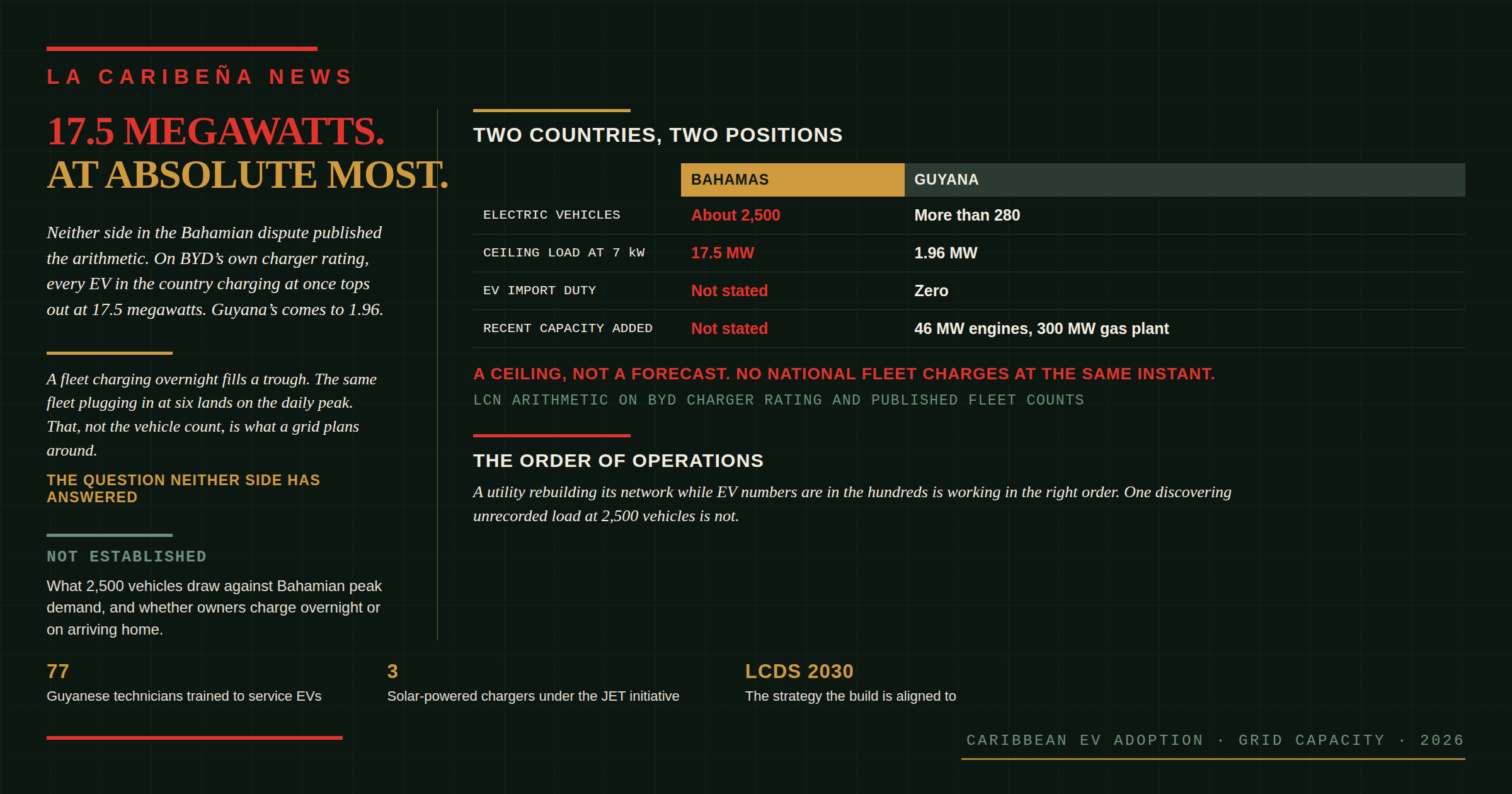
Every data point on the article's title card, in text.
- 2,500. Estimated electric vehicles on Bahamian roads, the dealers' own figure. Source: Tribune242.
- 280. Electric vehicles on Guyana's roads as of September 2025. Source: Joint SDG Fund, crediting the Guyana Chronicle.
- Six. Public charging stations in Guyana managed by the Guyana Energy Agency, with fourteen more expected. Source: as above.
- Zero. Import duty on electric vehicles in Guyana. Source: as above.
- Seventy-seven. Auto electricians and mechanical technicians trained in Guyana to service electric vehicles. Source: Joint SDG Fund.
- 7 kW. BYD's specified home wall charger for the Atto 3 and Dolphin. Source: BYD charging guidance.
- 17.5 MW and 1.96 MW. Ceiling load if every electric vehicle in the Bahamas, then in Guyana, charged simultaneously at 7kW. La Caribeña News arithmetic on the vehicle counts and charger rating above, not a published figure.
- 46 MW and 300 MW. Dual-fuel engines added to the Demerara-Berbice Interconnected System in 2021, and the gas-fired plant. Source: Guyana Energy Agency.
- Smart Grid. Modernisation of the transmission and distribution network, listed among the Guyana Energy Agency's transformative infrastructure priorities. Source: Guyana Energy Agency.
What are the Bahamian dealers arguing?
That the arithmetic does not support the accusation.
Tribune242 reported that Pia and John Farmer, co-founders of Easy Car Sales, said the estimated 2,500 electric vehicles on Bahamian roads represent an insignificant share of national electricity demand. They argued the capacity shortfall comes from inadequate investment and poor planning rather than from electric transportation.
The Farmers also said no government requirement currently obliges homeowners to seek permission before installing a charger, and described the suggestion that chargers should be reported as absurd. Bahamas Local News carried the same account.
What did the grid company actually say?
That unsanctioned load is showing up on the system, and chargers are part of it.
According to The Tribune, the dealers were responding to Bahamas Grid Company chief executive Dareo McKenzie and chief operating officer Ryan Holder, speaking at a press conference alongside Bahamas Power and Light at the Office of the Prime Minister. Holder attributed several faults to system overloads and pointed to connections added without the utility's knowledge, citing homeowners installing air-conditioning units without completing the administrative process.
The distinction is worth holding onto, because it is narrower than the headline exchange suggests. The utility's stated complaint is unrecorded load of any kind. Chargers are one example of it. Air conditioning is another, and there are far more air conditioners in the Bahamas than electric cars.
Does 2,500 vehicles move a national grid?
Neither side published the arithmetic, so this publication has done it.
The input is public. BYD, the world's largest electric vehicle maker and the brand now sold in Guyana, specifies a 7kW wall charger as the standard home unit for its Atto 3 and Dolphin, taking a standard-range battery from 20 to 100 per cent in around six hours. The factory-supplied plug-in cable is roughly a quarter of that.
Run the Bahamian fleet at that rate and the ceiling is 17.5 megawatts. That is 2,500 vehicles multiplied by seven kilowatts, every car in the country plugged into a full-rate home charger at the same instant.
That number is a physical ceiling, not a forecast. No national fleet charges simultaneously, and cars on the trickle cable draw closer to 4.4 megawatts in total. But it bounds the argument, which neither the dealers nor the utility have done. Whether 17.5 megawatts is trivial or serious depends on Bahamian peak demand, which La Caribeña News has not obtained and which the grid company has not published in this exchange.
The sharper point is that the ceiling matters less than the timing. A fleet charging overnight fills a trough that exists anyway. The same fleet plugging in at six in the evening lands on top of the daily peak. That distinction, not the vehicle count, is what utilities plan around, and it is absent from the argument on both sides.
What does the same arithmetic say about Guyana?
About two megawatts, against a grid adding hundreds.
Guyana's 280-plus electric vehicles, on the same 7kW assumption, come to a ceiling of roughly 1.96 megawatts. Set that against what the Guyana Energy Agency says has been added to the Demerara-Berbice Interconnected System: 46 megawatts of dual-fuel reciprocating engines in 2021 alone, and a 300 megawatt gas-fired plant.
On those published figures, every electric vehicle in Guyana charging at once would draw about four per cent of a single 2021 capacity tranche, and well under one per cent of the gas plant.
Two caveats belong with that. Not every electric vehicle in Guyana is a BYD, and 7kW is BYD's home-charger specification rather than a national average. And a ceiling is not a load profile: the figure that would actually constrain a utility is what the fleet draws at peak hour, which nobody has published for either country.
But it does answer the question the Bahamas is arguing about, in the direction the dealers claim. At Guyana's current fleet the number is small. The question is what it looks like at ten times the fleet, which is where the Bahamas is now.
Why does this reach Guyana?
Because Guyana is building the same exposure, faster, and with public money behind it.
Guyana had more than 280 electric vehicles on its roads as of September 2025, supported by six public charging stations managed by the Guyana Energy Agency, with fourteen more expected, according to an account published by the Joint SDG Fund crediting the Guyana Chronicle. Policy incentives include zero import duties on electric vehicles.
The state is also building the skills base. More than seventy-seven auto electricians and mechanical technicians have been trained to service and repair electric vehicles, and the Just Energy Transition Seed Funding Initiative, backed by the Joint SDG Fund, the United Nations Development Programme and the International Organization for Migration, is installing three solar-powered charging stations while certifying technicians in electric vehicle maintenance and solar photovoltaic systems. The Guyana Energy Agency announced that initiative in February 2025. The work is aligned to the Low Carbon Development Strategy 2030.
So Guyana sits at roughly a ninth of the Bahamian fleet, with a policy actively designed to grow it. On present trajectory the country reaches Bahamian numbers, and the question the Bahamas is now arguing about arrives with them.
Is Guyana better placed than the Bahamas?
On one measure, yes, and it is the measure that matters.
The Guyana Energy Agency lists modernisation of the transmission and distribution network, described as Smart Grid, among its transformative infrastructure priorities, alongside the Demerara-Berbice Integrated System, isolated grids and unconnected communities.
That is the substantive difference between the two positions. A utility that is rebuilding its network while EV numbers are in the hundreds is doing the work in the right order. A utility discovering unrecorded load at 2,500 vehicles is doing it in the wrong one.
Whether Guyana's build keeps pace with its own incentives is a separate question, and it is the one worth putting to the Agency and to Guyana Power and Light. Duty-free imports move faster than substations.
What has not been established?
Three things, and they are the reporting this story still needs.
The Bahamian load figure. Nobody has published what 2,500 vehicles draw against national peak demand, and without it both sides are asserting.
Guyana's current count. The 280 figure dates from September 2025 and duty-free imports have continued since. The present number is not something this publication has.
And the charging profile. Whether Caribbean EV owners charge overnight or on arriving home decides whether these fleets are a problem at all, and no utility in the region appears to have published that data.
Frequently Asked Questions
How many electric vehicles are on Bahamian roads?
An estimated 2,500, according to the figure cited by dealers Pia and John Farmer and reported by Tribune242. The figure is the dealers' own and has not been independently verified.
How many does Guyana have?
More than 280 as of September 2025, with six public charging stations managed by the Guyana Energy Agency and fourteen more expected.
What is the utility in the Bahamas actually complaining about?
Unrecorded load added without its knowledge. Chargers are one example given. Air-conditioning units installed without completing the administrative process were another.
How much power would Guyana's electric vehicles draw?
About 1.96 megawatts if all 280 charged at once on a 7kW home charger, which is La Caribeña News arithmetic rather than a published figure. That is roughly four per cent of the 46 megawatts of dual-fuel engines added to the grid in 2021, and under one per cent of the 300 megawatt gas plant.
Why does charging time matter more than vehicle numbers?
A fleet charging overnight uses capacity that would otherwise sit idle. The same fleet charging in the early evening adds to the daily peak, which is what constrains a grid.