By LCN Business Desk
Two Caribbean territories put fuel prices in the news on the same day, and they are not in the same position.
In The Bahamas, motorists were warned to brace for petrol as high as US$7.50 a gallon. Peter Roker, who operates Roker's Gas Station and is an Esso dealer, said dealers were given notice of the increase with little time to prepare. Petrol at his station was selling at US$7.06 before it. The rise is 44 cents.
In the British Virgin Islands, regular petrol sells at US$5.15.
What is being asked for in the British Virgin Islands?
Regulation, and by someone outside government.
Skelton Cline, a social and political commentator, said on his programme Honestly Speaking that "there should be regulations in place". He called for a Trade Commission covering competition and consumer protection, and for authorities to monitor fuel purchases, storage and retail price changes, pointing to a system in the United States Virgin Islands that tracks purchases, deliveries, timing, dates and quantities to test whether price increases correspond to fuel actually sold.
The comparison he drew is the one to hold on to. He cited regular petrol in the British Virgin Islands at US$5.15 against US$5.25 in St Thomas. The territory he wants regulated is the cheaper of the two.
Premier Dr Natalio Wheatley has announced a technical working group to monitor prices across the territory, covering fuel and broader price movements. That is surveillance rather than a price, and it commits no money.
What does a Caribbean government pay to hold a fuel price down?
Guatemala has an answer, and it is nine figures.
La Caribeña News reported in September that Guatemala's Congress passed two fuel measures in a fortnight. One suspended the taxes until 31 December, which should take about 83 United States cents a gallon off diesel. The other capped the price and paid importers the difference from a fund. Together they commit about Q5.8 billion, or US$762 million.
That cap did not arrive as policy in the abstract. It followed truckers sealing the Mexico and El Salvador routes, after which the price was held at Q39 a gallon.
Does state ownership hold the price down?
Not in Guyana, where the state retailer is the dearer one.
Guyoil, which is state-owned, raised diesel by 14.4 per cent in September and is now more expensive than Mobil and Rubis. A state pump in an oil-producing country is selling above the private sellers beside it.
That bears on the British Virgin Islands argument. The instrument being demanded there is regulation of private sellers. The Guyanese case is a government that owns a seller outright and has not used it to undercut anyone.
How far apart are these markets?
By US$2.35 a gallon, across jurisdictions in the same sea.
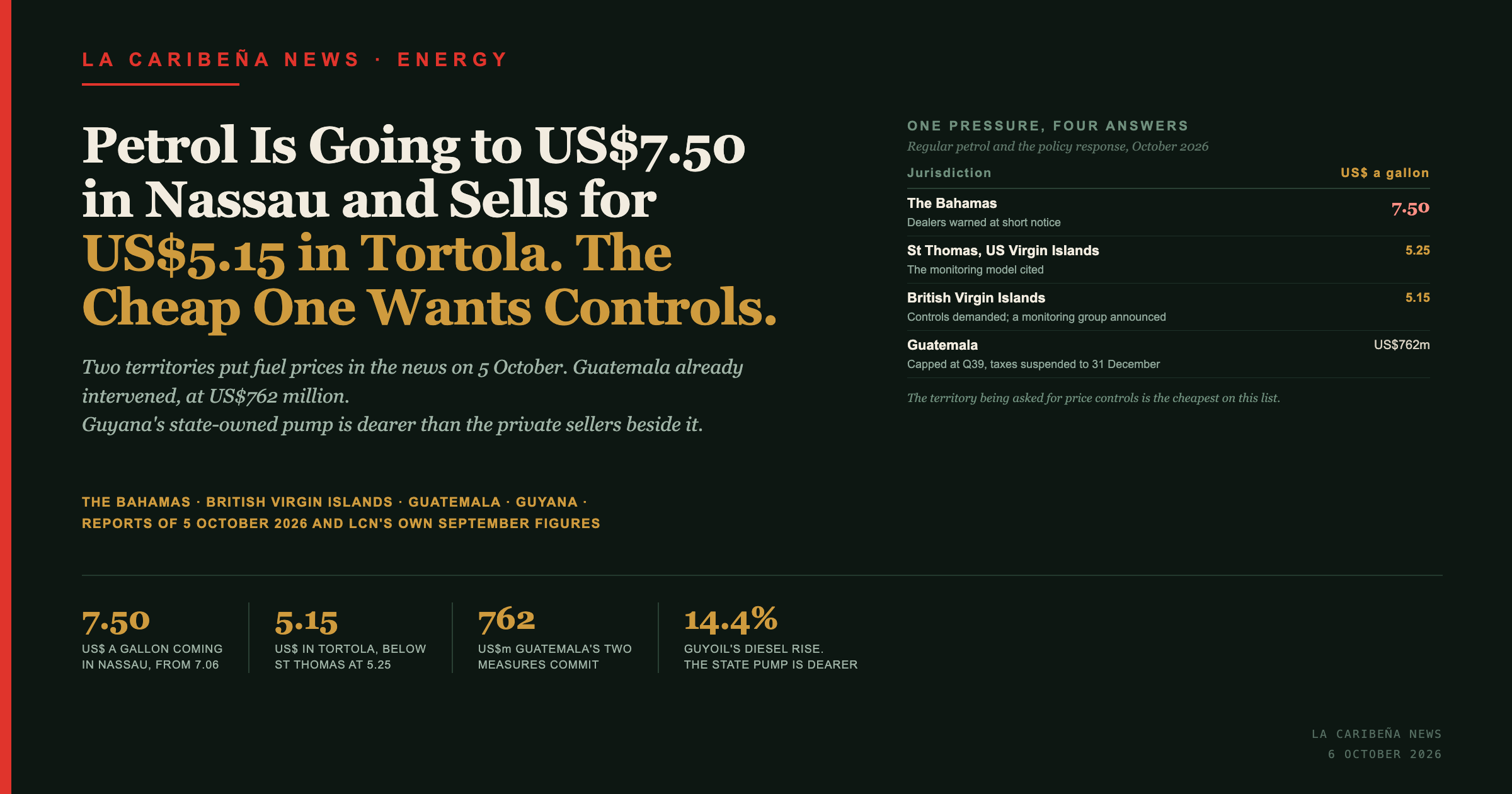
| Jurisdiction | Regular petrol, US$ a gallon | What is happening |
|---|---|---|
| The Bahamas | 7.50, from 7.06 | Dealers warned of the increase at short notice |
| United States Virgin Islands, St Thomas | 5.25 | The model cited for monitoring |
| British Virgin Islands | 5.15 | A commentator demands controls; the Premier announces a monitoring group |
| Guatemala | capped at Q39 a gallon | Taxes suspended to 31 December, measures costing US$762 million |
Roker's warning in Nassau is about what happens to the sellers rather than only to drivers. Station operators may have to cut opening hours and staffing, he said, because fixed operating costs do not fall when the price of fuel rises.
What the title card shows
US$7.50 a gallon: the petrol price Bahamian motorists were warned to brace for on 5 October 2026, reported by Tribune242. US$7.06: the price at the station quoted before that increase, making the rise 44 cents. US$5.15: regular petrol in the British Virgin Islands, cited by Skelton Cline on 5 October 2026. US$5.25: regular petrol in St Thomas, United States Virgin Islands, the neighbouring jurisdiction he cited as the monitoring model, and the higher of the two. US$762 million: the combined commitment of Guatemala's two fuel measures, about Q5.8 billion, reported by La Caribeña News on 26 September 2026. 83 United States cents a gallon: the expected fall in diesel from Guatemala's tax suspension to 31 December. Q39 a gallon: the Guatemalan price cap, imposed after truckers sealed the Mexico and El Salvador routes. 14.4 per cent: the September diesel increase by Guyoil, the Guyanese state retailer, which is now dearer than Mobil and Rubis. US$2.35: the gap between the coming Bahamian price and the British Virgin Islands price.
Frequently Asked Questions
How high are Bahamian petrol prices going?
Motorists were warned on 5 October 2026 to brace for as much as US$7.50 a gallon, up from US$7.06 at the station quoted, a rise of 44 cents. Dealers said they received notice with little time to prepare.
What is being proposed in the British Virgin Islands?
Skelton Cline, a commentator rather than an official, called for a Trade Commission covering competition and consumer protection and for monitoring of fuel purchases, storage and retail price changes. Premier Dr Natalio Wheatley has announced a technical working group to monitor prices.
Is the British Virgin Islands expensive by regional standards?
Not on the figures cited. Regular petrol there was given as US$5.15 against US$5.25 in St Thomas in the United States Virgin Islands, and against a coming US$7.50 in The Bahamas.
What has holding a fuel price down cost in the region?
Guatemala's two measures, a tax suspension to 31 December and a price cap paid for from a fund, commit about Q5.8 billion, or US$762 million.
Does a state-owned retailer sell more cheaply?
Not in Guyana. Guyoil raised diesel 14.4 per cent in September and is now dearer than Mobil and Rubis.