By LCN Business Desk
A cruise ship spends a great deal of its working life tied to a quay rather than at sea. It sits docked in Bridgetown or St George's for eight to twelve hours with several thousand people aboard, and for every one of those hours its engines are running, burning fuel to light the cabins, cook the food and hold the air conditioning up.
Shore power is the alternative to that. A cable from the quay, the engines switched off, and the island selling the ship its electricity for the day.
Two things have to exist before it can happen: a connection built at the berth, and generation behind it able to carry one very large customer for as long as the ship is in. The cruise lines are now buying their half of it.
What did Ambassador actually sign?
A contract to fit one ship, then two more, with no price and no megawatt rating attached to any of it.
Ambassador Cruise Line has contracted the Italian marine technical services firm EnerMoves SRL to install a shore power connection system on Renaissance, Cruise Industry News reported on 31 October. Work has started and commissioning falls in the ship's October to November 2027 drydock. Two further contracts are planned, for Ambience in its November to December 2027 drydock and for Ambition in autumn 2028. The line gave no cost, no capacity, no list of ports and no named executive.
Renaissance is the ship that matters here. It carries Ambassador's Caribbean winter programme, eight 14-night fly-cruise itineraries out of Bridgetown with two repositioning voyages between the United Kingdom and Barbados at either end of the season. Fitted in late 2027, it arrives for the following winter able to plug in.
How many ports can take the ships that are already fitted?
Forty ports worldwide can, on the industry body's own count.
The Cruise Lines International Association (CLIA) published its 2026 Environmental Technologies and Practices report on 16 September, its ninth annual edition, covering more than 90 per cent of global oceangoing cruise capacity.
| CLIA 2026 report | Figure |
|---|---|
| Member ships able to connect to onshore power | 193 |
| The same count in 2018 | 55 |
| Share of reporting ships | 65% |
| Share of reporting capacity | 72.5% |
| Further ships planned for retrofit | 47 |
| Newbuilds specified with the capability | 39 |
| Projected by 2039 | 279 |
| Cruise ports with at least one equipped berth | 40 |
| Share of ports where cruise ships call | under 3% |
*Figures from CLIA's 2026 Environmental Technologies and Practices report. CLIA's 45 oceangoing member lines operated 327 ships and about 692,000 lower berths as at August 2026; the environmental dataset covers 297 ships in operation through 2025, so the percentages are calculated against that reporting fleet rather than the full member fleet.*
Three quarters of the fleet's capacity will be able to do something that fewer than three ports in a hundred can receive. CLIA does not publish which forty ports they are, so the report settles the count and not the map.
What does a shore power berth cost?
Twenty-five million United States dollars a terminal, on the only published per-berth figure in the region.
PortMiami puts its own programme at an estimated US$125 million across five cruise berths, US$25 million per terminal, against US$21.7 million in grants from the Florida Department of Transportation and the United States Environmental Protection Agency. The county does not say how the balance was funded. Even with five berths built, only three ships can connect on any given day, which is a power limit rather than a quayside one. Plugging in cuts emissions by up to 98 per cent with the engines off.
Miami is where the Caribbean's own traffic is organised from, and it is the nearest shore power to the basin. The 4,500-berth MSC Meraviglia homeports there for this winter and spends it calling at St Maarten, St Kitts and Grand Turk. It can plug in where it sleeps and nowhere it visits.
Set US$25 million against what cruise tourism is worth to a small cruise destination. This newspaper reported last week that cruise tourism put US$19.28 million into Saint Vincent and the Grenadines across the 2023/2024 cruise year, the figure against which Global Ports Holding's thirty-year concession was measured. One berth at PortMiami's price is about 1.3 times that. At the US$104.36 the Florida-Caribbean Cruise Association and Business Research and Economic Advisors measured as average passenger spending ashore, it is the direct expenditure of about 240,000 passenger visits.
Both comparisons measure the destination economy rather than port revenue, which reaches a port as head tax and berthing fees. They size the economy a port authority argues in front of, not its own balance sheet.
Why is the grid the harder half?
Because the ship is a large customer and the island is a small system.
CLIA Europe puts a large cruise ship's consumption at up to 12 megawatts. Lloyd's Register says at least 5 and perhaps approaching 10. An engineering benchmark for a 3,000 to 5,000 passenger ship gives 7 to 12 megawatts across eight to twelve hours alongside, and notes that the load rises with ambient temperature, which puts a Caribbean call at the upper end of any range quoted for a European one. The Port of Québec is building a single 16 megawatt connection at Berth 30, due to run in 2028.
Now read that against the systems that would have to carry it. The figures below are from the country tables in Navigating the Energy Transition in the Caribbean, the 2025 regional outlook published by the Latin American Energy Organization (OLADE).
| Country | Installed capacity | Main power utility |
|---|---|---|
| Grenada | 70 MW | Grenlec |
| Belize | ~180 MW | Belize Electricity Ltd |
| Haiti | 270 MW | Electricite d'Haiti |
| Barbados | 334 MW | Barbados Light & Power |
| Guyana | 400 MW | Guyana Power & Light |
| Suriname | 550 MW | Energiebedrijven Suriname |
| Jamaica | 1,050 MW | Jamaica Public Service |
| Trinidad and Tobago | 2,100 MW | T&TEC |
| Dominican Republic | 5,200 MW | CDEEE |
| Cuba | 6,200 MW | Union Electrica |
*OLADE's "Key Energy Indicators" tables for 2022 to 2025, which name the main power utility in each country. Barbados is 295 MW thermal and 39 MW solar, Guyana is diesel-dominated, Haiti is diesel and hydro, Trinidad and Tobago is gas-fired with generation by independent producers, and Cuba is 75 per cent thermal and 22 per cent renewables.*
A single 16 megawatt connection of the kind Québec is building would be close to a quarter of everything Grenada has installed. One ship at the lower end of the industry's own range, 7 megawatts, would be a tenth of it.
Installed capacity flatters every one of those fractions, because plant sits out for maintenance and firm capacity is lower than nameplate. What a utility can actually offer is the gap between demand at its peak and what it has running, and in Guyana that gap is published. Guyana Power and Light told a news conference on 7 September that peak demand had reached 257 megawatts against 265.6 available, about 8.6 megawatts of headroom. A berth connection rated as Québec's would be nearly twice that on its own.
A large new customer on a small system is a problem this region is already managing in other forms. Guyana has pitched itself as a regional data centre hub on a grid with no spinning reserve, and the Bahamas Grid Company has attributed system faults to connections added without its knowledge, air conditioning among them, on a system where electric vehicle dealers put the blame on decades of underinvestment instead. A cruise berth differs from both in being scheduled. The utility knows the ship is coming, which is the one advantage in the file.
Does any rule require a Caribbean port to build it?
No, and the one part of the Caribbean inside the rule is written out of it by name.
The obligation is European and it is split across two instruments. Lloyd's Register sets out the ship-side duty under FuelEU Maritime, Regulation (EU) 2023/1805: from 1 January 2030 a container or passenger ship over 5,000 gross tons moored at the quayside in a TEN-T maritime port in the European Economic Area must connect to onshore power and use it for all its electrical demand, extending from 1 January 2035 to any EEA port where onshore power is available. The port-side duty sits in the Alternative Fuels Infrastructure Regulation, Regulation (EU) 2023/1804.
Neither reaches a Caribbean port, because the Caribbean is not in the trans-European transport network. Two exceptions in the ship-side rule matter anyway. A ship is excused where no connection point is available at the port, which is the position at every Caribbean berth today. And the regulation carries derogations for ports on islands and in outermost regions that are not directly connected to the mainland grid, a description that fits Martinique and Guadeloupe, the French departments that are simultaneously European Union territory and Caribbean cruise destinations. Ambition's 42-night Caribbean sailing from London Tilbury on 5 January 2027 calls at Pointe-à-Pitre.
So the ships arrive equipped under a European timetable and the ports they call at are outside it. Nothing obliges a Caribbean port authority to spend, and nothing compensates one that does.
What should a port or a utility take from it?
That the timetable is set by competition for calls rather than by law, and that the quayside is the cheaper half.
A port authority weighing shore power is not buying one asset. It is buying a berth connection, then a generation and transmission position behind it that has to hold a single customer drawing a measurable share of the national system for eight to twelve hours at a time, on days when two ships may be in. On the islands at the top of that table the second half is the project and the first half is the invoice people notice.
The sequence this region has seen before runs the other way round. A destination that cannot take a ship's load is not penalised in 2030. It is simply a port where a line's new equipment earns nothing, on an itinerary where another port's does, and itineraries are rewritten annually. The figure a board can act on is not the emissions saving but the megawatts, and OLADE publishes those for every country in the region.
The entities
- Ambassador Cruise Line is the United Kingdom operator of Renaissance, Ambience and Ambition.
- EnerMoves SRL is the Italian marine technical services firm contracted to install the shore power systems.
- Cruise Lines International Association (CLIA) is the cruise industry body, whose 45 oceangoing member lines operate 327 ships.
- Onshore power supply, also called shore power or cold ironing, lets a ship shut down its engines and draw electricity from a port's grid at berth.
- PortMiami is the Miami-Dade County cruise and cargo port, which has built shore power at five cruise berths.
- Latin American Energy Organization (OLADE) is the intergovernmental energy body whose 2025 regional outlook carries the country capacity tables.
- FuelEU Maritime is Regulation (EU) 2023/1805, which carries the ship-side onshore power duty.
- Alternative Fuels Infrastructure Regulation is Regulation (EU) 2023/1804, which carries the port-side duty.
- Trans-European transport network (TEN-T) is the European Union corridor and port network to which those duties attach.
What the title card says
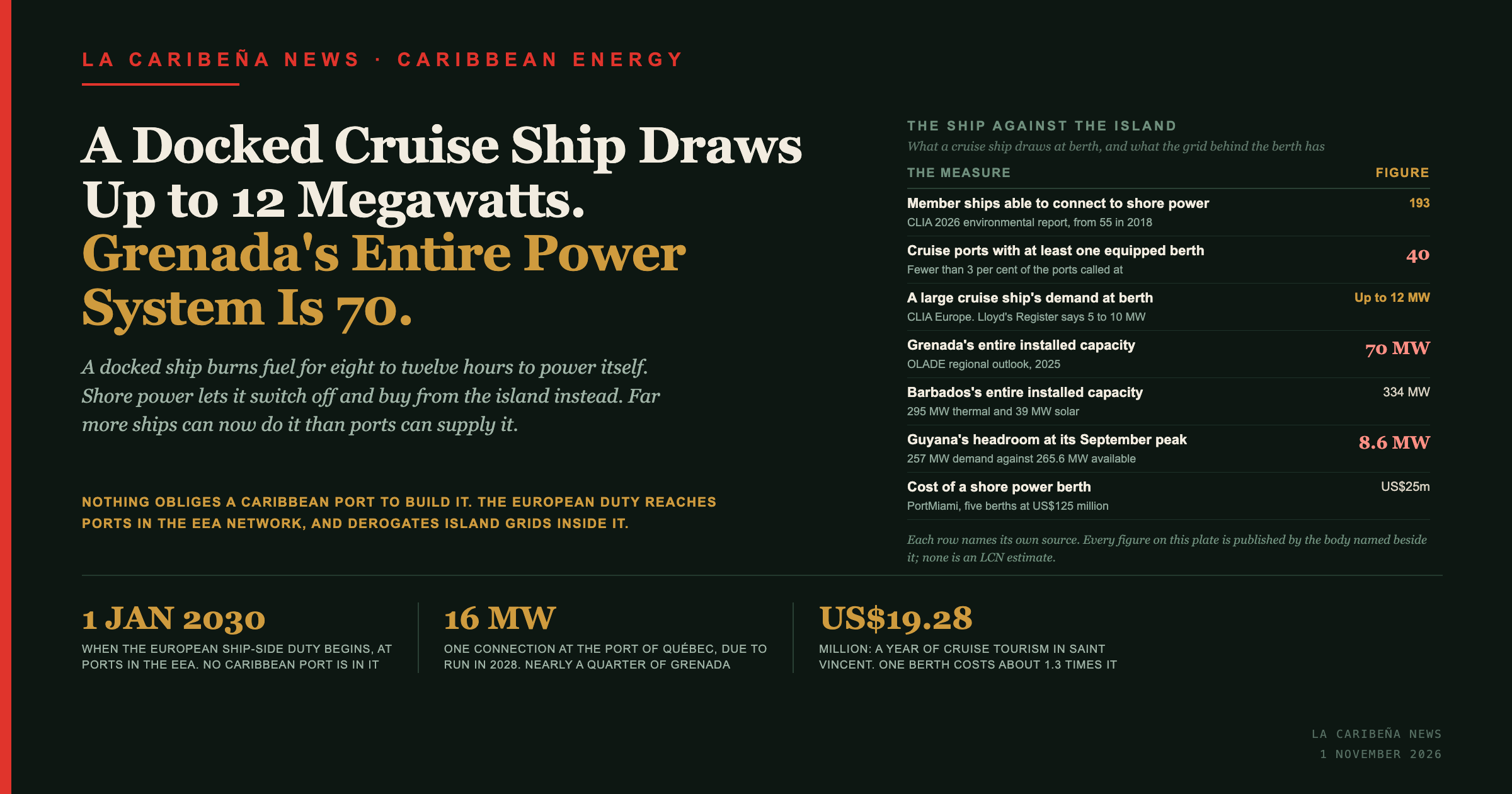
- Headline: a docked cruise ship draws up to 12 megawatts, and Grenada's entire power system is 70.
- A large cruise ship's demand at berth: up to 12 megawatts. Source: CLIA Europe. Lloyd's Register puts it at 5 to 10 megawatts.
- Member ships able to connect to shore power: 193, against 55 in 2018. Source: CLIA's 2026 Environmental Technologies and Practices report, published 16 September 2026.
- Cruise ports with at least one equipped berth: 40, fewer than 3 per cent of the ports where cruise ships call. Source: the same report.
- Grenada's entire installed capacity: 70 megawatts. Barbados's: 334 megawatts, being 295 thermal and 39 solar. Source: the Latin American Energy Organization's 2025 regional outlook.
- Guyana's headroom at its September peak: 8.6 megawatts, from peak demand of 257 megawatts against 265.6 available. Source: Guyana Power and Light's news conference of 7 September 2026, as reported by this newspaper at the time.
- Cost of a shore power berth: US$25 million per terminal, across five berths costing an estimated US$125 million in total. Source: Miami-Dade County.
- One connection at the Port of Québec is rated 16 megawatts and is due to run in 2028, which is close to a quarter of Grenada's whole system.
- Cruise tourism put US$19.28 million into Saint Vincent and the Grenadines across the 2023/2024 cruise year, so one berth at PortMiami's price is about 1.3 times that.
- The European ship-side duty begins on 1 January 2030 at ports in the European Economic Area. No Caribbean port is in that network, and the rule derogates island grids that are inside it.
- Ambassador Cruise Line's contract with EnerMoves SRL, reported 31 October 2026: Renaissance in its October to November 2027 drydock, Ambience in November to December 2027, Ambition in autumn 2028.
Frequently Asked Questions
What is shore power and why is it being fitted now?
Onshore power supply, also called cold ironing, lets a ship switch off its engines at the quay and draw electricity from the port's grid instead. Cruise lines are fitting it ahead of a European Union requirement that takes effect on 1 January 2030 for container and passenger ships over 5,000 gross tons at ports in the trans-European transport network.
How many ports can a shore-power-equipped cruise ship actually plug into?
Forty worldwide, fewer than 3 per cent of the ports where cruise ships call, according to CLIA's 2026 Environmental Technologies and Practices report. The same report counts 193 member ships able to connect, up from 55 in 2018, and projects 279 by 2039. CLIA does not publish the list of the forty ports.
Does a Caribbean port have to install shore power?
No. The European obligations attach to ports in the trans-European transport network and, from 2035, to ports in the European Economic Area. No Caribbean port is in either. The ship-side rule also excuses a ship where the port has no connection point, and carries derogations for island and outermost-region ports that are not directly connected to the mainland grid.
Why is electricity supply the harder part for a Caribbean island?
Because the ship is a large single customer. Industry figures put a large cruise ship's demand at berth between about 5 and 12 megawatts, rising with ambient temperature, and the Port of Québec is building one 16 megawatt connection. OLADE's 2025 country tables put Grenada's whole installed capacity at 70 megawatts, Belize's at about 180 and Barbados's at 334.
What does a shore power berth cost?
PortMiami puts its five-berth programme at an estimated US$125 million, or US$25 million per terminal, of which US$21.7 million came from Florida state and United States federal grants. By comparison, cruise tourism put US$19.28 million into Saint Vincent and the Grenadines across the 2023/2024 cruise year.