By LCN Business Desk
The world's largest cruise company will put as many ships in Europe next year as it puts in the Caribbean, for the first time.
"In 2027, Europe will, for the first time, tie with the Caribbean as our largest deployment region, each representing 34% of our mix," Chief Executive Josh Weinstein told analysts on Carnival Corporation's third-quarter earnings call on 29 September, as reported by Cruise Industry News. Carnival is not the only line moving tonnage: MSC has since shifted the Meraviglia out of Brooklyn to Miami, examined in MSC Moves Its Meraviglia to Miami.
In 2026 the Caribbean takes 35 per cent of Carnival's deployment and Europe 31. In the third quarter of 2027, the northern summer, Europe reaches 47 per cent against 43 per cent this year.
Chief Financial Officer David Bernstein gave the figure that fixes what those percentages mean. "We are forecasting a capacity increase of 0.5% in 2027 compared to 2026," he said on the same call.
How much Caribbean capacity is Carnival actually removing?
About two per cent of its own, which is a reallocation rather than a retreat.
Carnival gave shares of its fleet, not numbers of ships, and the fleet is getting bigger. A share that falls from 35 per cent to 34 per cent is therefore not a one point cut.
Picture the 2026 fleet as 100 ships. Thirty-five of them sail the Caribbean and 31 sail Europe. In 2027 the fleet is 0.5 per cent bigger, so call it 100.5 ships, and each region takes 34 per cent of it, or 34.2 ships.
| Region | Ships in 2026 | Ships in 2027 | Change |
|---|---|---|---|
| Caribbean | 35.0 | 34.2 | About minus 2.4 per cent |
| !Europe | 31.0 | 34.2 | About plus 10.2 per cent |
Carnival Corporation stated the shares and the 0.5 per cent capacity increase. The ship counts are an illustration on a fleet of 100, and the change between them is La Caribeña News arithmetic.
So for every hundred ships Carnival sails, the Caribbean loses a little under one and Europe gains three. The Caribbean stays tied for Carnival's largest deployment region.
Where is the demand pulling the ships?
North, to colder water.
Weinstein pointed to "Northern European deployments where guest interest continues to grow in coolcations, cooler weather destinations and outdoor activities like hiking, exploring the fjords of Norway". The shift is not simply toward the Mediterranean, which has long been the European staple. "We actually have more European sailings outside of the Med than in the Med, and we love that position," he said.
The Caribbean is no longer competing only with other warm-water islands. It is competing with a Norwegian fjord in July.
What happens to the Caribbean capacity that remains?
It concentrates on seven destinations that are Carnival's own.
"The Caribbean remains an important part of our strategy and will benefit from continued expansion of our Paradise Collection portfolio," Weinstein said.
The Paradise Collection is Carnival Corporation's own term for its exclusive Caribbean destinations, which the company says let it "unlock paradises only our ships can reach". There are seven.
| Destination | Where | How Carnival describes it |
|---|---|---|
| Celebration Key | Grand Bahama, The Bahamas | "purpose-built for Carnival Cruise Line guests" |
| RelaxAway, Half Moon Cay | The Bahamas | "exclusive destination" |
| Princess Cays | The Bahamas | Over 40 acres, "over half a mile of pristine white-sand shoreline" |
| Isla Tropicale | Roatán, Honduras | "crystal clear beaches, blue skies and warm sun" |
| Amber Cove | Near Puerto Plata, Dominican Republic | "one of the Caribbean's newest destinations" |
| Grand Turk Cruise Center | Turks and Caicos | "world-class, beach front cruise facility" of nearly 18 acres |
| Puerta Maya | Cozumel, Mexico | "expansive cruise center" |
Destinations and descriptions as published by Carnival Corporation.
Three of the seven are in The Bahamas. Amber Cove sits beside Puerto Plata, the Dominican second city that has just bought three winter air routes of its own, reported in A Dominican Second City Just Bought Three Winter Routes.
How fast is the owned footprint growing?
At Celebration Key, by five ships and a million guests in a single year.
Carnival's newest exclusive destination opened on the southern coast of Grand Bahama in July 2025. Its pier has since been expanded from two berths to four, ahead of schedule, taking it to four ships and more than 13,000 guests a day and adding roughly 200 ship calls and 700,000 guest arrivals a year.
"Celebration Key is expected to welcome approximately 3.5 million guests next year with 31 ships calling versus 26 this year."
Weinstein said the destination "recently marked its first anniversary, having welcomed almost 2.5 million guests in its first year alone". On the pier work he said that "finishing the pier extension ahead of schedule gives us a real jump on meeting the extraordinary demand we're seeing", in the company's expansion announcement.
So Carnival's Caribbean deployment share falls by one point while guest arrivals at its own Bahamian destination are forecast to rise by about a million.
What is at stake in where a ship berths?
What the passenger spends, and who is standing there to receive it.
The Florida-Caribbean Cruise Association's economic impact study, prepared by Business Research and Economic Advisors for the 2023/2024 cruise year, counted 29.4 million passenger onshore visits across 33 Caribbean and Latin American destinations, generating US$4.27 billion in direct expenditure. Passengers spent an average of US$104.36 each ashore. The transit passenger disembarkation rate was 83 per cent, down from 85 per cent in 2018. That average is what a destination forfeits when a call is dropped, and it has no claim to recover it, examined in The Port It Skipped Got Nothing.
The five country markets in which Carnival holds a Paradise Collection destination are among the largest the study measured.
| Market | Onshore visits, 2023/24 | Average passenger spend |
|---|---|---|
| The Bahamas | 3,914,000 | US$120.93 |
| Cozumel | 3,561,900 | US$110.01 |
| Dominican Republic | 2,036,100 | US$79.78 |
| Honduras | 1,404,500 | US$99.20 |
| Turks and Caicos | 796,700 | US$102.22 |
Figures from the FCCA and BREA study for the 2023/2024 cruise year. These are country totals across every cruise line calling, not Carnival's own traffic and not traffic to the Paradise Collection facilities.
Those five markets together account for 11.7 million of the 29.4 million onshore visits in the study, about 40 per cent. Carnival holds a controlled berth in each of them.
What does the shift mean for an island paid per visit?
No call, no payment. That is the whole of it.
A cruise destination without a berth of its own earns from a ship in two ways: a head tax on each passenger landed, and whatever those passengers spend ashore. Both are per visit. Neither accrues when the ship sails somewhere else.
The head tax is small, and it is where the asymmetry starts. Ambassador Daven Joseph put Caribbean ports at "$5 to $12 per head in head tax and port charges" in an opinion published on 25 September, against US$46 a passenger in Alaska. "Alaska charges $46 per passenger. We charge $5," he wrote of Antigua. He cited the World Bank putting cruise visitor spending at US$37 to US$139 against US$1,600 for a stay-over visitor to Antigua, and cruise fares at US$3,000 to US$7,000 per guest per week. These are his figures, in an argument he was making, and no harmonised regional rate exists to check them against. Prime Minister Gaston Browne has proposed a regional minimum of US$30 to US$50 a head. Neither CARICOM nor the OECS has adopted it.
The Bahamas is the exception, and it did not get there by accident. Its tax schedule charges US$23 for "every cruise ship passenger leaving The Bahamas by sea from any harbour in The Bahamas" and US$25 for "every cruise ship passenger leaving The Bahamas by sea from a private destination not visiting any other port in The Bahamas", as published by The Bahamas Customs Department. A tourism sustainability levy of US$5 and a tourism enhancement levy of US$2 apply on top.
So a passenger landed at a Bahamian private destination pays US$32, and one landed at Nassau or Freeport pays US$30.
The Bahamas defines a private destination in its own tax schedule as "a premises situated on any island within The Bahamas providing amenities and entertainment for cruise ship passengers", and charges two dollars more for it.
Celebration Key, RelaxAway Half Moon Cay and Princess Cays all sit inside that definition. The Bahamas legislated for the private island and priced it above its own public harbours.
Which countries does that leave?
The ones the region's own private sector body named three days ago.
The CARICOM Private Sector Organization issued a release on Royal Caribbean Group's 50 per cent investment in Sandals Resorts, naming seven member states it expects to gain: Jamaica, Antigua and Barbuda, Saint Lucia, The Bahamas, Barbados, Grenada, and Saint Vincent and the Grenadines. This newspaper reported it in The Caribbean Body Named Seven Countries That Gain From the Sandals Deal.
One of those seven holds a Carnival exclusive destination.
| CPSO-named country | Carnival exclusive destination | Onshore visits, 2023/24 | Average passenger spend |
|---|---|---|---|
| !The Bahamas | Three | 3,914,000 | US$120.93 |
| Jamaica | None | 1,196,000 | US$117.09 |
| Antigua and Barbuda | None | 712,400 | US$82.39 |
| Saint Lucia | None | 646,400 | US$84.95 |
| Barbados | None | 611,400 | US$81.97 |
| Grenada | None | 257,400 | US$62.83 |
| Saint Vincent and the Grenadines | None | 195,200 | US$59.39 |
Countries as named in the CPSO release. Visit and spending figures from the FCCA and BREA study for the 2023/2024 cruise year, covering all cruise lines calling.
Two things separate these transactions, and they should not be run together. Royal Caribbean Group and Carnival Corporation are different companies. And the Sandals investment is in stay-over resorts, which is a different business from a cruise call: the seven named would gain through hotel rooms, not through head tax.
What the two have in common is the direction of ownership. A cruise company is buying into Caribbean assets in both cases. In one the asset is a resort chain conceived and headquartered in the region, which the CPSO called "a powerful signal to international investors of the bankability of Caribbean assets, Caribbean management and Caribbean brands". In the other the asset is a pier the cruise company built and controls.
Saint Vincent and the Grenadines is on the CPSO's list. It recorded 195,200 onshore visits in the study and the lowest average spend of the 33 destinations measured, US$59.39. It has no berth in anybody's portfolio.
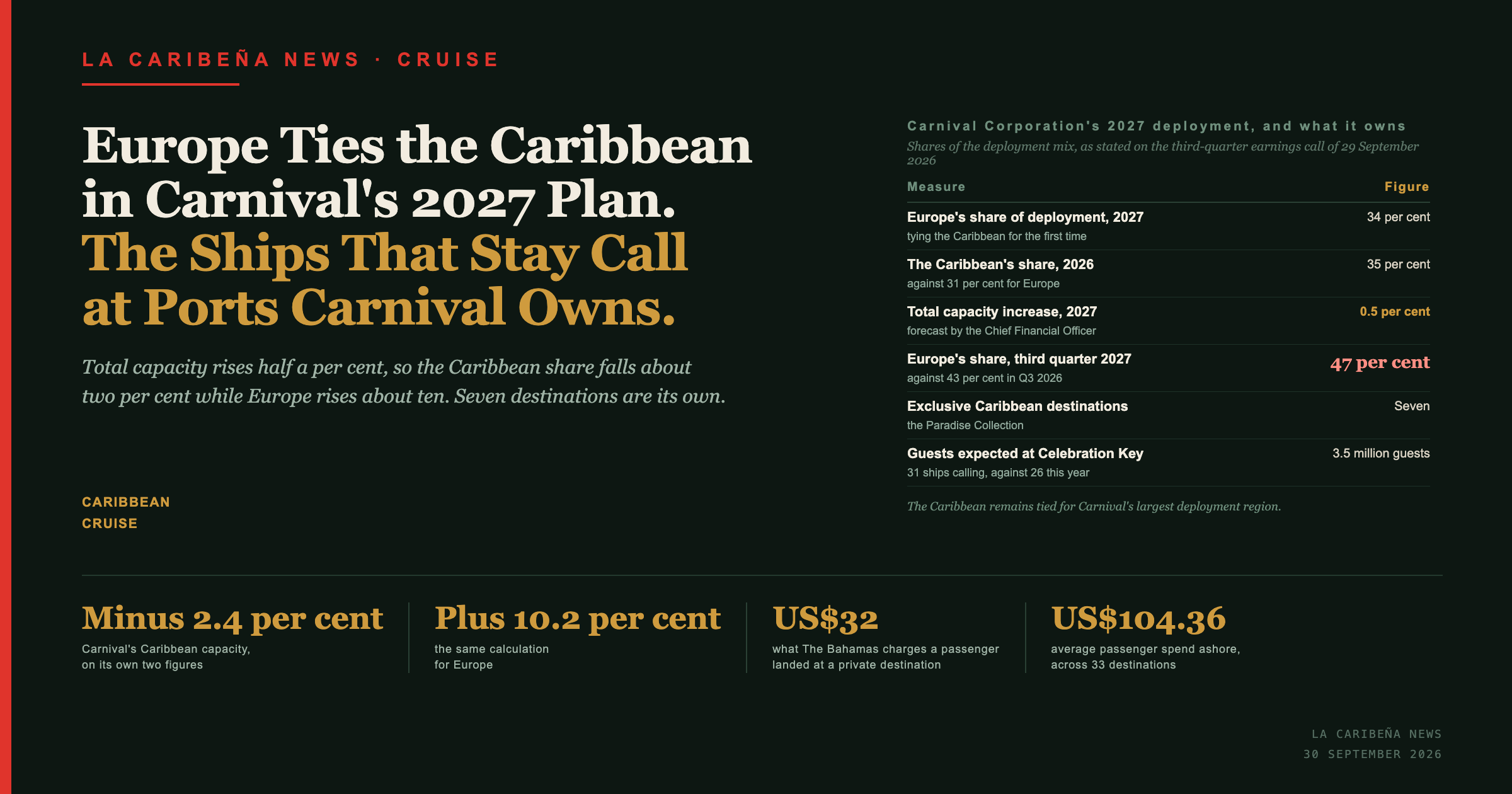
What the title card shows
Every data point on the article's title card, in text.
The panel, "Carnival Corporation's 2027 deployment, and what it owns":
- 34 per cent. Europe's share of Carnival's deployment mix in 2027, tying the Caribbean for the first time. Source: Josh Weinstein, Carnival Corporation Q3 2026 earnings call, 29 September 2026.
- 35 per cent. The Caribbean's share in 2026, against 31 per cent for Europe. Source: Carnival Corporation Q3 2026 earnings presentation.
- 0.5 per cent. Carnival's forecast total capacity increase in 2027 against 2026. Source: David Bernstein, Chief Financial Officer, on the same call.
- 47 per cent. Europe's share in the third quarter of 2027, against 43 per cent in the third quarter of 2026. Source: Carnival Corporation Q3 2026 earnings presentation.
- Seven. Exclusive Caribbean destinations in Carnival's Paradise Collection. Source: Carnival Corporation.
- 3.5 million guests. Expected at Celebration Key next year, with 31 ships calling against 26 this year. Source: Josh Weinstein.
The footer strip:
- Minus 2.4 per cent. The change in Carnival's Caribbean capacity implied by a 34 per cent share of a fleet growing 0.5 per cent. Source: La Caribeña News calculation.
- Plus 10.2 per cent. The same calculation for Europe.
- US$32. What a cruise passenger landed at a Bahamian private destination pays in departure tax and levies, against US$30 at Nassau or Freeport. Source: The Bahamas Customs Department.
- US$104.36. Average passenger spend ashore across the 33 destinations. Source: FCCA and BREA.
Is the Caribbean losing the cruise industry?
Not on the record of the past month.
MSC placed its newest flagship in the Southern Caribbean and took another ship off the route, set out in MSC Puts Its Newest Flagship in the Southern Caribbean. Royal Caribbean agreed to buy half of Sandals Resorts for about US$3 billion, reported in A Cruise Line Is Buying Half of Sandals for US$3 Billion. The Caribbean Private Sector Organisation named seven CARICOM countries it expects to gain from that transaction, in The Caribbean Body Named Seven Countries That Gain From the Sandals Deal.
One operator is rebalancing its mix toward Europe while deepening a footprint it owns. Two others have moved toward the region in the same month. What a port authority reads in Carnival's numbers is not a withdrawal, and it is not growth either.
The destinations with the most to weigh are the ones with no berth of their own in the arrangement. A passenger who disembarks at a company-built pier on Grand Bahama has arrived in The Bahamas. A passenger who never disembarks anywhere else has not arrived in St Vincent, where the study counted 195,200 onshore visits and an average spend of US$59.39, the lowest of the 33.
Frequently Asked Questions
What did Carnival Corporation announce about its 2027 deployment?
On its third-quarter earnings call on 29 September 2026, Chief Executive Josh Weinstein said that in 2027 Europe will tie with the Caribbean as the company's largest deployment region, each representing 34 per cent of the mix. It is the first time Europe has matched the Caribbean.
Is Carnival cutting Caribbean capacity?
Slightly, in absolute terms. The Caribbean share falls from 35 per cent to 34 per cent while total capacity rises 0.5 per cent, which implies a decline of about 2.4 per cent in Caribbean capacity and an increase of about 10.2 per cent in Europe. The Caribbean remains tied for the company's largest deployment region.
What is the Paradise Collection?
Carnival Corporation's term for its seven exclusive Caribbean destinations: Celebration Key, RelaxAway Half Moon Cay and Princess Cays in The Bahamas, Isla Tropicale in Roatán, Amber Cove in the Dominican Republic, Grand Turk Cruise Center in Turks and Caicos, and Puerta Maya in Cozumel. The company says they let it "unlock paradises only our ships can reach".
How big is Celebration Key becoming?
It opened on Grand Bahama in July 2025 and welcomed almost 2.5 million guests in its first year. Carnival expects approximately 3.5 million guests next year with 31 ships calling against 26 this year. Its pier has been expanded from two berths to four, allowing four ships and more than 13,000 guests a day.
What does a cruise passenger spend ashore in the Caribbean?
An average of US$104.36, according to the Florida-Caribbean Cruise Association study prepared by Business Research and Economic Advisors for the 2023/2024 cruise year, which counted 29.4 million onshore visits across 33 destinations and US$4.27 billion in direct expenditure. Spend varies widely by destination, from US$190.61 in Panama to US$58.68 in Trinidad.