By LCN Business Desk
The CARICOM Private Sector Organization issued a release on the Royal Caribbean Group investment in Sandals Resorts describing it as "a defining moment for the regional private sector", the CPSO records. The release sets out the terms, names the destinations the Organization expects to benefit, and makes an argument about the Single Market that the deal's other coverage did not carry.
What are the terms?
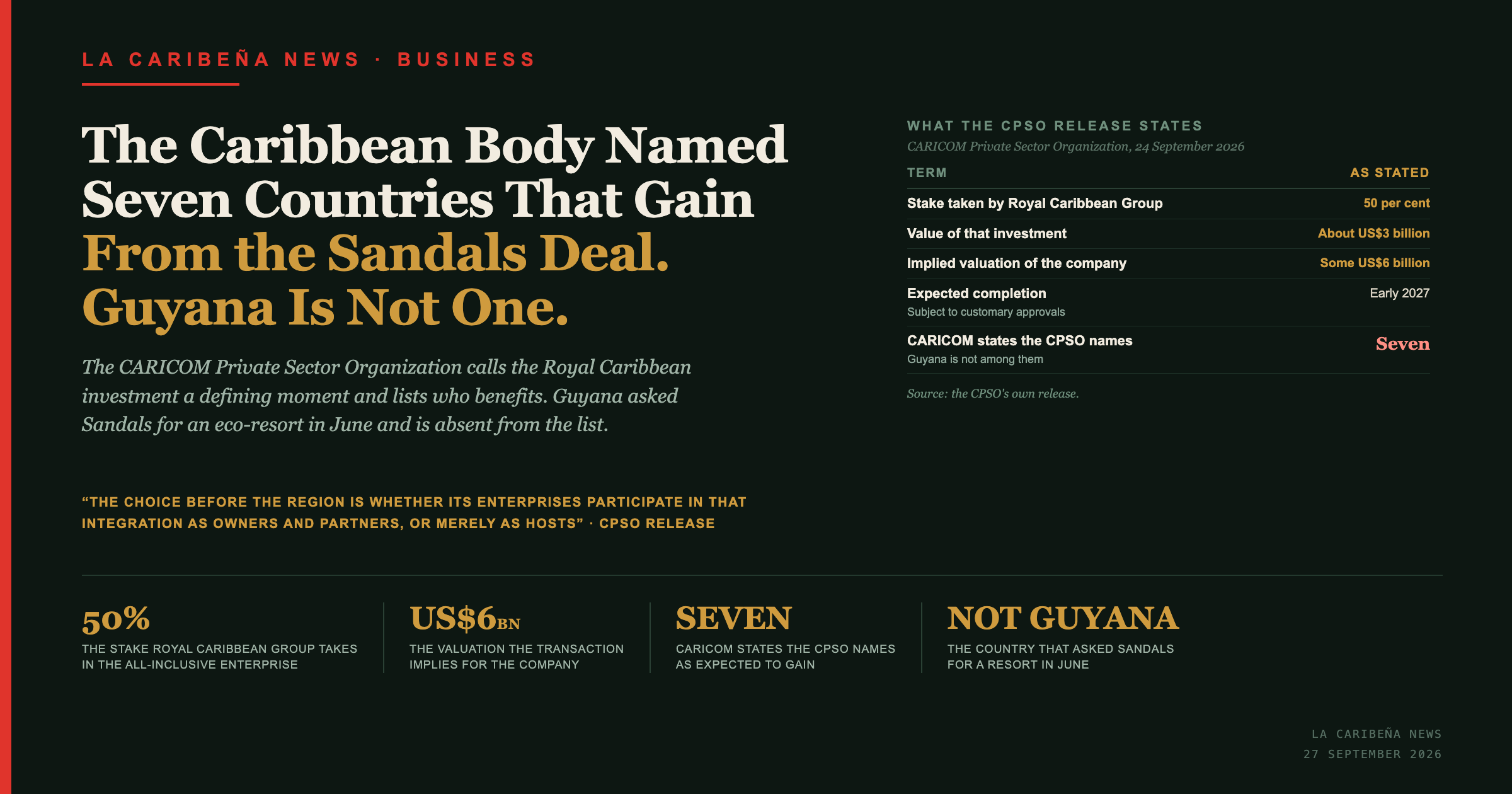
Royal Caribbean Group takes a 50 per cent stake in the all-inclusive resort enterprise, valued at approximately US$3 billion and expected to close in early 2027 subject to customary approvals, the CPSO release states. It puts the implied valuation of the whole company at some US$6 billion, for a business "conceived, built and headquartered in the Caribbean".
| Term | As the CPSO release states it |
|---|---|
| Stake taken by Royal Caribbean Group | 50 per cent |
| Value of that investment | Approximately US$3 billion |
| Implied valuation of the company | Some US$6 billion |
| Expected completion | Early 2027, subject to customary approvals |
| Brands on the Royal Caribbean side | Royal Caribbean, Celebrity Cruises, Silversea |
CNBC reported the same valuation and added the market's reading: Royal Caribbean's stock was down roughly 25 per cent over the past year after the company trimmed revenue-growth forecasts on softer demand for European sailings. Sandals and its Beaches brand hold more than a dozen properties across the Caribbean.
Which countries does the CPSO expect to gain?
Seven, and it names them. The release says the combined reach of the two companies will expand visitor arrivals, lengthen stays, deepen airlift and cruise connectivity, and multiply demand across CARICOM destinations "including Jamaica, Antigua and Barbuda, Saint Lucia, The Bahamas, Barbados, Grenada, and Saint Vincent and the Grenadines".
Guyana is not on that list. In June the Government asked Sandals to build an eco-resort here, reported in A Cruise Line Is Buying Half of Sandals for US$3 Billion. The country's own cruise and arrivals base remains small, set out in Diamond Jubilee Cruise Puts Guyana's Small Ship Tourism on the Map. The seven named are the established all-inclusive and cruise markets, and the list reads as a description of where the properties already are.
What does the CPSO say it means for the Single Market?
That the CSME worked. The release calls the partnership a demonstration of "the CSME working as intended: a regional firm using the Single Market as its platform for growth, attracting world-scale capital on world-scale terms", and "a powerful signal to international investors of the bankability of Caribbean assets, Caribbean management and Caribbean brands".
The Organization has used the same platform to price regional exposure before, on the Panama Canal, reported in The Panama Canal Cut Its Daily Booking Slots to 32. How far the Single Market actually clears a path for a regional firm is a separate record, examined in CARICOM Gives a Business Three Ways to Raise a Trade Barrier.
The release puts the choice in plain terms. "The choice before the Region is whether its enterprises participate in that integration as owners and partners, or merely as hosts," it says, adding that Sandals enters the partnership "with its Caribbean identity, leadership and headquarters intact, and with governance shared at the highest level".
Where does the CPSO say the gains should land?
In regional production. The release sees "a renewed opportunity to deepen the linkages between tourism and regional production, in agriculture, agro-processing, manufacturing and services, so that the gains from expanded visitor demand are retained and multiplied within the Community".
That is the part with a Guyanese address. A processor selling into a resort chain needs a certificate a foreign buyer recognises, the gap set out in A Pomeroon Cassava Maker, Certified Four Years, and the sectors expected to scale were named again this month in Guyana's Manufacturers Told Clothing, Hotels and Tech to Grow. Expanded visitor demand in seven other member states is a market for Guyanese produce only if a Guyanese supplier can meet the standard and the freight.
Who spoke, and was the reception unanimous?
Dr Patrick Antoine, Chief Executive Officer and Technical Director of the CPSO, is quoted in the release: "Sandals is proof that the Caribbean produces not only world-class destinations but world-class companies." He said the Organization stands ready to work with the company "to ensure that this historic partnership translates into jobs, supply-chain opportunities and enduring prosperity for the people of our Community". The CPSO is an Associate Institution of CARICOM.
Outside the region the reading is cooler. Live and Let's Fly headlined that the deal splits analysts. Regional coverage carried the CPSO's own framing: the Jamaica Observer reported the release under the defining-moment line, and the St Vincent Times ran it under the airlift and supply-chain heading.
What the title card shows
- 50 per cent: the stake Royal Caribbean Group takes in the all-inclusive resort enterprise. Source: CPSO release, 24 September 2026.
- About US$3 billion: the stated value of that investment. Source: CPSO release.
- Some US$6 billion: the valuation the transaction implies for the whole company. Source: CPSO release, and reported by CNBC.
- Early 2027: when the transaction is expected to close, subject to customary approvals. Source: CPSO release.
- Seven: the CARICOM member states the CPSO names as expected to gain. Guyana is not among them. Source: CPSO release.
- "As owners and partners, or merely as hosts": the choice the CPSO puts to the region. Source: CPSO release.
Frequently Asked Questions
What did the CPSO say about the Sandals and Royal Caribbean partnership?
It called the transaction a defining moment for the regional private sector and said the combined reach of the two companies will expand visitor arrivals, lengthen stays, deepen airlift and cruise connectivity, and multiply demand across CARICOM destinations. It named seven member states it expects to benefit.
How much is Royal Caribbean Group paying, and for what?
A 50 per cent stake in the all-inclusive resort enterprise, valued at approximately US$3 billion, implying a valuation of some US$6 billion for the company. Completion is expected in early 2027, subject to customary approvals.
Which CARICOM countries did the CPSO name?
Jamaica, Antigua and Barbuda, Saint Lucia, The Bahamas, Barbados, Grenada, and Saint Vincent and the Grenadines. Guyana is not among them.
What does the CPSO say the deal means for the Single Market?
That it demonstrates the CSME working as intended, with a regional firm using the Single Market as a platform for growth and attracting world-scale capital, and that it signals the bankability of Caribbean assets, management and brands to international investors.
Who is Dr Patrick Antoine?
The Chief Executive Officer and Technical Director of the CARICOM Private Sector Organization, an Associate Institution of CARICOM that represents the organised private sector in the governance of the CARICOM Single Market and Economy.