By LCN Business Desk
Guests boarded Icon of the Seas at PortMiami on Saturday 26 September as scheduled and then stayed alongside. The ship did not sail until 16:00 on Sunday 27 September, a delay Royal Caribbean attributed to required maintenance without describing the work, Royal Caribbean Blog reported.
One port came off the itinerary to recover the day. The call at Costa Maya, on Mexico's southern Quintana Roo coast, was dropped for Monday 28 September, Cruise Hive reported. Roatan on 29 September, Cozumel on 30 September and the company's private Bahamian resort on 2 October were all kept.
What is a cancelled call worth to the port?
The figure can be estimated from the industry's own commissioned research. Business Research and Economic Advisors measured passenger spending across 33 Caribbean and Latin American destinations for the Florida-Caribbean Cruise Association, covering the 2023/2024 cruise year. Costa Maya recorded 1,853,900 passenger onshore visits at an average of US$78.17 each, or US$144.91 million for the year.
The same study puts the transit passenger disembarkation rate at 83 per cent, down from 85 per cent in 2018. Icon of the Seas carries 5,610 passengers at double occupancy and up to 7,600 at maximum.
| Basis | Passengers aboard | Onshore visits at 83 per cent | Spending at US$78.17 |
|---|---|---|---|
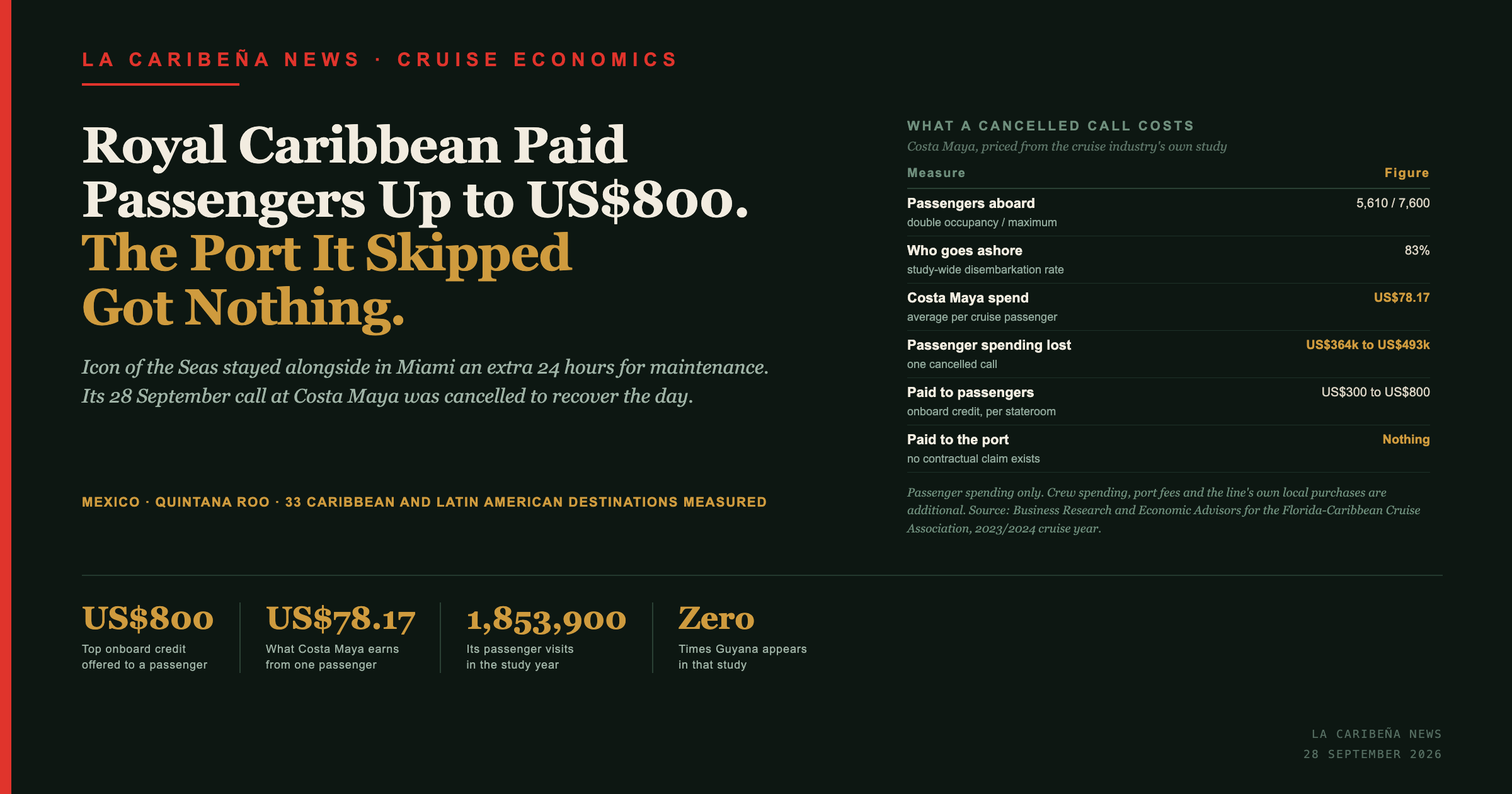
| Double occupancy | 5,610 | 4,656 | US$364,000 |
| Maximum capacity | 7,600 | 6,308 | US$493,000 |
Figures rounded. Passenger spending only. Crew spending, port fees and the cruise line's own local purchases are additional and are not estimated here.
So a single missed call removes somewhere between about US$364,000 and US$493,000 of passenger spending from a town of roughly 2,600 people. Mahahual, the settlement beside the cruise terminal, has been the subject of sustained local argument about how little of the traffic stays on shore.
Who is compensated when a call is dropped?
The people aboard. Royal Caribbean offered refundable onboard credit of US$300 for inside and oceanview staterooms, US$350 for balconies and US$800 for suites, with a further US$50 for third and fourth guests sharing.
The port has no equivalent. A cruise call is not a contract the destination can enforce against the line, and a maintenance decision taken at a berth in Florida is not a matter on which the skipped destination is consulted. The money moves to the passengers who lost a beach day. It does not move to the vendors, tender operators, taxi drivers and excursion sellers who lost a day's trade, because nothing obliges it to.
Passengers were made whole for a lost beach day. The town that lost its Monday was not party to the decision and had nothing to claim.
The asymmetry is not a complaint about this particular ship. It is the ordinary structure of the business, and it is visible in the study's own numbers. Costa Maya is the fourth-largest destination in the table by visits and one of the weakest on value, at US$78.17 a head against US$163.45 at St Maarten and US$166.22 in the US Virgin Islands. High volume and low yield is the position a single cancellation hurts most, because the destination has built for the throughput.
Does any of this reach Guyana?
Guyana does not appear in the study at all. Neither does Suriname. The nearest participating destination is Trinidad, the smallest of the 33, with 65,900 onshore visits at US$58.68 a passenger for a total of US$3.87 million. Set against Costa Maya's US$144.91 million, that is the scale of the gap between the Caribbean's cruise economy and its southern edge.
Guyana is nonetheless in the market. The Diamond Odyssey call for the sixtieth independence anniversary was reported in Diamond Jubilee Cruise Puts Guyana's Small Ship Tourism on the Map, and the country's ambitions run to small-ship and expedition traffic rather than the 7,600-berth class.
The timing places the question sharply. Royal Caribbean is buying half of Sandals for US$3 billion, reported in A Cruise Line Is Buying Half of Sandals for US$3 Billion, and the Caribbean Private Sector Organisation named seven countries it expects to gain from the transaction, reported in The Caribbean Body Named Seven Countries That Gain From the Sandals Deal. Guyana was not among the seven.
A country still negotiating its entry is in a better position to write terms than one that has already built a pier and a tender dock around an expected number.
What would actually change the arithmetic?
Terms, not volume. Nothing in the record suggests a destination can compel a call, and no Caribbean destination has the leverage to try alone. What is available is the contract: minimum guaranteed calls over a season, notice periods, and a stated remedy when a call is dropped for reasons that are not weather or safety. Those are ordinary commercial terms in other industries and they are the exception in this one.
Carnival Corporation has since told investors that Europe will tie with the Caribbean as its largest deployment region in 2027, examined in Europe Will Tie the Caribbean in Carnival's 2027 Deployment. Deployment decisions move faster than any port can react. MSC moved its newest flagship into the Southern Caribbean and took another ship off the route, reported in MSC Puts Its Newest Flagship in the Southern Caribbean, and has since moved the Meraviglia from Brooklyn to Miami. A destination that has no notice period and no remedy absorbs each of those decisions in full.
The study also records that disembarkation rates are falling on both counts, from 85 to 83 per cent for passengers and from 39 to 30 per cent for crew. Fewer people are coming ashore from each ship. A destination competing only on the number of calls is competing on the measure that is weakening.
What the title card shows
US$800: the highest onboard credit Royal Caribbean offered a delayed passenger, for a suite, against US$300 for an inside or oceanview stateroom. Nothing: what was offered to Costa Maya, which had no contractual claim to make. 28 September 2026: the date of the cancelled call. US$78.17: Costa Maya's average spending per cruise passenger in the 2023/2024 cruise year, from the study commissioned by the Florida-Caribbean Cruise Association. 1,853,900: its passenger onshore visits in that year, the fourth-highest of the 33 destinations measured. 5,610 and 7,600: the ship's passenger capacity at double occupancy and at maximum. 83 per cent: the study's transit passenger disembarkation rate. Zero: the number of times Guyana appears in that study.
Frequently Asked Questions
Why was the Icon of the Seas sailing delayed, and which port was cancelled?
Royal Caribbean cited required maintenance and did not describe the work. Passengers boarded at PortMiami on Saturday 26 September as scheduled and the ship remained alongside until 16:00 on Sunday 27 September. The 28 September call at Costa Maya was cancelled to recover the day. Roatan on 29 September, Cozumel on 30 September and the line's private Bahamian resort on 2 October were kept, with the ship returning to Miami on 3 October.
What compensation was offered?
Refundable onboard credit of US$300 for inside and oceanview staterooms, US$350 for balconies and US$800 for suites, with a further US$50 for third and fourth guests in the same stateroom. The compensation went to passengers. No payment was made to the cancelled destination.
How much does Costa Maya earn from a cruise passenger?
US$78.17 on average during the 2023/2024 cruise year, across 1,853,900 passenger onshore visits, totalling US$144.91 million. The figures are from Business Research and Economic Advisors, which conducted the study for the Florida-Caribbean Cruise Association.
Can a destination require a cruise line to keep a scheduled call?
On the public record this newspaper can find, Caribbean destinations do not hold enforceable minimum-call guarantees or stated remedies for cancellations. Itinerary changes for maintenance, weather or operational reasons are made by the operator.
Is Guyana included in the cruise industry's economic impact study?
No. The 2023/2024 study covers 33 Caribbean and Latin American destinations and Guyana is not among them. The smallest participant is Trinidad, with 65,900 passenger onshore visits and US$3.87 million in passenger expenditure.