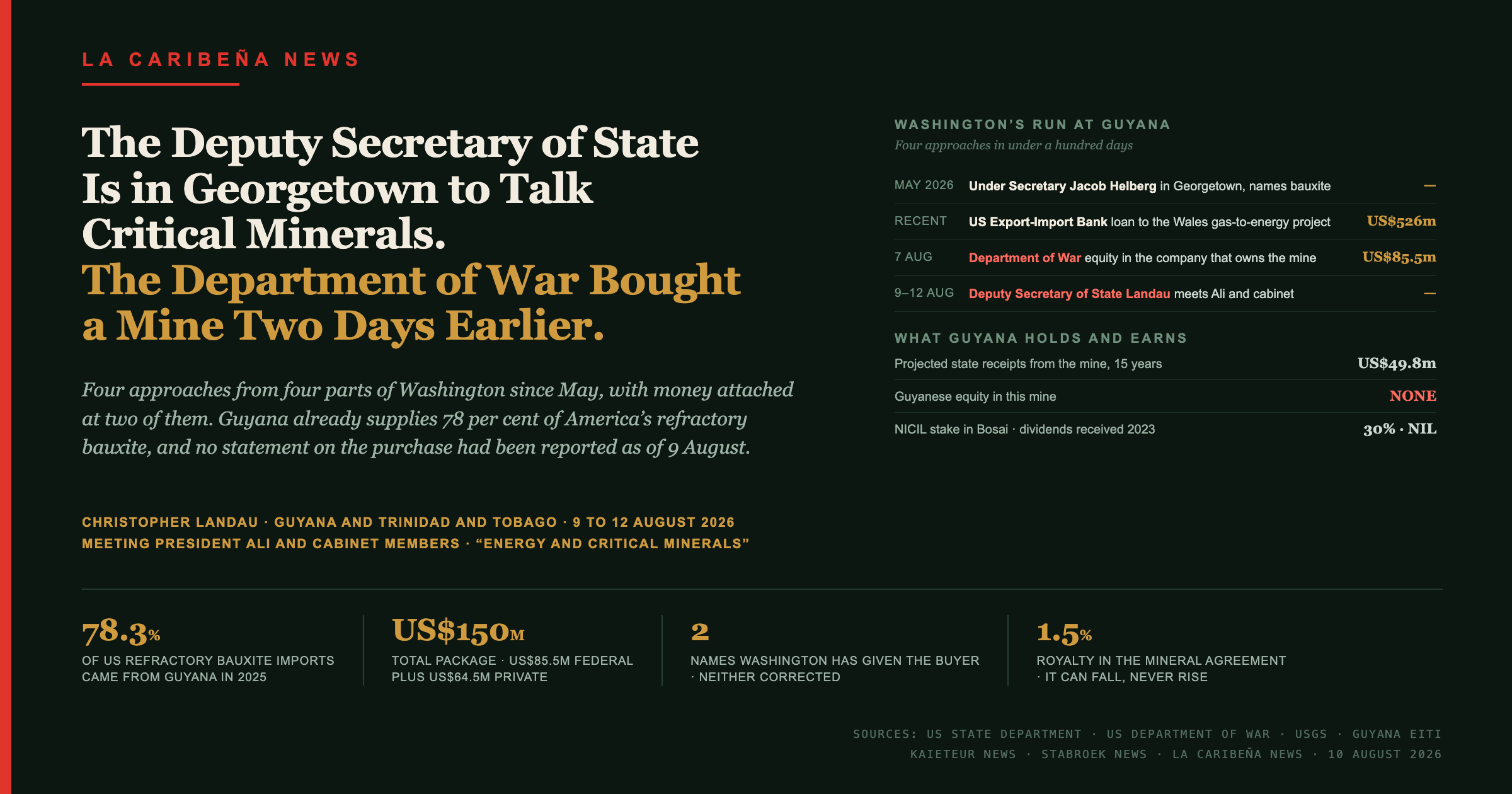
Quick summary: United States Deputy Secretary of State Christopher Landau is in Guyana and Trinidad and Tobago from 9 to 12 August 2026 to discuss energy and critical minerals, meeting President Irfaan Ali and cabinet members. His visit follows a US$85.5 million Department of War equity investment in a Guyanese bauxite mine announced on 7 August, which Kaieteur News reported on 9 August had drawn no public statement from the Guyanese government.
BY LA CARIBEÑA NEWS · 10 AUGUST 2026
The second most senior official in the United States State Department is in Georgetown this week, and the State Department has said what he is there for.
Deputy Secretary of State Christopher Landau will meet President Irfaan Ali "and cabinet members to discuss expanding bilateral economic cooperation and strengthening bilateral investment opportunities," according to the department's own travel announcement. "The visit will also focus on enhancing collaboration in strategic sectors including energy and critical minerals." He travels 9 to 12 August, taking in Trinidad and Tobago, where he meets Prime Minister Kamla Persad-Bissessar on "shared energy and security priorities." Trinidad arrives at that meeting with gas production under pressure and its own deepwater prospect written down by its operator and sold this month, having spent two years asking Guyana for hydrocarbons and being told there are none to spare.
Two days before he left, a different arm of the United States government bought into a Guyanese mine.
What has the United States already done here?
Four approaches since May, from four different parts of Washington.
May. Under Secretary of State for Economic Affairs Jacob Helberg visited Georgetown and named the mineral directly. "Because the reserves of bauxite are known and there are already investments today, we talked a fair amount about those," he said, in remarks reported by Demerara Waves.
The Export-Import Bank. Guyana's Wales gas-to-energy project is partly financed by a US$526 million loan from EXIM, and a White House briefing on the project was held recently.
7 August. The Department of War announced an US$85.5 million equity investment in Strategic Bauxite USA, LLC, through its Industrial Base Analysis and Sustainment programme, alongside US$64.5 million of private co-investment. The money is to acquire and expand the First Bauxite mine, build calcination capacity in Guyana, and contribute to a brown-fused alumina plant in the United States. The Department of State separately funded associated infrastructure. The full account is here.
9 August. Landau lands.
That is a diplomatic sequence with money attached at two points in it, and it has run in under a hundred days.
Why bauxite, and why now?
Because Guyana is already the source, and the Department of War said so in terms.
United States imports of refractory-grade calcined bauxite in 2025 came overwhelmingly from Guyana: 123,000 tonnes of a 157,000 tonne total, or 78.3 per cent, against 28,800 tonnes from China, on United States Geological Survey figures. In the first quarter of 2026 the share was 79.9 per cent.
The department framed the problem as dependence on supply "sourced directly from China or Chinese-owned entities". That second clause is the operative one in Guyana, where Bosai Minerals Group, a Chinese company, produces calcined refractory bauxite at Omai near Linden.
So the American interest is not in finding Guyanese bauxite. It is in owning the part of it that is not already Chinese-owned.
What has Guyana said?
About the underlying sale, a good deal. About Washington's money, nothing that has been reported.
Kaieteur News reported on 9 August, under the headline "U.S. invests US$85.5M to acquire Guyanese bauxite mine in push against Chinese dominance; Govt remains silent," that "despite the scale of the deal and its explicit framing as a counter to Chinese influence in the country, the government of Guyana has not issued any public statement or response." Attempts to reach the Minister of Natural Resources were unsuccessful.
The government has spoken about the underlying sale, though, before Washington's money was announced.
Minister of Natural Resources Vickram Bharrat, on 18 July, said the incoming owner was expected to inject US$100 million into the operation, increasing production capacity, creating employment, and establishing a processing facility allowing greater value-added activity within Guyana rather than solely extraction.
Foreign Secretary Robert Persaud told the Associated Press in May that Guyana wanted United States investment but was seeking more value-added processing rather than raw mineral exports.
Both of those are the same ask, and it is a reasonable one to measure the coming years against, because the history of this particular mine runs the other way. Under previous ownership the ore was shipped raw and the calcining was done elsewhere: in the United States, and through a distribution and calcining agreement with ARCIRESA in Spain, with sizing at Mineralmahlwerk C. Welsch in Germany. Guyana exported the rock. Europe took the upgrading margin.
The Department of War release does commit money to calcination facilities at the mine.
Suriname's oil minister made the same argument from the other direction last week, warning that concentrating local content on one sector drains every other one.
Who is the counterparty?
Two arms of the United States government have given it two different names.
The Department of War release names Strategic Bauxite USA, LLC, abbreviated SBX. The White House fact sheet on the same transaction says the department "is investing over $85 million into Standard Bauxite". Neither has been corrected.
The company is new. Its co-founder and executive director lists the role as beginning in January 2026, roughly six months before the acquisition.
It is not a listed shell of the kind that has become familiar in mining acquisitions. A search of the United States Securities and Exchange Commission's register returns no company under either name, and the only filings containing the phrase are those of Alcoa, Alcan and Kaiser Aluminum using it descriptively between 2007 and 2021. Strategic Bauxite USA is a limited liability company, not a registered, publicly traded corporation, so it files nothing and discloses nothing by obligation. That is why the price it paid for the mine has never been published, and why the only figures in public are the ones the United States government chose to announce.
The seller, First Bauxite, has been privately held since December 2018, when its majority creditor took it private in a court-approved arrangement under British Columbia law and minority shareholders were paid four Canadian cents a share.
The mine itself is real and running. Bonasika, between the Essequibo and Demerara rivers in Region Three, has produced since 2020. The company says more than 90 per cent of its workforce is Guyanese.
What Guyana earns from it
The royalty on this mine is 1.5 per cent, and the company may deduct it as an expense against taxable income.
That rate is fixed at clause 9.2 of the mineral agreement between Guyana, the Guyana Geology and Mines Commission and the company, signed in November 2011. Stabroek News reported the rate as 3 per cent in 2023. The agreement says 1.5.
For comparison, Guyana charges 5 per cent on gold and 3 per cent on diamonds, and the Stabroek oil contract carries a 2 per cent royalty, against the 6.25 per cent Suriname signed on the block next door. Bauxite is the lowest-rated mineral in the country. The royalty is deductible as an expense against taxable income, as it is in the other Guyanese mineral agreements this newspaper has reviewed, including both gold agreements.
Over the life of the mine, on figures reported by Stabroek News in 2023, the Guyanese state was projected to receive US$49.8 million across fifteen years: royalty of US$6.4 million, a mining licence fee of US$1.42 million, employee PAYE of US$18.95 million, withholding tax of US$5.53 million and company tax of US$17.47 million.
The Department of War has put US$85.5 million into the equity of the company that holds it, in one transaction.
Guyana holds no equity in this mine. It holds 30 per cent of Bosai and 10 per cent of the dormant Bauxite Company of Guyana, both through the state company NICIL, on the record of the Guyana Extractive Industries Transparency Initiative. NICIL reported receiving no dividends from Bosai in 2023.
Nor does the mine carry a local content obligation, because the Local Content Act 2021 reaches petroleum and nothing else. Inside the sector it does cover, the reserved categories run from 90 per cent of catering down to 5 per cent of engineering and machining, and have already been found to have no category at all for some of what the operators actually buy. ExxonMobil's exploration has meanwhile added four more leads on the Stabroek terms.
The data in this article
- Visit: US Deputy Secretary of State Christopher Landau, Trinidad and Tobago and Guyana, 9 to 12 August 2026. Meetings with President Irfaan Ali and cabinet members, and with Prime Minister Kamla Persad-Bissessar.
- Stated focus, from the State Department: expanding bilateral economic cooperation, strengthening investment opportunities, and "enhancing collaboration in strategic sectors including energy and critical minerals."
- Prior approaches: Under Secretary Jacob Helberg, May 2026; a US$526 million US Export-Import Bank loan to the Wales gas-to-energy project; the Department of War equity investment of 7 August 2026.
- Department of War: US$85.5 million equity in Strategic Bauxite USA, LLC, through the Industrial Base Analysis and Sustainment programme, plus US$64.5 million private co-investment. Total US$150 million.
- Naming: the White House fact sheet calls the counterparty Standard Bauxite. Neither announcement has been corrected.
- US refractory-grade calcined bauxite imports 2025: Guyana 123,000 tonnes of 157,000, 78.3 per cent. China 28,800 tonnes. Q1 2026: Guyana 79.9 per cent. Source: USGS.
- Projected Guyanese state receipts from the mine over fifteen years: US$49.8 million, of which royalty US$6.4 million. Source: Stabroek News, 2023.
- State equity in bauxite, held by NICIL: Bosai Minerals Group Guyana Inc. 30 per cent, Bauxite Company of Guyana Inc. 10 per cent. No dividends received from Bosai in 2023. Source: Guyana EITI Report FY2023.
- First Bauxite has been privately held since December 2018, when minority shareholders were paid C$0.04 a share in a plan of arrangement under British Columbia law.
Frequently Asked Questions
Why is the US Deputy Secretary of State in Guyana?
The State Department says Christopher Landau is travelling to Trinidad and Tobago and Guyana from 9 to 12 August 2026, and that in Guyana he will meet President Irfaan Ali and cabinet members to discuss expanding bilateral economic cooperation and investment, with a focus on strategic sectors including energy and critical minerals.
What did the Department of War announce on 7 August?
An US$85.5 million equity investment in Strategic Bauxite USA, LLC, through the Industrial Base Analysis and Sustainment programme, with a further US$64.5 million from private co-investment. The funds are to acquire and expand the First Bauxite mine in Guyana, build calcination capacity there, and contribute to a brown-fused alumina plant in the United States.
Has the Guyanese government responded to the investment?
Kaieteur News reported on 9 August that the government had issued no public statement or response, and that attempts to reach the Minister of Natural Resources were unsuccessful. The minister had commented on the underlying sale in July, saying the new owner was expected to invest US$100 million and to establish processing capacity in Guyana.
Why does the United States want Guyanese bauxite specifically?
It already buys it. Guyana supplied 78.3 per cent of United States refractory-grade calcined bauxite imports in 2025, against 28.8 thousand tonnes from China. The Department of War describes American dependence as being on supply from China or Chinese-owned entities, and one producer of that grade in Guyana, Bosai Minerals Group, is Chinese-owned.
What does Guyana receive from the mine?
Over the fifteen-year life of the mine the state was projected to receive US$49.8 million in royalty, taxes and fees, on figures reported in 2023. Guyana holds no equity in this mine, though it holds 30 per cent of Bosai and 10 per cent of the dormant Bauxite Company of Guyana through NICIL.