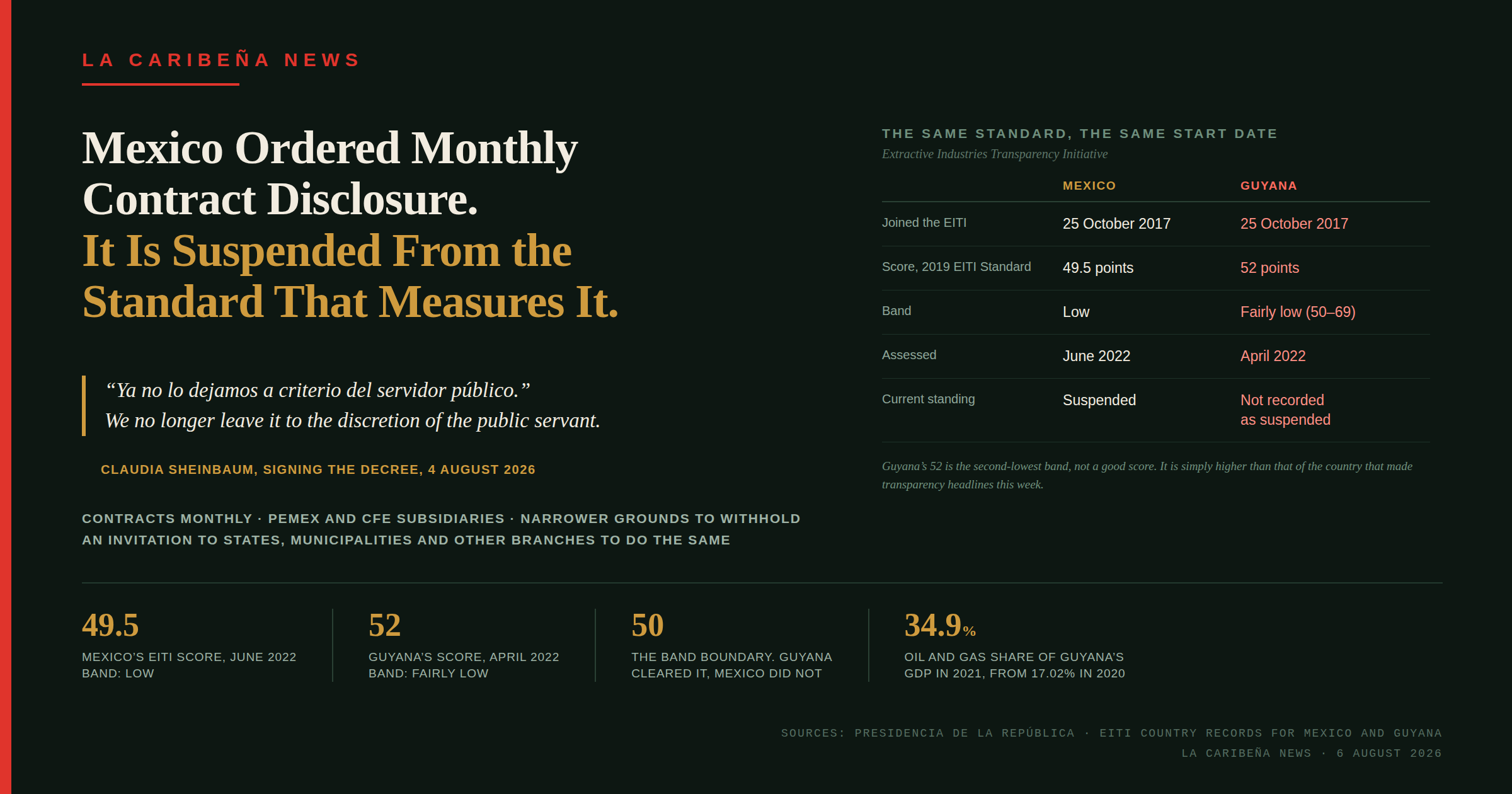
Claudia Sheinbaum signed a decree taking disclosure out of officials' hands. On the global transparency standard for oil, gas and mining, Mexico scored 49.5 and is suspended. Guyana, which joined the same standard on the same day in 2017, scored 52.
BY LCN NEWSROOM
Quick summary: Mexican President Claudia Sheinbaum signed a decree on 4 August 2026 requiring public contracts to be published monthly and extending disclosure to Pemex and CFE subsidiaries. Mexico is currently suspended from the Extractive Industries Transparency Initiative, having scored 49.5 points in June 2022, partly for breaches concerning civil society participation. Guyana scored 52 on the same standard.
What the title card shows
Every data point on the article's title card, in text.
- 4 August 2026. Date Sheinbaum signed the transparency decree. Source: Presidencia de la República.
- Monthly. Required publication frequency for public contracts under the decree. Source: Presidencia de la República.
- 49.5 points, "low". Mexico's score implementing the 2019 EITI Standard, assessed June 2022. Source: EITI.
- 52 points, "fairly low". Guyana's score on the same standard, assessed April 2022. Source: EITI.
- 50. The points boundary between the "low" and "fairly low" bands. Guyana cleared it; Mexico did not. Source: EITI scoring bands.
- Suspended. Mexico's current standing with the EITI. Source: EITI.
- 25 October 2017. The date both Mexico and Guyana joined the EITI. Source: EITI.
- 34.9 per cent. Oil and gas share of Guyana's GDP in 2021, up from 17.02 per cent in 2020. Source: EITI.
What does the Mexican decree actually do?
It moves four categories of information out of official discretion and onto a calendar.
The Presidency's account of the signing sets out four areas: public procurement, the subsidiaries of the state oil company Pemex and the state electricity company CFE, oversight and audits, and an invitation to states, municipalities and other branches of government to adopt the same standard voluntarily.
Sheinbaum's own explanation is the sharpest part of it. Under the existing law, she said, public servants can determine what is made public and what is not, on grounds of national security or of the procedure the information sits in. With this decree, she said, "ya no lo dejamos a criterio del servidor público": we no longer leave it to the discretion of the public servant. She named the level at which that discretion had sat, referring to a director of an area of Pemex or CFE, or of any ministry.
She also committed to a frequency: "cada mes se va a estar informando de los contratos públicos," contracts reported every month.
A fixed calendar plus a shrinking list of exceptions is more than a statement of intent. A discretion that must be exercised monthly against a published rule is a discretion that can be audited.
So why does the standing matter?
Because Mexico is currently suspended from the international standard built to measure exactly this.
The Extractive Industries Transparency Initiative is the global standard for disclosure in oil, gas and mining. It scores its members out of 100 across stakeholder engagement, transparency, and outcomes and impact.
The EITI's country record for Mexico states that Mexico achieved a low overall score, 49.5 points, in implementing the 2019 EITI Standard in June 2022. It records that Mexico is suspended for having only partly met Requirement 1.3 on civil society engagement, which it describes as serious breaches of the EITI protocol on the participation of civil society, and that Mexico is also suspended as a result of that low score.
That is the tension worth reporting. A decree is an executive act. The requirement Mexico was marked down on is participation, and participation is not something an executive act can issue.
Mexico has ordered its officials to publish more. The thing it was penalised for was not publishing too little. It was civil society's ability to take part.
None of that makes the decree worthless. Publishing contracts monthly is a real obligation with a real date attached, and it is more than most producers do. It simply does not answer the finding against Mexico, and readers should not assume it does.
Where does Guyana sit on the same scale?
Above Mexico, which is not the comparison most people would guess.
Guyana joined the EITI on 25 October 2017. So did Mexico, on the same day.
The EITI's country record for Guyana shows that Guyana achieved a fairly low overall score, 52 points, in implementing the 2019 EITI Standard in April 2022. The EITI's bands place "fairly low" at 50 to 69 points. Guyana cleared the boundary by two points. Mexico missed it by half a point and fell into the band below.
Guyana has published five EITI reports since joining, the most recent covering 2023 and published on 31 December 2025.
| Mexico | Guyana | |
|---|---|---|
| Joined the EITI | 25 October 2017 | 25 October 2017 |
| Score, 2019 EITI Standard | 49.5 points | 52 points |
| Band | Low | Fairly low |
| Assessed | June 2022 | April 2022 |
| Current standing | Suspended | Not recorded as suspended |
Source: the EITI's published country records for Mexico and Guyana. Both scores are against the 2019 EITI Standard.
Does that mean Guyana is doing well?
No, and it would be a misreading of these numbers to say so.
Fifty-two points out of a hundred is a pass into the second-lowest band. It is better than suspended, and it is not good. The EITI itself lists what Guyana EITI is still working towards: systematic disclosure of extractives data, and strengthening its disclosures of extractive contracts and beneficial ownership.
Guyana's validation is also four years old, from April 2022, and the latest data on its EITI record is from 2022. A country whose oil and gas sector went from 17.02 per cent of GDP in 2020 to 34.9 per cent in 2021 has changed a great deal since it was last measured.
So the honest reading is narrow. On the one international scale both countries can be compared against, Guyana scores higher than the country that just made headlines for a transparency decree. That is a fact about Mexico's standing more than a compliment to Guyana's.
What should Guyanese readers take from this?
Three things, all checkable.
A decree is not a score. Mexico has generated a transparency headline this week while suspended from the transparency standard. The lesson is not that Mexico is acting in bad faith. It is that announcements and assessments measure different things, and only one of them is independent.
Participation is the requirement that bites. Mexico's suspension rests substantially on civil society engagement, not on document counts. Any Guyanese debate about disclosure that focuses only on what is published, and not on who gets to take part in deciding, is having half the argument.
The next validation is the number to watch. Guyana was last assessed in April 2022, before the sector doubled its share of the economy. When the next validation lands, the score either moves or it does not, and that is a public fact rather than an argument.
This publication has reported at length on what Guyana does and does not disclose about its oil sector, including what the IMF actually said about cost-oil audits and how Guyana's contract terms compare with Suriname's. The pattern is the same here. The arguments are rarely about whether information exists. They are about who decides when you see it, and who is in the room when that is decided.
Frequently Asked Questions
What did Sheinbaum sign, and when?
A decree to strengthen transparency across Mexican government entities, signed on 4 August 2026, covering public procurement, Pemex and CFE subsidiaries, oversight and audits, and inviting states, municipalities and other branches to adopt the same approach.
How often must contracts now be published in Mexico?
Monthly. Sheinbaum said public contracts and other relevant information would be reported every month.
Why is Mexico suspended from the EITI?
The EITI's country record states Mexico is suspended for having only partly met Requirement 1.3 on civil society engagement, described as serious breaches of the EITI protocol on the participation of civil society, and also as a result of achieving a low overall score of 49.5 points in June 2022.
Does Guyana really score higher than Mexico?
On this measure, yes. Guyana scored 52 points, placing it in the "fairly low" band of 50 to 69. Mexico scored 49.5, placing it in the band below. Both were assessed against the 2019 EITI Standard in 2022.
Does that mean Guyana's disclosure is good?
No. Fifty-two out of a hundred is the second-lowest band, and the EITI lists contract disclosure and beneficial ownership among the areas Guyana is still working on. Its last validation was April 2022.
Is Guyana suspended?
The EITI's country record for Guyana does not record a suspension. It records a validation status of "fairly low".