By LCN Business Desk
For twelve years the Georgetown Chamber of Commerce and Industry has asked the Bank of Guyana to change one paragraph of one guideline, the paragraph that treats a business's own plant and equipment as poor security for a loan. Six of its presidents have put the case. The guideline was revised once, in July 2021, and the paragraph survived.
In October 2026 the state opened a bank that the paragraph cannot touch. A Commencement Order gazetted on 16 September brought its Act into force and fixed the opening for 5 October. It drew up to 20,000 applications by 20 October, nearly 30 per cent of those counted by 12 October from agriculture, and a month after opening applicants were posting publicly that they had heard nothing. The route is a single section of the Guyana Development Bank Act, which amends neither the guideline nor the statute the guideline is made under.
What exactly exempts the development bank?
Section 32 of its own Act removes it, and section 6(a) keeps it out independently.
Supervision Guideline No. 5 is issued under Part IX, section 61 of the Financial Institutions Act, Cap. 85:03, and binds every financial institution licensed under it. Section 32 of the Guyana Development Bank Act reads that the Bank "shall not be subject to the Financial Institutions Act [Cap. 85:03] and shall be governed by this Act and any orders and regulations made under this Act."
Section 6(a) closes the other door. The Bank "shall not accept deposits from the general public", which keeps it outside the definition of a licensed depository financial institution even before section 32 is reached.
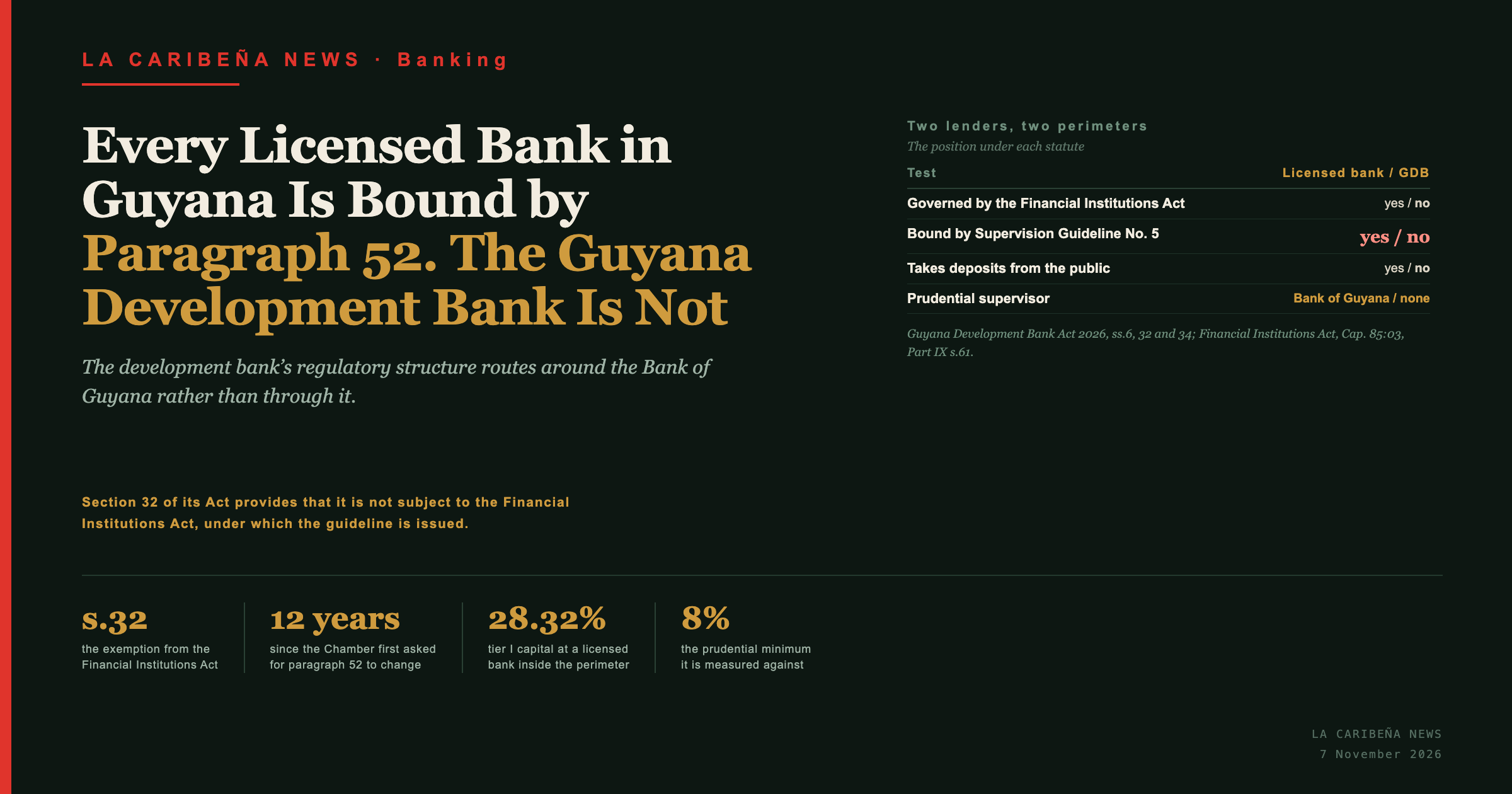
| Licensed commercial bank | Guyana Development Bank | |
|---|---|---|
| Governed by the Financial Institutions Act | yes | no, by section 32 |
| Bound by Supervision Guideline No. 5 | yes | no |
| Takes deposits from the public | yes | no, by section 6(a) |
| Prudential supervisor | Bank of Guyana | none |
| Lending terms fixed by | the guideline and the licence | policy, pending regulations under section 34(1)(b) |
Guyana Development Bank Act 2026, sections 6, 32 and 34; Financial Institutions Act, Cap. 85:03, Part IX section 61.
::: Paragraph 52 binds every bank licensed under the Financial Institutions Act. Section 32 puts this one outside that Act. :::
Who regulates its lending?
On the face of the Act, no prudential or conduct regulator does.
Section 32 removes the Bank from the licensing and prudential supervision regime the Bank of Guyana administers. Its external accountability runs elsewhere: to the Auditor General on the accounts, to the Minister on policy and appointments, which produced a seven-member board carrying the Finance Secretary and a sitting Member of Parliament, and to the National Assembly through its reporting obligations, where the Opposition wants the Bank to publish sectors, geography, default rates and approval criteria.
For a borrower it means no paragraph 52. It also means no prudential regulator setting provisioning standards for the loans, and no conduct regulator for how they are sold or collected, in a process where those selected are to be named publicly before they are financed.
Are the collateral-free terms binding?
Not yet. They are policy.
The Bank was launched on terms including lending without collateral, which this newspaper set out when it opened in October: a Quick Loan to G$300,000 and an SME Loan to G$3,000,000, both at zero interest, drawn from a G$20 billion first tranche that funds about 6,666 loans at the ceiling and paid out in Guyana dollars. Section 34(1)(b) of its Act lets the Minister make regulations on "the terms and conditions applicable to loans provided by the Bank". Regulations under that paragraph are what would give a collateral-free commitment legal force.
Until such regulations are made, and none is cited here, the terms are an administrative commitment rather than a statutory entitlement, and a borrower cannot point to a provision that compels them.
What does the rule do to a bank that is inside the perimeter?
It leaves one sitting on capital it does not lend.
Bank of Baroda (Guyana) Inc. is inside the perimeter, and its audited accounts for the year ended 31 March 2026, signed on 28 April 2026, show what that looks like. Tier I capital stood at 28.32 per cent of risk-weighted assets, against the 8 per cent minimum the Bank of Guyana's guidelines stipulate. Of G$44.62 billion in total assets, G$30.44 billion sat in cash, deposits with the central bank and Treasury bills. Net loans and advances were G$13.61 billion against deposits of G$37.58 billion, or 36.2 per cent.
The accounts record that the bank's impairment provisions are made "as per Bank of Guyana Supervision Guideline No.5", and that "the collateral held are in excess of the total loans and advances". It realised no collateral during the year.
Its capital stood at more than three times the floor, and the loan-to-deposit ratio fell from 38.7 per cent to 36.2 while the balance sheet grew by a third. On 6 November its group chief executive opened a new Georgetown head office and named equipment financing among its targets.
What does paragraph 52 say?
That a business's own machinery is not good security.
Paragraph 52 of Supervision Guideline No. 5 reads that collateral "such as specialized manufacturing facilities and equipment for ongoing operations which involve large-scale employment of workers would not normally be considered well-secured because of the difficulties of actual foreclosure or of disposing of the collateral in a timely manner at values sufficient to protect the financial institution from loss."
The Chamber's case against it was set out on 6 November. An oil services firm's principal asset is specialised equipment. A manufacturer's is its plant. Under the guideline that governs every licensed bank in the country, neither is normally well-secured.
Who has been Governor for all of it?
The same person, since the year the Chamber started asking.
Dr Gobind Ganga was appointed Governor of the Bank of Guyana on 2 December 2014, on the Bank's own profile of him, after nine years as Deputy Governor. The Chamber began pressing for paragraph 52 to change in 2014. He was Governor for the July 2021 revision that left the paragraph standing, and he is Governor now.
In March 2023 the Chamber said in a press release that an independent intervention was needed because it had "lost confidence in the leadership of the Bank of Guyana, or its capacity to implement policies that will guide Guyana's financial sector to support growth". The Bank replied the same day that it is an independent central bank whose mandate is clearly defined by law.
::: These are longstanding matters, and they raise a question that belongs in public rather than in back-room whispers: whether the current leadership team at the Bank of Guyana is right for this country at this juncture of its transformation. :::
The guideline stands unamended, the statute it is made under stands unamended, and the lender opened in October is outside both. The Governor also asked a furniture exporter why she wanted a US dollar account, and mortgages took 36.5 per cent of the new credit and construction and engineering 1.8.
What does a business do with this?
Establish which perimeter your lender sits in before you ask what it will accept.
The two lenders now operate under different law. A commercial bank applies a guideline that discounts plant and is supervised on its provisioning. The development bank applies neither, and its terms rest on policy that regulations have not yet fixed.
From a commercial bank, the question is what it will treat as well-secured and how it applies paragraph 52. From the development bank, it is whether the published terms are in regulations yet, and who a borrower complains to if they are not honoured. Those terms run through four steps from applying online to money in the account, an application that asks the Quick Loan for four things and the SME Loan for seven, an identity card that opens an account without carrying a TIN, and a website that serves a notice to anyone reading it from outside Guyana.
The entities
- Guyana Development Bank is the state lender opened in October 2026, which section 32 of its own Act exempts from the Financial Institutions Act and which takes no deposits from the public. - Financial Institutions Act is the statute, Cap. 85:03, under Part IX section 61 of which Supervision Guideline No. 5 is issued. - Supervision Guideline No. 5 is the Bank of Guyana guideline on loan classification and provisioning, whose paragraph 52 treats specialised manufacturing facilities and equipment as not normally well-secured. - Bank of Guyana is the central bank, which administers the licensing and prudential supervision regime that section 32 removes the development bank from. - Bank of Baroda (Guyana) Inc. is a licensed commercial bank inside that perimeter, with tier I capital at 28.32 per cent of risk-weighted assets at 31 March 2026. - Georgetown Chamber of Commerce and Industry is the business body six of whose presidents have asked for paragraph 52 to change since 2014, and which said in March 2023 that it had lost confidence in the Bank's leadership. - Dr Gobind Ganga is Governor of the Bank of Guyana, appointed on 2 December 2014. - Auditor General, the Minister and the National Assembly are the development bank's lines of external accountability under its Act.
What the title card says
- Kicker: Banking. - Headline: every licensed bank in Guyana is bound by paragraph 52, and the Guyana Development Bank is not. - Deck: the development bank's regulatory structure routes around the Bank of Guyana rather than through it. - Standfirst: section 32 of its Act provides that it is not subject to the Financial Institutions Act, under which the guideline is issued. - Panel, "Two lenders, two perimeters", sub-headed as the position under each statute, four rows of test against answer: - Governed by the Financial Institutions Act: a licensed bank yes, the development bank no. - Bound by Supervision Guideline No. 5: yes, and no. - Takes deposits from the public: yes, and no. - Prudential supervisor: the Bank of Guyana, and none. - Panel note: Guyana Development Bank Act 2026, sections 6, 32 and 34; Financial Institutions Act, Cap. 85:03. - Chip: section 32, the exemption from the Financial Institutions Act. - Chip: twelve years, since the Chamber first asked for paragraph 52 to change. - Chip: 28.32 per cent, tier I capital at a licensed bank inside the perimeter. - Chip: 8 per cent, the prudential minimum that bank is measured against. - Note: the Governor has held office since 2 December 2014, the year the Chamber began asking for paragraph 52 to change. - Date line: 7 November 2026.
Correction
Corrected 7 November 2026. This article originally gave Bank of Baroda (Guyana) Inc.'s figures from its accounts for the year ended 31 March 2024 and described those as the most recent published. They are not. The bank publishes its audited accounts on its own Guyana website, where the newest set is for the year ended 31 March 2026, signed on 28 April 2026, and where audited annual reports run back to the year ended 31 March 2009. The figures above are now taken from the 2026 accounts: tier I capital 28.32 per cent against an 8 per cent minimum, total assets G$44.62 billion, net loans G$13.61 billion and deposits G$37.58 billion. The earlier figures were read from the Indian parent's shareholders' pages, which carry the 2024 set. Nothing else in this article is changed.
Frequently Asked Questions
Does Supervision Guideline No. 5 apply to the Guyana Development Bank?
No. The guideline is issued under Part IX, section 61 of the Financial Institutions Act, and section 32 of the Guyana Development Bank Act provides that the Bank is not subject to that statute.
Who supervises the development bank's lending?
No prudential or conduct regulator does, on the face of its Act. Accountability runs to the Auditor General on the accounts, the Minister on policy and appointments, and the National Assembly through the Bank's reporting obligations.
Is the Bank allowed to take deposits?
No. Section 6(a) provides that it shall not accept deposits from the general public, which is also why it falls outside the definition of a licensed depository financial institution.
Are the no-collateral lending terms legally binding?
Not on the strength of anything cited here. Section 34(1)(b) lets the Minister make regulations on the terms and conditions applicable to the Bank's loans, and until regulations are made those terms are policy.
Who has been Governor of the Bank of Guyana through this?
Dr Gobind Ganga, appointed on 2 December 2014 on the Bank's own profile of him. The Chamber began asking for paragraph 52 to change that year, and he was Governor for the July 2021 revision that left it standing.
Why does a licensed bank's capital ratio appear in this story?
Because it shows what the perimeter produces. Bank of Baroda (Guyana) Inc., which is inside it, held tier I capital at 28.32 per cent of risk-weighted assets at 31 March 2026 against an 8 per cent minimum, with more than two-thirds of its balance sheet in cash and government paper.