By LCN Business Desk
Guyana's banks lent out an additional G$155,671 million between 2023 and 2025. More than half of it went to two categories: mortgages and personal lending. The sector that builds things took G$2,743 million, one dollar in every fifty-five.
Over the same two years the banks' excess liquid assets, the balances held above what the regulator requires, grew 162 per cent.
How much are Guyana's banks not lending?
Slightly more than half of what they take in, and the gap widens every year.
| Licensed depository financial institutions | 2023 | 2024 | 2025 |
|---|---|---|---|
| Average excess liquid assets, G$ million | 148,890 | 225,881 | 390,139 |
| Liquid asset ratio | 31.8% | 38.4% | 43.6% |
| Customer deposits as a share of loans | 189.2% | 195.2% | 202.4% |
Bank of Guyana, Annual Report 2025, Table XXXIV, Liquidity Indicators. The deposits-to-loans line is the Bank's own, not a calculation.
For every dollar the banks had lent at the end of 2025 they held slightly more than two dollars of customer deposits, and that ratio has widened in each year of the series.
The system is not under strain. Capital adequacy stood at 18.5 per cent against a prudential minimum of 8 per cent, non-performing loans fell 13.9 per cent, and the non-performing ratio was 1.5 per cent. The Bank's own conclusion was that "no amplification of systemic risk was observed; consequently, there was no need for immediate policy action." Its first-quarter 2026 report describes the banks as "adequately capitalised, highly liquid and profitable", and its own open market operations as managing "excess liquidity in the financial system".
Which borrowers got the money?
Mortgage and personal borrowers took the bulk of it.
| Share of the G$155,671m increase in private sector credit, 2023 to 2025 | |
|---|---|
| Real estate mortgages | 36.5% |
| Other services | 23.2% |
| Personal | 18.8% |
| Agriculture | 7.0% |
| Manufacturing | 7.0% |
| Distribution | 4.3% |
| Construction and engineering | 1.8% |
| Mining | 1.4% |
Computed from the Bank of Guyana's sectoral credit table, Annual Report 2025. Private sector credit rose from G$376,119 million to G$531,790 million. The eight named sectors account for G$155,626 million of the G$155,671 million increase. These are sector totals, not firm sizes, so small and medium enterprises cannot be separated out of them.
Mortgages took G$56,779 million and personal lending G$29,330 million, 55.3 per cent of the whole increase between them. The four sectors that make or move things took 17.2 per cent, less than half what mortgages took alone.
::: The four productive sectors took 17.2 per cent of the new lending between them. Mortgages alone took more than twice that. :::
Manufacturing credit grew 50.5 per cent over the two years. On a base of G$21,564 million that rise is G$10,896 million, or 7.0 per cent of the new lending. The Bank's own narrative reports 2025 growth of 41.2 per cent for manufacturing, 37.4 per cent for personal lending and 30.0 per cent for mining, each of which the table reproduces.
What secured any of it?
It is not documented in the figures the Bank publishes.
The sectoral table reports what credit was for. It does not report what was pledged. A manufacturing loan secured on the proprietor's house and a manufacturing loan secured on plant sit in the same row and cannot be told apart, and the same holds for agriculture, distribution, mining and services.
The Bank publishes nothing that would separate them. The word "collateral" appears four times in its 2025 annual report, in prudential commentary, in the payments system, in its own liquidity operations and in an accounting note. "Secured" and "real property" do not appear at all. There is no table of lending by security type.
A mortgage is secured on land by definition. For every other row, what a borrower had to put up is absent from the published figures, and nothing the Bank or any bank publishes links the pattern to the rule.
What does the rule say?
That a business's own machinery is not good security.
Supervision Guideline No. 5 is issued under Part IX, section 61 of the Financial Institutions Act and binds every licensed bank in Guyana. Paragraph 52 reads that collateral "such as specialized manufacturing facilities and equipment for ongoing operations which involve large-scale employment of workers would not normally be considered well-secured because of the difficulties of actual foreclosure or of disposing of the collateral in a timely manner at values sufficient to protect the financial institution from loss."
Six presidents of the Georgetown Chamber of Commerce and Industry have asked the Bank of Guyana to change that paragraph since 2014, which this newspaper set out on 6 November. The guideline was revised once in those years, on 30 July 2021, and the paragraph survived. An oil services firm's principal asset is specialised equipment. A manufacturer's is its plant.
Paragraph 47 of the same guideline, five paragraphs earlier, reads that collateral "is a secondary source of repayment and serves as a buffer for unforeseen losses", that banks "should not over-rely on collateral when assessing a credit exposure", and that "the primary focus should be on the borrower's ability to service the debt".
::: Paragraph 47 tells banks not to over-rely on collateral. Paragraph 52 tells them the collateral a manufacturer actually owns is not well-secured. :::
Who has been Governor through all of this?
The same person who was Governor when the Chamber said it had lost confidence in the Bank's leadership.
Dr Gobind Ganga was appointed Governor on 2 December 2014, on the Bank's own profile of him. The Chamber began asking for paragraph 52 to change that same year. He was Governor for the July 2021 revision that left it standing, for the Chamber's March 2023 statement that it had lost confidence in the Bank's leadership, and through the two years of credit data above. The Department of Public Information listed him as Governor in Guyana's delegation to the 62nd plenary of the Caribbean Financial Action Task Force in September 2026, and he chairs the board of the Deposit Insurance Corporation.
::: These are longstanding matters, and they raise a question that belongs in public rather than in back-room whispers: whether the current leadership team at the Bank of Guyana is right for this country at this juncture of its transformation. :::
Over the same tenure Guyana has stayed outside the CARICOM payment system's pilot group, and the Fast Pay launch set for 2 June 2026 remains unconfirmed. He also asked a furniture exporter why she wanted a US dollar account.
What does a business do with this?
Ask what the lender will take as security, not whether it has money.
Banks holding deposits at twice their loan book, capital at more than twice the minimum and a 1.5 per cent non-performing ratio are neither short of funds nor under stress. What decides whether any of it reaches a contractor or a manufacturer is narrower: what a bank will treat as well-secured, and how it applies paragraph 52 to plant.
One lender in Guyana is outside paragraph 52 altogether. Section 32 of the Guyana Development Bank Act puts it beyond the Financial Institutions Act.
The entities
- Bank of Guyana is the central bank, which issues Supervision Guideline No. 5 and publishes the liquidity and sectoral credit series above. - Supervision Guideline No. 5 is issued under Part IX, section 61 of the Financial Institutions Act, and its paragraph 52 treats specialised manufacturing facilities and equipment as not normally well-secured collateral. - Dr Gobind Ganga is Governor of the Bank of Guyana and chairs the board of the Deposit Insurance Corporation ex officio. - Georgetown Chamber of Commerce and Industry is the business body six of whose presidents have asked for paragraph 52 to change since 2014. - Financial Institutions Act is the statute, Cap. 85:03, under which the guideline is issued and every commercial bank is licensed.
What the title card says
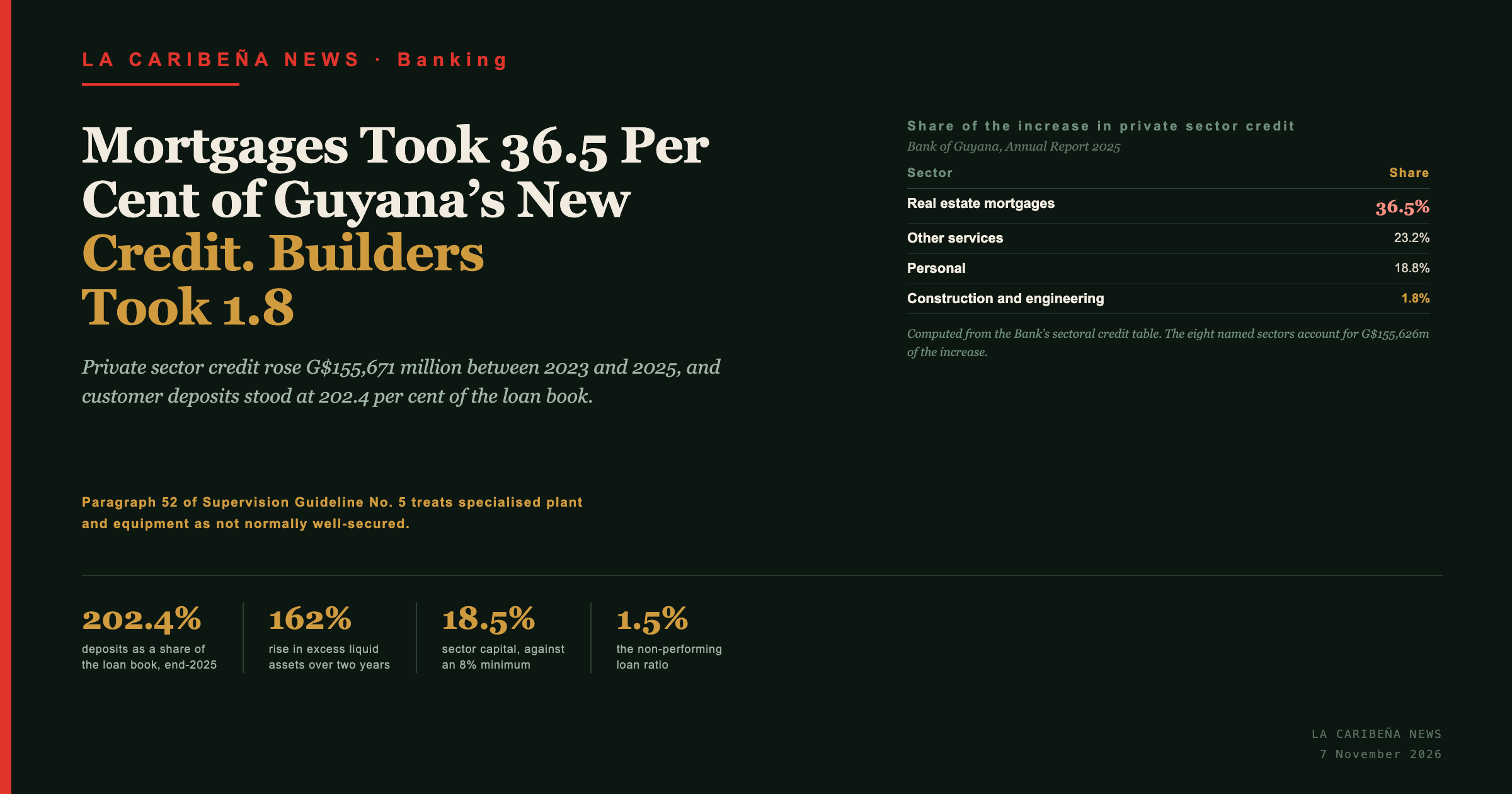
- Kicker: Banking. - Headline: mortgages took 36.5 per cent of Guyana's new credit, and builders took 1.8. - Deck: private sector credit rose G$155,671 million between 2023 and 2025, and customer deposits stood at 202.4 per cent of the loan book at the end of 2025. - Standfirst: paragraph 52 of Supervision Guideline No. 5 treats specialised plant and equipment as not normally well-secured. - Panel, "Share of the increase in private sector credit", sub-headed as Bank of Guyana, Annual Report 2025, four rows of sector against share: - Real estate mortgages, 36.5 per cent. - Other services, 23.2 per cent. - Personal, 18.8 per cent. - Construction and engineering, 1.8 per cent. - Panel note: computed from the Bank's sectoral credit table; the eight named sectors account for G$155,626 million of the increase. - Chip: 202.4 per cent, customer deposits as a share of the loan book at the end of 2025. - Chip: 162 per cent, the rise in excess liquid assets over two years. - Chip: 18.5 per cent, sector capital adequacy against an 8 per cent minimum. - Chip: 1.5 per cent, the non-performing loan ratio. - Date line: 7 November 2026.
Frequently Asked Questions
How much of their deposits are Guyana's banks lending?
At the end of 2025 customer deposits were 202.4 per cent of total non-interbank loans on the Bank of Guyana's own liquidity table, meaning the banks held slightly more than two dollars of deposits for every dollar lent. The figure was 189.2 per cent in 2023 and has widened each year.
Which sector got the smallest share of the new money?
Mining, at 1.4 per cent, then construction and engineering at 1.8 per cent. On growth rates construction and engineering was the slowest of the eight sectors named, up 13.1 per cent over the two years against 41.4 per cent for private credit as a whole.
Are the banks in difficulty?
No. Capital adequacy was 18.5 per cent against a prudential minimum of 8 per cent, non-performing loans fell 13.9 per cent and the non-performing ratio was 1.5 per cent. The Bank found no amplification of systemic risk and no need for immediate policy action.
Does this show that banks refused to lend against equipment?
No. The series records the stock of credit by sector of use, not lending decisions, and the Bank publishes no breakdown by security type. Weak demand, declined applications and borrowers financing abroad would all produce the same figure.
What is paragraph 52?
A provision of Supervision Guideline No. 5 stating that collateral such as specialised manufacturing facilities and equipment for ongoing operations involving large-scale employment would not normally be considered well-secured, because of the difficulty of foreclosing or disposing of it in time at a value that protects the lender.