By LCN Business Desk
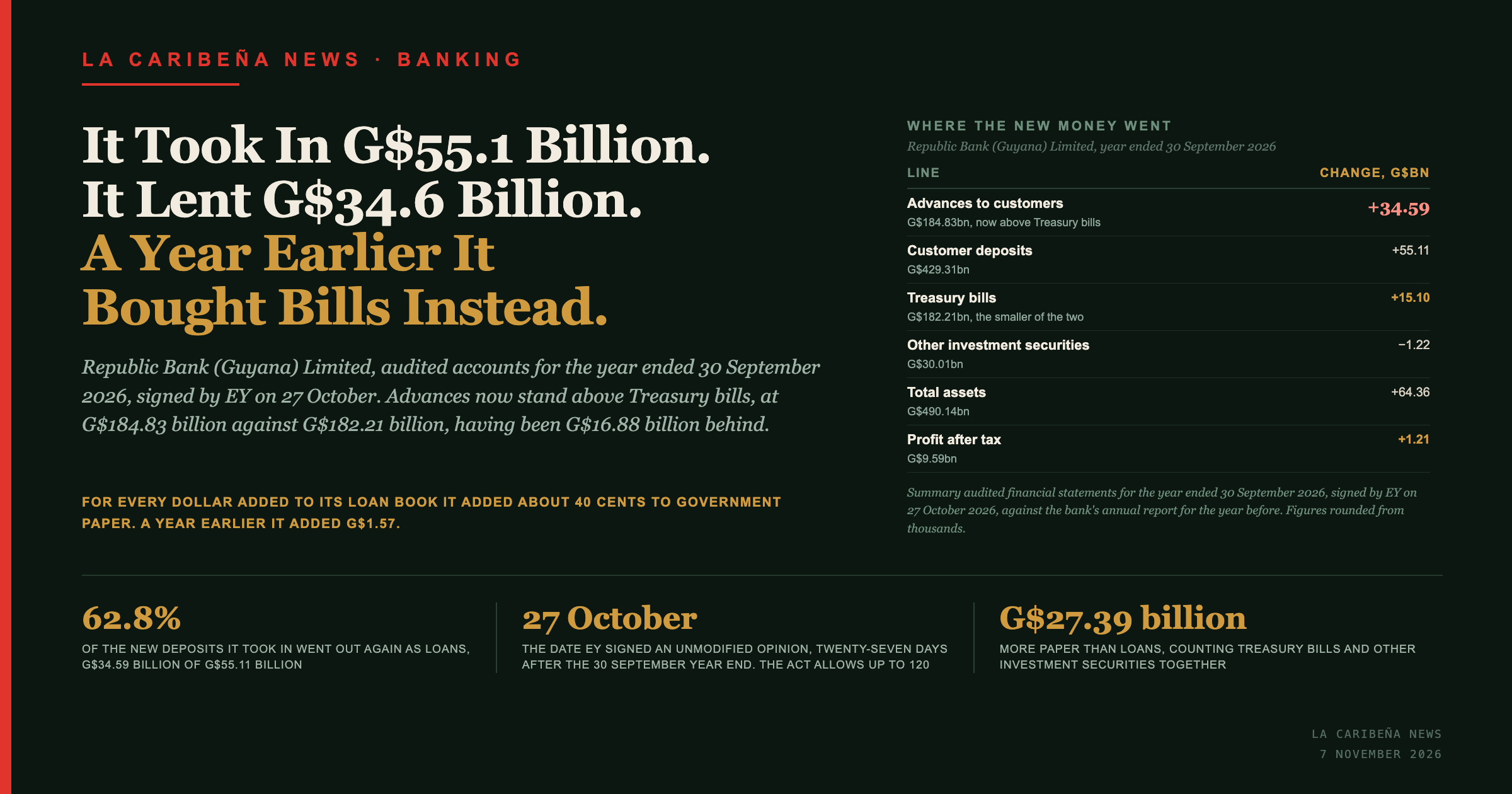
Republic Bank (Guyana) Limited is the country's largest bank. In the year to 30 September 2026 its customers put in G$55.1 billion of new deposits. Its loan book grew by G$34.6 billion.
EY signed an unmodified opinion on the accounts on 27 October 2026. The board approved them the day before.
What do the accounts show?
A loan book growing faster than the bank's holdings of government paper.
| G$ billion | FY2025 | FY2026 | Change |
|---|---|---|---|
| Advances to customers | 150.24 | 184.83 | +34.59 |
| Treasury bills | 167.11 | 182.21 | +15.10 |
| Other investment securities | 31.22 | 30.01 | −1.22 |
| Customer deposits | 374.20 | 429.31 | +55.11 |
| Total assets | 425.78 | 490.14 | +64.36 |
| Profit after tax | 8.37 | 9.59 | +1.21 |
Republic Bank (Guyana) Limited, summary audited financial statements for the year ended 30 September 2026, and its annual report for the year before. Figures are rounded from thousands.
The two lines have crossed. Lending now sits above the bills, having trailed them by G$16.88 billion twelve months ago.
The crossing is narrower than it looks. Set the bank's other investment securities alongside the bills and the paper still comes to G$212.22 billion, which is G$27.39 billion more than it has lent out.
How much of the new money went into loans?
Almost two thirds of it.
Loans absorbed 62.8 per cent of the year's new deposits. Securities took G$13.88 billion once the fall in other holdings is set against the rise in bills, so for every dollar the bank added to its loan book it added about 40 cents to government paper.
::: For every dollar Republic Bank added to its loan book, it added about 40 cents to government paper. A year earlier it added G$1.57. :::
What was it doing the year before?
The reverse. It bought more paper than it lent.
In the year to 30 September 2025 the ratio ran the other way, at G$1.57 of paper for every dollar lent: the loan book grew G$23.87 billion while securities grew G$37.54 billion.
All six of Guyana's commercial banks hold money abroad, and five put more new money into securities than into loans. On these figures Republic has moved to the other side of that line, and it is the biggest bank to do so.
Why does the choice matter to the bank?
Because the two assets pay very different rates.
A 91-day Treasury bill paid 1.10 per cent at the end of 2025 and lending paid a weighted average of 7.85, on the Bank of Guyana's own tables. Lending pays far more and costs more to do, because a bank must check the borrower, watch the loan and set aside its own capital against it.
The scale of the paper trade shows in the cash flow statement. The bank bought G$424.6 billion of Treasury bills over the twelve months and redeemed G$408.5 billion, because short bills mature and are replaced again and again.
How quickly were these accounts published?
Twenty-seven days after the year closed.
EY signed on 27 October, against a ceiling of 120 days that sections 23 and 24 of the Financial Institutions Act allow an auditor, extendable by a further 90, after which the bank has 20 days to publish.
What the public gets is a two-page summary of the balance sheet and the income statement. The notes that carry the breakdown of who borrowed and on what terms come later, in the full annual report. The Act requires publication in a newspaper and on display in each branch, and names no website.
What does this mean for a business?
Ask on these numbers rather than last year's.
A bank that has just put almost two thirds of its new deposits into lending is a different counterparty from one buying paper at three to two, and these figures are eleven days old, the newest any Guyanese bank has published.
What still decides a loan is security. Paragraph 52 of Supervision Guideline No. 5 treats specialised manufacturing facilities and equipment as not normally well-secured, and that rule has not changed. Of all the new credit the banks gave out between 2023 and 2025, mortgages took 36.5 per cent and builders 1.8.
The entities
- Republic Bank (Guyana) Limited is the largest commercial bank in Guyana, with total assets of G$490.14 billion at 30 September 2026. - EY audited the accounts and signed an unmodified opinion on 27 October 2026. - Bank of Guyana is the central bank. It sells Treasury bills and publishes the interest rates above. - Treasury bills are short-term loans to the Government of Guyana. A 91-day bill paid 1.10 per cent at the end of 2025. - Financial Institutions Act is the statute whose sections 23 and 24 set when a bank's audited accounts must be reported and published. - Supervision Guideline No. 5 is the Bank of Guyana rule on lending and security. Its paragraph 52 treats plant and machines as not normally well secured.
What the title card says
- Kicker: Banking. - Headline: Republic Bank lent G$34.6 billion of the G$55.1 billion it took in, and a year earlier it put more into Treasury bills than into loans. - Deck: audited accounts for the year ended 30 September 2026, signed by EY on 27 October. - Standfirst: for every dollar added to loans it added about 40 cents to government paper, against G$1.57 a year earlier. - Panel, "Where the new money went", sub-headed as the year ended 30 September 2026, four rows of line against change: - Customer deposits, up G$55.11 billion. - Advances to customers, up G$34.59 billion. - Treasury bills, up G$15.10 billion. - Other securities, down G$1.22 billion. - Panel note: summary audited financial statements, statement of financial position. - Chip: 62.8 per cent of new deposits, lent out. - Chip: 40 cents of paper per dollar lent, against G$1.57 a year earlier. - Chip: 27 days from year end to the auditor's signature. - Chip: G$490.14 billion of total assets. - Date line: 7 November 2026.
Frequently Asked Questions
How much did Republic Bank lend out of its new deposits?
Deposits rose G$55.11 billion in the year to 30 September 2026 and its loan book grew G$34.59 billion, which is 62.8 per cent.
Are its loans now bigger than its Treasury bills?
Yes. Advances stood at G$184.83 billion against Treasury bills of G$182.21 billion. A year earlier the bills were larger by G$16.88 billion. Counting its other securities as well, the bank still holds G$27.39 billion more paper than it has lent.
What did it do the year before?
Its loan book grew G$23.87 billion and its securities grew G$37.54 billion, which is G$1.57 of paper for every dollar lent. In the latest year that figure is about 40 cents.
Who audited the accounts and when?
EY signed an unmodified opinion on 27 October 2026, twenty-seven days after the 30 September year end. The board approved the accounts on 26 October.
Where can the public read them?
A two-page summary of the balance sheet and income statement is published. Under section 24 of the Financial Institutions Act a bank must publish in a newspaper and display the accounts in each branch. The Act names no website, and the full notes come later in the annual report.