By LCN Business Desk
Bank of Baroda (Guyana) Inc. grew its deposits by almost a third in the year to 31 March 2026. Most of that money went into Government of Guyana Treasury bills, and a little over a quarter of it into new lending.
Its auditors, Maurice Solomon, Chartered Accountants, signed an unqualified opinion on 28 April 2026, twenty-eight days after the year closed.
What did the bank do with the new money?
It bought Treasury bills with most of it.
| Year ended 31 March, G$ billion | 2025 | 2026 | Change |
|---|---|---|---|
| Customer deposits | 28.60 | 37.58 | +8.98 |
| Treasury bills | 9.67 | 16.90 | +7.22 |
| Loans and advances | 11.06 | 13.61 | +2.55 |
| Total assets | 33.56 | 44.62 | +11.06 |
| Shareholders' equity | 4.44 | 4.99 | +0.55 |
Statement of Financial Position, audited financial statements for the year ended 31 March 2026. Figures are published in thousands and restated here in billions.
New holdings of government paper ran at 2.83 times new lending, and the bills grew three times faster in percentage terms than the loan book did.
::: For every G$1 the bank added to its loan book, it added G$2.83 to its holdings of Government of Guyana Treasury bills. :::
A third destination sits in the related-party note. Money placed on deposit with Bank of Baroda New York, part of the same group, rose from G$770 million to G$3.390 billion over the year, earning interest at 1.25 to 3 per cent. That is an increase of G$2.620 billion, against the G$2.550 billion the loan book grew by. The bank's deposit with its own New York office grew by G$70 million more than its lending to Guyanese borrowers.
An interbank placement with a group affiliate is ordinary treasury practice for a subsidiary bank, and the accounts disclose it as a related-party balance as they are required to. Deposits raised in Guyana funded it.
Has the share of deposits it lends changed?
No. It has sat between 36 and 39 per cent for three years.
Loans stood at 36.6 per cent of deposits at 31 March 2024, 38.7 per cent a year later and 36.2 per cent at 31 March 2026. The balance sheet grew 33 per cent in the most recent year and that proportion ended it slightly lower than it began.
At the year end, cash, balances with the Bank of Guyana and Treasury bills together came to G$30.44 billion of G$44.62 billion in total assets, or 68.2 per cent.
Which industries did the lending go to?
Property and services. Between them they hold 77.9 per cent of the book.
| Loans and advances, gross, G$ billion | 2025 | 2026 | Share of book |
|---|---|---|---|
| Housing and commercial real estate | 5.113 | 5.624 | 41.2% |
| Services | 3.491 | 5.001 | 36.7% |
| Construction and engineering | 0.938 | 1.124 | 8.2% |
| Mining and quarrying | 0.487 | 0.767 | 5.6% |
| Manufacturing | 0.454 | 0.567 | 4.2% |
| Household | 0.498 | 0.417 | 3.1% |
| Agriculture | 0.182 | 0.146 | 1.1% |
Note 17(e), diversification of exposure. The columns are gross and sum to the published G$13.645 billion and G$11.164 billion. The balance sheet shows a larger rise because the impairment provision fell from G$104 million to G$36 million over the year.
Two of the seven sectors took 81.4 per cent of the year's growth. Two of them shrank: household lending by 16.2 per cent and agriculture by 19.9 per cent, from G$182 million to G$146 million. At the Guyana Development Bank, opened in October 2026 to lend without collateral, agriculture is the largest single category of applications at almost 30 per cent.
::: Agriculture is 1.1 per cent of this bank's loan book, and it fell by a fifth in a year. Almost 30 per cent of applications to the Guyana Development Bank are agricultural. :::
The bank's own note calls the portfolio highly diversified, and the test it applies there is a single-borrower one: no exposure to an individual borrower exceeds 25 per cent of the capital base. Sector concentration is a different measure and the note does not claim anything about it.
Construction and engineering at 8.2 per cent of the book is the one line that runs against the national pattern, where the sector took 1.8 per cent of all new private credit between 2023 and 2025. In money it is G$186 million of new lending over the year.
What kind of lending is it?
Mortgage lending and overdrafts, which are 96.6 per cent of the book between them.
| Loans and advances by facility, gross, G$ billion | 2025 | 2026 | Share of book |
|---|---|---|---|
| Mortgages | 6.550 | 7.894 | 57.9% |
| Overdrafts | 4.075 | 5.293 | 38.8% |
| Term loans | 0.382 | 0.316 | 2.3% |
| Others | 0.073 | 0.074 | 0.5% |
| Demand loans | 0.081 | 0.065 | 0.5% |
| Staff loans | 0.002 | 0.003 | 0.0% |
Note 10, which analyses the same gross loan book by instrument rather than by industry.
The accounts give no breakdown of what sits inside the services category, which is the largest contributor to the year's growth. What note 10 does establish is the instrument. Mortgage facilities come to G$7.894 billion, and the housing and commercial real estate sector line is G$5.624 billion, so at least G$2.271 billion of mortgage lending is advanced to borrowers classified in other sectors: credit secured on property, extended to businesses in services, construction, mining and manufacturing.
Overdrafts, which grew 29.9 per cent, are working capital rather than investment. Term loans, the instrument a firm buys equipment with, fell 17.3 per cent to G$316 million, and demand loans fell 19.8 per cent.
The provision release of G$68 million over the year is recorded in note 10 as a reduction "as per Bank of Guyana Supervision Guideline No.5", the same guideline whose paragraph 52 governs what counts as well-secured.
What happened to its capital ratio?
It has almost halved in two years, because assets grew faster than equity.
| Tier I capital as a share of risk-weighted assets | |
|---|---|
| 31 March 2024 | 50.06% |
| 31 March 2025 | 44.53% |
| 31 March 2026 | 28.32% |
| Bank of Guyana minimum | 8% |
The bank's own capital adequacy note in each year's accounts. The 2025 accounts give the 2024 figure and the 2026 accounts give the 2025 figure, so the series is the bank's own.
Shareholders' equity rose 12.4 per cent over the year while total assets rose 33.0 per cent. A ratio whose numerator grows at a third of the pace of its denominator falls, and this one fell to 3.54 times the regulatory floor from more than six times it two years earlier. The accounts describe the bank as remaining well capitalised.
What do the accounts say about security?
That the bank holds more collateral than it has lent, and did not sell any.
The notes record that impairment provisions are made under Supervision Guideline No. 5, "as per Bank of Guyana Supervision Guideline No.5" in the accounts' own words, that "the collateral held are in excess of the total loans and advances", and that during the year the bank realised no collateral. Paragraph 52 of that guideline treats specialised manufacturing plant and equipment as not normally well-secured, which six Georgetown Chamber presidents have asked the Bank of Guyana to change since 2014.
Collateral in excess of the loan book is a lending policy as much as a figure. It describes a bank that advances against security it is confident of and keeps the balance in instruments that need none.
How does this sit beside the rest of the sector?
Every licensed bank in Guyana is holding deposits worth about twice its loans.
Across all licensed depository institutions, customer deposits stood at 202.4 per cent of loans at the end of 2025 on the Bank of Guyana's own liquidity table, and mortgages took 36.5 per cent of the new credit while construction and engineering took 1.8. The aggregate shows the outcome. These accounts show a single year of it being decided, line by line, in a bank that is bound by paragraph 52, like every licensed bank in Guyana.
Where can a business read a Guyanese bank's accounts?
In a newspaper, on a branch wall, and on whatever each bank chooses to put online.
Sections 23 and 24 of the Financial Institutions Act set the timetable and the channel. The auditor's reports go to the bank and to the Bank of Guyana not later than 120 days after the year closes, extendable by 90 days, and within 20 days of receiving them the bank must publish its balance sheet and income statement in a newspaper of general circulation, exhibit them in each office and branch, and forward copies to the central bank. The Act names no website and establishes no public register.
What a business can actually consult therefore varies by bank. Baroda posts audited annual reports on its own Guyana site running back to the year ended 31 March 2009, which is eighteen years, and its quarterly balance sheets run from 2013 and stop at 30 September 2022. Guyana Times published Guyana Bank for Trade and Industry's audited statements for the year ended 31 December 2025 in its edition of 27 February 2026, two months after that year closed.
What does a business do with this?
Ask this bank for equipment finance and find out what it will take as security.
Baroda had been weighing closure in Guyana. On 6 November its group chief executive opened a new head office in Georgetown and named equipment financing among the bank's targets. The accounts show a lender with G$30.44 billion in cash and government paper, capital at three and a half times the floor, and a loan book that has stayed near 36 per cent of deposits for three years.
A contractor or manufacturer reading that is not looking at a bank short of money. The question on the table is what it treats as well-secured, and the stated interest in equipment financing is the place to put it.
The entities
- Bank of Baroda (Guyana) Inc. is a licensed commercial bank in Guyana and a subsidiary of Bank of Baroda (India), with a financial year ending 31 March and tier I capital at 28.32 per cent of risk-weighted assets at 31 March 2026. - Maurice Solomon, Chartered Accountants audited the accounts and signed an unqualified opinion on 28 April 2026. - Bank of Guyana is the central bank, whose guidelines set the 8 per cent minimum ratio of qualifying capital to risk-weighted assets and which receives every licensed institution's audited accounts. - Treasury bills are short-term Government of Guyana debt, of which the bank held G$16.90 billion at 31 March 2026. - Guyana Development Bank is the state lender opened in October 2026, almost 30 per cent of whose applications are agricultural. - Bank of Baroda New York is a United States office of the same group, with which the Guyana bank held G$3.390 billion on deposit at 31 March 2026. - Supervision Guideline No. 5 is the Bank of Guyana guideline on credit exposure classification and provisioning, under which the bank makes its impairment provisions. - Financial Institutions Act is the statute, Cap. 85:03, whose sections 23 and 24 set the audit timetable and require publication in a newspaper and exhibition in branches. - Guyana Bank for Trade and Industry is a licensed commercial bank whose audited statements for the year ended 31 December 2025 were published in Guyana Times on 27 February 2026.
What the title card says
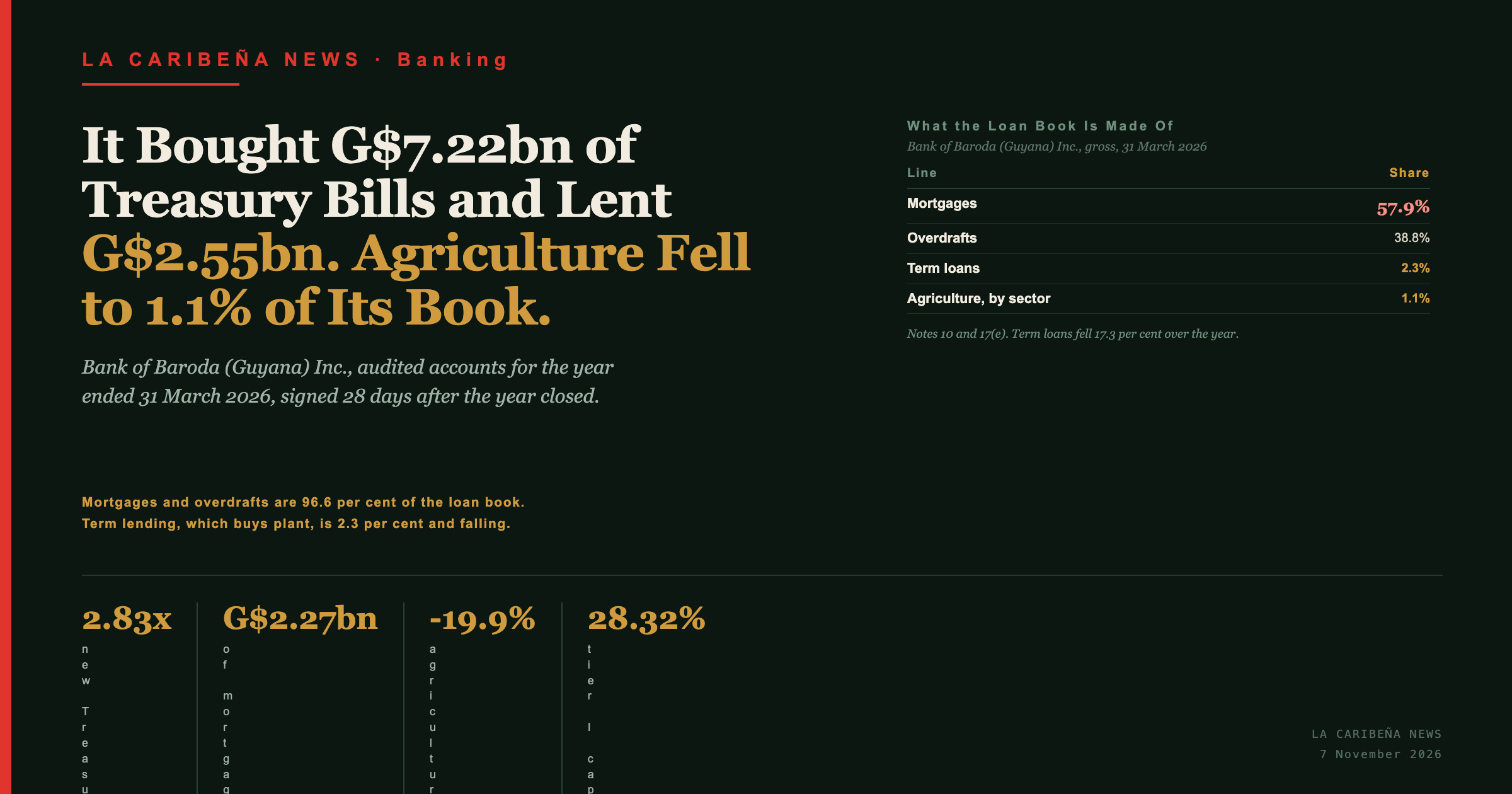
- Kicker: Banking. - Headline: Bank of Baroda bought G$7.22 billion of Guyana Treasury bills and lent G$2.55 billion, and agriculture fell to 1.1 per cent of its loan book. - Deck: the year ended 31 March 2026, on audited accounts signed twenty-eight days after the year closed. - Standfirst: mortgages and overdrafts are 96.6 per cent of the loan book, and term lending, which buys plant, is 2.3 per cent and falling. - Panel, "What the loan book is made of", sub-headed as gross at 31 March 2026, four rows of line against share: - Mortgages, 57.9 per cent. - Overdrafts, 38.8 per cent. - Term loans, 2.3 per cent. - Agriculture, by sector, 1.1 per cent. - Panel note: notes 10 and 17(e), and term loans fell 17.3 per cent over the year. - Chip: 2.83 times, new Treasury bills per dollar of new lending. - Chip: G$2.27 billion of mortgage lending outside the property sector line. - Chip: a 19.9 per cent fall in agriculture lending over the year. - Chip: 28.32 per cent, tier I capital against an 8 per cent minimum. - Date line: 7 November 2026.
Frequently Asked Questions
How much did Bank of Baroda's deposits grow in Guyana?
Customer deposits rose from G$28.60 billion to G$37.58 billion in the year ended 31 March 2026, an increase of G$8.98 billion or 31.4 per cent.
How much of that went into lending?
Loans and advances rose G$2.55 billion over the same year, to G$13.61 billion. Treasury bill holdings rose G$7.22 billion, to G$16.90 billion, so new government paper ran at 2.83 times new lending.
What kind of loans are they?
On note 10 of the 2026 accounts, mortgages are 57.9 per cent of the gross loan book and overdrafts 38.8 per cent, 96.6 per cent between them. Term loans are 2.3 per cent and fell 17.3 per cent over the year. Mortgage facilities exceed the housing and commercial real estate sector line by G$2.271 billion, so that much mortgage lending is advanced to borrowers classified in other sectors.
Why did the capital ratio fall?
Shareholders' equity grew 12.4 per cent while total assets grew 33.0 per cent. Tier I capital went from 50.06 per cent of risk-weighted assets at 31 March 2024 to 44.53 a year later and 28.32 at 31 March 2026, against an 8 per cent minimum. The accounts describe the bank as remaining well capitalised.
Are these accounts audited and current?
Yes. Maurice Solomon, Chartered Accountants, signed an unqualified opinion on 28 April 2026, twenty-eight days after the 31 March year end, and the bank publishes the set on its own Guyana website alongside audited annual reports back to the year ended 31 March 2009.
How much of the money left Guyana?
The bank's placement with Bank of Baroda New York, part of the same group, rose from G$770 million to G$3.390 billion in the year ended 31 March 2026, an increase of G$2.620 billion earning 1.25 to 3 per cent. Its loan book grew G$2.550 billion over the same year.
Which industries does the bank lend to?
On note 17(e) of the 2026 accounts, housing and commercial real estate is 41.2 per cent of the gross loan book and services 36.7 per cent. Construction and engineering is 8.2 per cent, mining 5.6, manufacturing 4.2, household 3.1 and agriculture 1.1. Agriculture and household lending both fell over the year.
Where does the law require a Guyanese bank to publish its accounts?
In a newspaper of general circulation in Guyana, exhibited in each office and branch, and forwarded to the Bank of Guyana, within 20 days of receiving the auditor's reports under section 24 of the Financial Institutions Act. The Act names no website and establishes no public register.