By LCN Business Desk
A Treasury bill is a short-term loan to the Government of Guyana. At the end of 2025 a 91-day bill paid a bank 1.10 per cent a year.
Lending to businesses and people paid 7.85 per cent. Both rates come from the Bank of Guyana's own tables.
What do the banks earn?
A gap of 6.75 points between lending and government bills.
| Rate at end-December 2025 | |
|---|---|
| Banks' lending rate, weighted average | 7.85% |
| Prime lending rate, weighted average | 7.91% |
| Treasury bill, 91 days | 1.10% |
| Treasury bill, 364 days | 1.09% |
| Treasury bill, 182 days | 0.99% |
| What banks pay small savers | 0.81% |
Bank of Guyana, Annual Report 2025, table of selected interest rates. The bill rates held near these levels in every month of 2025.
The Bank says so in its own words. The 91-day bill yield "was stable at 1.10 percent", and the 182-day and 364-day bills stayed "relatively stable at 1.00 percent and 1.09 percent".
One number in those tables is easy to misread. The Bank Rate is 5.00 per cent and has not moved since 2016. It is a policy rate, not what a bank earns on a bill.
Why would a bank accept less interest on a Treasury bill?
Because its deposits cost even less, and a bill ties up no capital.
Banks pay small savers 0.81 per cent. Their own accounts show what they pay across all deposits: Scotiabank 0.29 per cent last year, Republic Bank 0.32, Demerara Bank 0.55, Bank of Baroda 0.66. So a bill at 1.10 still earns them money.
A loan is harder work. The bank must check the borrower, watch the loan, chase it if it sours, and set aside its own capital against it. Citizens Bank Guyana Inc.'s accounts show how much that matters. It held G$151.1 billion of assets. Only G$65.0 billion counted as risky under the central bank's rules, and its loan book alone was G$63.9 billion.
Almost all the risk sits in the loans. Government paper counts for close to nothing, so it ties up no capital.
::: A bank sets aside about eight dollars of its own capital for every hundred it lends. For every hundred it puts in Treasury bills, it sets aside almost nothing. :::
What did each bank actually do?
Five of the six put more new money into securities than into loans.
| Bank | Year end | Lent | Parked | New securities per $1 lent |
|---|---|---|---|---|
| Bank of Nova Scotia, Guyana branch | 31 Oct 2025 | 32.6% | 15.4% | 5.40 |
| Bank of Baroda (Guyana) Inc. | 31 Mar 2026 | 30.5% | 37.9% | 2.83 |
| Citizens Bank Guyana Inc. | 30 Sep 2025 | 42.3% | 30.2% | 2.57 |
| Guyana Bank for Trade and Industry | 31 Dec 2025 | 32.3% | 39.5% | 2.35 |
| Republic Bank (Guyana) Limited | 30 Sep 2025 | 35.3% | 46.6% | 1.57 |
| Demerara Bank Limited | 30 Sep 2025 | 52.0% | 26.2% | 0.26 |
Each bank's own audited accounts. "Lent" and "parked" are shares of total assets. Year ends differ and span fourteen months, so these are not the same twelve months. Demerara's figures are for the bank, not the group.
Across the six, loans came to G$512.8 billion and securities to G$475.4 billion. The banks hold almost as much paper as they have lent out.
Scotiabank is the sharpest case. Its securities grew from G$6.7 billion to G$27.2 billion in one year, while its loan book grew 7 per cent. Deposits rose G$44.6 billion and lending rose G$3.8 billion, so it lent about one dollar in every twelve it took in.
So where does the money go?
Out of the country, wherever the bank has a way to send it. One of the six is moving the other way.
| Bank | What it holds abroad, in its own words |
|---|---|
| Guyana Bank for Trade and Industry | "investments are maintained overseas from which income of G$1,674M was earned". That is 78 per cent of all the investment income in its accounts |
| Demerara Bank Limited | G$55.86 billion "due from related party", placed with its own subsidiary |
| Bank of Baroda (Guyana) Inc. | G$3.39 billion placed with Bank of Baroda New York, up from G$0.77 billion |
| Citizens Bank Guyana Inc. | G$289.0 million of investment income "earned out of Guyana", against G$419.9 million earned in it |
| Republic Bank (Guyana) Limited | G$862.8 million of interest income from "other countries". Its securities that are not Treasury bills pay 4.45 per cent |
| Bank of Nova Scotia | G$3.36 billion on deposit with head office and related companies. It took a G$8.55 billion position with Scotiabank & Trust (Cayman) Ltd. down to nil during the year, and holds G$43.0 billion at the Bank of Guyana above what the rules require |
Each bank's own audited accounts for the year shown in the table above.
Republic Bank's figure is the one that prices the choice. Its Treasury bills pay it about the published rate. Its other securities pay 4.45 per cent, four times as much, and those are the ones held outside Guyana.
Did one bank lend much more than the rest?
Demerara did. It also parks more abroad than any of them.
Demerara lent 52.0 per cent of its assets while the others lent 30 to 42 per cent. It grew its loan book by almost a third in one year. On the face of it, that is the bank that found customers the others could not.
Its own balance sheet says something else. Beside those loans sits G$55.86 billion owed to it by a related party, which is its own subsidiary. That is 22.8 per cent of the bank. The subsidiary holds G$63.4 billion of securities, and the group earns 4.79 per cent on them.
::: Demerara did not find customers the other banks could not find. It found a better place to park. :::
What do researchers call this?
Two things, and they disagree about whose fault it is.
The first is called the lazy banks idea. Shahe Emran and Subika Farazi studied 60 developing countries in 2009. They found that for every extra dollar a government borrowed from its own banks, private borrowers lost about $1.40 of credit. A bank that can hold safe government paper has less reason to chase harder customers.
That finding does not hold everywhere. Later work found about one for one in Egypt, much less in Nigeria, and the opposite in Macedonia, where government borrowing went with more private lending, not less.
The second idea is about cash a bank cannot get rid of. An International Monetary Fund paper by Magnus Saxegaard splits spare cash into two kinds: cash a bank chooses to hold, and cash it is stuck with. It says countries rich in oil or minerals end up with the second kind when the foreign money coming in is not mopped up. Deposits arrive faster than good projects do.
Guyana's own banks describe both. Republic Bank says it manages its money "in an environment of inadequate investment opportunities". Citizens Bank says the Treasury bill auction is the central bank's main tool "to manage the excess liquidity".
But Demerara is the test. If there were simply nothing good to lend to, it could not have grown its loan book by a third in the same year, in the same country, under the same rules.
What else does the central bank decide?
What a bank may count as good security.
Citizens Bank's report records that at 30 September 2025 there were G$765.0 billion of Treasury bills outstanding, and that commercial banks held G$358.2 billion of them, or 46.8 per cent. In one year Bank of Baroda bought G$7.22 billion of Guyana Treasury bills and lent G$2.55 billion.
The Bank of Guyana sells those bills. It also writes the rule on lending, and its Governor asked a furniture exporter why she wanted a US dollar account. Paragraph 52 of Supervision Guideline No. 5 says a factory's own plant and machines are not normally well secured. Six presidents of the Georgetown Chamber of Commerce and Industry have asked for that to change since 2014.
What does this mean for a business?
The banks are not short of money. Ask what they will take as security.
A bank taking 1.10 per cent at home and sending the rest abroad is not a bank with nothing to lend. Of all the new credit the banks handed out between 2023 and 2025, mortgages took 36.5 per cent and builders 1.8.
What decides a loan is what the bank will take as security, and whether it will accept plant and machines rather than land. One lender in Guyana is not bound by paragraph 52 at all.
The entities
- Bank of Guyana is the central bank. It sells Treasury bills, publishes the interest rate tables above, and writes the rules banks lend under. - Treasury bills are short-term loans to the Government of Guyana. A 91-day bill paid 1.10 per cent at the end of 2025. - Republic Bank (Guyana) Limited is the country's largest commercial bank, with G$425.8 billion of assets. - Guyana Bank for Trade and Industry is a commercial bank that earned G$1,674 million of investment income overseas. - Demerara Bank Limited is a commercial bank that lent 52.0 per cent of its assets and placed G$55.86 billion with its own subsidiary. - Citizens Bank Guyana Inc. is a commercial bank that earned G$289.0 million of investment income out of Guyana. - Bank of Baroda (Guyana) Inc. is a commercial bank owned by Bank of Baroda in India. - Bank of Nova Scotia is the Canadian bank whose Guyana business traded as a branch through the year reported here. Its own accounts record that on 1 November 2025 that business moved into a wholly-owned subsidiary, Scotiabank Guyana Incorporated. - Supervision Guideline No. 5 is the Bank of Guyana rule on lending and security. Its paragraph 52 treats plant and machines as not normally well secured. - Shahe Emran and Subika Farazi wrote the 2009 study of government borrowing and private credit in 60 developing countries. - Magnus Saxegaard wrote the International Monetary Fund paper that splits spare bank cash into chosen and stuck.
What the title card says
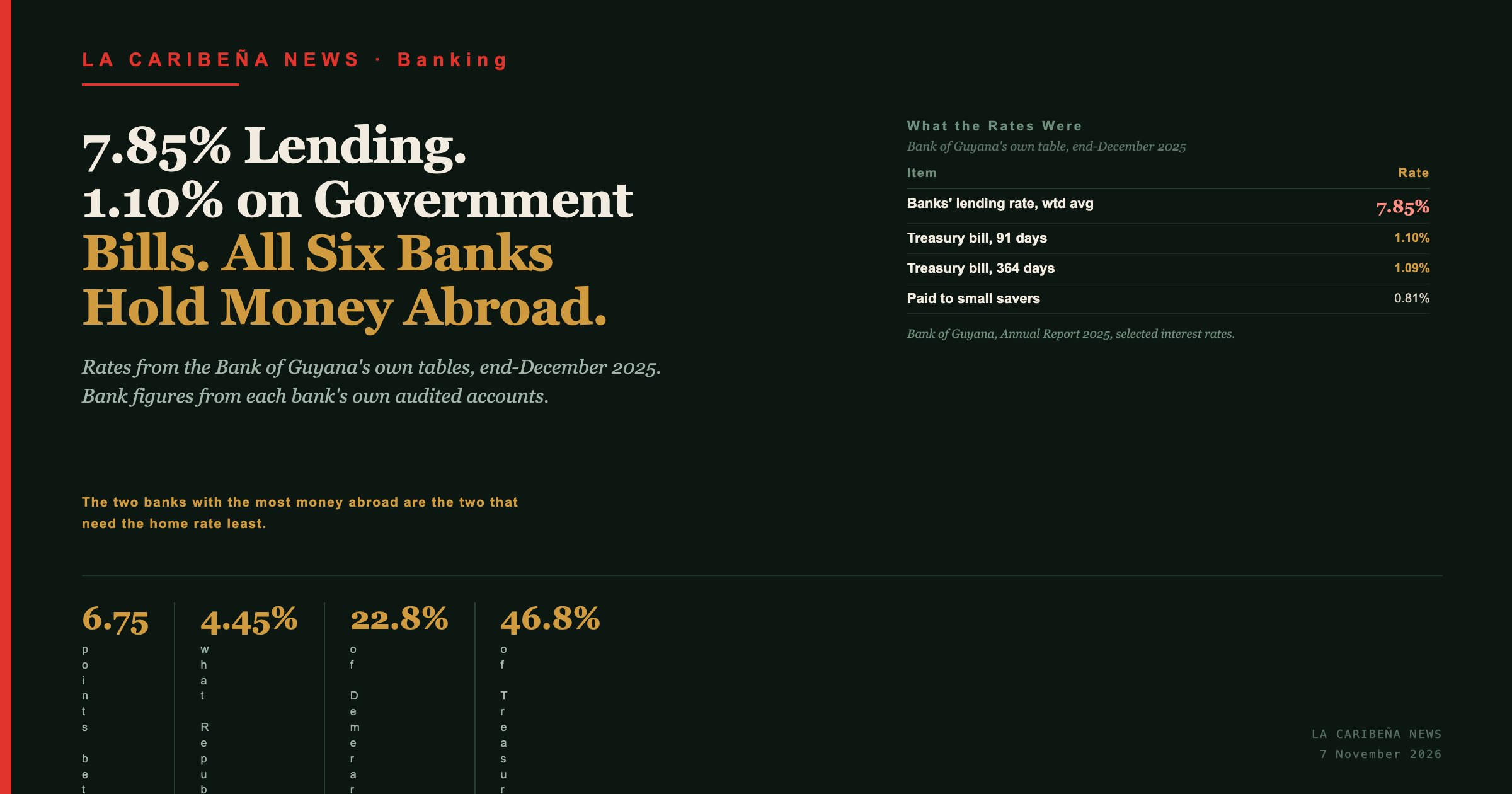
- Kicker: Banking. - Headline: Guyana's banks earn 7.85 per cent lending and 1.10 on government bills, and all six hold money abroad. - Deck: rates from the Bank of Guyana's own tables at the end of December 2025. - Standfirst: the two banks with the most money abroad are the two that need the home rate least. - Panel, "What the rates were", sub-headed as end-December 2025, four rows of item against rate: - Banks' lending rate, weighted average, 7.85 per cent. - Treasury bill, 91 days, 1.10 per cent. - Treasury bill, 364 days, 1.09 per cent. - What banks pay small savers, 0.81 per cent. - Panel note: Bank of Guyana, Annual Report 2025, selected interest rates. - Chip: 6.75 points, the gap between lending and a 91-day bill. - Chip: 4.45 per cent, what Republic earns on securities that are not Treasury bills. - Chip: 22.8 per cent of Demerara, placed with its own subsidiary. - Chip: 46.8 per cent of Treasury bills, held by commercial banks. - Date line: 7 November 2026.
Correction
Corrected 7 November 2026. This article originally described the Bank of Nova Scotia's Guyana operation only as "a branch of a Canadian bank" in a table of money held abroad, which implied an offshore position the bank's own accounts contradict. Note 5 of its statements for the year ended 31 October 2025 shows G$3.36 billion on deposit with head office and related companies, G$43.0 billion with the Bank of Guyana above the required reserve, and a position with Scotiabank & Trust (Cayman) Ltd. reduced from G$8.55 billion to nil during the year. Scotiabank is the one bank of the six reducing what it holds abroad, and the table now says so. No other bank's figures are changed. Corrected again the same day: the entity list described the Bank of Nova Scotia as running the Guyana branch in the present tense. Its own accounts, note 1 and note 29 for the year ended 31 October 2025, record that effective 1 November 2025 the Guyana business was restructured out of the branch into a wholly-owned subsidiary, Scotiabank Guyana Incorporated. Every figure here is for the year ended 31 October 2025, when it was a branch, and none is changed.
Frequently Asked Questions
What do Guyana's banks earn on Treasury bills?
A 91-day bill paid 1.10 per cent at the end of December 2025, a 182-day bill 0.99 and a 364-day bill 1.09. The rates come from the Bank of Guyana's own table and held near those levels in every month of the year.
What do they earn on loans?
The weighted average lending rate was 7.85 per cent at the end of December 2025, and the prime lending rate 7.91. The gap against a 91-day bill is 6.75 points.
Is the Bank Rate the same thing?
No. The Bank Rate is 5.00 per cent and has not moved since 2016. It is a policy rate, not what a bank earns on a bill.
Why not just lend more?
Banks pay small savers 0.81 per cent, and their accounts show they pay between 0.29 and 0.66 per cent across all deposits. So a bill at 1.10 makes money. A bill also ties up almost no capital, while a loan ties up about eight dollars in every hundred and has to be checked, watched and chased.
Which bank holds the most abroad?
Guyana Bank for Trade and Industry reported G$1,674 million of investment income earned overseas, which is 78 per cent of all the investment income in its accounts. Demerara Bank placed G$55.86 billion with its own subsidiary, 22.8 per cent of its balance sheet.