By LCN Business Desk
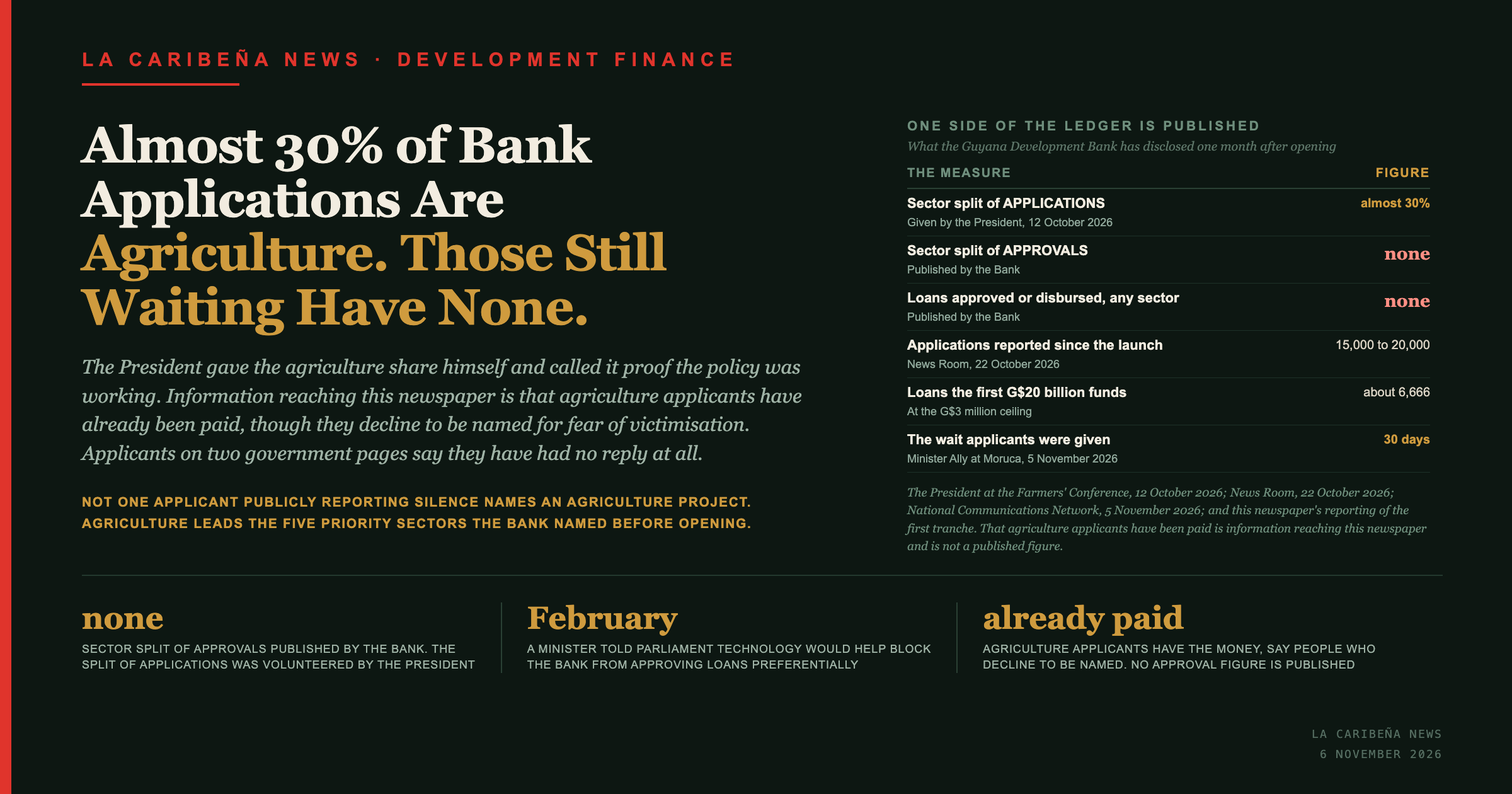
The government has volunteered exactly one figure about who is applying to the Guyana Development Bank, and it is the agriculture share. President Irfaan Ali gave it himself on 12 October, and presented it as proof the policy was working.
Information reaching this newspaper is that people who applied for agriculture-related projects have already received money, although such persons decline to be named for fear of victimisation.
Applicants posting publicly under the state broadcaster's own report this week say they have had no response at all, past 30 days. Not one of them names an agriculture project.
The Bank publishes a sector breakdown of its applications. It publishes nothing at all about approvals.
What exactly did the President say?
That the agricultural share was the clearest sign the policy was working.
Speaking at the opening of the Farmers' Conference at the Arthur Chung Conference Centre, Liliendaal, Ali put the agricultural share of applicants for the collateral-free, interest-free loans of up to G$3 million at almost 30 per cent. His words were that if there is one indication of how the policy direction is leading to a new wave in agriculture, it is this fact.
The same report records that the government did not immediately say how many applications had been acted on. This newspaper reported the same share from the Bank's own disclosure in October, so the figure rests on two independent accounts.
Agriculture is also first among the five sectors the Bank named before it opened. Government channels promoted the facility to farmers directly, and the President used the same platform to announce he was negotiating preferential agricultural rates with Republic Bank and Demerara Bank.
What is published, and what is not?
| Published | Not published |
|---|---|
| 15,000 to 20,000 applications since launch | Any count of loans approved |
| Almost 30 per cent of applications from agriculture | Any count of loans disbursed |
| Agriculture first among five priority sectors | Any split of approvals by sector |
| Two loan products and their ceilings | Any published order of processing |
| A 30-day expectation for contact | Any regional distribution |
Application volumes as reported by News Room on 22 October 2026; the agriculture share from the President on 12 October 2026.
A sector share of applications tells an applicant how crowded their lane is. A sector share of approvals would tell them whether their lane moves. Only the first exists.
What are applicants saying?
Applicants on two separate government pages are saying the same thing.
Minister of Public Service, Government Efficiency and Implementation Zulfikar Ally told residents of the Moruca Sub-Region that borrowers can expect to hear from the Bank within approximately 30 days, National Communications Network reported on 5 November. The Bank opened on 5 October. Ally said thousands of applications had already been received, and that he had engaged commercial banks to register hinterland residents who hold no bank account, which matters because the loan is paid into one.
Under that post, one commenter wrote "I apply on the first day and still have not get a response and that's 30 days". Another wrote "Since October the 7 still under review". A third asked "Is it 30 days from application or 30 days from today".
The Ministry of Public Service's own post promoting the Bank carries the same complaint from different people. Of thirteen comments read there, six separate applicants say they applied and have heard nothing. One wrote "Yea, I'm at 100% completed on the portal. I'm waiting for the banks reply and can't hear anything as yet". Another put the wait at a month and asked the question the Bank's own silence invites: "I completed the application online and still waiting to see a change on the application online and nothing so im wondering if ppl actually getting this. It's been 1 month now and the application remains the same". A seventh wrote "How long before approval thats what people wanna know".
Facebook ranks what it shows, and its own notice says some comments may be filtered out, so these are a subset of two threads rather than a count of anything. Three things about them are checkable. The complaint appears on two separate government pages rather than one. Different accounts post it on each page. And across all sixteen comments read, nobody reporting silence identifies an agriculture project.
The commenters are private individuals and are not named here.
What is the second thing they are asking?
Whether an older applicant can get in at all.
Two commenters on the Ministry's post raise it without being prompted. One asks "Wam to ppl over 60?". Another writes "Only young people can win with this bank ....old people can't win !!".
Nothing published sets an age criterion either way. The Government's service page names market vendors, salons, barbershops, food sellers, seamstresses and mechanics, and says nothing about age. The seven requirements given in May say nothing about age. Neither does the Development Bank's own description of its five priority sectors.
The question was put to Parliament in February, in general terms. We Invest in Nationhood's Tabita Sarabo-Halley asked what would safeguard applicants against discrimination. Minister Rodrigues answered that the law would govern the institution through a board, and that this is a government that does not discriminate against anyone.
An applicant cannot check that against anything. The Bank publishes no breakdown of applicants or approvals by age, by region, or by anything other than sector, and the sector breakdown covers applications only.
What did the government promise about preferential approval?
That technology would prevent it. The commitment was given in Parliament, eight months before the Bank opened.
During consideration of the 2026 estimates, APNU's Terrence Campbell asked what would stop political interference in lending, and defined precisely what he meant: not discrimination, but "somebody calling the bank manager and say John or Jane has to get a loan". Minister of Industry and Commerce Susan Rodrigues answered that technology would be used to help block the bank from approving loans preferentially, with applications handled by the board and assisted by a technology platform to address subjectivity, bias and the consolidation of power. She described Campbell's question as subjective and loaded with insinuations.
The same report sets out why the question was asked. The Guyana Agricultural and Industrial Development Bank, established in the 1970s, was dissolved in 1995 over a high level of non-performing loans, partly owing to politically-influenced lending.
Minister Ally added a second commitment in May, telling a Guyana Manufacturing and Services Association luncheon that every account would be audited by the Auditor General and every government injection laid before Parliament. Neither commitment has yet produced a published approval figure of any kind.
How far does the money reach?
About a third of the way, and nothing published says who is served first.
This newspaper has reported the first tranche of G$20 billion against a G$3 million ceiling, funding about 6,666 loans, against the 15,000 to 20,000 applications reported since launch. Something therefore decides order. No published rule says what, which is the gap the February commitment was given to close. This newspaper set out the four steps the Bank itself describes between applying and being paid in October, and argued before the doors opened that a bank which publishes its criteria can answer an accusation on the day it is made.
What does an applicant actually need?
Four items on the Government's page. Seven were listed in May.
The Government of Guyana service page sets out the Quick Loan as an online application for up to G$300,000 at zero interest, for market vendors, salons, barbershops, food sellers, seamstresses and mechanics. It asks for one valid identification document, a phone number, a short description of the business and its purpose, and bank details. A credit officer reviews it, a letter of offer follows, it is signed online, and the money is paid into the account. Businesses needing more apply for the SME Loan, to G$3,000,000.
In May, Minister Ally listed seven requirements for the same ceiling: a credit score, National Insurance Scheme compliance, Guyana Revenue Authority compliance, a digital identity card preferred with the existing card accepted, a detailed business plan, financial statements where applicable and proof of address, alongside a background check on an applicant's record of paying debts. Which list governs an application made today is not stated anywhere published.
What is not established here?
That agriculture applicants have been paid. This is information reaching this newspaper, from people who decline to be named for fear of victimisation. The Bank has confirmed nothing, and because no approval or disbursement count exists in public in either direction, it cannot be checked against the Bank's own record.
That agriculture is being approved at a higher rate. Agriculture was the largest single source of applications and is first among the stated priority sectors. No published figure breaks approvals down by sector, so a difference in rate is not demonstrable either way from the public record.
Whether the technology safeguard was built. The February commitment was to a technology platform addressing bias in approval. Nothing published describes what was implemented, who audits it, or what it does when a sector is a stated priority.
Whether the 30 days runs from application or from 5 November. A commenter asked exactly that. The announcement as reported does not say.
Which requirement list applies now. The Government page gives four items and the May statement gave seven heavier ones. No published note reconciles them.
The entities
- Guyana Development Bank is the state development bank that opened on 5 October 2026, lending to G$300,000 on a Quick Loan and to G$3,000,000 on an SME Loan, both at zero interest and without collateral, across five priority sectors led by agriculture. - Irfaan Ali is the President of Guyana, who gave the agriculture application share at the Farmers' Conference on 12 October 2026. - Zulfikar Ally is Minister of Public Service, Government Efficiency and Implementation, who gave the 30-day expectation at Moruca and the audit commitment in May. - Susan Rodrigues is Minister of Industry and Commerce, who told Parliament in February that technology would help block preferential approval. - Terrence Campbell is the APNU parliamentarian who asked what would prevent political interference in the Bank's lending. - Tabita Sarabo-Halley is the We Invest in Nationhood parliamentarian who asked in February what would safeguard applicants against discrimination. - Guyana Agricultural and Industrial Development Bank was the state development bank dissolved in 1995 over non-performing loans, partly owing to politically-influenced lending. - Moruca Sub-Region is the hinterland sub-region where the 5 November sensitisation exercise was held. - National Communications Network is Guyana's state broadcaster, which reported the 30-day expectation.
What the title card says
- Headline: almost 30 per cent of applications are agriculture, and the applicants reporting silence name no agriculture project. - Agriculture share of applications: almost 30 per cent, given by the President on 12 October 2026. - Date the Bank opened: 5 October 2026. Date of the 30-day expectation: 5 November 2026. - Applications reported since launch: 15,000 to 20,000. - Loans the first G$20 billion funds at the G$3 million ceiling: about 6,666. - Approval counts, disbursement counts and sector splits of approvals published: none. - Published breakdown of applicants or approvals by age or region: none. - Date the government promised technology would block preferential approval: 11 February 2026.
Frequently Asked Questions
What share of Development Bank applications is agriculture?
Almost 30 per cent, the largest single source. President Irfaan Ali gave the figure at the Farmers' Conference on 12 October 2026 and presented it as evidence the policy was working.
Have agriculture applicants been paid before others?
Information reaching this newspaper is that people who applied for agriculture-related projects have already received money, although such persons decline to be named for fear of victimisation. The Bank has published no approval or disbursement figure, so there is no official count to set against that.
Did the government say anything about preferential approval?
Yes. In February 2026 Minister of Industry and Commerce Susan Rodrigues told Parliament that technology would be used to help block the bank from approving loans preferentially, answering a question about political interference in lending.
How long is the wait?
Minister Ally said approximately 30 days. Whether that runs from application or from the 5 November announcement has not been published, and commenters who applied in early October report still waiting.
Is there an age limit on a Development Bank loan?
No published document sets one. The Government's service page, the seven requirements given in May and the Bank's five priority sectors are all silent on age. Two commenters on the Ministry of Public Service's post ask whether older applicants can qualify, and nothing published answers them.
How many loans can the current money fund?
About 6,666, on a first tranche of G$20 billion at the G$3 million ceiling, against 15,000 to 20,000 applications reported since launch.