By LCN Business Desk
Four documents open an account at the Development Bank, which has been taking applications since it opened and whose requirements were read on its own site on 16 October 2026. Three of the four are pieces of paper with a number on them. One is a register.
What does the e-ID actually hold?
Identity data, biometrics and copies of the documents you proved it with.
The Digital Identity Card Registry, which sits under the Office of the Prime Minister, publishes what it takes at enrolment.
| What is collected | As the Registry describes it |
|---|---|
| Personal details | "full name, date of birth, address information, and other voluntary information" |
| Biometric data | "fingerprints and a facial image, captured at enrolment" |
| Source documents | "digital copies of your citizenship documents and other supporting documents" |
Source: Digital Identity Card Registry, e-id.gov.gy.
The card is a polycarbonate smart card with an embedded microchip. Registration and issuance are governed by the Digital Identity Card Act, 19 of 2023, and the card is issued by the Data Protection Commissioner appointed under the Data Protection Act, 18 of 2023. The Registry notes that the pairing of the two laws "is not a coincidence".
What does enrolment demand?
Originals, an address proved within six months, and your parents' details.
Enrolment is open to citizens aged 14 and over. Proof of citizenship must be original: a birth certificate that is not laminated, together with a GECOM identification card, a valid passport or a valid provisional travel document, with other routes for those born abroad to Guyanese parents, for citizenship by marriage, registration, naturalisation or adoption.
Proof of address may be a driver's licence, a utility bill, a bank statement, an envelope processed through the Guyana Post Office Corporation, or another official document showing name and address. Everything except the driver's licence must be dated within the last six months, and the name must match the source documents.
An applicant must also give the full names, dates and places of birth of both parents, the same for a spouse if there is one, and contact information. The Registry publishes no fee for enrolment.
Does it carry a TIN or an NIS number?
No.
Neither a Taxpayer Identification Number nor a National Insurance Scheme number appears in the Registry's description of what it collects, in the enrolment requirements published on the Government's own services portal, or in the reporting of the Bill's passage through the National Assembly in August 2023. The Act was described there as providing for a registry for the collection of identity data, and for cards containing digital identity data.
That matters at the Bank, because one of its two loans asks for a TIN.
Why does any of this help a Development Bank application?
Because the Bank says it prefills from a record, and only one of the four documents is a record.
The Bank accepts an E-ID, a National ID Card, a Driver's Licence or a Passport to create an account, and its sign-in asks for a "National ID/Passport/E-ID Number". It states that an applicant's details are "Prefilled From Your National ID Record Where Possible", and that "If We Can't Fetch Your Details Automatically, You Can Type Them In Or Upload A Document."
A passport number and a licence number identify a document. The e-ID sits on a register that already holds a verified name, a date of birth, an address proved against a document dated within six months, biometrics and digital copies of the source papers. A number the Bank can check is not the same thing as a record it can draw from.
The Registry also publishes the consent mechanism that makes any such sharing lawful: "By utilising your identity card as a form of identification with any authority, you consent to specific data being shared with that entity, for the purposes of conducting a specific transaction."
What the Bank asks for against each loan is set out in What You Need Before You Apply.
Which loan does it help most?
The Quick Loan, because that list has no TIN on it.
The Bank's Quick Loan of up to G$300,000 asks for one valid ID, a phone number, a short description of the business, and bank details before disbursement. Every identity item on that list is something the e-ID record already holds.
The SME Loan of up to G$3,000,000 adds business registration and a TIN. Neither is on the e-ID, and neither is obtained at the Registry. A TIN comes from the Guyana Revenue Authority and business registration from the Commercial Registry. The two products and their ceilings are set out in The Development Bank Has Two Loans, Not One.
So the card shortens the identity half of an application and does nothing for the tax half.
What else does the card now do?
It replaces a passport to Barbados.
Barbados and Guyana agreed to accept valid national e-ID cards for travel between the two countries from 1 July 2026. The CARICOM Secretariat reported that more than seventy representatives met virtually on 5 June to work through the implementation, among them immigration officials of both countries, airlines operating in the Caribbean, electoral officials, the CARICOM Implementing Agency for Crime and Security and the International Air Transport Association.
Their agenda gives the measure of the change: adjustments to check-in, boarding and passenger verification, the inclusion of a field for e-ID cards on Customs and Immigration forms, the handling of in-transit passengers and of diversions and unscheduled stops, and data accuracy.
Barbados Prime Minister Mia Mottley used the Trident e-ID card to travel to Guyana for Guyana's sixtieth anniversary of Independence on 26 May 2026.
What should an applicant take from all this?
One enrolment, two uses, and one gap to close separately.
A Guyanese with an e-ID holds a travel document for Barbados and the identity key to a Development Bank application in the same card. A Guyanese without one has three other ways to open the account and no register behind any of them.
An applicant for the larger loan still needs the Revenue Authority and the Commercial Registry. The board that will assess them is set out in Guyana's Development Bank Has Seven Directors, the capital behind the lending in G$20 Billion to Lend and a G$3 Million Ceiling, and the fact that none of this is readable from outside the country in The Development Bank's Website Stops at Guyana's Border. The four steps that follow, once an application is in, are set out in From Application to Money in the Account.
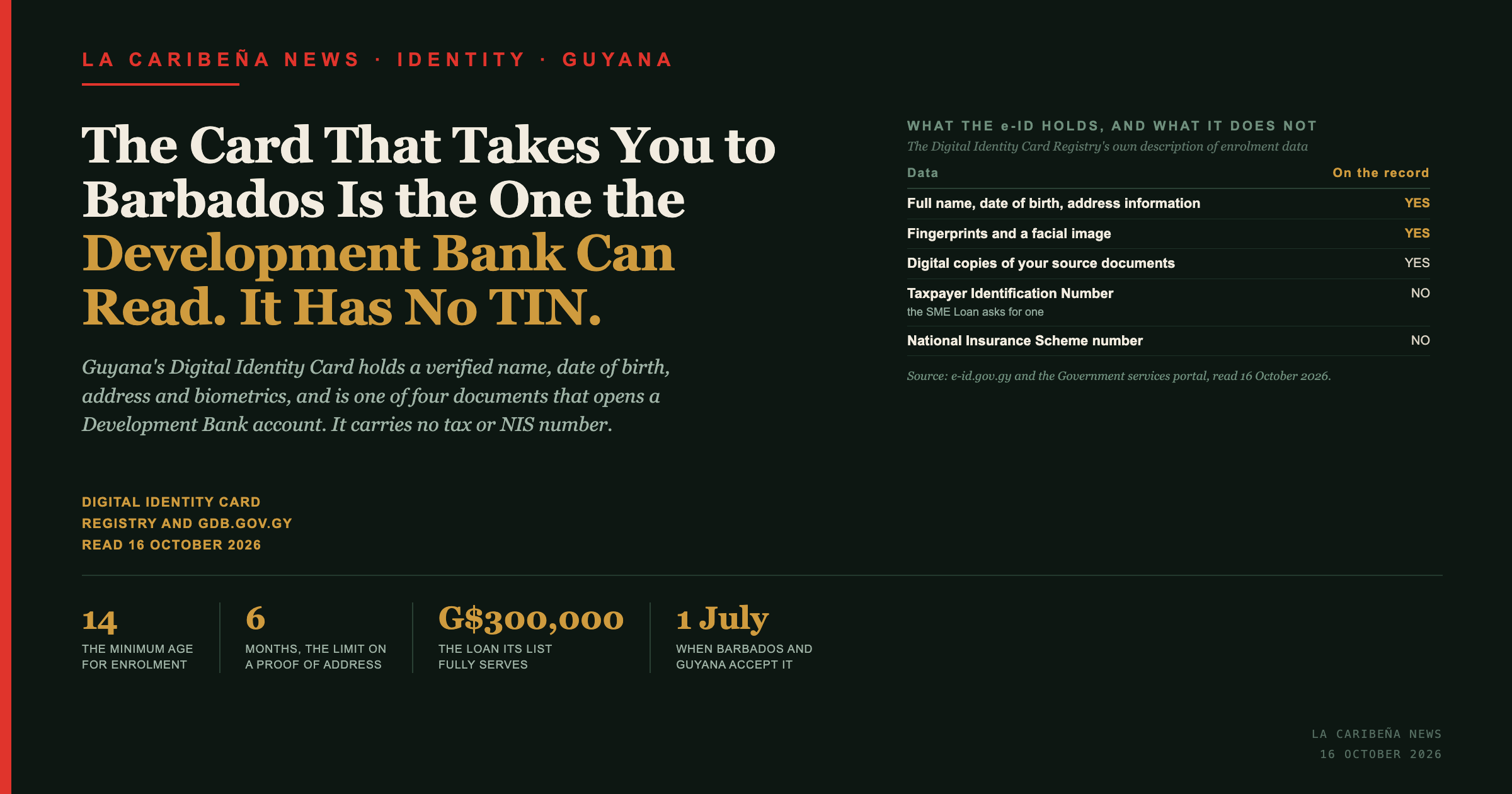
What the title card shows
Every data point on the article's title card, in text.
- 3 categories of data. What the Registry collects: personal details, biometrics, and digital copies of source documents.
- No TIN, no NIS. Neither appears in the Registry's description of what it collects, in the published enrolment requirements, or in the reporting of the Act.
- 14 years. The minimum age for enrolment.
- 6 months. The maximum age of a proof of address, other than a driver's licence.
- 1 July 2026. The date from which Barbados and Guyana accept each other's national e-ID cards for travel.
Frequently Asked Questions
What does Guyana's e-ID collect?
Personal details including full name, date of birth and address information; biometric data in the form of fingerprints and a facial image; and digital copies of citizenship and other supporting documents.
Does the e-ID include a TIN or NIS number?
No. Neither appears in the Registry's description of the data it collects, in the enrolment requirements published on the Government's services portal, or in the reporting of the Bill's passage.
How does the e-ID help with a Guyana Development Bank application?
The Bank says details are prefilled from the National ID record where possible. Of the four documents it accepts to open an account, the e-ID is the one attached to a register already holding a verified name, date of birth, address and biometrics.
Which Development Bank loan does it help most?
The Quick Loan of up to G$300,000, whose requirements are one valid ID, a phone number, a short description of the business, and bank details. The SME Loan additionally requires business registration and a TIN, which the card does not carry.
Can the e-ID be used to travel to Barbados?
Barbados and Guyana agreed to accept valid national e-ID cards for travel between the two countries from 1 July 2026.