By LCN Business Desk
The French embassy in Georgetown takes fingerprints. It takes the payment, the forms and the courier envelope that brings the passport back. It does all of that strictly for people travelling to France.
A Guyanese travelling to any of the other twenty-six Schengen states cannot use it. They apply in person at the Netherlands embassy in Paramaribo or the German embassy in Port of Spain, which means an international flight to hand over a fingerprint.
On Wednesday the President said so out loud, at a conference his government was hosting.
What did the President actually object to?
The process, not the requirement. Speaking at the opening of the Caribbean Tourism Organisation's State of the Tourism Industry Conference in Guyana, the same platform from which he told international investors they were too laid-back about the region, Irfaan Ali said the European Union "is still backward in this region."
"You have to travel to Suriname and Trinidad to get biometrics to do it. In a day of digitisation and AI, we have the EU that is operating from a Stone Age kind of operation and they're our friends; we can tell them frankly."
He put the cost in days rather than dollars. "You want to host international conferences so you invite us to all of the beautiful conferences that we want to attend but we have to invest four days before we get the visa to attend." He suggested biometric data could establish whether an applicant had a criminal record without any of it.
Nothing in those remarks asks to be taken off the visa list. They ask for the counter to be closer.
Why can France not simply serve everyone?
Because it needs the other governments to agree, and it has said so. The French position already on record is that the Schengen visa its Georgetown embassy issues is strictly for visits to France, and that this could change only if France reaches agreement with other EU member states to let Guyanese enter the Schengen area from elsewhere.
That is a correct statement of the mechanism. It is also only half of it.
What does the EU's own Visa Code say about that?
It provides for exactly this arrangement, names it, and tells the governments concerned to try to conclude it. The instrument is Regulation (EC) No 810/2009, the Visa Code, as amended in 2019. Article 8 is headed "Representation arrangements."
Its first paragraph carries the sentence that matters for Georgetown.
"A Member State may also represent another Member State in a limited manner solely for the collection of applications and the enrolment of biometric identifiers."
France has the equipment in Georgetown. Limited representation would let it enrol fingerprints for other member states without deciding a single one of their visa applications.
Paragraph 4 is why France cannot do it alone, and it confirms the French account. A bilateral arrangement is required between the representing and the represented state, and it may provide for the represented state to supply premises, staff and payment.
Then the Code turns to the governments that are absent. Paragraph 5 says member states lacking their own consulate in a third country "shall endeavour to conclude representation arrangements" with member states that have one. Paragraph 6 goes further and describes Guyana's situation in the abstract:
"With a view to ensuring that a poor transport infrastructure or long distances in a specific region or geographical area does not require a disproportionate effort on the part of applicants to have access to a consulate, Member States lacking their own consulate in that region or area shall endeavour to conclude representation arrangements."
A flight to Paramaribo to give a fingerprint is the disproportionate effort that paragraph contemplates. Paragraph 10 adds a fallback for a state that is neither present nor represented: it "shall endeavour to cooperate with an external service provider," the outsourced application centre familiar to anyone who has applied for a visa in a larger capital.
The duty in those three paragraphs rests on the member states with no consulate in Guyana. It does not rest on Guyana, and it does not rest on France alone.
One limit has to be stated plainly, because it is the whole weight of the thing. "Shall endeavour" obliges effort and not outcome. Article 8 gives Guyana no entitlement, sets no deadline and creates nothing a third country can enforce. The Code provides the remedy and asks member states to try for it. Whether any has tried is a question for them.
Is this a regional policy?
No, and the distinction is doing a lot of work in public. Short-stay visa policy is a European Union competence exercised country by country under Regulation (EU) 2018/1806. Annex II lists the countries whose nationals are exempt for stays of up to 90 days in any 180-day period. Annex I lists those who must hold a visa.
| CARICOM full members on the Schengen visa lists | Countries |
|---|---|
| Exempt (Annex II) | Antigua and Barbuda, The Bahamas, Barbados, Dominica, Grenada, St Kitts and Nevis, St Lucia, St Vincent and the Grenadines, Trinidad and Tobago |
| Visa required (Annex I) | Guyana, Jamaica, Suriname, Belize, Haiti |
Source: Regulation (EU) 2018/1806, Annexes I and II, consolidated text.
The exemption is not a permanent grant, either. Brussels has been strengthening its power to suspend Annex II listings, pressure now bearing on the five Eastern Caribbean states that sell citizenship, as reported in Argentina Will Sell Citizenship for About US$350,000.
Nine Caribbean neighbours hold the exemption and Guyana does not, which is why the regional framing fails. Five of the nine negotiated their way on, concluding short-stay waiver agreements with the European Union under Council Decisions in 2015, as set out in An Open Economy, A Closed Door.
That report also established the other direction. Guyana admits nationals of thirteen Schengen states without a visa, on the Ministry of Foreign Affairs list, while the European section of the companion list runs to three entries for ordinary Guyanese passport holders. Every one of the twenty-seven EU member states requires a visa of a Guyanese traveller.
Civic society leader Timothy Tucker made the point sharply on Facebook this week, writing that nobody should "try to insult our intelligence by trying to say it's a regional policy, IT ISN'T so many countries in the Caribbean/ Caricom don't require visas to travel to Europe." On the listing, the Annexes bear him out.
Guyana sits on the wrong side of more than one such list. Mexico's foreign ministry exempts five CARICOM states and requires a visa of the other nine, a split set out in Aeromexico Will Fly to Jamaica and The Bahamas.
On the President's complaint the regional character is real, though, and the two are easily confused. Biometrics sit in Paramaribo and Port of Spain precisely because the consular network is organised regionally. That is a fact about where embassies are, not about who is welcome.
What does the paperwork cost?
Enough to show up in trade statistics. Across up to 194 destination and 214 origin countries between 1995 and 2013, introducing a visa requirement cut tourism flows between two countries by more than 20 per cent, in work by Mathias Czaika and Eric Neumayer published in Applied Geography. The same study found restrictions were "economically most harmful for poorer countries," and that deterred tourists, goods and capital were "redirected to other visa-free destinations."
That last finding is the one worth holding at a tourism conference. Friction does not postpone a trip. It moves it to a competitor.
The border works in one direction for goods and another for people, which is a pattern the region knows. CARICOM courts the Haitian market while Haitians are refused movement within it, documented in The Market Courted, The People Shut Out. Europe is meanwhile removing the EUR 98 a tonne sugar preference that was the Caribbean's trading advantage, so the relationship is being renegotiated on several counters at once.
There is also a measured precedent for the specific fix the President asked for. Mexico replaced a consular visa for Brazilians with an electronic one in February 2026 and applications tripled, a result reported in Mexico Put Brazil's Visa Online. Guyana has moved off visa lists before, too: the United Kingdom lifted its requirement in November 2022, covered in How Guyana's Oil Boom Is Rewriting Its Passport.
Is Guyana alone in the complaint?
It is a long way from alone, and the figures from elsewhere are larger. African countries lost about EUR 60 million in rejected Schengen visa fees during 2024, on analysis by the LAGO Collective reported by CNN. Rejected short-stay applications cost applicants worldwide roughly US$145 million in non-refundable fees that year, about nine tenths of it borne in Africa and Asia. The fee is EUR 90 and it is not returned when an application fails.
Refusal rates track income. Ghana, Senegal and Nigeria saw rates reported between 40 and 50 per cent in 2024, with Comoros highest at 61.3 per cent. Marta Foresti, who founded the group, put it to CNN as a transfer: "The poorest countries in the world are paying the richest countries not to let them in."
The pattern has a settled name in the research. Steffen Mau and colleagues described a "global mobility divide" in the Journal of Ethnic and Migration Studies in 2015, finding that visa-free access widened for OECD citizens across four decades while stagnating or shrinking for African ones. Eric Neumayer had already shown how visa rules let states regulate access selectively rather than opening or closing a border to everyone equally.
Why it is felt as an insult rather than a queue has been studied as well. Mobility restrictions are experienced "not merely as administrative inconvenience but through questions of dignity, recognition, and unequal treatment," in work by Yasin, Ali and Namoco published in the International Journal of Sociology and Social Policy in 2024.
Writing for the European Center for Populism Studies in September, Zeynep Temel set out why the grievance travels so easily, and was careful about how far it goes. Visa rejection does not make anyone a populist, she argued, but the inequality supplies unusually tangible material because it exposes a contradiction:
The international order "celebrates openness, connectivity, and circulation while continuing to distribute the practical freedom to move largely according to nationality."
The people most affected are often the ones a growing economy can least afford to frustrate, a group whose departures were traced in The Exit Corridor.
Georgetown spent this week hosting a conference about moving people across borders for money. The World Bank put Guyana's growth at 23.7 per cent in the same days, the fastest in the hemisphere, and Jamaica's tourism minister asked the region to fund its own resilience from visitor fees. The host government's own citizens still buy a plane ticket to a neighbouring country to begin an application to visit Europe.
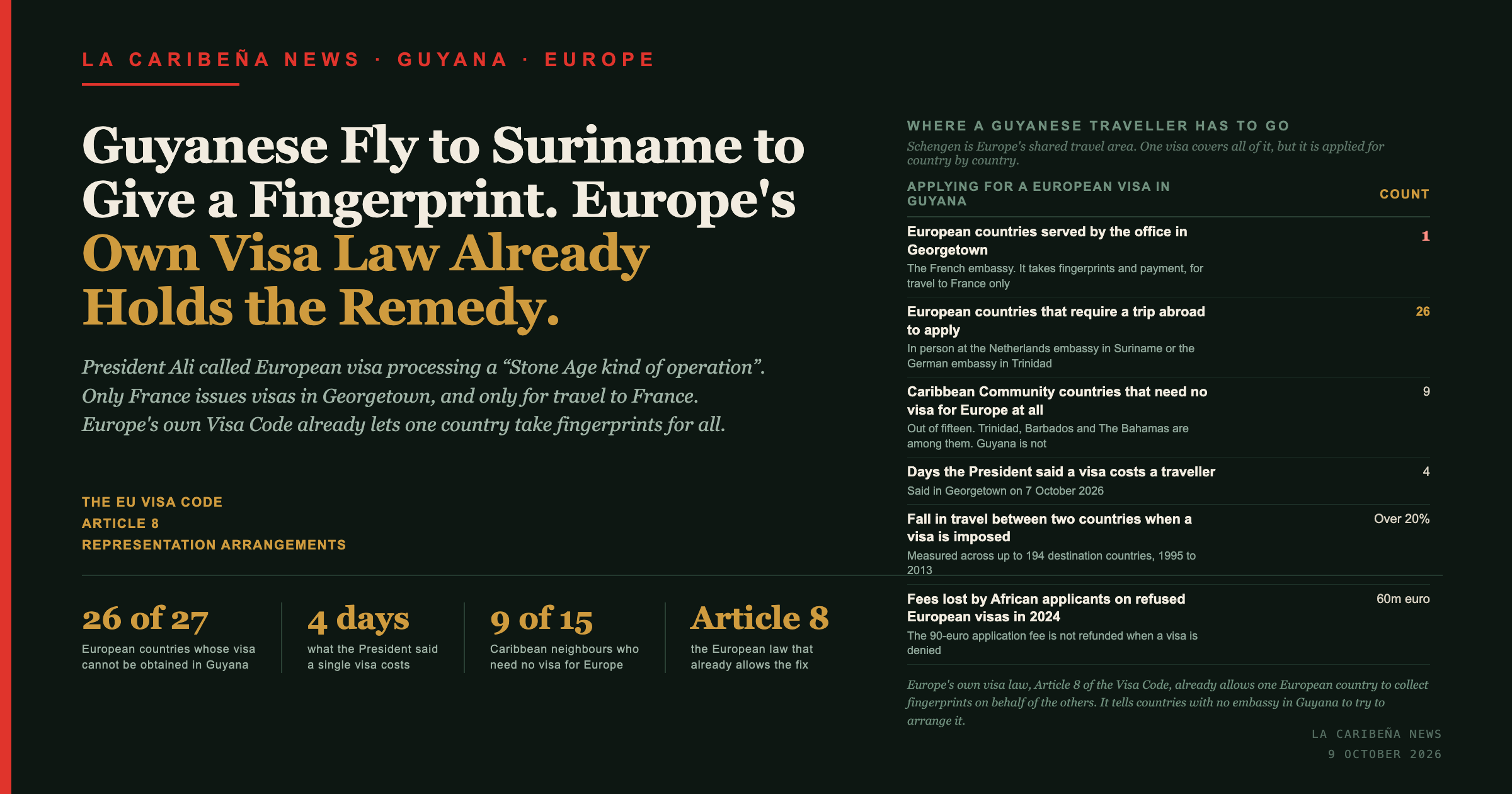
What the title card shows
Every data point on the article's title card, in text.
- 26 of 27. EU member states whose Schengen visa a Guyanese cannot obtain in Georgetown. The French embassy serves applications for France only.
- Paramaribo and Port of Spain. Where Guyanese must go in person to enrol biometrics for any other Schengen state, at the Netherlands and German embassies respectively.
- Four days. The time President Ali said a Guyanese must invest to obtain a visa before travelling.
- Article 8. The provision of the EU Visa Code, Regulation (EC) No 810/2009, that lets one member state enrol biometric identifiers on behalf of another, and tells member states without a consulate to endeavour to arrange it.
- 9 of 15. CARICOM full members exempt from the Schengen visa requirement under Regulation (EU) 2018/1806. Guyana is not one of them.
- More than 20 per cent. The fall in tourism between two countries when a visa requirement is introduced, measured across up to 194 destinations by Czaika and Neumayer, Applied Geography, 2017.
- EUR 60 million. Fees lost by African applicants on refused Schengen visas in 2024, on LAGO Collective analysis. The EUR 90 fee is not refunded.
Frequently Asked Questions
Do Guyanese need a visa to visit Europe?
Yes. Guyana is listed in Annex I of Regulation (EU) 2018/1806, so Guyanese nationals require a Schengen visa. Nine CARICOM full members are exempt under Annex II, including Trinidad and Tobago, Barbados and The Bahamas.
Where can a Guyanese apply for a Schengen visa?
The French embassy in Georgetown processes applications, including biometric enrolment, but strictly for travel to France. For any other Schengen state an applicant must attend in person at the Netherlands embassy in Suriname or the German embassy in Trinidad and Tobago.
Could the Georgetown office serve other European countries?
Article 8 of the EU Visa Code allows a member state to represent another in a limited way solely to collect applications and enrol biometric identifiers. It requires a bilateral arrangement between the two governments, and it directs member states without their own consulate to endeavour to conclude one, particularly where distance would otherwise impose a disproportionate effort on applicants.
Is the European Union obliged to change this?
No. Article 8 uses the words "shall endeavour," which obliges effort rather than a result. It gives Guyana no entitlement, sets no deadline and is not enforceable by a country outside the European Union.
What does a visa requirement cost a country economically?
Research covering up to 194 destination countries found that introducing a visa requirement reduces tourism between the two countries by more than 20 per cent, with the heaviest effect on poorer countries, and that the deterred travel and trade is redirected to destinations that do not require a visa.