SMALL BUSINESS · THE INTERVIEW
July 4, 2026 | By La Caribeña News
Quick summary: Timothy Tucker, past president of the Georgetown Chamber of Commerce and Industry and an executive member of Guyana’s Private Sector Commission, is urging micro and small businesses to register now with the Small Business Bureau, free of charge, so they can borrow from the Guyana Development Bank the moment it opens in 2026.
GEORGETOWN, GUYANA. The Guyana Development Bank has not yet opened its doors, and that, says Timothy Tucker, is exactly the point. The businessman who spent two years at the front of the Local Content fight now has a simpler campaign: get Guyana’s smallest businesses formal, compliant, and paper-ready before the money arrives.
Speaking on Starting Point, a Guyanese podcast whose full interview airs Sunday, July 5 at 12 p.m. on Facebook, YouTube and Spotify, Tucker called the bank “a great initiative, great opportunity for businesses” aimed squarely at “budding entrepreneurs, micro businesses, and small businesses.” Then came the caution that anchors his whole message.
“Just like the small business bureau, they’re going to require you to have your house in order.”
Timothy Tucker · Starting Point
Tucker speaks from three seats at once. He chairs the Trade, Investment and Legal Committee of the Guyana Manufacturing and Services Association, chairs the Economy, Trade and Investment Committee of the Private Sector Commission, and served as president of the Georgetown Chamber of Commerce and Industry from April 2021 to March 2023. Few private sector figures in Guyana carry a longer record of arguing that ordinary Guyanese businesses deserve first claim on the country’s boom.
What Is the Guyana Development Bank Offering MSMEs?
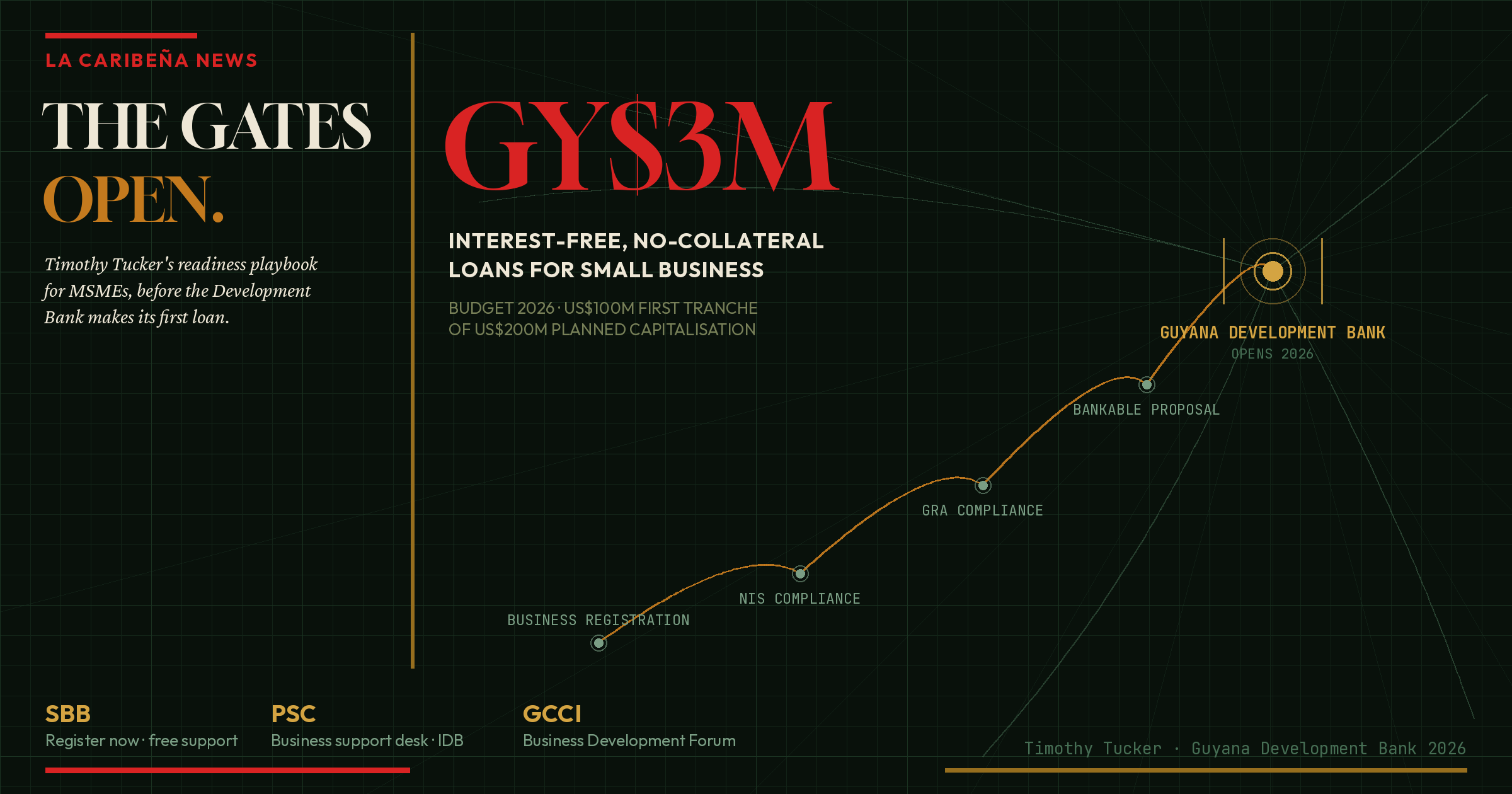
Budget 2026 set aside an initial US$100 million for the bank, the first tranche of a planned capitalisation of at least US$200 million, according to the Department of Public Information. Once operational, the institution is expected to lend up to GY$3 million to small businesses without interest or collateral, with qualifying borrowers eligible for a further GY$7 million through commercial banks at preferential rates. The Guyana Development Bank Bill 2026 was tabled in the National Assembly on June 5, as reported by INews Guyana, and awaits debate before the bank can make its first loan. Some economists and opposition lawmakers have called for the bill to go to a Special Select Committee, so the parliamentary timetable, not the capital, is now the variable to watch.
THE BANK, BY THE NUMBERS
US$100M capitalised in Budget 2026, of US$200M planned GY$3M in zero-interest, no-collateral micro-loans GY$7M more through commercial banks at preferential rates Bill tabled June 5, 2026 · debate pending.
For a country where collateral requirements have historically shut micro enterprises out of commercial credit, the design is deliberate. The bank is meant to reach the vendor, the small manufacturer, and the service provider who could never satisfy a commercial lender’s security demands. Tucker’s warning is that the same businesses most likely to benefit are the ones least likely to be paperwork-ready.
What Does Tucker Say Businesses Should Do Right Now?
His checklist starts with formalisation. Business registration, National Insurance Scheme enrolment, and Guyana Revenue Authority compliance come before any loan application, because a development bank, he noted, still needs to see a real business. It is not, in his words, “self financing.”
He pointed entrepreneurs to institutions that will do the preparation work with them at no cost. “There are many organizations within the country that can help you,” he said. The Private Sector Commission runs a Business Support Desk, backed by the Inter-American Development Bank, that offers free consultations on business plans and financial feasibility. “It’s there to help persons get those bankable proposals,” Tucker said. The Small Business Bureau offers the same service. “Small Business Bureau does the same thing as well, they offer those services for free,” he added.
He also flagged the GCCI’s annual Business Development Forum, which he described as “an excellent event every year” that teaches start-ups the mechanics of registration and compliance. The forum has run since 2018 and gave micro and small enterprises top billing at its most recent edition.
He reminded self-employed listeners that they enjoy the same monthly income tax threshold as salaried workers, so small profits are not the tax burden many informal operators fear. On air, Tucker put that threshold at GY$130,000 a month. The reality is better than he said. That was the 2025 level; Budget 2026 raised the threshold to GY$140,000 from January 1, per News Room Guyana. A registered microbusiness clearing GY$140,000 a month in profit owes no income tax at all. The gap between the figure Tucker quoted and the one now in force only strengthens his point: the tax system has moved further in the small operator’s favour than even its advocates were crediting on air.
The payoff is speed on launch day.
“As soon as those gates open at the Guyana Development Bank, you can go right in and secure your financing with a bankable product proposal.”
Timothy Tucker · Starting Point
The advice matters beyond any single loan. The readiness ecosystem Tucker describes is already producing results at the community level, where institutions like the ones behind Region 3’s youth business movement, which La Caribeña News profiled in June, are training the young entrepreneurs the Development Bank is meant to reach. Formal MSMEs hire formally, and an economy that finances its own entrepreneurs gives its professionals one more reason to build at home rather than join the exit corridor La Caribeña News documented that same month.
Who Is Timothy Tucker, and Why Does His Advice Carry Weight?
Tucker is the owner of pest control firm Rid-O-Pes and was elected GCCI president in April 2021, as reported by News Room Guyana. His presidency became synonymous with one cause. The Chamber, under his leadership, pressed relentlessly for a legislated guarantee that Guyanese companies would capture value from the oil economy, advocacy that culminated when President Dr. Mohamed Irfaan Ali signed the Local Content Act into law in December 2021.
Tucker’s advocacy did not soften once the law passed. In November 2021 he warned that local content policy and legislation must guard against “rent-a-citizen” scenarios, where foreign firms recruit token Guyanese partners to qualify, a position reported by Kaieteur News. When the Local Content Secretariat denied certification to Ramps Logistics in June 2022, the Chamber under Tucker declared that no “rent-a-citizen” fronting should be tolerated, per Demerara Waves. When he was re-elected in 2022, OilNOW simply called him a “local content advocate.” The label fit.
His positions carried an edge that sometimes cut in two directions at once. In January 2022, after the CARICOM Private Sector Organisation objected that Guyana’s Local Content Act violated regional free trade rules, Tucker responded that it might be time for Guyana to leave the CARICOM Single Market and Economy, as reported by Demerara Waves. Two months later he was publicly blasting Trinidad and Tobago for discriminating against Guyanese exporters and demanding fairer access to that market, per News Room Guyana. Critics saw a contradiction there: protection for Guyanese firms at home, open doors demanded abroad. Tucker’s framing was reciprocity. Guyanese businesses had faced non-tariff barriers in Port of Spain for years, and he was unwilling to watch CARICOM rules invoked against Guyana’s one piece of defensive legislation while those barriers stood. Reasonable people can differ on whether that is a double standard or hard bargaining. What it is not is confusion about whom he works for.
The man who once mused about leaving the Single Market now chairs the Private Sector Commission committee responsible for economy, trade and investment, working within the regional system he criticised. That evolution, from insurgent to institution-builder, is the through line that runs straight into this podcast appearance. In 2021 the argument was that Guyanese firms deserved a protected seat at the oil and gas table. In 2026 the argument is that the smallest Guyanese firms should be ready to claim their seat at the financing table. Both rest on the same conviction: opportunity means little to a business that is not positioned to take it.
Frequently Asked Questions
What is the Guyana Development Bank?
It is a government-backed financial institution announced in the PPP/C administration’s 2025 manifesto and funded with an initial US$100 million in Budget 2026, part of a planned capitalisation of at least US$200 million. It is designed to lend to micro, small and medium enterprises that cannot meet commercial banks’ collateral requirements. The Guyana Development Bank Bill 2026 received its first reading in the National Assembly on June 5, 2026 and awaits debate.
How much can a small business borrow, and on what terms?
The bill tabled in June 2026 provides for micro-credit loans of up to GY$3 million at zero interest for qualifying small businesses, with reported access to a further GY$7 million through commercial banks at preferential rates. Final terms will be confirmed when the National Assembly passes the bill and the bank publishes its lending criteria.
What should an entrepreneur do before the bank opens?
Timothy Tucker’s advice is to complete business registration, NIS enrolment and GRA compliance now, then build a bankable business proposal. The Small Business Bureau offers free support services, and the Private Sector Commission’s business support desk, partially funded by the IDB, helps businesses prepare bankable proposals at no cost.
Where can I watch the full Timothy Tucker interview?
The full episode of Starting Point airs Sunday, July 5, 2026 at 12 p.m. and will be available on the podcast’s Facebook page, YouTube channel and Spotify.