By LCN Business Desk
Argentina intends to sell citizenship. Economy Minister Luis Caputo unveiled the scheme at an investor event in Paris on 2 October, offering a passport in exchange for a non-refundable contribution of 311,000 euros to the Treasury, or 711,000 euros placed in a new government bond and held for seven years. A family of four would pay 444,000 euros. Bloomberg and Fortune reported the two routes in dollar terms as about US$350,000 and US$800,000. Applications are expected to open before the end of the year.
The purpose is stated. Argentina's Treasury faces close to 22 billion euros of foreign-currency debt falling due in 2027, and a consortium of investment firms advising the Government estimates the programme could raise up to 2.2 billion euros. Intelligence and financial oversight agencies are to vet applicants' identities, criminal records and sources of funds. The idea dates from President Javier Milei's July 2024 visit to Sun Valley, Idaho, where technology executives expressed interest in Argentine citizenship.
Five Caribbean states have been selling citizenship for decades. In June they were asked to stop.
What has the European Commission asked the Caribbean to do?
End the programmes by the middle of 2028.
Antigua and Barbuda, Dominica, Grenada, Saint Kitts and Nevis and Saint Lucia each received a letter dated 25 June 2026, signed by the European Commissioner for Internal Affairs and Migration, Magnus Brunner, requesting that they phase out citizenship by investment by 1 June 2028, with a transition period of 24 months. The Commission also asked for interim safeguards, including stronger due diligence and the exclusion of applicants under European Union sanctions.
The consequence named for non-compliance is the loss of visa-free access to the Schengen area. The European Union's revised visa suspension mechanism treats the operation of a citizenship-by-investment programme as itself a ground for suspension, which is a change from treating weak vetting as the problem.
The European Commission has not published the letter. Its existence and its terms are confirmed by Antigua and Barbuda's Office of the Prime Minister, and this newspaper reports it on that basis.
What is the Caribbean actually being asked to give up?
On the International Monetary Fund's figures, about five per cent of GDP.
Citizenship receipts have averaged approximately that share across the five states in recent years, and in places the dependence runs far deeper. In Dominica, citizenship receipts have accounted for roughly 37 per cent of annual government revenue.
This is not the only fiscal limit in the region set from outside it. In the British Virgin Islands, a runway extension has waited years on United Kingdom approval to borrow beyond the territory's debt ratios.
The decline has already started, and Saint Kitts and Nevis shows its speed. A 2025 International Monetary Fund report recorded citizenship fees there falling from 21.7 per cent of GDP in 2023 to 8.1 per cent in 2024. The country's overall fiscal deficit widened to 11.7 per cent of GDP in 2025 as the revenue fell further. That is the adjustment arriving before the deadline does.
Since 1 July 2024 the five have operated a common price floor of 200,000 United States dollars for every citizenship option, agreed regionally through the Organisation of Eastern Caribbean States. The floor was itself a response to external pressure, adopted to stop the programmes undercutting one another.
How does Argentina's price compare?
It is above the Caribbean floor by roughly three-quarters.
Argentina's contribution route, at about US$350,000 in the dollar terms reported, sits well above the 200,000 United States dollar minimum the five Caribbean states agreed. A buyer choosing on price alone would not choose Buenos Aires.
A buyer choosing on what the passport does might. Argentine nationals hold visa-free access to the Schengen area, as the citizens of the five Caribbean states currently do, and Argentina is a G20 economy of some 46 million people rather than a state of a few hundred thousand at most. The product is not identical, and the price difference says so.
Is the same instrument being treated the same way?
The letter went to five small island states.
Argentina is opening a citizenship-by-investment programme explicitly to raise foreign currency against a debt repayment schedule. It is pitching it to investors in a European capital. Its nationals hold Schengen visa-free access, so the revised visa suspension mechanism is capable of reaching it on its face.
On the public record this newspaper can find, the European Commission has not written to Argentina. That is an absence on the record rather than a statement of what Brussels will or will not do, and the Argentine scheme was announced yesterday.
What can be said is narrower and still worth stating. The instrument the Caribbean has been told to retire by 2028, on the ground that selling citizenship is itself the problem, has now been adopted by a G20 member and presented to investors as sovereign financing.
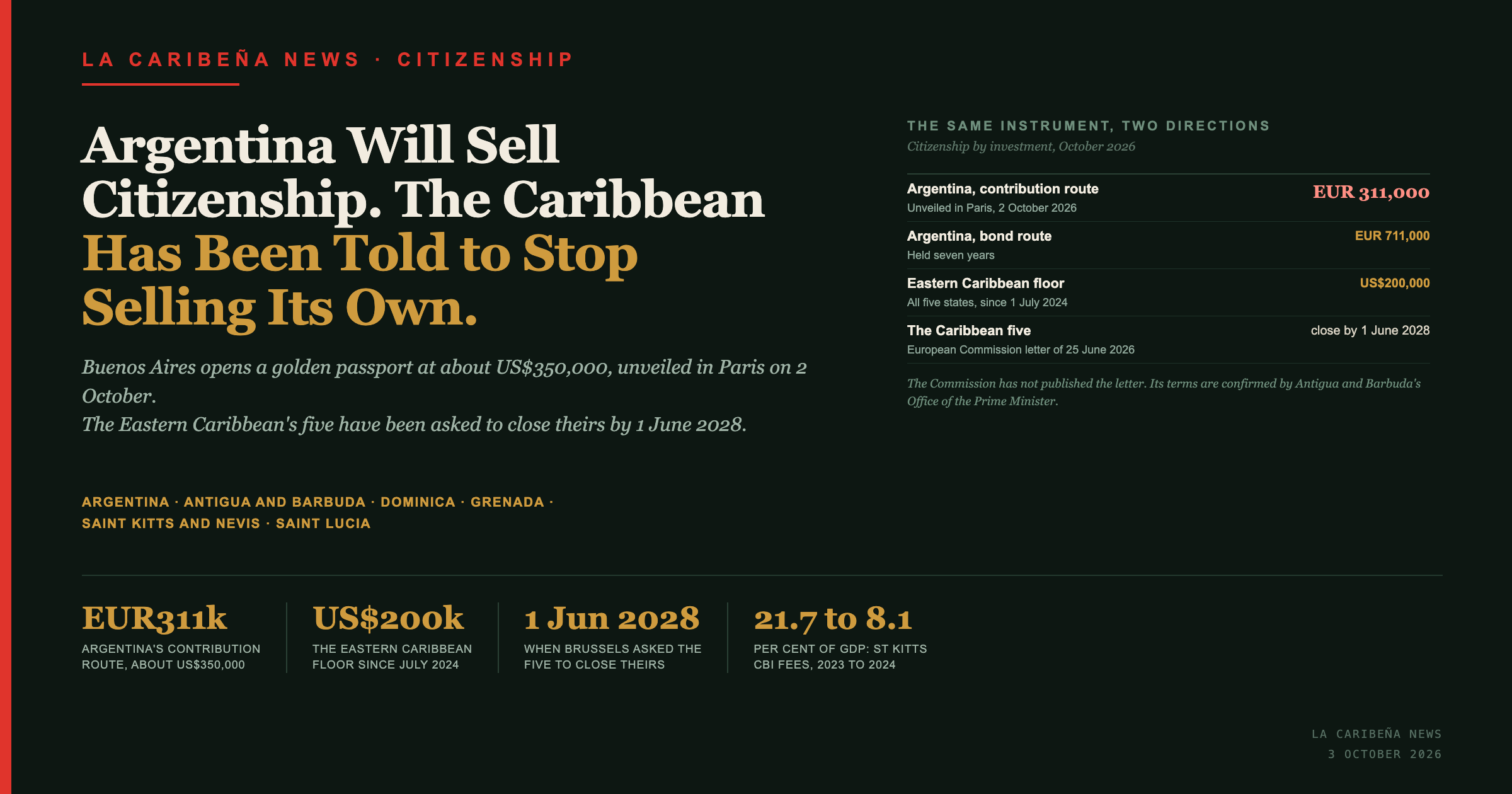
What the title card shows
311,000 euros: the non-refundable contribution to the Argentine Treasury under the scheme unveiled by Economy Minister Luis Caputo in Paris on 2 October 2026. 711,000 euros: the alternative, placed in a new government bond and held for seven years. 444,000 euros: the cost for a family of four. About US$350,000 and US$800,000: the two routes as reported in dollar terms by Bloomberg and Fortune. 22 billion euros: Argentina's foreign-currency debt falling due in 2027. 2.2 billion euros: the amount a consortium of investment firms advising the Government estimates the programme could raise. US$200,000: the common price floor for every citizenship option in the five Eastern Caribbean states, in force since 1 July 2024. 1 June 2028: the date by which the European Commission has requested those five end their programmes, in a letter dated 25 June 2026 signed by Commissioner Magnus Brunner. 24 months: the transition period proposed. About 5 per cent of GDP: average citizenship receipts across the five, on International Monetary Fund figures. 21.7 to 8.1 per cent of GDP: the fall in Saint Kitts and Nevis citizenship fees between 2023 and 2024. 11.7 per cent of GDP: that country's fiscal deficit in 2025. 37 per cent: the share of annual government revenue citizenship receipts have represented in Dominica.
Frequently Asked Questions
What is Argentina offering?
Citizenship in exchange for a non-refundable contribution of 311,000 euros to the Treasury, or 711,000 euros invested in a new government bond held for seven years. A family of four would pay 444,000 euros. Applications are expected to open before the end of 2026.
Why is Argentina doing it?
To raise foreign currency. The Treasury faces close to 22 billion euros of foreign-currency debt due in 2027, and advisers to the Government estimate the programme could raise up to 2.2 billion euros.
Which Caribbean countries sell citizenship?
Antigua and Barbuda, Dominica, Grenada, Saint Kitts and Nevis, and Saint Lucia. Since 1 July 2024 they have operated a common minimum of 200,000 United States dollars for every option, agreed through the Organisation of Eastern Caribbean States.
What has the European Union asked them to do?
A letter dated 25 June 2026 from Commissioner Magnus Brunner asked all five to phase out their programmes by 1 June 2028, with a 24-month transition and interim safeguards in the meantime. Non-compliance is linked to the loss of Schengen visa-free access. The European Commission has not published the letter; its terms are confirmed by Antigua and Barbuda's Office of the Prime Minister.
How much does this revenue matter to those states?
On International Monetary Fund figures, citizenship receipts have averaged about five per cent of GDP across the five. In Dominica they have been roughly 37 per cent of annual government revenue. In Saint Kitts and Nevis they fell from 21.7 per cent of GDP in 2023 to 8.1 per cent in 2024, and the fiscal deficit widened to 11.7 per cent of GDP in 2025.