By La Caribeña News · 11 August 2026
The Citizenship by Investment Unit of Dominica told its agents in October 2018 that special offers and discounts were contrary to law and instructed them to stop. In January 2022 it prohibited any claim that citizenship could be obtained below the prescribed minimum. In 2024 the Prime Minister said legislation would let the state revoke citizenships bought below the legal threshold, and sixty-eight passports were revoked.
On 7 August a Dominican hotelier stood up in Roseau and said it had carried on throughout.
Gregor Nassief, founder and chief executive of Secret Bay Resort & Residences, has written to Prime Minister Roosevelt Skerrit fourteen times in seven years about pricing inside the country's citizenship by investment programme. He held a press conference after his most recent letter, dated 17 June and addressed to Skerrit and Opposition Leader Jesma Paul-Victor, was leaked and began circulating. Copies had gone to Cabinet, to every parliamentarian, to President Sylvanie Burton, to the head of the Financial Intelligence Unit and to the head of the Citizenship by Investment Unit.
He told reporters he had not put the letter into circulation himself, and that once it was public an explanation was in the public interest.
What is the allegation?
That citizenship has been sold below the price the law sets, and the treasury has absorbed the difference.
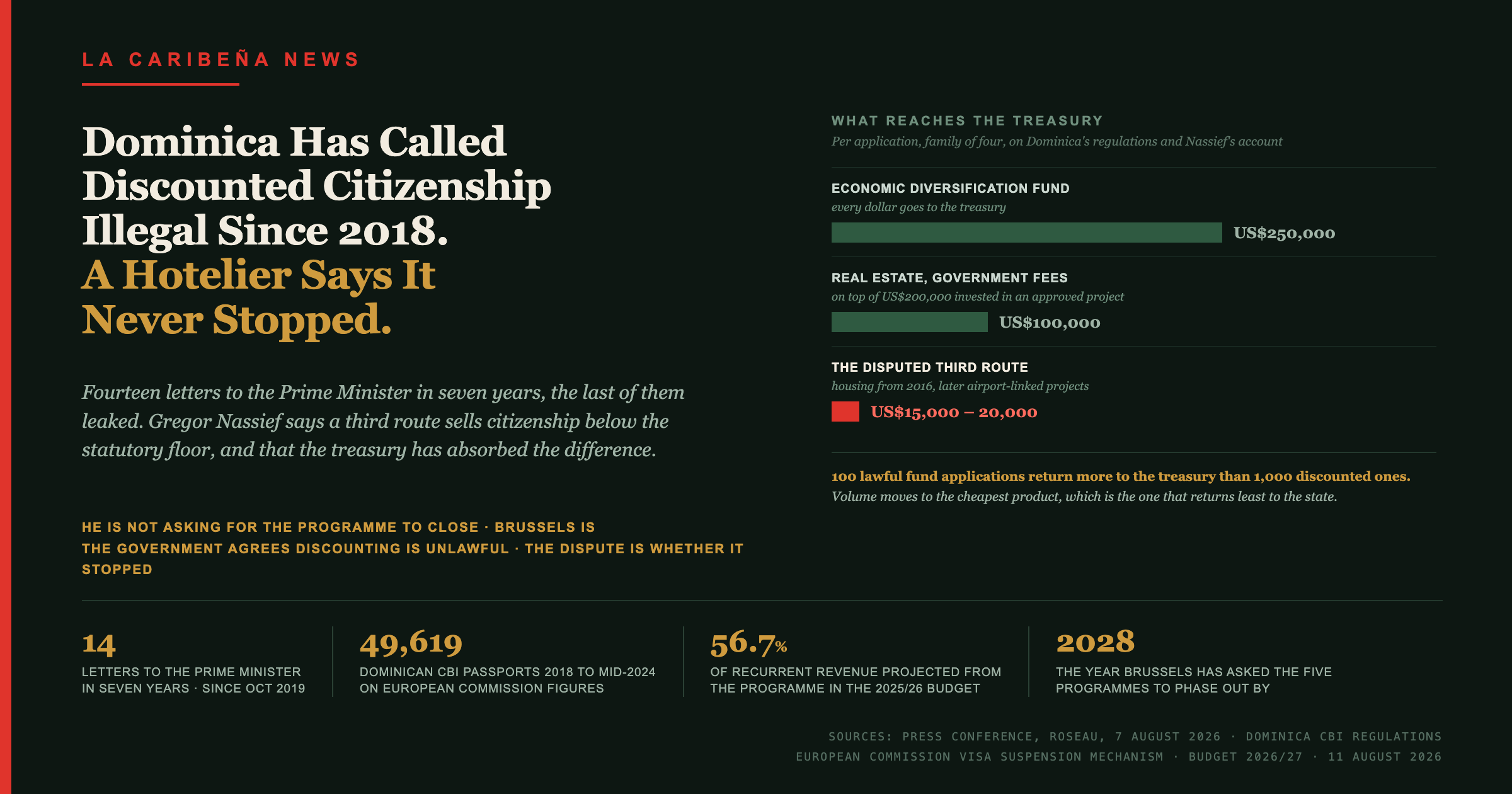
Dominica's regulations recognise two investment routes. A contribution to the Economic Diversification Fund runs to US$200,000 for a single applicant and US$250,000 for a main applicant with up to three dependants, and all of it goes to the treasury. A real estate applicant invests US$200,000 in a government-approved project and pays government fees on top, set at US$100,000 for a family of four in the June 2024 gazette. Nassief told the press conference both routes have functioned for years.
His objection is to a third flow. A housing option appeared between 2016 and 2018, joined later by projects tied to the new international airport, which he groups as a social infrastructure option. Pricing there, on his account, runs far below the statutory floor, and of each transaction only about US$15,000 to US$20,000 reaches the treasury.
Nassief put the consequence as arithmetic rather than accusation. On his figures, one hundred lawful fund applications would deliver more to the treasury than one thousand discounted ones. Volume migrates to the cheapest product, which is also the one returning least to the state, and applications that belong in the fund or the real estate route flow instead into the discounted scheme.
Legitimate developers lose on the same mechanism. He said stalled construction is visible across the island, that some projects began discounting themselves out of desperation to compete, and that it did not save them. He declined to name them.
Has Dominica ever accepted the practice is unlawful?
Repeatedly, and in its own words.
The instruction from the Citizenship by Investment Unit in October 2018 came from its then head, Emmanuel Nanthan, who told agents that discounting was contrary to law. The Unit's January 2022 warning went to the marketing of below-minimum citizenship. The current head, Marie-Therese Johnson, has said that anyone found to have obtained citizenship below the official minimum faces revocation, and the Unit has issued renewed warnings about unauthorised agents and non-compliant practices.
Nassief's first letter to the Prime Minister was dated 1 October 2019, months after Secret Bay was approved as a citizenship project and the transactions became visible to him. He read part of it back to reporters. Left unchecked, he wrote then, the practices would eat away at the legitimate parts of the industry and leave only those prepared to race to the bottom.
Seven years later his summary was that nothing had been done. He said he had met the Prime Minister many times, spoken to ministers, and met the President, before concluding that a parliamentary hearing was the only route left.
Skerrit has defended the programme as robust and transparent, and has pointed to its role in financing reconstruction after natural disasters. The government's stated position and the developer's account agree that selling below the floor is unlawful. They differ on whether it has been happening.
How many passports are involved?
Roughly fifty thousand in six and a half years, on European Commission figures.
Dominica does not publish issuance at that level, and Nassief was explicit that his numbers are not the government's. The European Commission's seventh report under its visa suspension mechanism records 34,596 Dominican citizenship passports issued between 2018 and 2022, a further 9,539 in 2023, and 5,484 in the first half of 2024. He totals those at 49,619.
Against that, he put the early years of the programme at between 500 and 800 a year, rising to roughly 2,000 by 2017 and 2018.
That change in scale is what he says the discounting produced, and what the country has since paid for.
What has it cost Dominica abroad?
Visa-free access to Britain, visa categories in the United States, and now the programme's future in Europe.
The United Kingdom revoked visa-free access for Dominican nationals on 19 July 2023, the then Home Secretary citing clear and evident abuse of the programme. Washington followed with a presidential proclamation in December 2025 imposing partial travel restrictions on nationals of Dominica, Antigua and Barbuda and Haiti, then in January 2026 froze immigrant visa processing for seventy-five countries including ten citizenship-by-investment jurisdictions, and cut visa validity from ten years to three months.
Brussels went furthest. The European Commission wrote to all five Eastern Caribbean programmes on 25 June 2026 asking them to phase out by 1 June 2028, with a twenty-four month transition. Skerrit chaired the meeting in Roseau on 10 July at which the five governments agreed a joint response and a mission to Brussels.
The pattern is familiar in the region, where Washington has reached individual directors' visas to change a company's decision and where passport access is treated as an instrument rather than a status. Nassief has felt it directly. In May he became the first Dominica-based hotelier elected president-elect of the Caribbean Hotel and Tourism Association. Weeks later his United States visa was not renewed, a decision he links to the restrictions.
What is Dominica's position without the programme?
Dependent, on the government's own budget arithmetic.
The 2025/2026 budget projected that 56.7 per cent of recurrent revenue would come from the citizenship programme, on the opposition Dominica Freedom Party's reading. Non-citizenship recurrent revenue stood at EC$456.2 million, about US$169 million, against recurrent spending of EC$679.9 million, about US$252 million.
Finance Minister Irving McIntyre presented the 2026/2027 budget on 4 August, days before the press conference, putting recurrent revenue at EC$1,032.1 million, about US$382 million. Tax revenue accounts for EC$473.5 million of that. Non-tax revenue, the category carrying citizenship receipts, accounts for EC$558.6 million.
Nassief's request running through all fourteen letters is for a foreign direct investment strategy unconnected to citizenship sales. He said no such strategy exists. The gap shows up in the votes Parliament passes and the treasury cannot fund: tourism marketing, the line he knows best, receives roughly a fifth of what legislators approve for it.
Elsewhere in the region the same dependence is being named early rather than late. Suriname's Minister of Oil, Gas and Environment warned last week about concentrating an economy on one revenue source, and Dominica itself has begun building an agency around its creative sector.
What is he asking for?
A hearing first, and the courts if that fails.
The 17 June letter asks for a parliamentary hearing or special committee review, with Cabinet, Parliament, the Financial Intelligence Unit, the Citizenship by Investment Unit, civil society and selected private sector participation. Failing that, it asks for judicial review, a commission of inquiry, and an independent forensic financial audit. It sought a reply within twenty-one days.
Beyond pricing, Nassief raised agreements he says should be public and are not, and construction begun before planning approval, which he framed as an environmental protection rather than a paperwork one.
He is not asking for the programme to be closed. That places him against Brussels, which wants it phased out by 2028, and against his own government, which says the discounting he describes has been prohibited since 2018, at the same time.
The data in this article
- Gregor Nassief, founder and chief executive of Secret Bay Resort & Residences, has written to Prime Minister Roosevelt Skerrit fourteen times over seven years about pricing in Dominica's citizenship by investment programme. First letter 1 October 2019. Press conference in Roseau, 7 August 2026.
- The letter at issue is dated 17 June 2026, addressed to Skerrit and Opposition Leader Jesma Paul-Victor, copied to Cabinet, all parliamentarians, President Sylvanie Burton, the head of the Financial Intelligence Unit and the head of the Citizenship by Investment Unit. It was leaked rather than published by him.
- Economic Diversification Fund route: US$200,000 for a single applicant; US$250,000 for a main applicant with up to three dependants, all to the treasury.
- Real estate route: US$200,000 in a government-approved project plus government fees, set at US$100,000 for a family of four in the June 2024 gazette.
- The disputed third route: a housing option from 2016 to 2018 and later airport-linked projects, grouped by Nassief as a social infrastructure option. He says about US$15,000 to US$20,000 per transaction reaches the treasury, and that 100 lawful fund applications would yield more than 1,000 discounted ones.
- Government position on discounting: the Citizenship by Investment Unit told agents in October 2018 that discounts were contrary to law; in January 2022 it prohibited marketing citizenship below the prescribed minimum; in 2024 the Prime Minister said legislation would permit revocation of citizenships obtained below the threshold, and 68 passports were revoked. Current Unit head: Marie-Therese Johnson.
- European Commission seventh report under the visa suspension mechanism: 34,596 Dominican citizenship passports issued 2018 to 2022, 9,539 in 2023, 5,484 in the first half of 2024. Nassief totals 49,619. He puts early-programme volumes at 500 to 800 a year, rising to about 2,000 by 2017 and 2018.
- United Kingdom revoked visa-free access for Dominican nationals on 19 July 2023. United States presidential proclamation of December 2025 imposed partial travel restrictions on Dominica, Antigua and Barbuda and Haiti; January 2026 froze immigrant visa processing for 75 countries including 10 citizenship-by-investment jurisdictions and cut visa validity from ten years to three months.
- European Commission wrote to the five Eastern Caribbean programmes on 25 June 2026 seeking phase-out by 1 June 2028 with a 24-month transition. The five governments agreed a joint response and a Brussels mission at a meeting chaired by Skerrit in Roseau on 10 July 2026.
- Dominica 2025/2026 budget: 56.7 per cent of recurrent revenue projected from the programme, per the opposition Dominica Freedom Party. Non-programme recurrent revenue EC$456.2 million (about US$169 million) against recurrent spending EC$679.9 million (about US$252 million).
- Dominica 2026/2027 budget, presented by Finance Minister Irving McIntyre on 4 August 2026: recurrent revenue EC$1,032.1 million (about US$382 million), of which tax revenue EC$473.5 million and non-tax revenue EC$558.6 million.
- Nassief was elected president-elect of the Caribbean Hotel and Tourism Association in May 2026 and his United States visa was not renewed weeks later.
Frequently Asked Questions
Who is Gregor Nassief? The founder and chief executive of Secret Bay Resort & Residences in Dominica, and since May 2026 the president-elect of the Caribbean Hotel and Tourism Association. Secret Bay was founded in 2011 and approved as a citizenship by investment project in 2019.
What exactly does he say is happening? That citizenship has been sold below the minimum price set in Dominica's regulations through a third route he calls the social infrastructure option, leaving about US$15,000 to US$20,000 per transaction for the treasury instead of the US$200,000 to US$250,000 the fund route delivers.
Does the Government of Dominica accept that discounting is illegal? It has said so repeatedly. The Citizenship by Investment Unit told agents in October 2018 that discounts were contrary to law, prohibited below-minimum marketing in January 2022, and the Prime Minister said in 2024 that citizenships obtained below the threshold could be revoked. Sixty-eight passports were revoked. The dispute is whether the practice stopped.
What is he asking for? A parliamentary hearing or special committee review including the Financial Intelligence Unit and the Citizenship by Investment Unit. Failing that, judicial review, a commission of inquiry and an independent forensic financial audit. He has said he would be willing to go to court, and he is not asking for the programme to be closed.
How much does Dominica depend on the programme? The 2025/2026 budget projected 56.7 per cent of recurrent revenue from it, on the opposition's reading, with non-programme recurrent revenue of EC$456.2 million against recurrent spending of EC$679.9 million.
What are Britain, the United States and the European Union doing? Britain removed visa-free access for Dominican nationals in July 2023. The United States imposed partial travel restrictions in December 2025 and froze immigrant visa processing in January 2026. The European Commission asked the five Eastern Caribbean programmes on 25 June 2026 to phase out by 1 June 2028.