ANALYSIS
Two CARICOM states moved on the creative economy inside two months. One started with a financing institution. The other started with a consultation, in a budget that shrank by EC$180 million, in the first year its fiscal rules bind.
BY LCN NEWSROOM · GEORGETOWN, GUYANA
Quick summary: Dominica announced the Creative Economy Development Agency in its 2026/27 budget on 4 August 2026, with its structure still to be settled through consultation. The budget fell to EC$1.15 billion from EC$1.33 billion. Guyana's Orange Economy framework, announced 21 June, named the Guyana Development Bank as its financing route, with creative industries a priority sector.
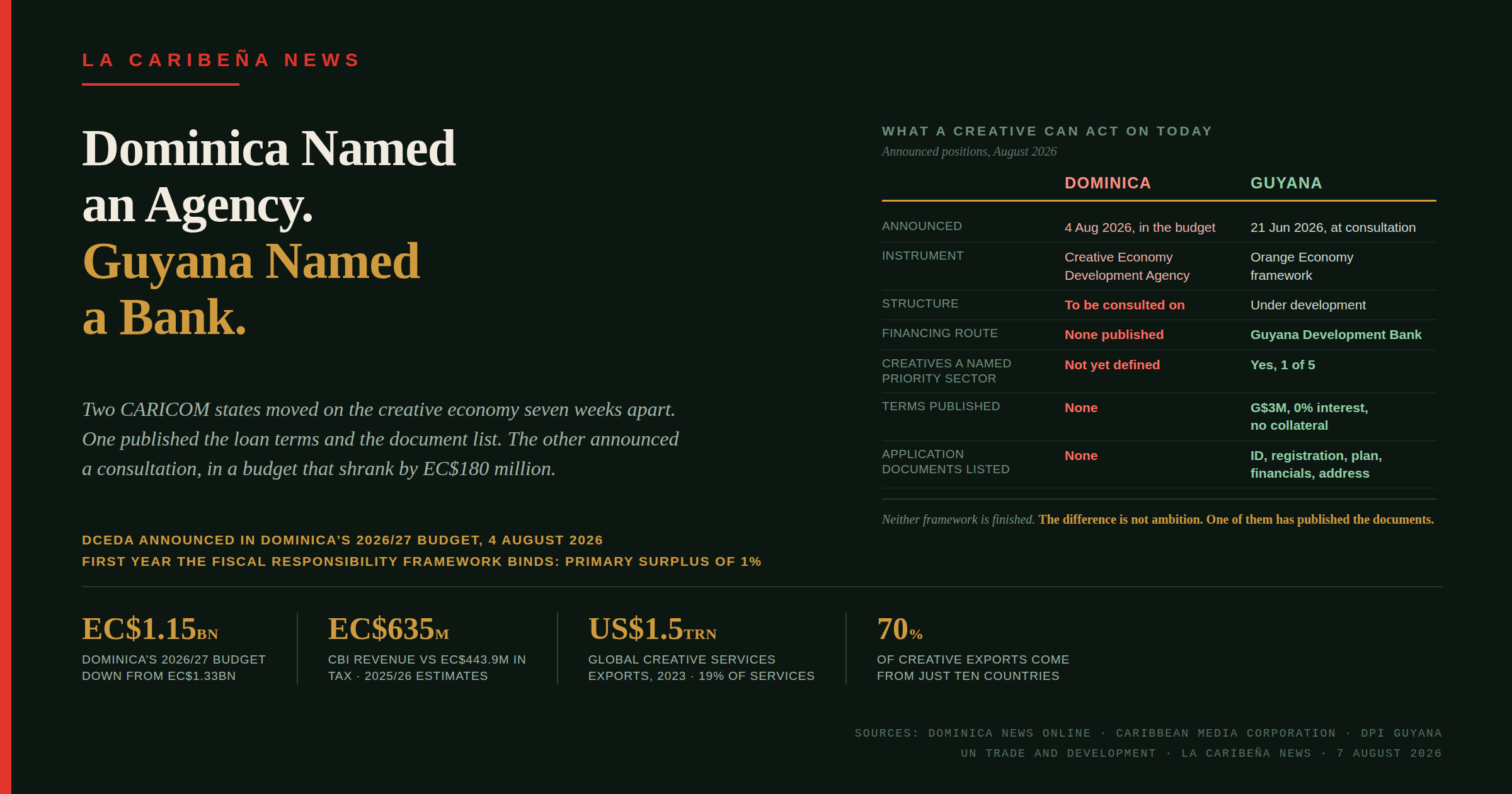
What the title card shows
Every data point on the article's title card, in text.
- EC$1.15 billion. Dominica's 2026/27 budget, presented 4 August 2026. Source: Caribbean Media Corporation reporting of the budget presentation.
- EC$1.33 billion. Dominica's 2025/26 budget, presented 25 July 2025. Source: Caribbean Media Corporation.
- 1 per cent, then 2 per cent. The primary surplus required under the Fiscal Responsibility Framework Resolution, which takes effect in FY2026/27. Source: 2025/26 budget address.
- EC$635.0 million against EC$443.9 million. Citizenship by Investment revenue against tax revenue in Dominica's 2025/26 recurrent estimates. Source: 2025/26 budget address.
- 21 June 2026. Date Guyana announced its Orange Economy framework, naming the Guyana Development Bank as the financing route. Source: Department of Public Information, Guyana.
- G$3 million, zero interest, no collateral. The Guyana Development Bank's announced terms for eligible borrowers, with creative industries one of five priority sectors. Source: Minister Zulfikar Ally, as reported by La Caribeña News.
- US$1.5 trillion. Global creative services exports in 2023, 19 per cent of all services exports. Source: UN Trade and Development.
- About 70 per cent. Share of global creative goods and services exports originating in just ten countries. Source: UN Trade and Development.
What did Dominica announce?
An agency for its creative sector, and a plan to work out what it is.
Finance Minister Dr Irving McIntyre used the 2026/27 budget presentation on 4 August to announce the Dominica Creative Economy Development Agency, or DCEDA.
"As a means of further harnessing the creative talent of our people, the Government has decided to establish Dominica's Creative Economy Development Agency," he told Parliament.
The government said it will spend the coming months consulting "artists, musicians, filmmakers, designers, event organisers, cultural practitioners and other stakeholders before finalising the new agency's structure."
What exists today?
The decision. Not the agency.
On the public record this newspaper can find, no legal form has been set, no allocation has been published, no commencement date has been given and no board or staff has been named. The consultation will determine the structure, and the structure will determine everything else.
That is not a criticism of consulting. Designing a creative economy body without talking to the people in it is how these agencies fail. It is a statement of what a practitioner can plan around this year, which is nothing yet.
What kind of budget is it landing in?
A smaller one, with new rules attached.
Dominica's 2026/27 package is EC$1.15 billion. The 2025/26 package, presented on 25 July 2025, was EC$1.33 billion. That is roughly EC$180 million less, about 14 per cent, year on year.
FY2026/27 is also the first year the Fiscal Responsibility Framework Resolution, approved by Parliament in 2021, takes effect. Under it the government targets a primary surplus of at least 1 per cent this fiscal year and at least 2 per cent thereafter. The budget also replaces the tiered income tax with a flat 10 per cent rate from 1 January 2027.
So the agency was announced in a year when the envelope contracted and a surplus rule started to bind. New institutions are cheapest to announce and most expensive to staff.
A decision to establish an agency is not an agency. The distance between them is measured in allocations, and none has been published.
Why does the Citizenship by Investment number matter?
Because it is the money that has been paying for diversification, and the minister has already flagged the risk to it.
In the 2025/26 recurrent estimates, Citizenship by Investment revenue was EC$635.0 million. Tax revenue was EC$443.9 million. The programme that sells citizenship was raising more than the tax system.
McIntyre was direct about the exposure in that address. Most CBI resources are committed to building the international airport, he said, and "international policy changes which could reduce CBI inflows" mean "now is the time to accelerate efforts to become less reliant on CBI."
That is the honest frame for DCEDA. It is a diversification instrument being created at the moment the revenue that funds diversification is least secure. The logic is sound and the timing is difficult, and both things are true at once.
What did Guyana do differently?
It named where the money comes from.
On 21 June, Minister of Tourism, Industry and Commerce Susan Rodrigues announced that Guyana is formally structuring its creative industries under an Orange Economy framework, positioning culture and creativity as an economic pillar alongside tourism. It was set out at a national consultation at the Arthur Chung Conference Centre with tourism, private sector and creative industry stakeholders.
"This is about recognising creativity as business, as investment, and as export potential," Rodrigues said. The objective, she added, "must be to transform talent into enterprise and ideas into exports."
Rodrigues identified access to finance as the constraint and pointed to the Guyana Development Bank, whose enabling legislation has been introduced in the National Assembly, as the route to credit for small and medium enterprises including those in the creative and tourism sectors.
Neither framework is finished. Guyana's Orange Economy structure is still being developed and its bank is still being stood up. But one of the two announcements told a creative business which door to knock on.
Can a Guyanese creative actually apply?
Yes, and the sector is named in the bank's own priority list.
When Minister of Public Service, Government Efficiency and Implementation Zulfikar Ally set out the bank's design to the Guyana Manufacturing and Services Association in May, he named five priority sectors: agriculture and agro-processing, tourism and hospitality, services and trade, creative industries, and digital industries.
Creative industries is not an afterthought in that list. It is one of the five the institution says it intends to concentrate capital, technical support and capacity building on.
The announced terms are specific. Eligible borrowers can access G$3 million at zero interest, with no collateral required. For a sector whose practitioners typically have talent, a laptop and no security to pledge, the collateral point is the one that matters most.
The application route is equally concrete. An applicant brings a national identification document, business registration papers, a detailed business plan, financial statements where applicable, and proof of address. Each applicant then meets one to one with a bank-appointed adviser before any disbursement, and a mobile-friendly platform for tracking submissions, mentorship and repayments is in development.
That is a list a musician in Linden or a designer in New Amsterdam can act on this week. Register the business, write the plan, book the meeting. None of it guarantees a loan, and a bank that is still being stood up has not yet proved it will lend at the volumes announced. But the difference between the two countries is not ambition. It is that one of them has published the documents.
| Dominica | Guyana | |
|---|---|---|
| Announced | 4 August 2026, in the budget | 21 June 2026, at a national consultation |
| Named by | Finance Minister Dr Irving McIntyre | Tourism, Industry and Commerce Minister Susan Rodrigues |
| Instrument | Creative Economy Development Agency | Orange Economy framework |
| Structure | To be set after consultation | Under development |
| Financing route named | None published | Guyana Development Bank, legislation introduced |
| Creative sector named a priority | Not yet defined | Yes, one of five priority sectors |
| Terms published | None | G$3 million, zero interest, no collateral |
| Application requirements published | None | ID, business registration, business plan, financials, proof of address |
Sources: Dominica News Online; Department of Public Information, Guyana.
How big is the market they are entering?
Large, growing, and among the most concentrated in world trade.
Global creative services exports reached a record US$1.5 trillion in 2023, according to UN Trade and Development, amounting to 19 per cent of all services exports. Across more than 55 countries studied, the creative economy accounts for over 6 per cent of gross value added.
Developing countries have gained ground. Their share of global creative services exports doubled from 10 per cent in 2010 to 20 per cent in 2022.
Then the number that should govern expectations. Roughly 70 per cent of global creative goods and services exports originate in only ten countries. No Caribbean state is among them.
That concentration is the real problem an agency has to solve. The constraint on a Dominican filmmaker or a Guyanese designer is not talent and it is not enthusiasm. It is distribution, rights, contracts, payment rails and the working capital to deliver an order that arrives from abroad. Those are the same constraints this newspaper has reported across Caribbean small business finance, wearing a different jacket.
What would tell us either is working?
Four things, and none of them is a launch event.
1. A published allocation. An agency with a line in the estimates is a policy. An agency without one is an intention.
2. A statutory form. Whether DCEDA is a company, a statutory body or a unit inside a ministry determines whether it can contract, hold rights or disburse.
3. A financing route a practitioner can actually use, with published criteria. Guyana has named an institution. Naming it is not the same as lending through it.
4. Export data. If the creative economy is being treated as trade, the test is receipts from abroad, not attendance at festivals.
The two announcements are seven weeks and roughly 1,600 kilometres apart, and they are aimed at the same thing. Dominica has begun by asking its sector what it needs, which is the right question. Guyana has begun by naming a balance sheet, which is the right answer to a different question. Whichever gets to a practitioner's bank account first will have been the better sequence.
Frequently Asked Questions
What is the Dominica Creative Economy Development Agency?
A body announced by Finance Minister Dr Irving McIntyre in the 2026/27 national budget on 4 August 2026 to support artists, musicians, filmmakers, designers and other cultural practitioners. Its structure has not been finalised and will follow a consultation.
Has funding been allocated to it?
No allocation has been published on the record this newspaper can find. The government has said it will settle the agency's structure after consulting the sector.
How large is Dominica's 2026/27 budget?
EC$1.15 billion, down from EC$1.33 billion in 2025/26. FY2026/27 is also the first year the Fiscal Responsibility Framework Resolution takes effect, requiring a primary surplus of at least 1 per cent.
What is Guyana's Orange Economy framework?
A framework announced on 21 June 2026 by Minister Susan Rodrigues to structure Guyana's creative industries as productive, exporting sectors. It identifies access to finance as the key constraint and points to the Guyana Development Bank, whose enabling legislation has been introduced.
Can creatives borrow from the Guyana Development Bank?
Creative industries is one of five priority sectors named for the bank, alongside agriculture and agro-processing, tourism and hospitality, services and trade, and digital industries. Announced terms are G$3 million at zero interest with no collateral required. Applicants need a national ID, business registration, a business plan, financial statements where applicable and proof of address, and meet a bank-appointed adviser before disbursement.
How concentrated are global creative exports?
Global creative services exports reached US$1.5 trillion in 2023, 19 per cent of all services exports, but roughly 70 per cent of creative goods and services exports come from only ten countries.