La Caribeña News | Editorial | 16 May 2026
In brief. Guyana’s economy grew 43.6% in 2024, yet most Caribbean small businesses still cannot borrow. The Caribbean Development Bank’s 2025 study found MSME loan rejection rates of 35% to 85% across CARICOM. The capital exists; the credit system cannot see them.
Guyana grew 43.6 percent in 2024. The International Monetary Fund called it the fastest-growing economy on Earth, averaging 47 percent real GDP growth per year since 2022. Oil output rose by roughly 98,000 barrels per day each year from 2020 to 2023, reaching about 645,000 by early 2024. Bank deposits swelled. Government revenue ballooned. And inside the same economy, the country’s Small Business Bureau disbursed roughly G$900 million in grants and loan guarantees in 2023, helping about 14,000 small businesses. That is about US$4.3 million. In an economy that added tens of billions in oil GDP that same year, the public small-business window looks like a rounding error.
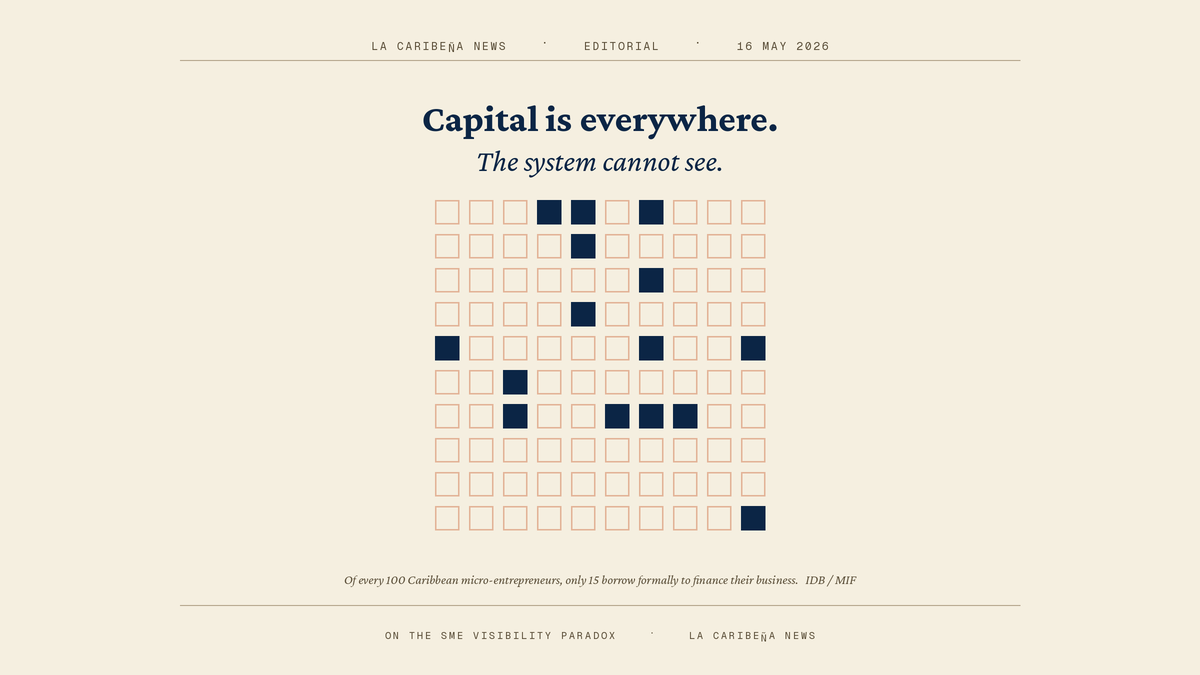
The mismatch is not unique to Guyana. The Caribbean Development Bank’s 2025 Access to Finance Study found a financing gap of more than 77 percent constraining MSME growth in Barbados, and loan-rejection rates of 35 percent there, 42 percent in Belize, 55 percent in Jamaica, and 85 percent in The Bahamas. An IDB study across Belize, Guyana, Jamaica, and Suriname found that only 15 percent of Caribbean micro-entrepreneurs had borrowed formally to finance their business in the previous year. The rest financed themselves or did not finance themselves at all.
Money is not the missing ingredient. CDB approved US$323 million across the region in 2024. The IDB Group raised IDB Invest’s capital by US$3.5 billion in March 2024, framing the increase explicitly around MSME finance. Afreximbank lifted its CARICOM facility from US$3 billion to US$5 billion in early 2026. Republic Bank Guyana’s after-tax profit rose 47.89 percent in the year ending September 2024. Private-sector credit in Guyana grew at 19.8 percent the same year, which sounds healthy until you place it next to a nominal economy that grew at more than double the speed. Banks are profiting. Capital is liquid. Small businesses still cannot borrow.
Why can’t Caribbean banks see small businesses?
The reason is a problem of vision, not supply. Caribbean commercial banks were trained, for two generations, to underwrite three things: a salary, a piece of land, and a clean credit history. A Linden boat-builder with twelve years of customer deposits in a mobile-money wallet, no land title, and no audited statements presents none of those three. The bank’s spreadsheet has no row for him. Creditinfo Guyana reached only 52.8 percent of adults in 2017, the last public figure. The other half of the country still has no credit file at all, which under the orthodox model means no score, no application, no loan. Published research by Guyanese economist Tarron Khemraj has shown for years that domestic banks would rather park excess liquidity in Treasury bills than write a small-business loan, because the Treasury bill has a credit file the system understands.
Three Caribbean-specific overlays make the problem sharper than it is in larger markets. The first is the correspondent banking de-risking shock of 2015 onward, documented by the IMF, the CDB, and the Atlantic Council. Twenty-one of twenty-three banks surveyed across twelve Caribbean countries had lost at least one correspondent banking relationship by 2017. The surviving banks responded by tightening compliance scrutiny on every borrower, and the small, cash-heavy, informal businesses were the first cut. The second overlay is climate vulnerability. Damage from Hurricane Melissa to Jamaica alone was estimated at roughly US$8.8 billion, about 41 percent of 2024 GDP. Banks underwrite small businesses against that baseline risk. Small businesses cannot. The third is brain drain. CARICOM has lost as much as 70 percent of its tertiary-educated labour force to OECD migration over the last three decades. The most credit-worthy young entrepreneurs leave. The credit model underwrites against who stays.
What does the susu prove?
The proof that demand exists is everywhere if regulators care to look. Box hand in Guyana and Antigua. Sou-sou in Trinidad. Partner in Jamaica. Sol in Haiti. Susu across the diaspora. These rotating savings clubs have organised small-business working capital across the Caribbean for over a century, without contracts, without collateral, on personal trust alone. A formal banking system that cannot reach the same people the susu reaches has not failed for lack of customers. It has failed to build the instruments that recognise them.
Some plumbing is finally being laid. Guyana’s Security Interest in Movable Property Act became law in 2024, and the Collateral Registry went fully operational in October 2025, allowing inventory, equipment, receivables, and vehicles to serve as loan security. Jamaica’s National Security Interests in Personal Property Registry has been running since 2013 and lists tens of thousands of assets. Belize launched its Movable Property Security Rights Act and registry in November 2024. The Eastern Caribbean Partial Credit Guarantee Corporation has backstopped more than 300 OECS small-business loans since 2018. The CDB’s Barbados MSME Financing Reform Initiative is moving on a US$560,000 technical-assistance grant. Pieces are in motion.
What hasn’t CARICOM done yet?
What CARICOM has not done is the part that matters most. There is no regional digital SME lender of any consequence. There is no Caribbean equivalent of South Africa’s Lulalend, India’s consent-based account-aggregator framework, or Mexico’s Konfio. The CDB’s Regional Credit Enhancement Facility, the vehicle that could backstop SME credit across the bloc, is still at the feasibility-study stage on US$160,000 of seed funding. Trinidad and Tobago, the region’s second-largest economy, still has neither a licensed credit bureau nor an operational movable-collateral registry. CARICOM’s Single ICT Space and a region-wide digital identity have been promised since 2014 with milestones targeted at 2025. The Jamaica Gleaner editorial board observed at the start of this year that progress is visibly behind schedule. A Guyanese small-business owner still cannot present an identity, an ownership claim, or a payment history to a Jamaican lender today, even though both countries share a single market on paper.
The diagnosis is well-funded. The plumbing is not. CARICOM does not need another small-business programme. It needs one regional ledger that recognises a small Caribbean entrepreneur the way the local susu already does: by what they have done, who has paid them, and what they own that is not a piece of land. Until that ledger exists, no amount of new funding programmes will close the gap. They will only mark it more precisely.
Frequently asked questions
What is the Caribbean SME visibility paradox?
The Caribbean SME visibility paradox is the gap between abundant capital in CARICOM markets and the small businesses that cannot access it. Regional banks, development institutions, and oil-economy liquidity are well-funded, but legacy underwriting requires audited statements, real-estate collateral, and a formal credit history that most Caribbean micro-entrepreneurs cannot supply.
How big is the SME credit gap in CARICOM?
The Caribbean Development Bank’s 2025 Access to Finance Study reports MSME loan rejection rates of 35% in Barbados, 42% in Belize, 55% in Jamaica, and 85% in The Bahamas. An IDB study across Belize, Guyana, Jamaica, and Suriname found that only 15% of Caribbean micro-entrepreneurs borrowed formally in the previous year.
What is being done to close the gap?
Guyana’s Collateral Registry went fully operational in October 2025, allowing inventory, equipment, and receivables to serve as loan security. Jamaica’s National Security Interests in Personal Property Registry has been running since 2013, and Belize launched its equivalent in November 2024. The Eastern Caribbean Partial Credit Guarantee Corporation has backstopped more than 300 OECS small-business loans since 2018.
What is the susu and why does it matter?
Susu, also known as partner, sou-sou, box hand, and sol across the Caribbean, refers to rotating savings and credit clubs that organise small-business working capital on personal trust alone, without contracts or collateral. Their persistence proves demand for credit exists; the formal banking system has failed to build instruments that recognise it.
What would actually close the Caribbean SME finance gap?
A regional digital SME lender that uses alternative data, a capitalised regional credit-enhancement facility, open banking standards, a CARICOM digital identity, and operational movable-collateral registries in every member state. Capital and diagnosis already exist; the connecting infrastructure does not.