By LCN Newsroom
La Caribeña News · 16 August 2026
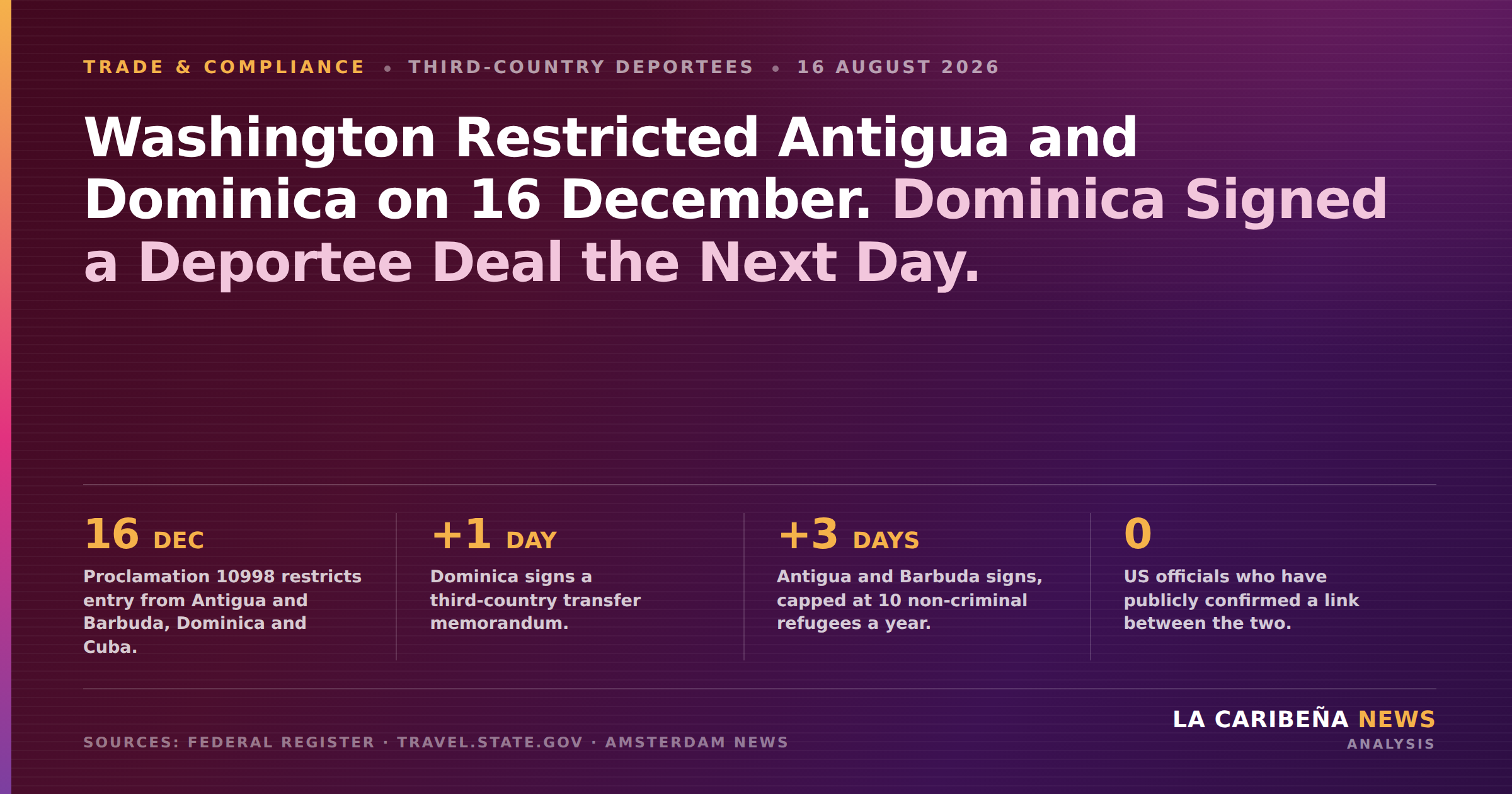
In short. Proclamation 10998 restricted entry from Antigua and Barbuda, Dominica and Cuba on 16 December 2025. Dominica signed a third-country deportee memorandum on 17 December and Antigua and Barbuda on 19 December. Prime Minister Gaston Browne said on 9 July 2026 he had “no doubt” the restrictions followed the deportee issue. No US official has confirmed a link, and Washington told St Vincent and the Grenadines there would be no penalty for refusing.
What is a third-country deportee?
Someone the United States removes to a country that is not their own and has no prior connection to them.
The distinction matters, because it determines what legal instruments Washington can use. Section 243(d) of the Immigration and Nationality Act authorises visa sanctions against a state that refuses to take back its own “citizen, subject, national, or resident.” It does not reach a refusal to accept third-country nationals. US Immigration and Customs Enforcement lists Cuba as the only current Caribbean designee under that section. Guyana’s 2001 designation was lifted.
There is therefore no statutory instrument for third-country pressure. Any leverage on that question has to run through discretionary measures instead: proclamations, visa bonds and the immigrant visa pause.
Those measures carry a price. As La Caribeña News set out on 16 August, a business traveller from one of the four designated states now commits US$15,185 before a flight is booked, and Antigua and Barbuda’s visa refusal rate runs at 38.89% against an overstay rate of 1.30%.
What does the sequence show?
That in two cases the memorandum followed the restriction within days.
Date | Event |
5 December 2024 | The Bahamas rejects a US proposal to host third-country deportees |
20 October 2025 | Belize signs a safe-third-country agreement, capped at 10 a year |
16 December 2025 | Proclamation 10998 restricts entry from Antigua and Barbuda, Dominica and Cuba, citing citizenship-by-investment vetting |
17 December 2025 | Dominica signs a third-country transfer memorandum |
19 December 2025 | Antigua and Barbuda signs, capped at 10 non-criminal refugees a year |
21–22 December 2025 | Antigua secures partial relief: visas held as of 31 December honoured |
11–13 January 2026 | Saint Lucia and St Kitts and Nevis announce non-binding memoranda |
21 January 2026 | Antigua and Barbuda, Cuba and Dominica added to the visa bond; 12 Caribbean states placed under the immigrant visa pause |
24 January 2026 | Grenada confirms it has still not agreed |
2 April 2026 | Grenada added to the visa bond, with no agreement signed |
18 June 2026 | Jamaica announces a non-binding memorandum, up to 25 a fortnight |
9 July 2026 | Browne says the restrictions followed the deportee issue |
What has Antigua and Barbuda said?
That the connection is not in doubt, and separately that the stated ground was citizenship by investment.
Prime Minister Gaston Browne, speaking on 9 July 2026: “I have no doubt in my mind that the restriction that was issued on Antigua as of the end of last year, effective January of this year, was as a result of this issue.”
He had said on 1 June that Washington asked for 120 people a year and that Antigua and Barbuda would take 10.
His response on 17 December 2025, the day after the proclamation, addressed a different rationale. He was“deeply disappointed that Antigua and Barbuda has been included in this proclamation on the stated ground that our Citizenship by Investment Programme has historically operated without a residency requirement,” adding that the programme “presents no risk whatsoever to the security of the United States.”
Sir Ronald Sanders, Antigua and Barbuda’s ambassador to Washington, took a conciliatory line on 19 December: the country “recognises and respects the responsibility of the United States to protect its national security.”
What does the record show against it?
Four things, and they are substantial.
The measures fell on states that signed and states that refused alike. Belize signed in October 2025 and was placed under the immigrant visa pause 93 days later. Jamaica was covered by the pause in January and signed in June. Grenada refused throughout and was bonded on 2 April 2026 with no agreement in place. The Bahamas refused in December 2024 and, while never bonded, is on the pause list.
Signing bought no relief. Antigua and Barbuda and Dominica both remained on the bond list when it was made permanent on 3 August 2026, and Browne was still petitioning for review the day before.
The published rationales are different. Proclamation 10998 and the bond rule published in the Federal Register on 3 August 2026 cite citizenship-by-investment vetting. The 21 January immigrant visa pause cites public charge grounds. Neither instrument mentions deportation. La Caribeña Newsexamined the designation criteria on 14 August and found the overstay data does not separate the designated states from the rest.
And Washington gave a direct answer on the question. St Clair Leacock, Minister of National Security of St Vincent and the Grenadines and Chairman of the Regional Security System, relayed it on 5 April 2026: “If you don’t want them, they will not force you, and there will be no penalties for not accepting refugees.”
Who signed, and on what terms?
Most of the region, with caps and conditions.
Belize accepted CARICOM and Central American nationals only, capped at 10 a year on a two-year term, and took its first transfers on 10 and 30 July 2026. Antigua and Barbuda capped its arrangement at 10 non-criminal individuals a year. Dominica put the figure at up to seven a quarter in March 2026 and took its first transfer on 22 July. St Kitts and Nevis limited its memorandum to CARICOM nationals, excluding Haitians and violent offenders. Saint Lucia signed a non-binding memorandum that “does not create any legal obligations.”
Jamaica announced the largest arrangement on 18 June 2026: up to 10,000 non-Jamaicans at 25 a fortnight, with the United States covering costs. Deputy Prime Minister Horace Chang described it as “a structured, managed process to transit individuals through Jamaica to their final destination”and stressed it was “an MOU… and not a binding agreement.”
Prime Minister Roosevelt Skerrit described Dominica’s arrangement as “a pragmatic step to preserve vital bilateral relations with Washington.”
Trinidad and Tobago, which publicly broke with the CARICOM Bureau’s protest against the December restrictions, escaped both the bond and the pause. So did Guyana, Suriname and the Dominican Republic. Guyana’s Foreign Secretary Robert Persaud said on 7 January 2026 that “productive discussions on a framework of understanding” were ongoing.
What can be concluded?
That the sequence is suggestive, that the governments concerned believe they were pressured, and that the documentary record does not establish it.
No US official has publicly linked the visa measures to third-country deportee acceptance. Every assertion of a link on the current record comes from a Caribbean capital. The dates in December are close enough that coincidence is a strain, and the pattern across the region is loose enough that pressure is not proved.
Both of those statements are true at once, and neither cancels the other.
Frequently asked questions
Can the US sanction a country for refusing third-country deportees? Not under Section 243(d), which covers only a state’s own nationals. Any leverage would have to run through discretionary measures such as proclamations, bonds or visa processing pauses.
How close were the December dates? Proclamation 10998 was issued on 16 December 2025. Dominica signed on 17 December and Antigua and Barbuda on 19 December.
Has any US official confirmed a link? No. Washington told St Vincent and the Grenadines in April 2026 that there would be “no penalties for not accepting refugees.”
Did signing an agreement lift any measure? No. Antigua and Barbuda and Dominica both signed in December 2025 and both remained on the visa bond list when it was made permanent in August 2026.
Which Caribbean states refused? The Bahamas in December 2024 and Grenada, which had not agreed as of January 2026. Grenada was added to the bond programme on 2 April 2026.