By Theon Alleyne, CRCP, CCEP — Compliance, regulation, business environment
La Caribeña News · 16 August 2026
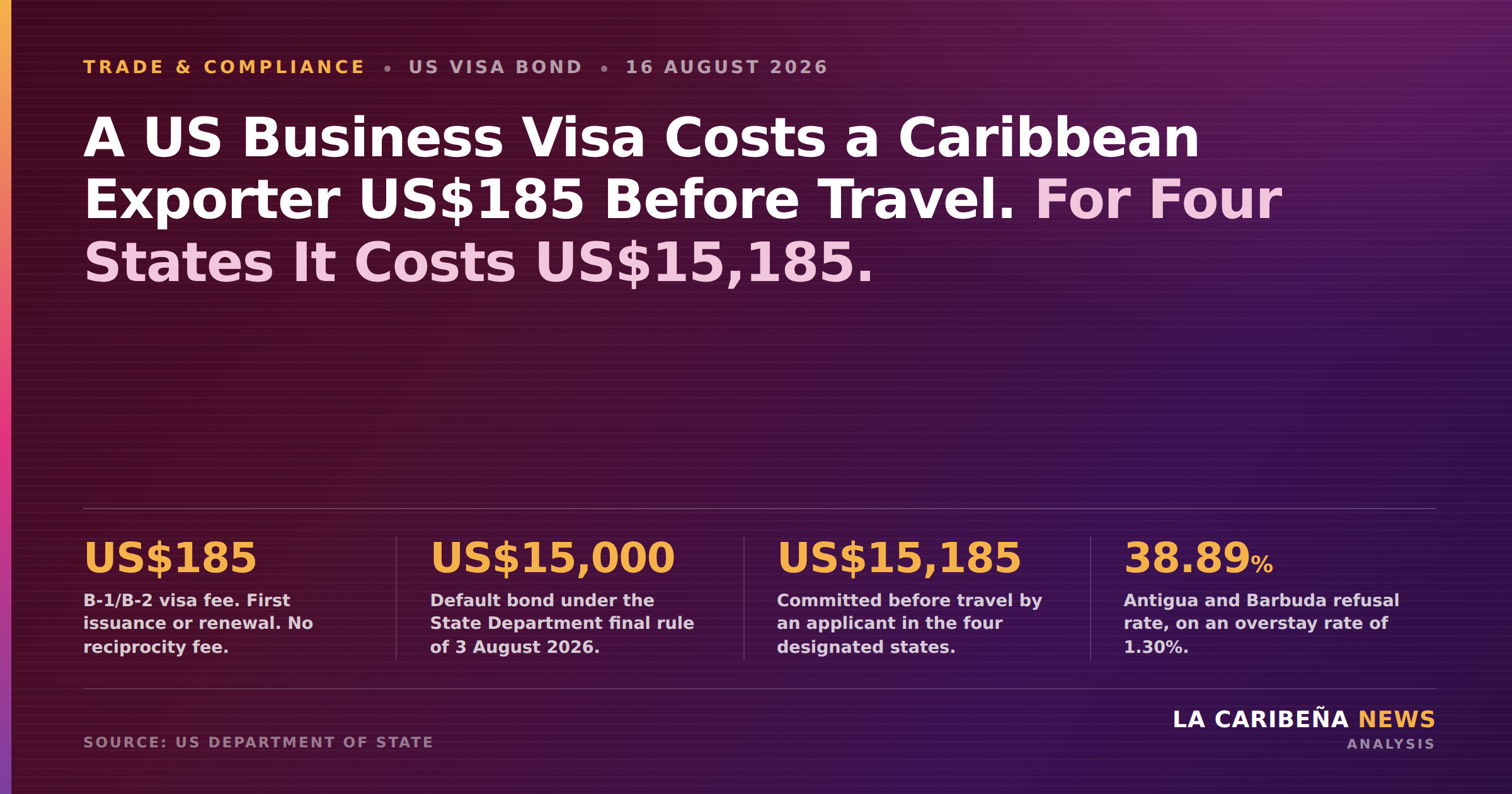
A US business visa costs a Caribbean applicant US$185 in fees. Nationals of Antigua and Barbuda, Cuba, Dominica and Grenada also post a bond of US$10,000 to US$20,000, defaulting to US$15,000, under the US Department of State final rule of 3 August 2026. That is US$15,185 to reach a buyer meeting. Antigua and Barbuda's FY2025 refusal rate was 38.89
What does a US business visa now cost a Caribbean exporter?
US$185 in fees, and US$15,185 for nationals of the four states that must also post a bond.
The machine-readable visa fee is US$185 for a B-1/B-2, first issuance or renewal, with no difference for interview-waiver renewals. A State Department temporary final rule of 9 June 2026 restates it as “currently set at $185 for B1/B2 applicants.” Antigua and Barbuda, Dominica, Grenada and Cuba carry no reciprocity issuance fee. No Caribbean CARICOM state is in the Visa Waiver Program, so ESTA does not apply.
A separate US$250 visa integrity fee was created by H.R.1, signed on 4 July 2025, and is charged at issuance rather than application. It does not appear on the State Department’s published fee schedule and could not be verified as collected at Caribbean posts as of 16 August 2026. Applicants should budget for it.
The final rule published in the Federal Register on 3 August 2026 states that consular officers “are expected to set the bond amount at $15,000, unless the officer has reason to believe the visa applicant’s circumstances would render the applicant unable to pay that amount,” in which case it falls to US$10,000. US$20,000 is the upper figure. The amount attaches to the applicant, not the country, and is refundable on compliance.
At the default tier that is US$15,185 committed before a flight is booked, in a region where micro, small and medium enterprises are 70% to 85% of businesses.
How long does that visa last?
Three months and one entry, for three of the four designated states.
The State Department’s reciprocity schedule, checked on 16 August 2026, sets B-1, B-2 and B-1/B-2 validity for Antigua and Barbuda, Dominica and Cuba at single entry, three months. Grenada retains multiple entry, 120 months.
That changes what the bond means in practice. A Grenadian exporter posts once and travels for ten years. An exporter from St John’s or Roseau posts, travels once, and starts again. On the same fee and the same bond, the cost per business trip differs by an order of magnitude depending on which designated island the passport comes from.
The Global Business Travel Association wrote in 2025 that the added friction would “dampen U.S. competitiveness in attracting foreign talent and reduce the flexibility of global business operations — especially for small and mid-sized organizations.”
Who pays it?
Businesses, mostly small ones, in an economy built on services.
Caribbean Export Development Agency figures put micro, small and medium enterprises at 70% to 85% of Caribbean businesses, 60% to 70% of GDP and roughly half of employment. Services are around 65% of regional GDP.
The Caribbean Development Bank reported in September 2025 that tourism supplies more than half of foreign exchange earnings in five of its 19 borrowing member countries and more than 30% in seven more. Ian Durant, its Vice President for Corporate Services, put the underlying position this way: “Our countries are small, open economies with no reserve currencies. The limited diversity in our export mix results in acute vulnerability.”
Waiting times add to the cost. As of 21 July 2026 the B1/B2 interview wait ran to roughly 120 days in Georgetown, 90 in Kingston and 270 in Santo Domingo, against under 15 days in Bridgetown and Port of Spain.
Which Caribbean states are subject to the bond, and why?
Four. Three of them sell citizenship.
State | FY2024 overstay rate | FY2025 B-visa refusal rate | Sells citizenship | Designated |
Antigua and Barbuda | 1.30% | 38.89% | Yes | January 2026 |
Grenada | 1.77% | 43.73% | Yes | 2 April 2026 |
Dominica | 4.29% | 42.89% | Yes | January 2026 |
Cuba | 6.96% | 70.86% | No | January 2026 |
St Kitts and Nevis | 1.31% | 35.09% | Yes | Not designated |
Non-waiver country average | 2.33% | — | — | — |
The August 2025 pilot rule set three grounds for designation: high B-1/B-2 overstay rates; vetting and screening information “so deficient as to warrant a partial or full suspension on the admission of nationals”; and “offering Citizenship by Investment, if the alien obtained citizenship with no residency requirement.”
As La Caribeña News reported on 14 August, Antigua and Barbuda is designated at an overstay rate of 1.30% and St Kitts and Nevis is not, at 1.31%. Both sit below the 2.33% average for countries outside the Visa Waiver Program.
The same three states appear in Proclamation 10998 of 16 December 2025, which restricted entry from Antigua and Barbuda, Dominica and Cuba with effect from 1 January 2026, citing citizenship-by-investment vetting. The bond designations followed three weeks later.
Does the refusal data match the stated criterion?
No. Refusal rates track the designation list more closely than overstay rates do, and the gap between the two is widest where the bond applies.
State Department FY2025 data gives adjusted B-visa refusal rates of 38.89% for Antigua and Barbuda, 42.89% for Dominica, 43.73% for Grenada and 70.86% for Cuba. Trinidad and Tobago is refused at 14.92%, the Bahamas at 14.46%, Barbados at 18.46% and Guyana at 26.61%. None of those four is designated.
Antigua and Barbuda is the sharpest case. Nearly two in five applicants are refused, from a country whose visitors overstay at 1.30%.
Is the visa bond a trade barrier?
It is a cost on services trade under the World Trade Organization’s fourth mode of supply. Whether it is a breach is a different question, and nobody has yet asked it.
The WTO Secretariat defines Mode 4 as “services traded by individuals of one WTO member through their presence in the territory of another,” covering “employees of services firms and self-employed service suppliers,” and in practice business visitors, intra-corporate transferees and contractual service suppliers. Permanent migration and access to the employment market fall outside it.
The GATS does not stop a member controlling its borders. The Annex on Movement of Natural Persons leaves members free to regulate the entry and stay of individuals“provided that the measures concerned are not applied in such a manner as to nullify or impair the benefits accruing to any Member.” Visa requirements are not in themselves a breach.
The narrower question is whether a bond of up to US$20,000, applied to states whose refusal rates already run near 40%, nullifies benefits in practice. No Caribbean government, the CARICOM Secretariat, Caribbean Export, the Caribbean Private Sector Organisation or any regional trade economist has been recorded putting it in those terms. The responses have been framed as sovereignty and equal treatment. Prime Minister Gaston Browne on 6 January 2026: “Our objective is straightforward. To ensure that Antiguan and Barbudan passport holders are treated no less favourably than nationals of other CARICOM countries.”
There is a forum for the trade version. Seventeen Caribbean states are beneficiaries of the Caribbean Basin Economic Recovery Act, which has no expiry date, and eight also hold Caribbean Basin Trade Partnership Act access, which runs to 30 September 2030. The US Trade Representative files biennial reports assessing beneficiary performance.
Why is no European country on the list?
Because they cannot be. Visa Waiver Program members are structurally excluded from the bond programme, and every EU state is a member.
That is worth stating plainly, because the absence of European names is not evidence of selective enforcement. It is a feature of how the instrument is built.
The exposure runs the other way. As La Caribeña News set out on 15 August, no Caribbean state sits inside the Visa Waiver Program, so none is structurally exempt. Geoff Freeman, President and Chief Executive of the US Travel Association, told Reuters on 12 August that he expects the bond to reach “perhaps all countries where visas are required.”
The travel.state.gov roster stood at 51 countries when last updated on 13 May 2026. Vanuatu, which sells citizenship, is on it. It is Pacific, not Caribbean.
Does the United States sell status too?
It sells residence, at four times the price of a Caribbean passport, and it is not on any list.
Executive Order 14351 of 19 September 2025 created the Gold Card. It costs US$1m as an individual gift to the US government, or US$2m in corporate sponsorship with a 1% annual maintenance fee, plus US$15,000 processing. A Platinum tier at US$5m offers up to 270 days a year in the United States without US tax on non-US income. The Order relies on 15 U.S.C. §1522, the Secretary of Commerce’s gift-acceptance authority, and routes recipients into the existing EB-1 and EB-2 categories. The United States has priced residence since 1990 through EB-5, currently US$800,000 in a targeted employment area.
The products are not the same, and the difference matters. A Caribbean citizenship-by-investment passport confers nationality on approval, transmissible to descendants, with no days of residence required. The Gold Card confers lawful permanent residence only. Naturalisation is a separate step requiring five years of continuous residence and 30 months of physical presence on US soil.
What they share is the moment of sale. The Gold Card requires no investment, no job creation, no business and no residency at the point of purchase.
There is a further asymmetry, and it runs against the security framing. No Caribbean citizenship-by-investment passport has ever conferred entry to the United States. What it buys is visa-free travel to the Schengen area and the United Kingdom. At a US consulate it buys a place in the queue, and now a bond. The Gold Card sells the thing Caribbean programmes never sold, which is residence in the United States itself.
None of this makes entry to the United States an entitlement. It is not. Washington sets its own terms of admission, and Costa Rica’s foreign minister Manuel Tovar stated the ordinary position when he told the New York Times that such decisions fall “under the strict sovereignty of the United States.” No Caribbean government has argued otherwise, and neither does this article. The questions that remain are commercial: what the measure costs, whether the stated criterion matches the observed pattern, and whether it is applied to everyone who meets it.
Cassandra Zimmer-Wong of the Niskanen Center put the last of those in March 2026: “The critical question is not whether the U.S. should offer residency or citizenship by investment — it has done so since 1990. It is whether the programs it administers will be held to the same standards it demands of others, and whether those standards will be enforced consistently or selectively.”
Uptake has been thin. As of 25 April 2026 one Gold Card applicant had been approved, with Commerce Secretary Howard Lutnick telling a congressional committee there were “hundreds in the queue that they are going through.”
What is at stake fiscally?
Enough for the International Monetary Fund to name it as the driver of a member state’s deficits.
In St Kitts and Nevis, citizenship-by-investment inflows equalled 21.7% of GDP in 2023 and 8.1% in 2024. The Fund’s 2025 Article IV staff report states: “The main driver of the deficits is a structural decline in CBI revenue.” The overall fiscal balance was -10.6% of GDP in 2024, with public debt at 52.2% and projected to reach 72.4% by 2030. Its March 2026 mission attributed part of the 2025 slowdown to “headwinds from low Citizenship-by-Investment (CBI) inflows.”
Grenada’s programme brought in EC$1.12bn in 2024, with approvals falling from 1,583 that year to a projected 536 in 2025. Saint Lucia recorded EC$240.3m, about US$89m, in the financial year to March 2024.
Washington is not the only pressure. The European Commission wrote to Antigua and Barbuda, Dominica, Grenada, St Kitts and Nevis and Saint Lucia on 25 June 2026 asking them to phase out citizenship by investment by 1 June 2028, with reinforced vetting and exclusion of EU-sanctioned persons by September 2026, with Schengen access as leverage. Under Regulation (EU) 2025/2441, adopted by the Council on 5 November 2025, operating an investor citizenship scheme is now a standalone ground for suspending visa-free travel.
No EU member state sells citizenship any longer. Malta’s scheme fell to the Court of Justice of the European Union in Commission v Malta, C-181/23, on 29 April 2025, the Grand Chamber holding that “the acquisition of Union citizenship cannot result from a commercial transaction.”Cyprus ended its programme in 2020 and Bulgaria in 2022.
Residence is a different matter. Malta’s residence programme survived the judgment untouched and was re-priced by Legal Notice 146 of 2025. Portugal, Greece, Italy, Hungary, Cyprus and Latvia all still sold residence in 2026, several from around €250,000 and Latvia from €50,000 plus a €10,000 state payment. Spain closed its golden visa on 3 April 2025 and Ireland closed in February 2023.
Browne’s response to the European letter set out the fiscal position. He would not accept “a unilateral phase-out that would cause irreparable harm to the national economy,”described the programme as “a critical pillar of Antigua & Barbuda’s non-tax revenue base” funding “hospitals, schools, infrastructure, and disaster recovery,” and asked for“tangible EU assistance in generating equivalent replacement revenues.”
Frequently asked questions
What does a US business visa cost a Caribbean applicant in 2026? US$185 for a B-1/B-2, first issuance or renewal, with no reciprocity fee. Nationals of Antigua and Barbuda, Cuba, Dominica and Grenada also post a bond of US$10,000 to US$20,000, defaulting to US$15,000.
How long is the visa valid? The reciprocity schedule sets Antigua and Barbuda, Dominica and Cuba at single entry, three months. Grenada retains multiple entry for 120 months.
Why is Antigua and Barbuda designated when St Kitts and Nevis is not? Overstay rates do not separate them: 1.30% against 1.31%. The rule names citizenship by investment with no residency requirement as a separate designation ground.
Is the US visa bond a trade barrier? It is a cost on Mode 4 services trade. The GATS permits members to regulate entry provided measures do not nullify or impair benefits. No Caribbean government has yet made that argument formally.
Why is no European country subject to the bond? Visa Waiver Program members are structurally excluded and every EU state is a member. No Caribbean state is in the programme.
Does a Caribbean CBI passport give access to the United States? No. It confers visa-free travel to the Schengen area and the United Kingdom. Holders apply for a US visa like everyone else.