By LCN Newsroom — Trade and MSME
La Caribeña News · 16 August 2026
In short. The US State Department says a letter of invitation “is not one of the factors used in determining whether to issue or deny the visa.” A Caribbean exporter’s US buyer therefore cannot help. Four things a firm does control: the 12-month renewal window for an interview waiver, third-party posting of the visa bond, the evidence that answers section 214(b), and where else it sells.
Why does a US buyer’s invitation letter not help?
Because the decision is not about the buyer. It is about the applicant.
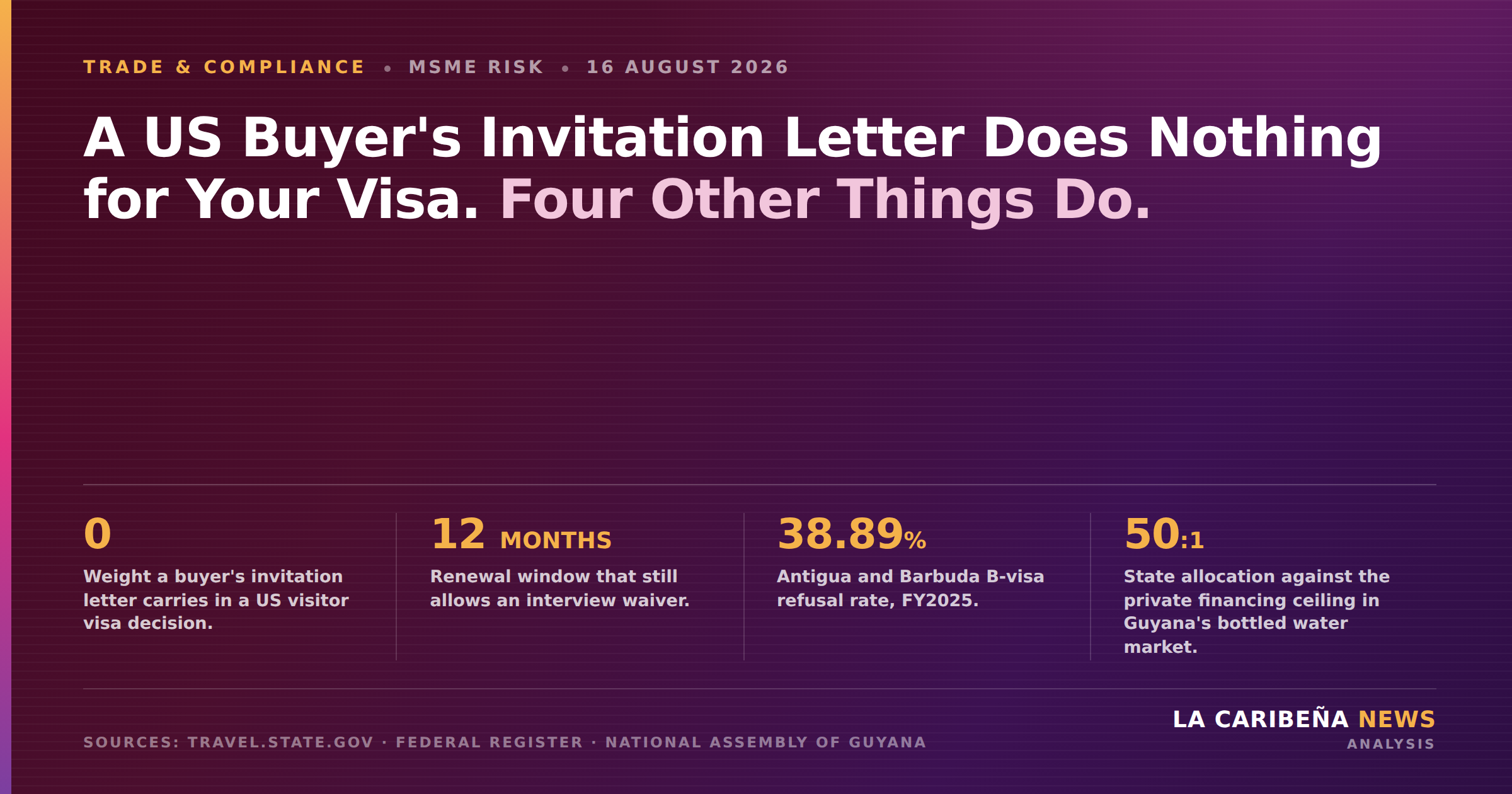
The State Department’s own guidance on visitor visas is unambiguous: “A letter of invitation or Affidavit of Support is not needed to apply for a visitor visa… it is not one of the factors used in determining whether to issue or deny the visa.” Applicants “must qualify based on their ties abroad… rather than assurances from U.S. family and friends.”
There is no sponsorship mechanism for a B-1 business visa. A purchase order from a Miami distributor, a signed letter from a trade show, an email from a buyer confirming a meeting: none of it is weighed in the way most firms assume.
What is weighed is section 214(b) of the Immigration and Nationality Act, which presumes every applicant intends to immigrate until they show otherwise. The Department lists what counts: “your job; your home; and/or your relationships with family and friends,” alongside“circumstances, travel plans, financial resources, and ties outside of the United States.”
That distinction matters commercially. A firm that spends three weeks securing an invitation letter has spent three weeks on a document that carries no weight, and no weeks on the evidence that does.
The refusal numbers give the scale of it. State Department figures for fiscal 2025 put the adjusted B-visa refusal rate at 38.89% for Antigua and Barbuda, 42.89% for Dominica and 43.73% for Grenada. Trinidad and Tobago sits at 14.92%, the Bahamas at 14.46% and Barbados at 18.46%.
What can a firm actually control before an interview?
Four things, all of them administrative rather than persuasive.
The renewal window. From 1 October 2025 the State Department requires an in-person interview for essentially all nonimmigrant visa applicants. One narrow exception survives: a B-1/B-2 renewal filed within 12 months of the prior visa’s expiry, where the previous visa was full validity, the applicant is 18 or over, applies in the country of nationality or usual residence, has never been refused and shows no apparent ineligibility. Officers retain discretion. A firm that tracks expiry dates and files inside that window keeps an option that a firm which lets a visa lapse for 13 months does not.
Who posts the bond. Under the final rule effective 3 August 2026, the bond may be posted by the applicant “or a third party on their behalf” through pay.gov. A company can carry it for a travelling employee. It is returned when the visa expires unused, the holder does not travel, or the holder departs in compliance. It is forfeited on overstay, on an untimely change-of-status filing, on failure to depart within 10 days of an extension denial, or on filing an asylum application. Entry and exit must be through a commercial airport of entry or a CBP preclearance facility.
What the traveller may do on arrival. A B-1 covers negotiating contracts, consulting business associates, attending conferences and installing or servicing equipment under contract. It does not cover receiving a salary from a US source. A firm that sends someone to do work outside that list is not managing risk, it is creating it.
The evidence file. Since ties abroad are the test, the material that answers it is employment records, property, dependants, a return itinerary and evidence of the business continuing without the traveller. This is documentation a company can prepare once and reuse.
None of this raises an approval rate to a certainty. It removes the failures that are self-inflicted.
Why is this the same risk as the shipping route and the tariff?
Because they are not four risks. They are one exposure counted four times.
A typical Caribbean exporter sells into one principal market, ships on one principal route, borrows from one small domestic banking system and, increasingly, competes with one entrant whose balance sheet it cannot match. Each looks like a separate problem on a separate page of a business plan. They correlate.
The United States supplied 48.6% of the region’s 35 million stay-over arrivals in 2025, on Caribbean Tourism Organization figures. On WTO data for 2024 it took 58.6% of Dominican Republic merchandise exports, 40.8% of Trinidad and Tobago’s and 40.7% of Jamaica’s. Services are around 65% of Caribbean output and micro, small and medium enterprises are 70% to 85% of businesses, per the Caribbean Export Development Agency.
The Caribbean Development Bank put the position plainly in September 2025. “Our countries are small, open economies with no reserve currencies,” said Ian Durant, its Vice President for Corporate Services. “The limited diversity in our export mix results in acute vulnerability.”
Concentration is not a criticism of anyone. It is a fact about size. But it means that a visa decision, a canal draft limit and a tariff band are not independent events for a firm that depends on all three. La Caribeña News has covered each separately: the visa bond and its cost, the Panama Canal draft cuts, and the forced-labour tariff bands. For a business, they arrive as one quarter.
What did Patagonia show about who carries the risk?
That it can attach to a named person rather than a company.
In July a manager at CALF, a public services co-operative in Neuquén, Argentina, received messages referring to a US policy restricting visas for executives linked to Huawei’s expansion in the country. The co-operative wrote to the US ambassador asking whether this was official position and on what legal grounds. The embassy declined to comment. No visas were revoked. La Caribeña News reported the case on 7 August.
The mechanism cited was section 212(a)(3)(C) of the Immigration and Nationality Act, which allows a finding of inadmissibility where entry would have “potentially serious adverse foreign policy consequences.” It requires no conviction, no charge and no public finding.
The point for a Caribbean board is narrow and practical. Procurement decisions are recorded in minutes, and minutes name the people who approved them. A concentration that sits on the company’s balance sheet can surface as a consequence for an individual’s passport.
What does concentration look like in a domestic market?
It looks like a financing gap, and it is measurable.
Guyana’s National Assembly approved G$496.3 million on 2 August 2026 for a bottled water plant operated by Guyana Water Incorporated. The allocation was drawn from GWI’s coastal water supply services budget. The Minister of Public Utilities and Aviation, Deodat Indar, described it as “a strategic national project that enhances Guyana’s economic resilience, self-sufficiency, and long-term water security.”
Private bottlers can access a maximum of G$10 million through the Guyana Development Bank. That is a ratio of roughly 50 to 1 between the state allocation and the individual private ceiling.
Two figures matter for anyone assessing the market. Opposition MP Ganesh Mahipaul told the National Assembly on 10 August that imported bottled water accounts for 2.9% to 4.8% of monthly supply, and that local manufacturers already meet more than 95% of demand. The stated rationale for the plant is reducing reliance on imports.
The Guyana Manufacturing and Services Association welcomed the goal and asked for a different structure. The facility should “complement—not compete with—the private companies that already manufacture and distribute bottled water,” it said on 4 August, adding that “GWI’s primary responsibility remains providing reliable and safe potable water to households” and that commercial ventures“should support—not distract from—that core mandate.”
President Dr Mohamed Irfaan Ali addressed the point directly on 6 August. “GWI is not in competition with anyone,” he said.
There is a documented alternative on the record. At the commissioning of the Bartica water treatment plant in February, the President proposed a single shared national bottle-making facility serving all producers. “Every entity don’t need to have a bottle blower,” he said. La Caribeña News set out both positions on 6 August.
What does an operator’s core-mandate performance have to do with market entry?
For a private firm assessing a new competitor, it is one of the standard questions, and here it has a published answer.
The Public Utilities Commission’s 2025 annual report, reported in June 2026, found five Region 10 treatment plants recording pH between 3.7 and 5.4 against a World Health Organization safe range of 6.5 to 8.5, a level the report described as corrosive enough to pose direct health risks. Two of those plants recorded turbidity between 7 and 14 NTU against a safe level below 5. Peak iron was 1.76 mg/L against a 0.3 mg/L limit. Thirteen of GWI’s treatment plants met WHO standards nationally.
GWI disputes the reading. In early July it said the report“does not show that the water supplied to customers is unsafe to drink,” and that the turbidity and iron findings“mainly affect the water’s appearance, taste, colour and the operation of treatment plants.”
Both positions are on the record and this article takes neither. The commercial point is narrower. A private bottler assessing a new entrant would ordinarily look at that entrant’s operating record in its existing business, and would note that the capital for the new venture came out of the budget line for the existing one.
That is the same analysis a bank does before lending, and the same one a buyer does before signing a supply contract. It is a question about capacity, not about motive.
For the purposes of this article the question is not whether the decision was right. It is what it does to a private bottler’s risk profile, and the answer is structural rather than moral. A firm facing an entrant funded at 50 times its own financing ceiling has a concentration problem in its domestic market at the same time as it has one in its export market.
It is also worth knowing where that sits in competition law. The CARICOM Competition Commission’s Guidelines on Jurisdiction, approved in April 2025, set four cumulative conditions for the Commission to act, including cross-border effects. The Guidelines do not address state-owned enterprises, and contain no private complaint procedure. A purely domestic entry by a state enterprise, with no cross-border effect, sits outside that forum. Guyana’s Competition and Consumer Affairs Commission operates under the Competition and Fair Trading Act and can bring cases and seek remedies; whether state enterprises fall within the Act’s definition of an enterprise is a question for the Act’s text, and firms should establish it before assuming either answer.
Where can a Caribbean firm actually diversify this year?
Four routes are open now, and one that firms assume is open has narrowed.
Full free movement inside CARICOM. From 1 October 2025, nationals of Barbados, Belize, Dominica and St Vincent and the Grenadines may enter, reside, work and remain indefinitely in each other’s territories without a work or residency permit and, per Barbados’ guidance, without a skills certificate, including the right to establish a business and bring dependants. For the remaining member states the Skills Certificate regime applies, covering 13 categories as at December 2025.
Europe, under an agreement already in force. The CARIFORUM–EU Economic Partnership Agreement gives contractual service suppliers from CARIFORUM firms temporary entry for a cumulative period of up to six months in any 12, subject to at least three years’ professional experience in the contract sector and to qualification requirements and economic needs tests. Two-way trade was €37.5bn in 2024. A CARIFORUM–UK agreement is in force, with a Special Committee on Services established in December 2023.
Africa, with new money behind it. Afreximbank raised its Caribbean financing ceiling from US$3bn to US$5bn, announced at the CARICOM Heads of Government meeting in February 2026, with a Caribbean Trade Centre in Bridgetown and a business matchmaking channel through the African Caribbean Business Council.
Subsidised entry to European buyers. Caribbean Export’s 2025-26 trade mission to Belgium, France and the Netherlands subsidised over €10,000 per participating firm. Applications for that round closed in September 2025; the model is worth tracking for the next window.
The route that narrowed. Executive Order 14411 of 3 June 2026 directs US Customs and Border Protection to tighten rules on foreign importers of record.
Check this before you build a plan on it
Executive Order 14411, signed 3 June 2026, bans informal entries by foreign importers of record and adds higher continuous bond minimums and tangible US asset requirements.
The practical effect: the importer-of-record role moves to a US distributor or third-party logistics provider rather than the Caribbean seller. The direct-to-consumer marketplace channel that firms are routinely advised to use as an alternative to travelling has narrowed.
Selling into the United States without travelling has become harder, not easier. Any firm planning around a direct marketplace channel should verify the current position with a customs broker before committing stock or spend.
One caution on trade events. The Caribbean and Latin America Buyers’ Mission held in Miami in June 2026 is a forum for US suppliers selling into the Caribbean. Caribbean firms attend as buyers, not as sellers.
What should change in a board pack?
Three entries, none of which require a consultant.
Record concentration as a single line rather than several. If one market takes most of turnover, one route carries most of volume and one lender holds most of debt, that is one number, and it is the number that matters.
Keep a visa calendar alongside the insurance renewals. The 12-month window is the only remaining route to an interview waiver, and it is missed by inattention rather than by refusal.
Name the exposure. Where procurement decisions carry potential consequences for the individuals who approve them, the risk register should say which decisions and which roles, because a register that records only corporate risk will not surface it.
Frequently asked questions
Does a letter of invitation from a US buyer help a visa application? No. The State Department says it “is not one of the factors used in determining whether to issue or deny the visa.” Applicants must qualify on their ties abroad.
Can a company still get an interview waiver? Only for a B-1/B-2 renewal filed within 12 months of the prior visa’s expiry, where the applicant is 18 or over, applies in their country of nationality or residence and has never been refused. Officers keep discretion.
Can a company post the visa bond for an employee? Yes. The final rule permits the bond to be posted by the applicant or a third party on their behalf, through pay.gov.
What can someone do on a B-1 business visa? Negotiate contracts, consult business associates, attend conferences, and install or service equipment under contract. They may not receive a salary from a US source.
Where can a Caribbean firm sell without a US visa?Within CARICOM, where four states allow full free movement from October 2025; into the EU and UK under the CARIFORUM agreements; and into Africa through Afreximbank’s expanded Caribbean facility.