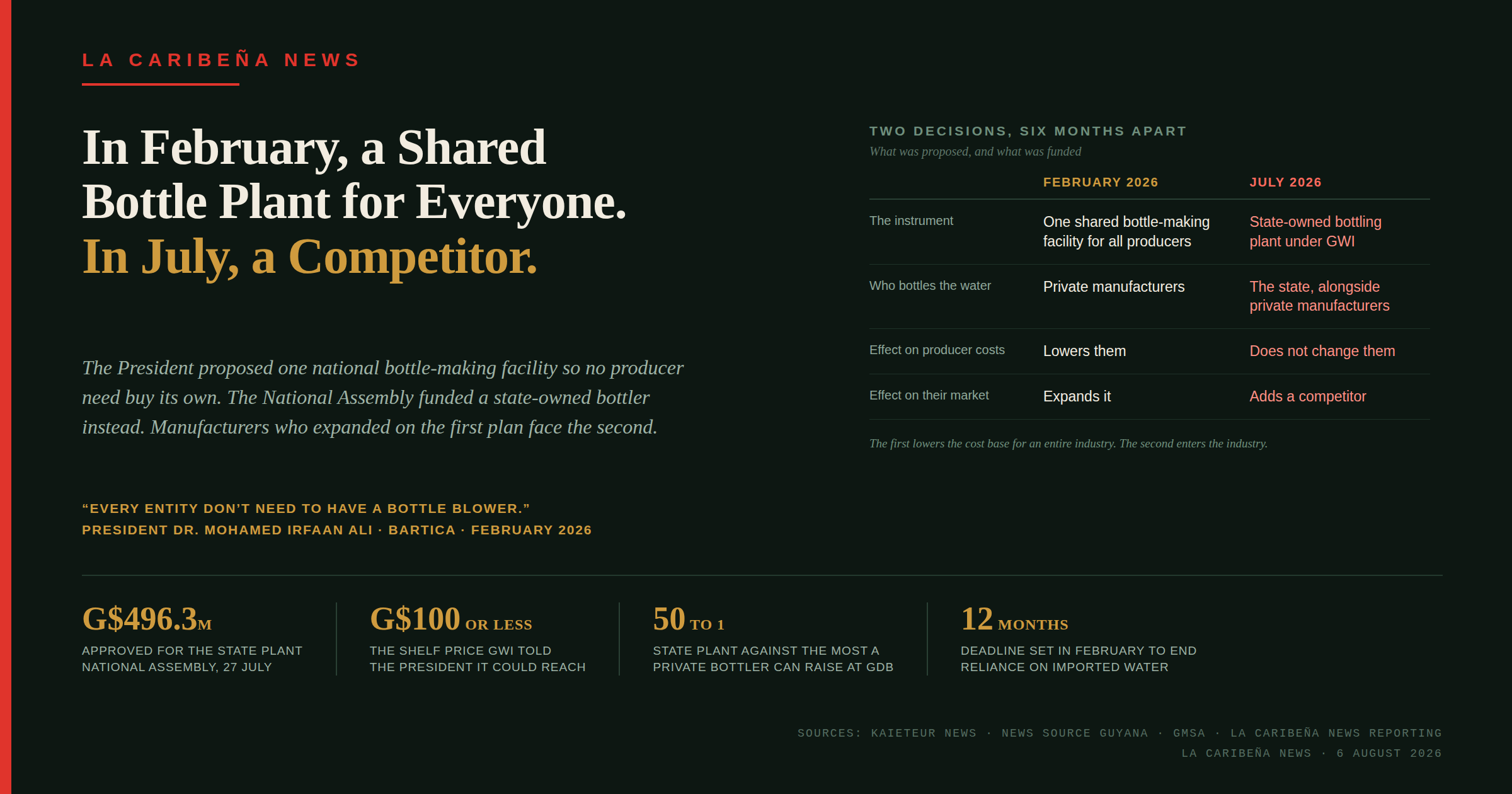
President Dr. Mohamed Irfaan Ali told the country in February that every producer did not need its own bottle blower, and that the state should work with the private sector. The National Assembly then voted G$496.3 million for a state bottling operation. Manufacturers who expanded on the first plan are now competing with the second.
BY LCN NEWSROOM
Quick summary: In February 2026 President Dr. Mohamed Irfaan Ali set a 12-month deadline to end reliance on imported bottled water and proposed shared production infrastructure, including a single national bottle-making operation, built with the private sector. On 27 July the National Assembly approved G$496.3 million for a state-owned bottling plant under Guyana Water Incorporated. The Guyana Manufacturing and Services Association says its members invested on the strength of the first proposal and now face a taxpayer-funded competitor.
What the title card shows
Every data point on the article's title card, in text.
- "Every entity don't need to have a bottle blower." The quotation printed on the card, from President Dr. Mohamed Irfaan Ali at Bartica in February 2026. Source: Kaieteur News.
- The comparison table on the card. February 2026 against July 2026, on four rows. The instrument: one shared bottle-making facility for all producers, against a state-owned bottling plant under GWI. Who bottles the water: private manufacturers, against the state alongside private manufacturers. Effect on producer costs: lowers them, against does not change them. Effect on their market: expands it, against adds a competitor. Source: La Caribeña News comparison of the February proposal as reported by Kaieteur News with the allocation approved on 27 July.
- G$496.3 million. Approved for the state plant by the National Assembly on 27 July 2026. Source: Kaieteur News, News Source Guyana.
- G$100 or less. The shelf price GWI officials told the President the utility could reach. Source: Kaieteur News.
- 50 to 1. The state plant's allocation against the most a private bottler can raise through the Guyana Development Bank, being G$10 million. La Caribeña News arithmetic on the two figures.
- 12 months. The deadline set in February to end reliance on imported bottled water. Source: Kaieteur News.
What did the President actually propose in February?
Shared infrastructure, built with the private sector. Not a state producer.
The commitment was made at the commissioning of a water treatment plant at Five Miles, Bartica, in Region Seven. President Dr. Mohamed Irfaan Ali gave the Ministry of Public Utilities and Aviation a 12-month deadline to end the country's reliance on imported bottled water, on a premise few would argue with. "You can't be such a resource rich country in fresh water and be importing bottled water," he said.
What he proposed next is the part that matters now, and it was reported at the time by Kaieteur News. He called on the ministry to work with the private sector to build local capacity, and he described how:
"Every entity don't need to have a bottle blower. We can have one entity to produce all of the plastic bottle at standard size across the country, so that we have economies of scale."
That is not a small remark. It is a specific industrial proposal: one shared facility making standard bottles for every producer in the country, so that no individual manufacturer has to carry the capital cost of blowing its own. He asked officials to examine every stage of production for further savings, and he set the objective plainly. "What we have to do is work with the private sector to see how we can actualise this, so that a country that is known as the land of many waters can have the cheapest water available to its people."
He also put a number on the target. GWI officials, he said, had assured him the utility could bottle water economically enough to sell it for G$100 or less.
What did the National Assembly fund in July?
Something different, and the difference is the whole argument.
On 27 July the National Assembly approved G$496.3 million to establish the country's first state-owned water bottling plant, allocated under Guyana Water Incorporated's coastal water supply services programme. La Caribeña News examined the appropriation when it passed, including the fact that treated water reaches about 80 per cent of the coastal population by the responsible minister's own account.
Read the two decisions side by side. In February the proposal was one shared bottle-making facility serving every producer. In July the money went to a state-owned bottling operation that will put its own product on the shelf.
Those are not the same policy. The first lowers the cost base for an entire industry. The second enters the industry.
| February 2026 | July 2026 | |
|---|---|---|
| What was proposed or funded | One shared bottle-making facility for all producers | State-owned bottling plant under GWI |
| Who produces the finished water | Private manufacturers | The state, alongside private manufacturers |
| Effect on a private producer's costs | Lowers them | Does not change them |
| Effect on a private producer's market | Expands it | Adds a competitor |
La Caribeña News comparison of the President's February proposal as reported by Kaieteur News with the allocation approved on 27 July.
What does the GMSA say it lost?
Investment made on the strength of the first plan.
The Guyana Manufacturing and Services Association issued a statement on Tuesday calling on the government to review the project. Its central complaint is not that the state is involved. It is that the state changed the shape of its involvement after businesses had acted.
"Several GMSA members have invested capital, built distribution networks, and created jobs in this space over many years," the association said. "Any initiative by the state should be structured to strengthen, not to compete with or undermine, that existing private investment."
The GMSA explicitly recalls the February commitment, noting that the President had called for close collaboration between government and the private sector, including shared production infrastructure such as bottle manufacturing, and not a state-run operation competing directly with private producers.
Its concern is stated in commercial terms. Direct state participation in a market already served by local manufacturers, it said, could discourage future private investment, create uncertainty for businesses that have committed substantial capital, and undermine the government's own agenda of private sector-led growth.
The association also made a point about GWI itself that deserves to survive the argument. The utility's foundational mandate is reliable, safe potable water delivered to every household, and that must remain its core priority. Commercial diversification, in the GMSA's words, should be additive to that mission rather than a distraction from it.
Who else has spoken for the private sector?
On the public record this newspaper can find, nobody except the GMSA.
The Guyana Manufacturing and Services Association has carried this argument alone. It is a sectoral body, speaking for manufacturing and services. Two organisations sit above it in the private sector's architecture. The Private Sector Commission of Guyana is the apex organisation, the umbrella body of the sector. The Georgetown Chamber of Commerce and Industry is the statutory chamber. On 6 August 2026 La Caribeña News searched the public record for a statement on the state bottling plant from either. We found none.
Neither the Chamber nor the Commission is quiet in general, and that is what makes the gap visible.
The Georgetown Chamber issued media releases on the MV Barima maritime tragedy on 20 and 26 July, and the most recent item in its business news section is dated 31 July, four days after the appropriation passed.
The Private Sector Commission's press release page shows an organisation that engages publicly, and specifically on trade. It has condemned Suriname's Corentyne River fees as anti-trade, anti-CSME and harmful to Guyanese livelihoods. It has called on CARICOM to stand firm as Venezuela presses its Essequibo claim. It has commended local content success and pushed for expanded opportunities for Guyanese business. It runs an Illicit Trade Desk and a Business Support Desk.
So this is not an organisation that avoids commenting on competition, on market access, or on the terms Guyanese businesses trade under. It has published on all three. It has published nothing this newspaper can find on the state entering a market its own members are in.
That finding carries a caveat, as at 6 August. Neither absence is proof of silence. Both bodies may have raised the matter with ministers privately, and either may speak yet.
It matters because both organisations have dues-paying members in this position. Some already bottle water. Others, on the President's February commitment to 100 per cent local production, may have been preparing to. Those members now face a competitor funded from the public purse, and the bodies they pay to represent them have said nothing publicly that we can locate.
The GMSA speaks for two parts of the economy, manufacturing and services. The apex body and the statutory chamber speak for all of it, and the precedent being set here is broader than water. If the state can announce a partnership, invite investment against it, and then enter the market itself, that is a fact about the investment climate rather than a fact about bottling.
What does the government say the plant delivers?
Cheaper water, and less dependence on imports.
The case is not thin and should not be dismissed. The Ministry of Public Utilities and Aviation has framed the facility as a strategic national project supporting economic resilience, self-sufficiency and long-term water security. Its stated commercial logic is that domestic production removes international freight, marine insurance, import handling fees and distributor markups from the price, with the potential to lower what consumers pay.
How has the President's own framing changed?
In February the private sector was the partner. In August it is the party with a question to answer.
This is the shift that has gone largely unremarked, and it is visible in the President's own words on the same subject six months apart.
In February, at Bartica, the burden sat with the state. "What we have to do," he said, "is work with the private sector to see how we can actualise this, so that a country that is known as the land of many waters can have the cheapest water available to its people." The failure being described was a national one: a country rich in fresh water importing it in bottles. The remedy was collaboration, and he named the mechanism.
On Thursday, leaving a community consultation on the East Coast of Demerara and asked about the manufacturers' objection, he turned the question around.
"The local manufacturers should ask themselves why foreign water is here displacing them, why do we have foreign coming to Guyana and displacing local producers."
The same fact is being described. The explanation has moved. In February, imported water on Guyanese shelves was evidence that the country had not built the capacity to displace it. In August, it is presented as something local manufacturers permitted, and should account for.
| February 2026, Bartica | August 2026, East Coast Demerara | |
|---|---|---|
| Who is asked to act | The state, working with the private sector | The local manufacturers, of themselves |
| Where the problem is located | A national capacity gap | Producers who let imports displace them |
| The instrument proposed | A shared bottle facility, at national scale | A state-owned producer |
| The private sector's role | Named partner | Not mentioned |
Both columns are the President's own public statements, as reported by Kaieteur News (February) and News Source Guyana (6 August 2026).
He went on to introduce a second idea that was not present in February. "It is a question of ensuring that there are some products that are social in nature," he said, "and when you look at the price of water across the region and internationally and water here, we have a duty and responsibility to the people and so its just arriving at that situation, balancing the need and balancing profitability."
Read that last clause carefully. Balancing need against profitability places the public interest on one side and profit on the other, and it is the manufacturers who are in the business of profit. In February the same producers were the partners who would deliver cheap water. In August they are the counterweight to it.
There is a reading that reconciles the two. A government may fairly conclude, six months on, that collaboration was tried and did not move fast enough against a 12-month deadline, and that the state must therefore act alone. That is a legitimate position. But it is a different position, and it has not been argued as one. Nobody has said the February plan was attempted and failed.
Which is the question that ought to be put, and it is not rhetorical. Was the shared bottle facility costed? Was it offered to manufacturers? Did they decline it? If the collaboration route was tested and found wanting, the government has a complete answer to the GMSA and should give it. La Caribeña News has not found any statement that it was tested at all.
And the government's own case does not close the gap either, because the February proposal would have addressed the price problem too, by the President's own reasoning. Shared bottle production at national scale lowers the input cost for every producer, which lowers the shelf price without the state selling anything. No published comparison shows why the second route beats the first on price, and this publication has not found one.
What happened when other states entered this market?
The models that lasted did not compete on price. The one that did is gone.
La Caribeña News set out three state bottling precedents when the appropriation passed, and read together they make a single point that bears directly on what Guyana has just funded.
| Venture | Model | Outcome |
|---|---|---|
| Rail Neer, India, 2003 | State supplies land and buys the output; private partners build and operate the plants | Still running |
| Hilly Aqua, Kerala | State corporation brand competing on product rather than on price | Still running and expanding |
| Amma Kudineer, Tamil Nadu, 2013 | State-run retail bottling at a subsidised price | Stopped after eight years |
From La Caribeña News reporting on the appropriation, citing the New Indian Express on Amma Kudineer.
Rail Neer is the February proposal in another country: the state provides the platform and guarantees demand, and private firms build and run the plants. Hilly Aqua competes, but on the product rather than by undercutting. Amma Kudineer is the model Guyana has just funded, and it is the one that stopped.
That is why the price target deserves more attention than it has had. GWI officials told the President the utility could bottle water to sell at G$100 or less. Nobody has published the cost build-up behind that figure.
If G$100 is achievable on GWI's costs alone, it is a genuine efficiency and the private sector has a problem it must answer. If it is achievable only because the bottling operation sits inside a utility with a regulated revenue base, public capital and a balance sheet that does not have to clear a commercial return, then it is not a price. It is a subsidy wearing a price tag, and every private bottler in the country is being asked to compete with the Consolidated Fund.
Those are different situations with the same shelf price, and only one of them is sustainable. Tamil Nadu's experience suggests which. A subsidised retail price is a recurring cost to the public purse for as long as it is held, which is why that venture lasted eight years and not thirty.
The question to put to GWI is therefore narrow and answerable. What is the projected unit cost of a bottle at the plant, what is included in it, and does the G$100 figure recover the utility's full cost of production including capital? Until that is published, nobody can tell whether Guyana is buying Rail Neer or Amma Kudineer.
Does this raise a CARICOM treaty question?
It raises one worth putting properly, and the answer starts with a definition.
Being state-owned does not place a commercial operation outside Caribbean competition law. The CARICOM Competition Commission's own Guidelines on Jurisdiction quote Article 1 of the Revised Treaty of Chaguaramas: an enterprise means "any person or type of organization, other than a non-profit organization, involved in the production of or the trade in goods, or the provision of services."
The test is what the body does, not who owns it. The only carve-out named is non-profit status. A state company bottling water for sale is producing and trading goods, so on that definition it is an enterprise like any other, and Chapter VIII of the Treaty applies to it.
The limit is jurisdictional. The Commission's guidelines are clear that Chapter VIII addresses cross-border business conduct that prevents, restricts or distorts competition within the CSME. Purely domestic effects are a matter for Guyana's own competition framework, not the regional one.
That is what makes the President's framing worth examining rather than repeating. His stated target is the displacement of local producers by "foreign water." Some bottled water imported into Guyana originates within CARICOM, and Community-origin goods are not foreign in the Treaty's sense; they move under the same single market Guyana belongs to. Displacing them by means of a state-funded entrant is a different proposition, legally, from displacing extra-regional imports.
This publication is not asserting that a breach has occurred, and nothing here establishes one. Three things would have to be shown: that the state entity's conduct is cross-border in effect, that it distorts competition in the CSME, and that its pricing rests on advantages a private competitor cannot obtain. Those are questions for the Commission and for Guyana's competition authority, not for a newspaper. What can be said is that the ownership of the entrant does not by itself put the question out of reach.
What should MSMEs be demanding now?
Not the reversal. The February plan.
The most useful thing about this dispute is that the alternative is already on the record, proposed by the President himself, and it is the one that grows the sector rather than dividing it. Manufacturers arguing only that the state should stay out will be arguing against a popular price promise and will lose. Manufacturers arguing for the shared bottle plant are arguing for the government's own February position.
Ask what happened to the shared bottle facility. It was proposed publicly in February and does not appear in what was funded in July. Whether it was costed, rejected or simply set aside is a question with an answer, and the ministry has it.
Ask for the price comparison. GWI told the President it could deliver water at G$100 or less. What would a private producer's shelf price be if bottles came from a shared national facility at scale? Until both numbers exist, nobody can say which route actually delivers the cheaper bottle.
Ask about the 50 to 1. This newspaper has already reported the asymmetry: the G$496.3 million voted to the state plant is roughly fifty times the G$10 million a private bottler can assemble through the Guyana Development Bank, being G$3 million at zero interest plus up to G$7 million in commercial co-financing. Beverage manufacturing is not among the bank's five named priority sectors. A private producer asked to compete on price with the state is being asked to do it at one fiftieth of the capital, from a facility that does not list their industry.
Ask where the G$496.3 million buys the most capacity. The same appropriation spent on shared inputs would lift every producer's output at once. Spent on a state plant it adds one producer. That is a public-value question, not an ideological one.
Ask for the terms in writing. Businesses expanded on a February commitment and were overtaken by a July appropriation. Whatever comes next, the sector's protection is a published plan with dates against it, not another undertaking given at a commissioning ceremony.
This is the same argument this newspaper set out in its examination of business clusters and Guyana's Local Content Act, where shared capability is what lets small firms reach work none of them could take alone. The President made that argument himself in February. The manufacturers are asking him to fund it.
Disclosure: Theon Alleyne is the founder and managing director of La Caribeña News. He is also a Director of the Guyana Manufacturing and Services Association and Chair of its Services Sub-Sector, and Vice President and Public Relations Officer of the Essequibo Islands-West Demerara Chamber of Commerce and Industry. This article reports the GMSA's position, asks why the Private Sector Commission and the Georgetown Chamber have published none, and argues for an approach that business support organisations would deliver. He sits on the board of one of the three bodies it discusses, and holds office in a fourth. He holds no interest in any bottled water business, and Guyana Water Incorporated is not a client of La Caribeña News or of EICCIO Advisors.
Frequently Asked Questions
What did the National Assembly approve?
G$496.3 million on 27 July 2026 to establish Guyana's first state-owned water bottling plant, allocated under Guyana Water Incorporated's coastal water supply services programme.
What had the President proposed in February?
At the commissioning of a water treatment plant at Five Miles, Bartica, he set a 12-month deadline to end reliance on imported bottled water and proposed shared production infrastructure, saying that not every entity needed its own bottle blower and that one entity could produce standard bottles nationally for economies of scale. He called on the ministry to work with the private sector.
What is the Guyana Manufacturing and Services Association asking for?
A review of the project and further consultation before it proceeds, with the initiative structured as a partnership that lowers costs and expands capacity across the sector rather than as a taxpayer-funded competitor to existing private producers.
What is the government's justification?
That the plant reduces reliance on imported bottled water and can lower retail prices by removing international freight, marine insurance, import handling fees and distributor markups, as part of a strategy of self-sufficiency and water security.
Does CARICOM competition law apply to a state-owned company?
The Revised Treaty defines an enterprise by activity rather than ownership, excluding only non-profit organisations. On that definition a state company producing and trading goods is an enterprise. The CARICOM Competition Commission's jurisdiction, however, concerns cross-border conduct affecting competition in the CSME; domestic effects fall to national authorities.
Has anyone found a breach of the Treaty?
No. This article does not allege one. It sets out which provisions would be engaged and what would have to be established.