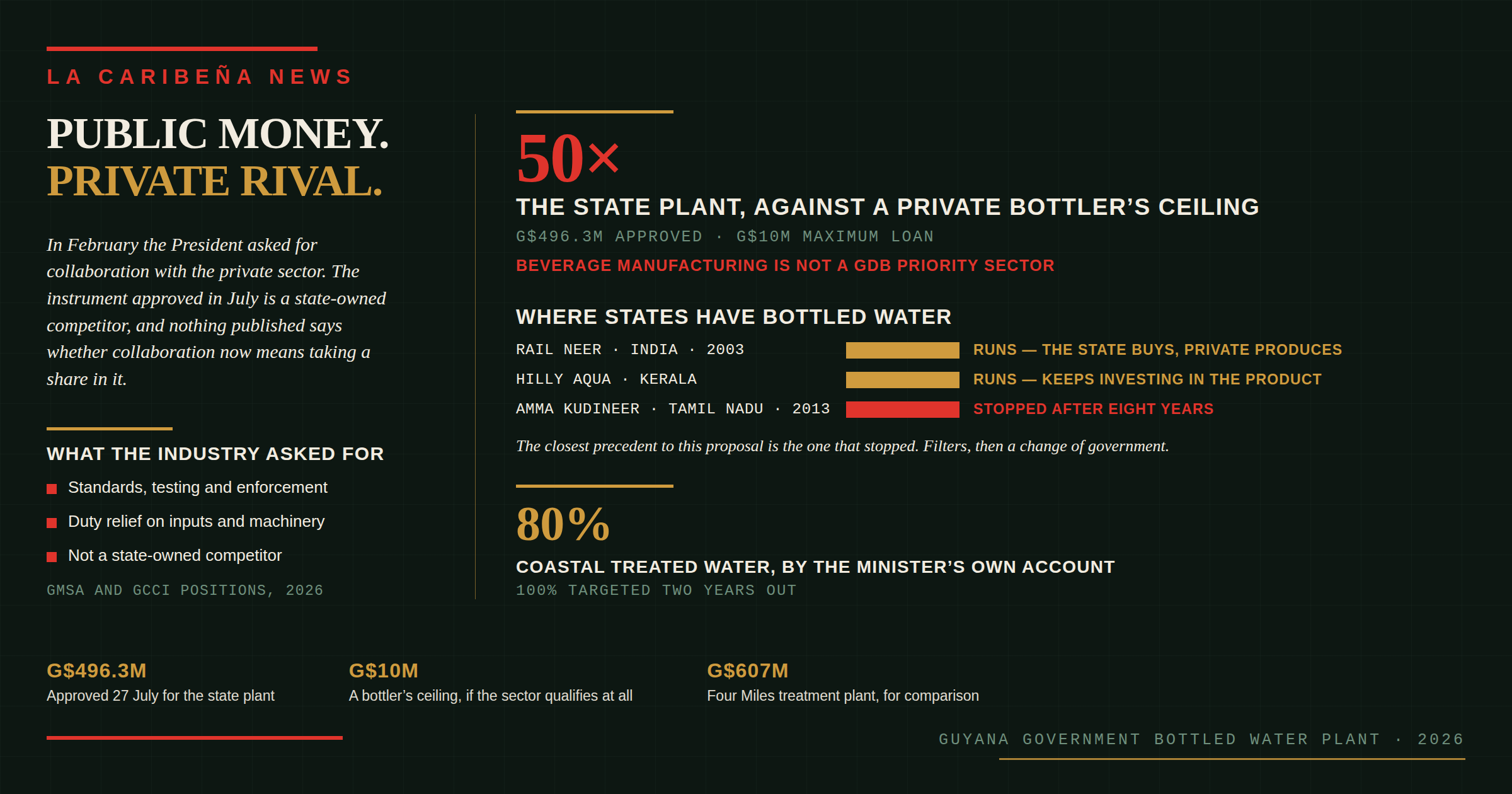
In February the President asked for collaboration with the private sector. The instrument approved in July is a state-owned competitor, and nothing published says whether collaboration now means taking a share in it.
BY LA CARIBEÑA NEWS
Quick summary: The National Assembly approved G$496.3 million on 27 July for Guyana's first state-owned water bottling plant, under Guyana Water Incorporated's coastal water-supply services programme. By the responsible minister's own account, treated water on the coastline reaches about 80 per cent of the population, with 100 per cent targeted two years out.
What exactly was approved?
A sum, inside an existing programme, without a bill.
The National Assembly approved G$496.3 million at its 27 July sitting to establish the country's first state-owned water bottling plant, Kaieteur News reported. The allocation sits under GWI's coastal water-supply services programme, Kiskadee Watch reported.
That matters for scrutiny. This is a provision approved within a utility's existing capital programme, not a standalone bill with a committee stage, an explanatory memorandum or a published business case. There is no legislation to read.
Minister of Public Utilities and Aviation Deodat Indar said the facility would meet national demand and cut reliance on imports, strengthening economic resilience, self-sufficiency and long-term water security. Local production, he said, could lower retail prices by removing international freight, marine insurance, import-handling fees and distributor mark-ups.
What the title card shows
Every data point on the article's title card, in text.
- 50 times. The distance between the G$496.3 million approved for the state plant and the roughly G$10 million a private bottler could assemble through the Guyana Development Bank. The multiple is arithmetic on the two figures below, not a sourced claim.
- G$496.3 million. Approved on 27 July 2026 for a state-owned bottling plant, under GWI's coastal water-supply services programme. Source: Kaieteur News, Kiskadee Watch.
- G$10 million. The maximum a private borrower can assemble through the Guyana Development Bank: G$3 million at zero interest plus up to G$7 million in commercial co-financing. Source: La Caribeña News.
- Beverage manufacturing is not a priority sector of the development bank. Its five named priorities are agriculture and agro-processing, tourism and hospitality, services and trade, creative industries, and digital industries. Source: La Caribeña News.
- Rail Neer, India, 2003. State-owned bottled water that still runs. The state supplies land and buys the output; private partners build and operate the plants.
- Hilly Aqua, Kerala. The state corporation's packaged water brand, still running and still expanding, competing on product rather than on price.
- Amma Kudineer, Tamil Nadu, 2013. State-run retail bottling at a subsidised price that stopped after eight years. Source: New Indian Express.
- 80 per cent. Treated water coverage on the coastline, per Minister Indar, May 2026, with 100 per cent targeted two years out. Potable access exceeds 95 per cent nationally. Source: Guyana Chronicle.
- G$607 million. Cost of the Four Miles treatment facility at Bartica, per Minister Indar, shown for comparison.
- What the industry asked for. Standards, testing and enforcement; duty relief on inputs and machinery; and not a state-owned competitor. Source: GMSA.
Is this what the President asked for?
Not quite, and the gap is the story.
Speaking at the commissioning of the Five Miles Water Treatment Plant in Bartica on 21 February, President Dr. Mohamed Irfaan Ali set the target: "The Ministry of Public Utilities and Aviation must set aside a target of ensuring that all our water consumed locally is produced locally in the next 12 months." His framing was blunt. "You can't be such a resource-rich country in fresh water and be importing bottled water."
But read what he said next, reported by the Department of Public Information. Achieving it would require close collaboration with the private sector and a focus on economies of scale. Rather than multiple entities duplicating investment, he suggested standardising production systems, such as shared plastic bottle manufacturing, to cut costs and raise competitiveness.
Shared inputs across many producers is an industrial-policy instrument. A single state-owned plant is a different one. The February speech pointed at the first; the July allocation funds the second.
Is the state meeting its existing water obligations?
BY ITS OWN NUMBERS, NOT YET.
In May, Minister Indar told the Guyana Dialogue that potable drinking-water access exceeds 95 per cent nationally, but that treated water on the coastline "is about 80 per cent", with 100 per cent targeted within two years. He pointed to seven new treatment plants built over five years, plants at Caledonia, Onderneeming, Parika and Wales, and further facilities planned at Stewartville and La Bonne Intention as housing expands.
He also gave a figure that frames the bottling allocation precisely. The treatment facility at Four Miles, Bartica, which treats surface water to international standards for the first time in that community, cost G$607 million.
So the bottling plant is budgeted at 82 per cent of the cost of the plant that gave a whole town treated water. That comparison has not been drawn in the coverage, and it is the sharpest way to state what the money represents.
APNU parliamentarian Ganesh Mahipaul made the priorities argument without the number. His party does not oppose a state bottling plant in principle, he said, but the allocation is "difficult to justify when many communities across Guyana continue to struggle with unreliable water supplies, poor water quality, low water pressure, and in some cases, no access to a proper water distribution system at all." His summary was sharper still: "Ordinary Guyanese are not asking the Government to sell them bottled water."
Can private producers reach the same money?
No, and the size of the loan is the second problem rather than the first.
The bank has named five priority sectors: agriculture and agro-processing, tourism and hospitality, services and trade, creative industries, and digital industries. Beverage manufacturing is not among them. Whether a water bottler qualifies at all, under "agro-processing" or under "services and trade", is a question the bank has not publicly answered. For a small producer that is the question which decides everything, and it is unresolved before any figure is discussed. A facility that does not name your sector is not a facility you can plan against.
Then the arithmetic. The Guyana Development Bank Act 2026 received presidential assent on 30 July, three days after the bottling allocation passed. Its headline facility is G$3 million at zero interest with no collateral, and commercial co-financing adds up to G$7 million, giving a maximum stack of about G$10 million per borrower. This publication has reported that the co-financing power in section 5(2)(b) carries no amount, no rate and no obligation, and that commencement still awaits a ministerial Order.
G$496.3 million is about fifty times the largest package a private bottler could assemble through that route, assuming the route is open to them at all.
So when the state says the development bank is for everyone, the honest position for a water manufacturer today is that neither the sector eligibility nor the scale has been established. The state has funded itself into the business at fifty times the ceiling available to the people already in it, through a bank whose stated priorities do not mention the sector they work in.
It is worth setting the state's number against what the private sector already commits. In January 2026, Banks DIH commissioned a G$13.7 billion malt bottling plant at Thirst Park, taking its capacity to 800,000 cases brewed, 800,000 bottled and 900,000 stored per month, with a canning line at 17,000 cans an hour to follow. That is malt rather than water, and the comparison is one of scale rather than product. But it is the order of magnitude at which Guyana's beverage manufacturers have been investing, and it is roughly twenty-seven times the sum the state has allocated to enter the market beside them.
"Ordinary Guyanese are not asking the Government to sell them bottled water."
>
Ganesh Mahipaul, MP
What did the industry actually ask for?
Standards, not subsidy. And it asked in person, in the same week, with GWI in the room.
On 16 March Minister Indar briefed the leadership of the Georgetown Chamber of Commerce & Industry, giving an overview of the government's flagship projects across energy generation, water, aviation and maritime. The ministry described it as part of efforts to strengthen partnerships with local business communities.
Two days later, on 18 March, the minister engaged private water producers and distributors directly, to collaborate on the President's target. The ministry's account records who was present: the ministry's Parliamentary Secretary and Director General, and GWI's chief executive with GWI managers.
The producers around that table are members of Guyana's two principal private-sector bodies. The GMSA attended as an association and published its own account. The Georgetown Chamber's membership includes Banks DIH, the country's largest beverage manufacturer. Between them, the chamber and the association speak for the firms the state plant will sell against.
That detail matters. The state utility's chief executive sat down with the private producers in March. In July the National Assembly funded that same utility to compete with them.
The Guyana Manufacturing & Services Association, whose members include bottled-water manufacturers, gave its account in a statement datelined 19 March and published on 1 June. It welcomed the 100 per cent local target for bottled water under HS 2201, called it a strategic move toward self-sufficiency, and estimated a potential import reduction of around G$150 million.
What the industry asked for is on the record: participants "stressed the crucial need for a unified approach among stakeholders and regulators to uphold consistent standards," alongside production and distribution inefficiencies, policy measures and investment incentives, and quality assurance and regulatory compliance.
Standards, incentives and enforcement. Not a state competitor.
How have other countries supported local water production?
Four instruments recur. Three are demand-side or cost-side. The fourth is state ownership itself, and its record is the most instructive of the set.
Standards and registration. Across West Africa the lead instrument is compulsory registration and enforcement against a published standard. Nigeria's National Agency for Food and Drug Administration and Control regulates bottled and sachet water against World Health Organization-based standards, and Ghana's Food and Drugs Authority runs a comparable registry. The published research finds the binding constraint is not the absence of rules but what registration actually guarantees. An assessment of sachet and bottled water quality in Ibadan, published in the Global Journal of Nutrition and Food Science, found that every sample was NAFDAC-registered yet 70 per cent of the sachet water carried no manufacturing or expiry date, even as 90 per cent of measured values fell within guideline limits. A University of Ghana cross-sectional study of the Accra market went further: registration numbers could be matched to regulatory records for only 77 of 118 sachets, all samples met national standards for faecal indicator bacteria and nitrate, and registration status was not associated with any quality indicator the study measured. Registration, on this evidence, is a floor rather than a guarantee, and its value rests on the enforcement behind it.
Tariffs and input relief. Within CARICOM the Common External Tariff already shelters finished consumer goods at 15 to 20 per cent while raw materials sit at 0 to 5 per cent and capital goods at 5 per cent. The regional convention is to exempt inputs, machinery, equipment and spare parts from duty, as Trinidad and Tobago does, so domestic producers face lower costs against imports that already carry the higher band.
Guaranteed offtake, with private operators. This is where the most useful comparison sits, and it is a Global South one.
India's Rail Neer is state-owned bottled water, produced by the Indian Railway Catering and Tourism Corporation since 2003. It is the closest thing to what Guyana has just funded, and its structure is almost the reverse. Rail Neer serves a captive channel the state already controls, railway stations and trains, and exists to assure quality for passengers rather than to compete on supermarket shelves. Of fourteen operational plants, nine run under public-private partnership, with six more planned the same way. The state contributes land and, critically, an assured offtake of the entire production, buying the output for sale through its own network. Private partners build and operate the plants.
So the Indian state did not become a bottler competing with bottlers. It became a guaranteed buyer and let private operators produce.
State ownership, and what became of it. Governments do build bottling plants, including within the last fifteen years, and two Indian states show the range of outcomes.
Tamil Nadu launched Amma Kudineer on 15 September 2013, a production and distribution project run by the state Ministry of Water Resources. One-litre bottles sold for 10 rupees at bus stands across the state, well under the private brands, on an explicit access argument. It is the closest precedent to what Guyana has just funded: a state water body producing bottled water and selling it to the public in open competition, at a price the private market cannot match.
It stopped. By November 2021 the Transport Department had halted sales statewide and converted the sales outlets into time offices. The reported causes were not ideological. Build-up in the filters had disrupted production, and the revamp sat unfinished through a change of administration. Within a year the state was testing groundwater at fresh sites and planning to re-enter the business through Aavin, its dairy co-operative, rather than restart the original scheme.
Kerala's Hilly Aqua is the counter-example. The packaged water brand of the Kerala Irrigation Infrastructure Development Corporation is state-run, sold commercially, and still expanding: a plant at Peruvannamuzhi in Kozhikode carried it into Malabar, and it has since moved into biodegradable bottles. It survives by continuing to invest in the product, not by being the cheapest bottle on the shelf.
So the question is not whether a government has ever done this. One has, repeatedly. The question is what determines whether it lasts. Rail Neer endures because the state buys rather than competes. Hilly Aqua endures because it keeps spending on plant and product. Amma Kudineer, the case that most resembles this proposal, ran eight years and was undone by maintenance and a change of government.
That is the structural objection, and it is not partisan. GWI is the sector's operator and, through the ministry, sits close to its regulation. A state bottler competing with private bottlers puts one institution on both sides of the same market. The demand-side and cost-side instruments achieve import substitution without that conflict, and the Rail Neer model achieves it while still putting public money behind guaranteed demand. The Tamil Nadu route achieved it for eight years and then did not.
What has not been disclosed?
Nearly all of the commercial case.
Mahipaul has asked the government to publish the plant's proposed location and production capacity, its total capital and operating costs, its projected selling price, its intended distribution network and its anticipated return on investment. He has also asked whether an independent market study was conducted.
None of that is in the public record. GWI has said locally treated and bottled water could sell for about G$100 per bottle or less where operating costs are managed efficiently, a figure reported in February. That is a price expectation, not a business case.
One further item is absent from that list and from the record: the plant's ownership structure. Nothing published says whether it will be held wholly by the utility, or whether private producers can take a stake in it. If collaboration with the private sector is still the objective the President set in February, an equity route is the mechanism that objective would run through, and it has not been described. A bottler reading the two announcements together has no way to tell whether the state has built a partner, a customer or a rival.
The absence is a function of the route chosen. Because the money came as a provision inside an existing capital programme rather than as a bill, no feasibility study, procurement plan or business case was required to be laid before the House. Whether one exists is itself an open question, and it is the one to put to the ministry first.
Which leaves the question the record cannot answer. Guyana already has private water bottlers. They took the risk, put in the capital, built the distribution and carried the regulatory cost of a market that did not exist here a generation ago. Out of public money, the state has now funded a competitor to them in that same market, without publishing a business case, without naming their sector among the priorities of its new development bank, and without describing any route by which they can take part. Public investment is ordinarily justified by a gap the private sector has not filled. The gap here has been filled, by the people the investment now competes with. Who benefits from the G$496.3 million is not a rhetorical question and it is not an accusation. It is a question the published record does not currently allow anyone to answer, and that is the reason to ask it.
Frequently Asked Questions
How much was approved and when?
G$496.3 million, approved by the National Assembly on 27 July 2026 under Guyana Water Incorporated's coastal water-supply services programme, to establish the country's first state-owned water bottling plant.
What is Guyana's current treated water coverage?
Minister Deodat Indar said in May 2026 that potable drinking-water access exceeds 95 per cent nationally while treated water on the coastline stands at about 80 per cent, with 100 per cent targeted within two years.
Can a private water producer borrow comparable money from the Guyana Development Bank?
No, and eligibility is the prior question. The bank's five named priority sectors do not include beverage manufacturing, and it has not publicly said whether a water bottler qualifies under any of them. On size, the facility is G$3 million at zero interest with up to G$7 million in commercial co-financing, a maximum of about G$10 million, against G$496.3 million for the state plant.
Did the industry oppose the 100 per cent local target?
No. Minister Indar briefed the Georgetown Chamber of Commerce & Industry on 16 March and engaged private water producers and distributors on 18 March, with GWI's chief executive present. The GMSA welcomed the target, estimated an import reduction of about G$150 million, and stressed the need for consistent standards upheld across stakeholders and regulators.
How do other governments support local bottled-water production?
Mainly through compulsory standards and registration, as in Nigeria and Ghana, and through tariffs and duty relief on inputs, as Trinidad and Tobago applies. India's state-owned Rail Neer is the closest comparator to a state plant, but it supplies a captive railway network, nine of its fourteen plants are public-private partnerships, and the state's contribution is land and guaranteed offtake rather than open-market competition.
Has a feasibility study been published?
No feasibility study, market study, business case or procurement plan has been published. Because the funds were approved within an existing capital programme rather than through a bill, none was required to be laid before the National Assembly.