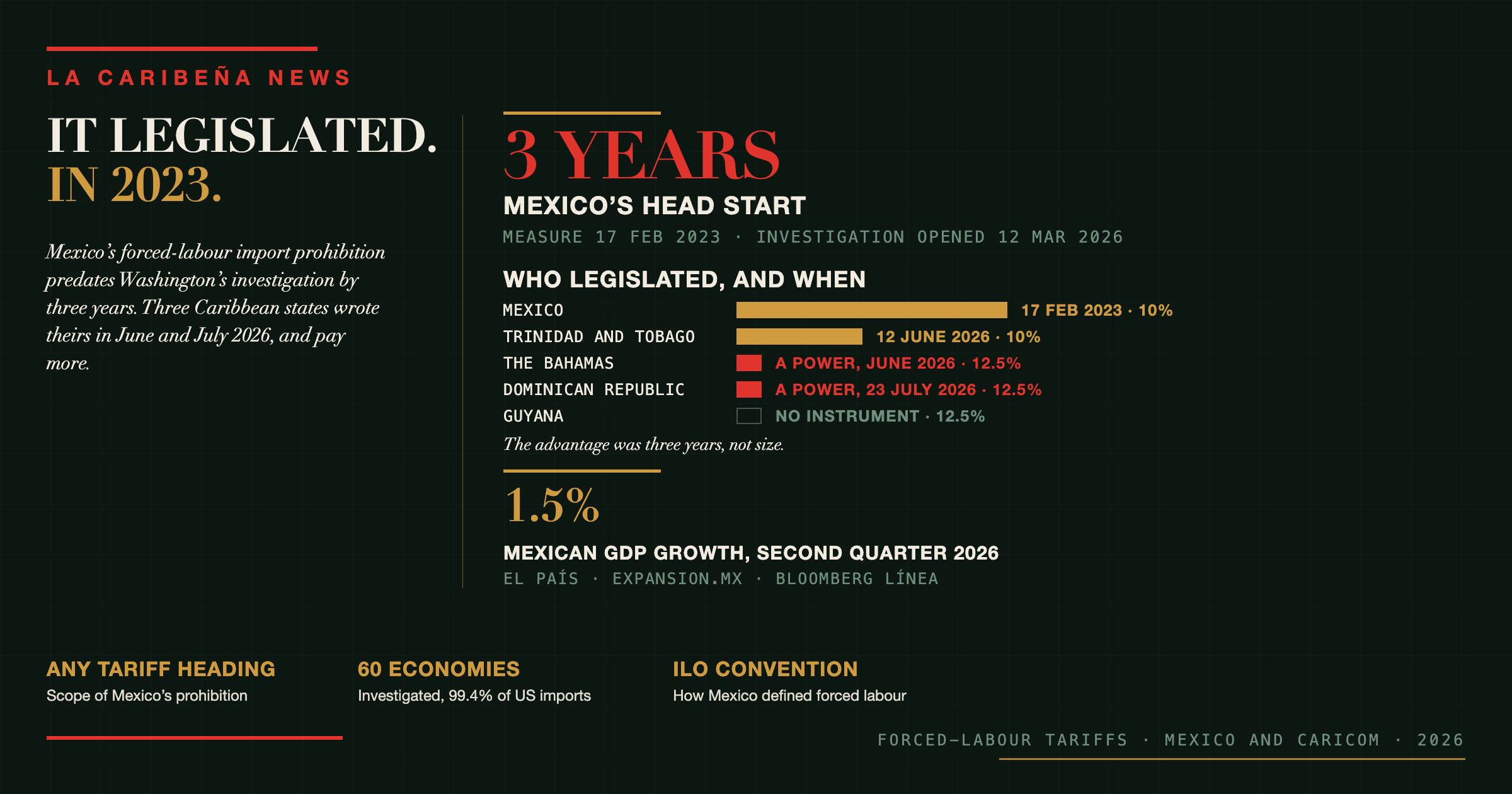
Mexico's forced-labour import prohibition predates Washington's investigation by three years. Three Caribbean states wrote theirs in June and July 2026, and pay more.
BY LA CARIBEÑA NEWS
Quick summary: Mexico's economy grew 1.5 per cent in the second quarter of 2026 and it entered the new United States forced-labour tariff regime in the lower 10 per cent band. The reason is an administrative measure published on 17 February 2023, three years before the investigation began. Nothing about it required Mexico's size.
What did Mexico report?
Growth of 1.5 per cent in the second quarter of 2026, described by EL PAÍS as a recovery for the region's second-largest economy. expansion.mx carried the same figure for the same period. Bloomberg Línea placed the quarter in the context of the World Cup and revisions to the USMCA trade pact.
That is the number. The more useful question for this region is why Mexico is paying 10 per cent on exports to the United States while Guyana, the Bahamas and the Dominican Republic pay 12.5.
What the title card shows
Every data point on the article's title card, in text.
- 1.5 per cent. Mexican GDP growth in the second quarter of 2026. Sources: EL PAÍS, expansion.mx, Bloomberg Línea.
- 17 February 2023. Date Mexico published its prohibition on importing goods produced with forced labour. Source: USTR Section 301 report, 2 June 2026.
- 3 years. Between that measure and the opening of the US investigation on 12 March 2026.
- 10 per cent. Mexico's additional US duty. Source: USTR final action.
- 12.5 per cent. What Guyana, the Bahamas and the Dominican Republic pay. Source: La Caribeña News.
- 60 economies. Investigated, covering 99.4 per cent of US imports.
Why is Mexico in the lower band?
Because it already had a prohibition, and had held it for three years.
USTR's report records that on 17 February 2023 Mexico published the Acuerdo que Establece Las Mercancías cuya Importación está Sujeta a Regulación a Cargo de la Secretaría del Trabajo y Previsión Social. The measure establishes that goods imported into Mexico under any tariff heading must not have been produced wholly or in part through forced or compulsory labour, and it defines forced labour in accordance with the Forced Labour Convention.
USTR opened its investigations on 12 March 2026. Mexico's instrument was three years old by then and was not written in response to anything.
That is the whole difference. Not the size of the economy, not the trade relationship, not the quality of the lobbying.
How does that compare with the Caribbean?
Uncomfortably, and the comparison is worth setting out plainly.
| Economy | Instrument | When | Rate |
|---|---|---|---|
| Mexico | Prohibition covering any tariff heading | 17 February 2023 | 10% |
| Trinidad and Tobago | Outright prohibition, Customs Act s.45 | 12 June 2026 | 10% |
| The Bahamas | Power for a Minister to prohibit by Order | June 2026 | 12.5% |
| Dominican Republic | Case-by-case power for customs, Decree 502-26 | 23 July 2026 | 12.5% |
| Guyana | None | n/a | 12.5% |
Trinidad and Tobago reached the same band as Mexico by enacting a real prohibition, ten days after USTR published its findings. That is the encouraging part of the table: the deadline was not the obstacle.
The Bahamas and the Dominican Republic both legislated a power to prohibit rather than a prohibition, a distinction this publication has examined in both cases. Guyana brought a witness and no instrument.
Was Mexico's advantage structural?
Only partly, and less than the region tends to assume.
The USTR report notes that commitments to prohibit forced-labour imports appear in the USMCA and in recently signed Agreements on Reciprocal Trade, which does give parties to such agreements a head start in obligation if not in drafting. CARICOM has no equivalent reciprocal instrument with the United States; its access has historically run through unilateral preference rather than a negotiated agreement carrying labour obligations.
But Mexico's qualifying measure was not the USMCA. It was a domestic administrative acuerdo, published by a labour ministry, applying to any tariff heading, defined against an ILO convention. That is a document a small state can write. It does not require a trade agreement, a large customs service, or a big budget. It requires having done it before being asked.
What follows for the region?
Two things, and the second is the one with a deadline.
The first is that the 12.5 per cent rate is not a judgement about Caribbean labour practices. It is a judgement about paperwork that existed or did not exist on a particular date. Nothing in USTR's finding says forced labour occurs in Guyana, the Bahamas or the Dominican Republic; the finding is that no prohibition had been imposed.
The second is that the standard has already moved. USTR set out eight elements it treats as evidence that a prohibition can be effectively enforced, and no economy of the sixty satisfied them, Mexico included. The next round will not be won by having a prohibition. It will be won by being able to run one.
Mexico's lesson is about timing rather than capacity. The instrument that put it in the lower band cost a ministry a publication in 2023.
Frequently Asked Questions
How much did Mexico's economy grow?
1.5 per cent in the second quarter of 2026, reported by EL PAÍS, expansion.mx and Bloomberg Línea, which linked the quarter to the World Cup and USMCA revisions.
Why does Mexico pay 10 per cent rather than 12.5?
Because it had imposed a forced-labour import prohibition before the investigation began. USTR records the measure as published on 17 February 2023, covering goods under any tariff heading and defining forced labour in line with the Forced Labour Convention.
Did Mexico's size or trade agreement decide it?
The USMCA carries commitments on forced-labour imports, but the measure USTR credits is a domestic administrative acuerdo published by Mexico's labour ministry, not the trade agreement itself.
Which Caribbean economies pay more, and why?
Guyana, the Bahamas and the Dominican Republic pay 12.5 per cent. Guyana had no instrument; the Bahamas and the Dominican Republic enacted powers to prohibit rather than prohibitions. Trinidad and Tobago enacted an outright prohibition on 12 June 2026 and pays 10 per cent.
Does the finding say forced labour occurs in those countries?
No. USTR's finding is that the economies concerned had failed to impose and effectively enforce a prohibition on importing goods produced with forced labour.