By LCN Business Desk
The deadline that arrives in November decides nothing about this year's receipts. It decides whether a revenue line survives to 2028.
What has to happen by 12 November?
A confirmation, not a closure.
Prime Minister Gaston Browne said on the Browne and Browne Show on Saturday 24 October that the government has until 12 November to confirm its intention to the European Commission, and that the programme would continue operating until the 1 June 2028 deadline, as reported by the investment migration publication IMI Daily. Preliminary Cabinet discussions favour confirming the phase-out, and ministers have not made a final decision.
Antigua and Barbuda's own press carried his words. "No final determination has been made, but based on the preliminary discussions, it's very likely that Antigua and Barbuda will suspend its CIP program come November 12th," Mr Browne said, as reported by the Antigua Observer. The state broadcaster, ABS TV Radio, carried the same account, reporting that Cabinet is leaning towards suspension following fresh talks with the European Union.
He put the choice itself in one sentence: "That we can continue our programs as we wish, but we would not continue to enjoy visa-free access into the Schengen area."
European Union representatives set out two options at a technical meeting with Eastern Caribbean officials during the week of 19 October, on Mr Browne's account. Governments can continue their programmes and risk losing visa-free access to the Schengen area, or confirm by 12 November that they will end them by June 2028.
The programme has run since 2013, and the access at stake is not only its own. Visa-free entry lets Antiguan and Barbudan passport holders travel to participating European states for short stays, generally up to 90 days in any 180, without a visa. Losing it would reach every ordinary passport holder travelling to Europe on business, as a tourist or to see family, which is a wider constituency than the programme's investors.
There is no official government announcement of a suspension. What exists is the Prime Minister's remarks and the reporting of them.
What does the instrument actually say?
That the trigger is the absence of a genuine link, not the sale of citizenship as such.
The European Commission grounded its request in Regulation (EU) 2025/2441 of the European Parliament and of the Council of 26 November 2025, which amends Regulation (EU) 2018/1806 and revises the visa suspension mechanism. It was published in the Official Journal on 10 December 2025 and is in force.
The operative wording sits in the list of grounds on which the mechanism may be triggered. One of them is:
"the operation, by a third country listed in Annex II, of an investor citizenship scheme under which citizenship is granted to a person, in exchange for pre-determined payments or investments, without that person having any genuine link to that third country"
The recitals put the same test in the Union's own terms, recording that it "respects the right of sovereign countries to decide on their own naturalisation procedures" while seeking to deter visa-exempt countries "from using visa-free access to the Union as a tool for leveraging individual investment in return for citizenship".
Read as drafted, the clause turns on the genuine link rather than on the existence of a programme. None of the parties quoted in the current reporting has proposed restructuring a programme on that basis, and the Commission's request as reported is a phase-out rather than a redesign.
What is at stake in money?
A revenue line that several of these states cannot replace quickly.
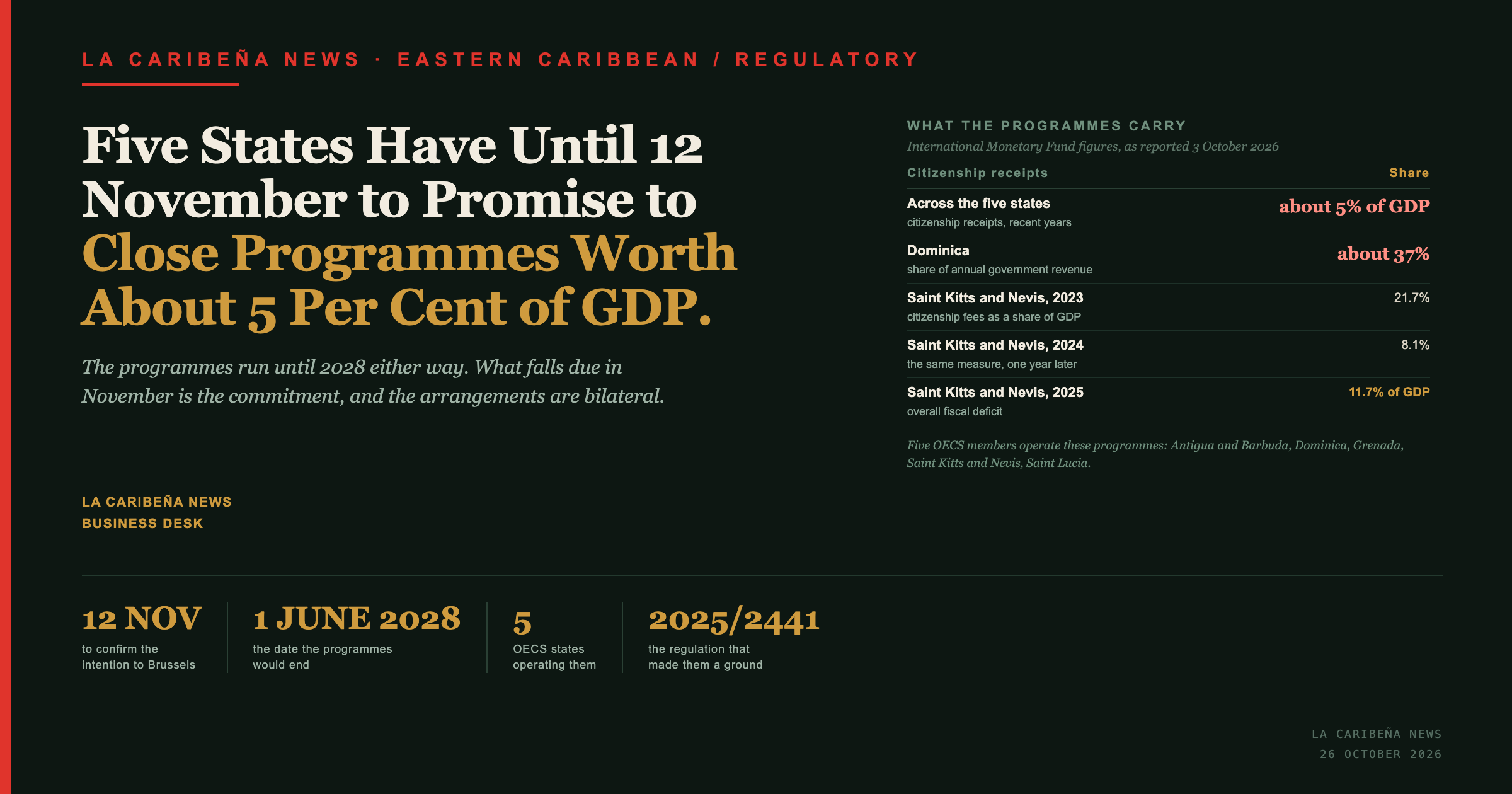
| Share | |
|---|---|
| Citizenship receipts across the five states, recent years | About 5 per cent of GDP |
| Dominica, share of annual government revenue | About 37 per cent |
| Saint Kitts and Nevis, citizenship fees as a share of GDP, 2023 | 21.7 per cent |
| Saint Kitts and Nevis, the same measure, 2024 | 8.1 per cent |
| Saint Kitts and Nevis, overall fiscal deficit, 2025 | 11.7 per cent of GDP |
Source: International Monetary Fund figures, as La Caribeña News reported when Argentina announced a golden passport of its own and the Caribbean's five were being asked to close theirs on 3 October 2026.
The Saint Kitts figures are the ones a finance ministry reads twice, because they show the adjustment arriving before any deadline does. Receipts there fell by roughly two thirds in a single year and the deficit widened as they went.
The Fund has said as much about the present uncertainty. Ana Corbacho, deputy director of its Western Hemisphere department, said uncertainty over the programmes could put government revenues at risk, and that their future would depend in part on how governments address governance concerns and respond to evolving international discussions, ABS TV Radio reported.
Why can one government not be outvoted by the others?
Because the arrangements are bilateral.
"So I've called for a meeting of the heads for early next week so that we could try and come to an OECS consensus," Mr Browne said of a meeting of Organisation of Eastern Caribbean States heads of government. He did not treat agreement as assured: "Even [if] there's no consensus, then each country obviously will have to take an independent decision." The visa-waiver arrangements are bilateral, which is what permits that outcome.
Five OECS members operate these programmes: Antigua and Barbuda, Dominica, Grenada, Saint Kitts and Nevis, and Saint Lucia. They already price together, having operated a common floor of US$200,000 since 1 July 2024.
Christopher Willis, managing partner at Latitude Group, told IMI Daily that any suspension "must be coordinated across all five jurisdictions, as unilateral action would undermine the region's commitment to harmonization and create significant uncertainty for investors", and that the challenge is "preserving Schengen visa-free access without sacrificing a vital source of national revenue". He also asked for "clarity for applicants whose files are already being processed".
What changed between June and October?
The stated position, by its own terms.
Brussels is not the only capital to have acted on these programmes. The United States restricted entry from Antigua and Barbuda, Dominica and Cuba under Proclamation 10998, citing citizenship-by-investment vetting, which this newspaper reported in August.
On 25 June 2026 the European Commissioner for Internal Affairs and Migration, Magnus Brunner, sent a formal letter to Antigua and Barbuda asking that the programme be phased out by 1 June 2028 with a 24-month transition, and according to Antigua's government the other four states received similar letters.
Mr Browne ruled out closure at the time, saying "with or without those visa-free arrangements, our CIP program continues". An Office of the Prime Minister statement on 6 July held the same line, saying the government "will not be pressured into a unilateral phase-out" and that the programme "cannot simply be abandoned without viable, concrete, and credible replacement revenues", adding that none of the European Union's offers were "quantified, binding, or explicitly framed as replacement revenues".
Four months later Cabinet is reported to be leaning the other way. The replacement revenues that the July statement made a condition have not been identified in the current reporting.
What does a firm with a file in process need to watch?
Four things, and the first is in days.
Whether a confirmation is sent by 12 November, and by how many of the five. Whether the OECS heads reach a common position, given that the visa arrangements are bilateral and permit them not to. What happens to applications already in processing, to existing commitments to investors and to approved developments linked to the programme: the Antigua Observer reports that Mr Browne did not outline how those matters would be handled, or whether alternative revenue measures were being considered. And whether any official government statement follows, because everything on the record today is a Prime Minister speaking on a radio programme.
The programme itself continues either way until 1 June 2028. The decision in November is about the commitment, and the commitment is what a buyer, a lender or a developer prices against. One of those governments is pricing against its own balance sheet this week: Prime Minister Gaston Browne said on 25 October 2026 that the government is considering drawing up to $60 million from the Treasury, State Insurance, Social Security and the Airport Authority for two new 150-room hotels.
The entities
- Citizenship by investment (CBI), also called a citizenship by investment programme (CIP), is the grant of citizenship in exchange for a payment or investment.
- Organisation of Eastern Caribbean States (OECS) is the sub-regional body whose five programme-operating members are Antigua and Barbuda, Dominica, Grenada, Saint Kitts and Nevis and Saint Lucia.
- Regulation (EU) 2025/2441 is the regulation of 26 November 2025 amending Regulation (EU) 2018/1806, which revised the European Union's visa suspension mechanism and added investor citizenship schemes to the grounds for suspension.
- Gaston Browne is the Prime Minister of Antigua and Barbuda, whose remarks on 24 October 2026 are the source for the 12 November date.
- Magnus Brunner is the European Commissioner for Internal Affairs and Migration, who signed the letter of 25 June 2026.
- Ana Corbacho is deputy director of the International Monetary Fund's Western Hemisphere department.
- Schengen area is the European travel zone to which visa-free access is the stake in the Commission's request, generally permitting stays of up to 90 days in any 180 without a visa.
What the title card shows
Every data point on the article's title card, in text.
- 12 November 2026. The date by which Antigua and Barbuda must confirm its intention to the European Commission. Source: Prime Minister Gaston Browne, 24 October 2026, reported by IMI Daily and ABS TV Radio.
- 1 June 2028. The date by which the Commission asked for the programmes to be phased out. Source: the Commission's letter of 25 June 2026, as reported.
- Five. The OECS member states operating these programmes. Source: IMI Daily.
- About 5 per cent of GDP. Citizenship receipts across the five in recent years. Source: International Monetary Fund, via La Caribeña News, 3 October 2026.
- 37 per cent. Dominica's citizenship receipts as a share of annual government revenue. Source: as above.
- 21.7 to 8.1 per cent. Saint Kitts and Nevis citizenship fees as a share of GDP, 2023 to 2024. Source: as above.
- Regulation (EU) 2025/2441. The instrument that made an investor citizenship scheme a ground for suspending visa-free access. Source: the Official Journal of the European Union, 10 December 2025.
Frequently Asked Questions
What must the Eastern Caribbean states decide by 12 November 2026?
Whether to confirm to the European Commission that they will end their citizenship by investment programmes by 1 June 2028. Antigua and Barbuda's Prime Minister said on 24 October that Cabinet discussions favour confirming, and that no final decision has been made.
Do the programmes close in November?
No. On the Prime Minister's account the programmes would continue operating until the 1 June 2028 deadline. The November date is for confirming the intention, not for closing.
What is the legal basis for the European Union's position?
Regulation (EU) 2025/2441, which amended Regulation (EU) 2018/1806 and revised the visa suspension mechanism. It lists as a ground for suspension the operation of an investor citizenship scheme under which citizenship is granted in exchange for pre-determined payments or investments without the person having any genuine link to that country.
How much revenue is involved?
Citizenship receipts have averaged about 5 per cent of GDP across the five states in recent years on International Monetary Fund figures, and about 37 per cent of annual government revenue in Dominica. In Saint Kitts and Nevis the fees fell from 21.7 per cent of GDP in 2023 to 8.1 per cent in 2024.
Can the five states be forced to act together?
No. Prime Minister Browne said the visa-waiver arrangements are bilateral, so each government will decide on its own if regional leaders cannot agree. He has called for a meeting of OECS heads of government to seek a coordinated response.