By LCN Business Desk
A pension fund, an insurance company, an airport authority and a treasury are being asked to back the same two buildings. What each would receive in return has not been said.
What is being proposed?
That the Treasury, State Insurance, Social Security and the Antigua and Barbuda Airport Authority between them finance two new 150-room hotels, with Cabinet deciding on Wednesday.
Prime Minister Gaston Browne said the government could assemble the initial funds without relying entirely on foreign investors, and named the sources, the Antigua Observer reported.
| Potential source | Indicative amount |
|---|---|
| Treasury | $10m to $20m |
| State Insurance | $10m |
| Social Security | $10m to $20m |
| Antigua and Barbuda Airport Authority | $10m |
| Public-sector total | $40m to $60m |
| Private investment that could supplement it | $20m to $30m |
Source: the Antigua Observer, 25 October 2026, reporting the Prime Minister's remarks.
Private money of that order would bring the total to about $80 million or more, with other investors and borrowing covering any remaining gap.
Both are new builds of roughly 150 rooms. Mr Browne said one could be built on land in the Greenfield area at Jolly Beach, with the other planned for Yeptons, and that if the proposals are approved he hopes the projects could be completed within about two years.
"I can pick up the phone Monday morning and raise $60 million," Mr Browne said.
The report writes "$" throughout without stating the currency. Antigua and Barbuda uses the East Caribbean dollar, and the two readings differ by roughly a factor of 2.7, so the figures are reproduced here as published rather than converted.
What has not been said?
Four things, and each is ordinarily settled before money moves.
| Put to the Prime Minister | Stated |
|---|---|
| Whether the institutions take equity stakes or provide loans | Not specified |
| The expected financial returns | Not outlined |
| Whether the governing boards were approached | Not said |
| Whether formal investment assessments were completed | Not said |
Source: the Antigua Observer, 25 October 2026.
The Antigua Observer records that the financial viability of the hotels has yet to be established, and that Cabinet is to assess the proposals and their viability on Wednesday 28 October 2026.
The distinction between equity and a loan is the one a trustee would reach for first. A loan carries a rate, a term and a ranking in a default. An equity stake carries none of those and is repaid only if the hotel works. They are different instruments with different risk, and the report attributes neither to the proposal.
Why does one of the four institutions sit differently?
Because Social Security's money is already promised to someone, and most of what it holds is a claim on the government now asking it for more.
Social Security manages contributions and pays benefits to insured workers, pensioners and other beneficiaries. Any participation would have to be considered alongside that obligation, as the Observer notes, and the obligation does not move with a hotel's occupancy rate.
The scale of that is on its own balance sheet. In the most recent actuarial review the Social Security Board publishes, conducted as at 31 December 2014, the claim on the government under a 2010 Memorandum of Understanding stood at $524.7 million of $642.9 million in total assets, and the review records that the Fund was operating "with no liquid assets". The Fund's position, the 2010 Memorandum and what has changed since are set out in this newspaper's companion report on the Social Security Fund.
The same question reaches State Insurance and the Airport Authority in a narrower form, of how a hotel investment fits obligations each already carries. An airport authority's balance sheet exists to fund runways and terminals.
Where does the land come from?
From a bank settlement, and part of it has already been sold once.
The government acquired land at Yeptons through an arrangement with Global Bank aimed at reducing an outstanding government liability. Part of that property was subsequently sold to the developer Patrice "Baba" Luke for a hotel project.
Mr Browne said Mr Luke was contacted on Friday about partnering with the government and other agencies on a larger development of about 150 rooms, and that the developer had expressed interest. The approach is three days old.
What is the argument for doing it this way?
Keeping the profits in the country.
"Rather than waiting on foreign ownership and having this extractive economy in which the proceeds or the profits, for that matter, are repatriated, let us expand domestic ownership and keep the profits here," Mr Browne said.
That is an argument about where returns land rather than about how large they are, and it is the same argument made across the region whenever a government takes a position in a hotel. It does not by itself answer what rate Social Security would earn, which is the question its own beneficiaries would ask.
What else is in front of this Cabinet?
A revenue decision, in the same week.
The same Prime Minister said on the same evening that Antigua and Barbuda is likely to suspend its citizenship by investment programme by 12 November, to preserve visa-free access to the Schengen area. That programme is part of a regional revenue line that the International Monetary Fund has put at about five per cent of GDP across the five Eastern Caribbean states that operate one.
So a government weighing whether to commit public institutions to two hotels is, in the same week, weighing whether to give up a revenue stream of that order. Neither decision has been taken, and the published record does not connect them. The calendar does.
What is settled before Wednesday, and what is not?
The sources and the date are published. The terms are not.
The four institutions and their indicative amounts are on the record, as are the two sites, the room counts and the Cabinet date. Not established: whether the institutions take equity or lend, what return each would earn, whether any governing board has been approached, whether investment assessments were completed, and the currency the figures are stated in.
A decision on Wednesday would commit four public balance sheets to two buildings on terms that have not been published. One of those balance sheets is a pension fund, and what that fund actually holds, and what its own actuary says about it, is set out here.
The entities
- Gaston Browne is the Prime Minister of Antigua and Barbuda, whose remarks of 25 October 2026 are the source for the proposal.
- Social Security, administered by the Social Security Board, is the Antigua and Barbuda scheme that manages contributions and pays benefits to insured workers and pensioners.
- State Insurance and the Antigua and Barbuda Airport Authority are the other public institutions named as potential sources of financing.
- 2010 Memorandum of Understanding is the agreement consolidating what the Government owed the Social Security Fund, standing at $524.7 million as at 31 December 2014.
- Jolly Beach and Yeptons are the two proposed hotel sites, the first in the Greenfield area.
- Global Bank is the bank through whose arrangement the government acquired land at Yeptons, in reduction of an outstanding government liability.
- Patrice "Baba" Luke is the developer who bought part of the Yeptons property and who the Prime Minister says was approached about partnering.
- East Caribbean dollar is the currency of Antigua and Barbuda, and the one the published report does not specify.
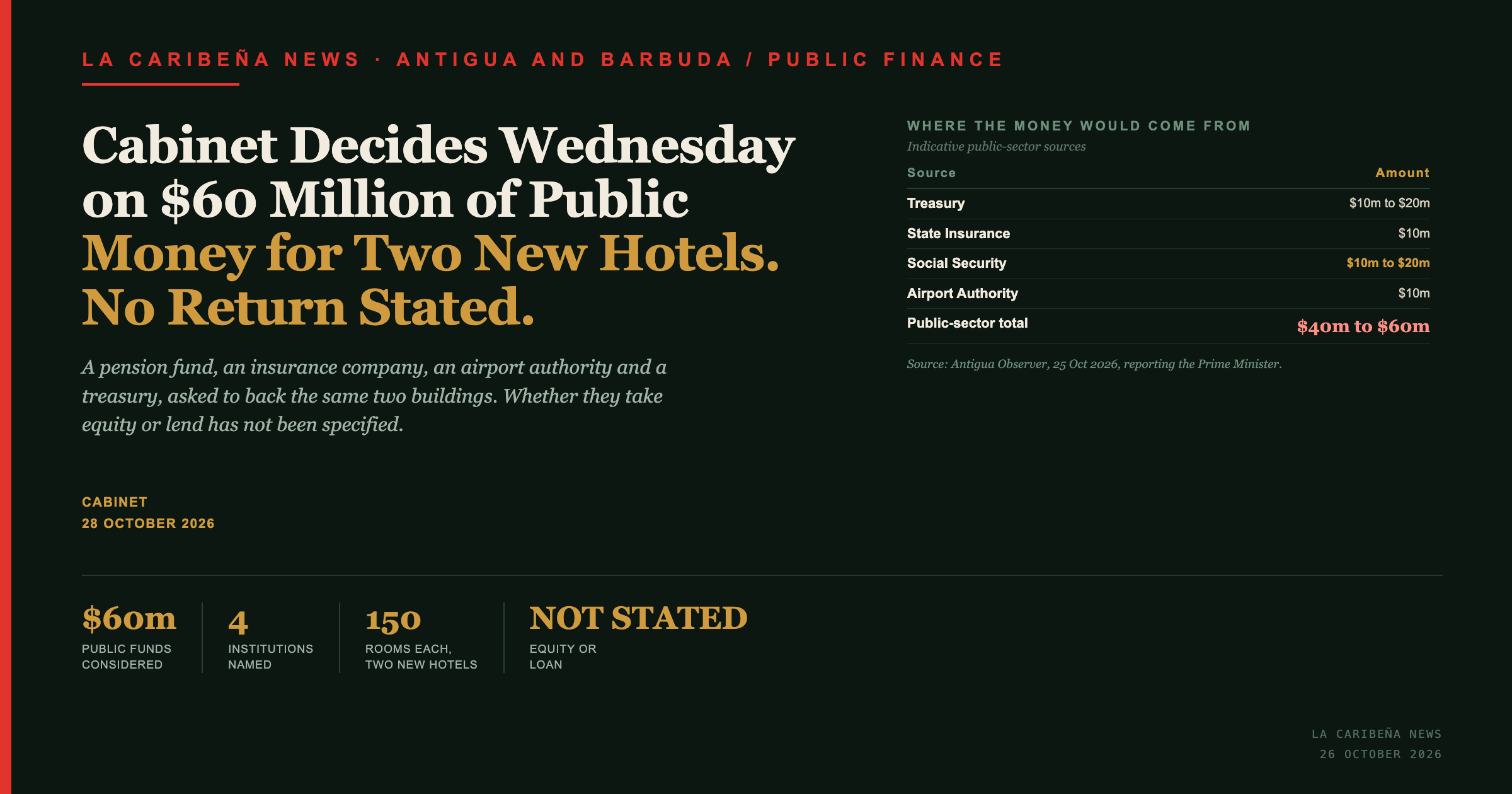
What the title card shows
Every data point on the article's title card, in text.
- $60m. The public-sector funds under consideration. Source: the Antigua Observer, 25 October 2026, as reported from the Prime Minister's remarks.
- Four institutions. Treasury at $10m to $20m, State Insurance at $10m, Social Security at $10m to $20m and the Airport Authority at $10m, a public-sector total of $40m to $60m. Source: as above.
- Two new hotels, about 150 rooms each. One on land in the Greenfield area at Jolly Beach, the other at Yeptons. Source: as above.
- 28 October 2026. The Cabinet meeting at which the proposals are to be assessed. Source: as above.
- Not stated. Whether the institutions take equity or lend, the expected returns, whether boards were approached, and whether investment assessments were completed. Source: as above.
Frequently Asked Questions
What is Antigua and Barbuda's government proposing?
Drawing up to $60 million from the Treasury, State Insurance, Social Security and the Antigua and Barbuda Airport Authority to help finance two new 150-room hotels, one on land in the Greenfield area at Jolly Beach and the other at Yeptons, with Cabinet to assess the proposals on Wednesday 28 October 2026.
Would the institutions own the hotels or lend to them?
The published report does not say. The Prime Minister did not specify whether the institutions would take equity stakes or provide loans, and did not outline the expected financial returns.
Has any institution agreed to take part?
The report does not say that any has. It records that the Prime Minister did not say whether the governing boards had been approached or whether formal investment assessments had been completed.
Are the figures in East Caribbean or United States dollars?
The report writes "$" without stating the currency. Antigua and Barbuda uses the East Caribbean dollar. The figures are reproduced here as published.
What is the argument for using public money?
The Prime Minister argued for expanding domestic ownership of tourism properties rather than depending on foreign investors, saying profits from foreign-owned developments are repatriated and that local ownership would keep earnings in the country.