--- title: "St Kitts Prices the Same Cannabis Acreage Twice, Nearly Twenty-Five Times Apart. Nothing in the Regulations Defines a Tier." slug: st-kitts-cannabis-licence-fee-tiers-overlap-schedule-ii-undefined-2026 canonical: https://www.lacaribenanews.com/st-kitts-cannabis-licence-fee-tiers-overlap-schedule-ii-undefined-2026/ date: 2026-10-30 desk: Business tags: ['Business', 'St Kitts and Nevis', 'Regulation', 'Investment', 'Agriculture'] feature_image: st-kitts-cannabis-licence-fee-tiers-overlap-schedule-ii-undefined-2026-title.png description: "Schedule II of St Kitts and Nevis's Cannabis (Medicinal Cannabis Licensing) Regulations prices cultivation Tier 5 at 1 to 5 acres or more and Tier 6 at 5 acres or more, at EC$170,000 and EC$4,200,000 for a foreign applicant. The word tier appears only in the fee schedules." ---
By LCN Business Desk
An applicant for a medicinal cannabis licence in St Kitts and Nevis is approved first and told what to pay afterwards. Regulation 16(1) provides that where the Authority approves an application, the applicant "is expected to produce all licensing fees, as specified in Regulation 31". The schedule that regulation points to gives two answers for the same piece of land.
What do the two tiers say?
That a cultivation of five acres is priced at EC$170,000 and at EC$4,200,000.
Schedule II sets the licence fee for a medicinal cannabis cultivation licence in six tiers, in Eastern Caribbean dollars, in two columns.
| Cultivation tier, as written in Schedule II | Foreigners and not local citizen | Local citizen |
|---|---|---|
| Tier 1, "up to 11000 square feet" | $30,000 | $1,000 |
| Tier 2, "11001 square feet to 22,000 square feet" | $40,000 | $1,500 |
| Tier 3, "22,001 square feet to 33,001 square feet" | $50,000 | $2,000 |
| Tier 4, "33,001 acre to 1 acre" | $60,000 | $3,000 |
| Tier 5, "1 to 5 acres or more" | $170,000 | $5,000 |
| Tier 6, "5 acres or more" | $4,200,000 | $200,000 |
Source: Cannabis (Medicinal Cannabis Licensing) Regulations, SRO No. 17 of 2022, Schedule II, which carries the citation "(regulation 30)". Tier descriptions are reproduced as written.
The two bottom rows overlap rather than meet. Tier 5 is open at the top, because "1 to 5 acres or more" does not close at five acres, and Tier 6 begins at the figure Tier 5 has already passed. A five-acre cultivation appears to answer both descriptions. So, on the words used, does a fifty-acre one.
The gap between the two readings is nearly twenty-five times for a foreign applicant and forty times for a local citizen, on this newspaper's arithmetic from the four figures.
Does anything in the regulations define a tier?
No. The word appears thirteen times in the instrument, and every one of them is inside a fee schedule.
The regulations run to seventeen schedules and a definitions provision. Regulation 2 is headed "Interpretation" and defines a list of terms, among them "applicant", "medicinal cannabis cultivation licence", "medicinal cannabis dispensary" and "medicinal cannabis goods". It does not define a tier.
Regulations 30 to 33 are the fee provisions, and each is a single line pointing at its schedule: application fees at 30, licence fees at 31, renewal fees at 32, administrative service fees at 33. None states how a tier is determined, who determines it, by what measure, or what happens where two descriptions fit.
The measure itself is not consistent down the column. Tiers 1 to 3 are expressed in square feet. Tier 4 is written as "33,001 acre to 1 acre", where the opening figure carries the unit of the tiers above it and the limit is an acre. Tiers 5 and 6 are in acres. One acre is 43,560 square feet.
When does an applicant learn the figure?
After approval, and the appeal right does not reach the classification.
The application fee is processed on approval, and the licence fee follows. Regulation 15, headed "Rejection of an application", then provides at subregulation (4) that "an applicant may appeal a rejection pursuant to these Regulations as specified in Part VII of the Cannabis Act, 2020".
An appeal against rejection is not an appeal against a fee. On the face of the regulations an applicant who is approved into Tier 6 rather than Tier 5 has been given a figure, not a decision it is told it may contest.
Licences run for three years under regulation 35(1), and Schedule II permits annual payment instead, so the figure is not a single event either.
Who qualifies for the lower column?
The schedules use three different categories for it, and the instrument defines none of them.
Schedule II and Schedule III head their cheaper column "Local citizen", against "Foreigners and not local citizen". That phrase appears nowhere else in the instrument, including in the Interpretation provision.
Schedule I, which sets application fees, uses a different word: "Residents for St. Kitts-Nevis are expected to pay half or special waiver can be granted of the fees that are proposed."
Regulation 28 then supplies a test for a third thing again. Headed "Factors considered when determining residency", it provides that the Authority "will review the totality of the evidence, and any single piece of evidence regarding the location of a person's primary home will not necessarily be determinative".
| The provision | The category it uses | What turns on it |
|---|---|---|
| Schedule II and III, column heading | Local citizen | The licence and renewal fee, a difference of up to EC$4,000,000 |
| Schedule I, note | Residents, who pay half | The application fee |
| Regulation 28 | Residency, on the totality of the evidence | Not stated to apply to either schedule |
Citizenship and residence are not the same status, and a test for the second is not a test for the first. An applicant reading the instrument to work out which column applies to it is directed to a residency test for a citizenship heading.
What else does a foreign applicant owe?
Equity in the company, free and in perpetuity, once foreign ownership passes 30 per cent.
Regulation 27(2) provides that a non-citizen holding a medicinal cannabis business licence, "with company ownership between 30 percent and 79 percent owned by the foreign entity, shall issue to the Government a 15 percent risk-free perpetual equity ownership of that company", and at "between 80 percent and 100 percent", 25 per cent.
Regulation 27(1) applies the Non-Citizens Land Holding Regulations Act to any non-citizen who is a director or shareholder of a company investing in a medicinal cannabis business.
The two bands do not join. A company 79 per cent foreign-owned falls in the first, one 80 per cent foreign-owned falls in the second, and the instrument provides for neither of the figures between them. Below 30 per cent foreign ownership no issuance is required at all, which places a step at 30 per cent and another at 80 per cent.
For a foreign investor the equity term is the larger number in the deal. A 25 per cent perpetual stake issued at no cost sits against a licence fee, and the licence fee is the part of the two that has a schedule.
Are there other errors in the same schedules?
Three more, and one of them puts a second overlap at the Tier 3 boundary.
Tier 3 runs "22,001 square feet to 33,001 square feet" and Tier 4 begins at "33,001". A cultivation of exactly 33,001 square feet appears in both, at EC$50,000 or EC$60,000 for a foreign applicant.
Schedule II carries the citation "(regulation 30)" beneath its heading. Regulation 30 is headed "Schedule of application fees", and it is the provision Schedule I cites. The licence fee provision is regulation 31, which no schedule cites, and regulation 16(1) sends the approved applicant to regulation 31 for the figure.
Items 8 and 9 of Schedule II both read "Medicinal Cannabis Export Licence Fee", at EC$9,000 and EC$4,500, with no import licence fee anywhere in the schedule. Schedule I charges EC$3,000 to apply for an import licence, and regulation 2 defines a "medicinal cannabis import or export licence" as a single licence issued per transaction.
The Tier 1 local figure is printed as "$1.000", with a decimal point where the other rows carry a comma. Schedule I describes its own contents as "the fees that are proposed", in an instrument that has been made.
Does the renewal schedule repeat it?
Every figure and every defect, which is what makes this a recurring exposure rather than a one-off.
Schedule III sets renewal fees under regulation 32. Its six cultivation tiers carry the same descriptions and the same amounts as Schedule II, including "1 to 5 acres or more" at EC$170,000 and "5 acres or more" at EC$4,200,000, the Tier 3 boundary at 33,001, the Tier 4 unit, the duplicated export item and the "$1.000".
Licences are three-year instruments, so the same question returns at each renewal, against a schedule that has not resolved it.
What does this mean for an applicant?
That the two documents to obtain before capital commits are a tier determination and an ownership-band ruling, both in writing.
The regulations give the Authority the decision on both and give the applicant no stated route to contest either. An operator that models entry on Tier 5 and is licensed into Tier 6 has a financing gap of EC$4,030,000 in the foreign column, on this newspaper's arithmetic from the two rows, and discovers it after approval.
The compliance burden in the same regulations is specified to the letter. The St Kitts and Nevis Medicinal Cannabis Authority said on 28 October 2026 that a major local bank is prepared to accept proceeds from licensed cannabis businesses, under a regulation that records every transaction from the licence application onward and lets a foreign law enforcement authority inspect the database. The transparency obligations in that instrument are drafted in detail. Its price list is not.
Capital is going into the Federation on terms that are settled. Demerara Distillers Limited broke ground on a US$14 million expansion in St Kitts and Nevis on 6 August 2026, committing thirteen times that subsidiary's 2025 revenue of about US$1.07 million.
Elsewhere in the region the direction on foreign ownership has been to remove limits rather than to price them. Argentina's Supreme Court on 29 September removed the last judicial obstacle to Article 154 of Decree 70/2023, which repealed the 2011 rural land law, ending four limits on foreign ownership including a 1,000 hectare ceiling, while a separate border security regime survives.
What is settled, and what is not?
The text of the schedules is settled. What it produces for a given applicant is not.
Every provision, figure and quotation here is from the Cannabis (Medicinal Cannabis Licensing) Regulations, SRO No. 17 of 2022, made under the Cannabis Act, No. 8 of 2020 and published on 28 July 2022 in Extra-Ordinary Gazette No. 39 of 2022. Tier descriptions, column headings and the Schedule I note are reproduced as written.
Not established: how the Authority in practice decides between two tiers that fit the same acreage; whether any applicant has yet been assigned a tier, since the first commercial licence had not been reported issued as at early August 2026; whether the regulations have been amended since 2022, since the version read here is the instrument as originally gazetted; whether "local citizen" is applied as citizenship or as residency; whether the regulation 28 residency test governs the Schedule I note, the Schedule II column, or both; what happens to a company whose foreign ownership falls between 79 and 80 per cent; whether the Government has taken an equity issuance under regulation 27(2) from anyone; and whether Schedule II's citation of regulation 30 has any effect on which provision governs the licence fee.
The instrument that requires every transaction in this industry to be recorded in seventeen lettered categories prices its own licence twice.
The entities
- Cannabis (Medicinal Cannabis Licensing) Regulations, SRO No. 17 of 2022 are the licensing regulations of St Kitts and Nevis, gazetted on 28 July 2022.
- Cannabis Act, No. 8 of 2020 is the statute under which the regulations are made and whose Part VII carries the appeal route.
- St Kitts and Nevis Medicinal Cannabis Authority is the regulator that approves applications and issues licences.
- Schedule I sets application fees and carries the note on residents paying half.
- Schedule II sets licence fees in six cultivation tiers and two columns.
- Schedule III sets renewal fees, identical to Schedule II.
- Regulation 27 governs non-citizen investment, including the equity issuance to the Government.
- Regulation 28 supplies the factors for determining residency.
- Non-Citizens Land Holding Regulations Act is the Act applied by regulation 27(1) to non-citizen directors and shareholders.
- Extra-Ordinary Gazette No. 39 of 2022 is where the regulations were published.
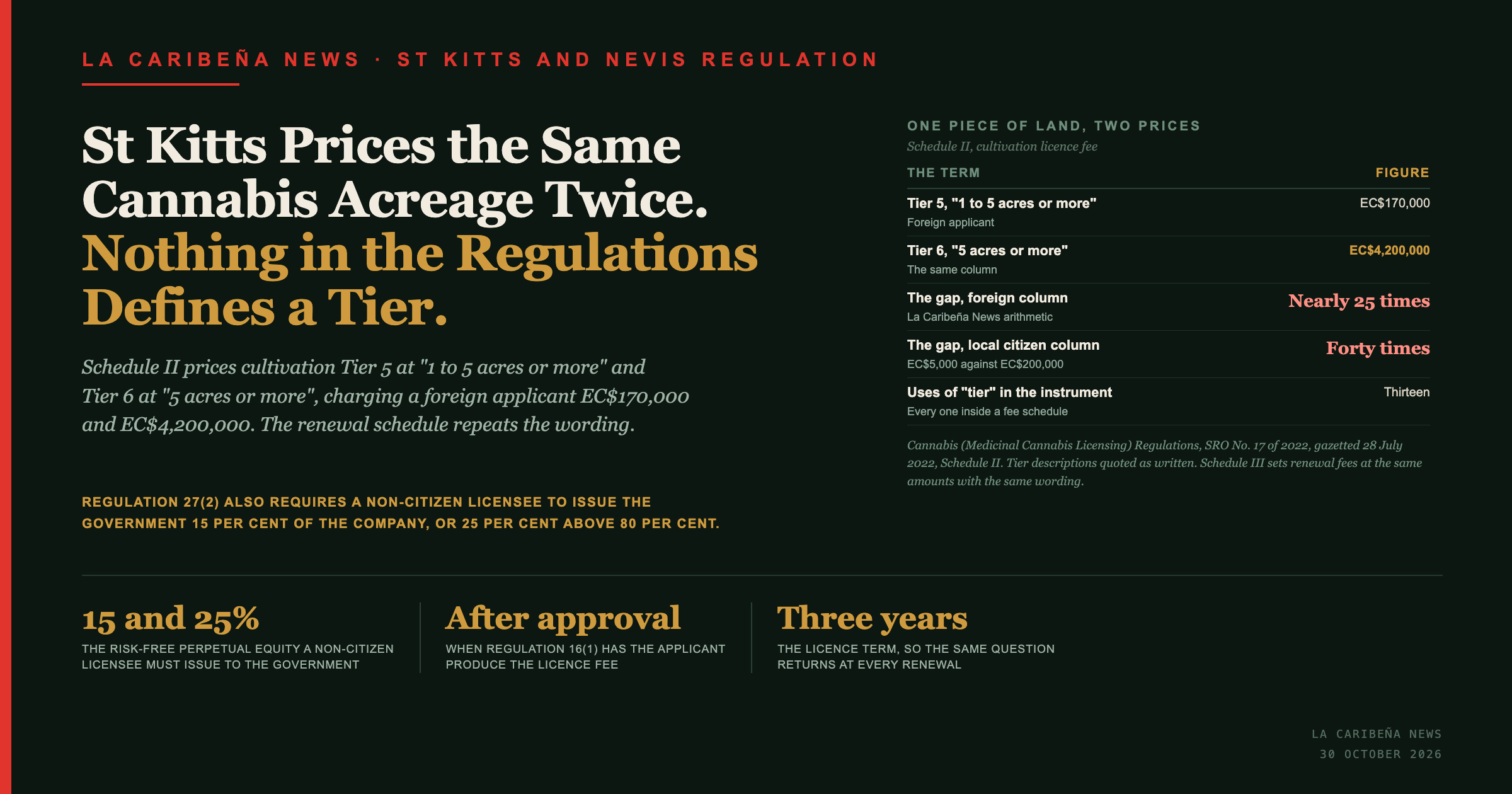
What the title card shows
Every data point on the article's title card, in text.
- EC$170,000. The Schedule II licence fee for a foreign applicant at Tier 5, "1 to 5 acres or more".
- EC$4,200,000. The same column at Tier 6, "5 acres or more".
- Nearly twenty-five times. The gap between the two for a foreign applicant, on this newspaper's arithmetic.
- Forty times. The same gap in the local citizen column, EC$5,000 against EC$200,000.
- Thirteen. Uses of the word tier in the instrument, every one inside a fee schedule.
- 15 and 25 per cent. The risk-free perpetual equity a non-citizen licensee must issue to the Government under regulation 27(2).
- 28 July 2022. When the regulations were gazetted.
Frequently Asked Questions
What is the cannabis licence fee in St Kitts and Nevis?
Schedule II of SRO No. 17 of 2022 sets it in Eastern Caribbean dollars across six cultivation tiers and two columns. A foreign applicant pays from $30,000 at Tier 1 to $4,200,000 at Tier 6, and a local citizen from $1,000 to $200,000. Other classes include a dispensary at $225,000 foreign and $10,000 local.
Why are two tiers in conflict?
Tier 5 is written as "1 to 5 acres or more" and Tier 6 as "5 acres or more". Because Tier 5 does not close at five acres, a five-acre cultivation appears to answer both descriptions, at EC$170,000 or EC$4,200,000 for a foreign applicant. The same wording appears in Schedule III for renewals.
Do the regulations say how a tier is decided?
No. The word tier appears thirteen times in the instrument and every occurrence is inside a fee schedule. Regulation 2, the Interpretation provision, does not define it, and regulations 30 to 33 each simply point at their schedule without stating how a tier is determined or by whom.
Does a foreign investor owe anything beyond the fees?
Yes. Regulation 27(2) requires a non-citizen licensee with company ownership between 30 and 79 per cent foreign-owned to issue the Government a 15 per cent risk-free perpetual equity ownership of the company, rising to 25 per cent where foreign ownership is between 80 and 100 per cent. Regulation 27(1) applies the Non-Citizens Land Holding Regulations Act to non-citizen directors and shareholders.
Who gets the cheaper column?
The schedules do not say consistently. Schedules II and III head it "Local citizen", a phrase used nowhere else in the instrument. Schedule I instead says residents are expected to pay half. Regulation 28 supplies factors for determining residency, on the totality of the evidence, without stating that it governs either schedule.
When does an applicant find out what it owes?
After approval. Regulation 16(1) provides that where the Authority approves an application, the applicant is expected to produce all licensing fees as specified in regulation 31. The appeal right at regulation 15(4) is against a rejection, under Part VII of the Cannabis Act, 2020, not against a fee classification.