By LCN Business Desk
A Caribbean company or individual can now buy Argentine farmland on the same terms as an Argentine one, with one exception that catches a large part of the country.
The Supreme Court of Justice ruled on 29 September that the Centro de Ex Combatientes Islas Malvinas La Plata, which had challenged the repeal, lacked standing to bring the case. The Court revoked a March 2024 decision of the Third Chamber of the Federal Court of La Plata that had declared the repealing provision unconstitutional. It rejected the proposition that an association may sue in defence of territorial sovereignty as though that were a collective right protected by article 43 of the National Constitution.
What were the limits before?
Four, and they were the reason a foreign buyer could not treat Argentina as an open market. Law 26.737, the Regime for the Protection of the National Domain on Property, Possession or Tenure of Rural Lands, was sanctioned on 22 December 2011. Marval, O'Farrell & Mairal, Argentina's largest law firm, set them out when the repeal was published.
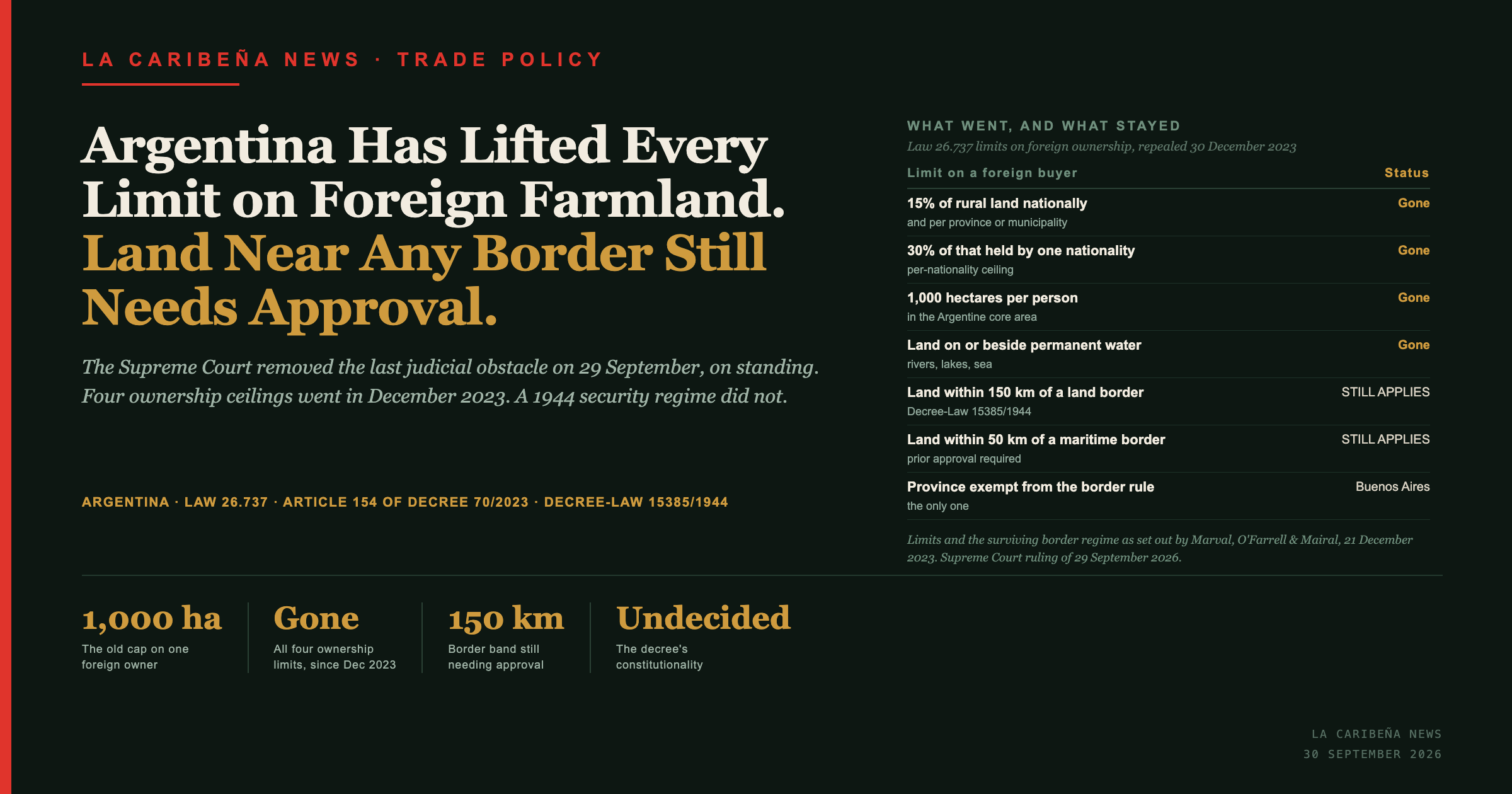
| The limit | What it meant |
|---|---|
| A 15 per cent national ceiling | Foreigners could not own or possess more than 15 per cent of rural land across the country, or of the territory of the province, municipality or equivalent entity where the property sat |
| A 30 per cent nationality ceiling | Persons of one same foreign nationality could not hold more than 30 per cent of that 15 per cent |
| A 1,000 hectare personal cap | The same foreign person could not hold more than 1,000 hectares in the core area north of Buenos Aires province and south of Córdoba and Santa Fe, or a provincially determined equivalent elsewhere |
| A water prohibition | Foreigners could not own land containing or adjacent to "large and permanent bodies of water" |
Limits as summarised by Marval, O'Farrell & Mairal, 21 December 2023.
Decree 70/2023 was published in the Official Gazette on 21 December 2023 and set no commencement date, so the repeal took effect on the eighth day afterwards, 30 December 2023. In the firm's words, the limitations "will have been eliminated, and foreigners will be able to freely acquire rural lands to use for all kind of investments".
What still restricts a foreign buyer?
The border. The repeal did not touch it.
The border security zone regime established in Decree-Law 15385/1944 remains in force, and it reaches 150 kilometres inland from a land border and 50 kilometres from a maritime one.
A foreigner buying rural property, and in some cases urban property, inside those bands must obtain prior approval from the National Directorate of Technical Border Affairs, which sits under the Ministry of the Interior. Only the Province of Buenos Aires is exempt.
Two further boundaries on what changed. Law 26.737 governed rural land, so urban property was never subject to these particular ceilings. And the tax and residency treatment of a non-resident owner is a separate regime that the repeal does not address.
Why would a Caribbean buyer be looking at all?
Because the region buys food it does not grow, and the capital to do something about that has begun moving outward rather than only in.
Demerara Distillers backed a St Kitts development with thirteen times that unit's annual revenue, an outward move that this newspaper found almost no other Guyanese firm making, in DDL Is Backing St Kitts With Thirteen Times That Unit's Annual Revenue. The routes are being built in the same direction: the hemisphere's first trade corridor runs through Argentina, set out in America Built Its First Trade Corridor in This Hemisphere.
Argentine agricultural capacity is the other half. Brazil's record harvest is already outrunning its storage, and the region's food import bill is the standing argument for sourcing closer to home, a case examined in Washington Opened 300,000 Tonnes of Beef to the Hemisphere.
On the public record this newspaper can find, no Caribbean or CARICOM buyer has yet acquired Argentine rural land under the new position. That is not the same as none having done so; it is not established either way.
What could reverse it?
Two things, and neither is settled.
The Supreme Court decided standing and nothing else. It said expressly that its ruling does not pass judgment on the constitutional validity of Article 154, and does not interfere with the intervention of the Legislative Power provided for by the Constitution. The merits have never been tested.
A decree of necessity and urgency also remains subject to congressional treatment, and the opposition is seeking to bring Decree 70/2023 before the Chamber of Deputies. That treatment is further advanced than it appears: the Senate had already rejected the decree outright, examined in Argentina's Senate Rejected the Farmland Decree in March. The instrument that removed the limits is an executive decree, not a statute passed by Congress, and it can be treated as such.
So the position today is that the ceilings are not in force, the decree removing them has not been ruled on, and the body that could reverse it has been asked to look at it.
What the title card shows
29 September 2026: the date the Supreme Court of Justice revoked the ruling that had declared Article 154 of Decree 70/2023 unconstitutional, holding that the claimant lacked standing. 15 per cent: the national ceiling on foreign ownership of rural land under Law 26.737. 30 per cent: the share of that ceiling any one foreign nationality could hold. 1,000 hectares: the maximum one foreign person could hold in the Argentine core area, north of Buenos Aires province and south of Córdoba and Santa Fe. All four limits ceased to apply on 30 December 2023. 150 km and 50 km: the border security bands, from a land border and a maritime one, inside which a foreign buyer still needs prior approval from the National Directorate of Technical Border Affairs under Decree-Law 15385/1944. Buenos Aires province is the only exemption. Limits and the border regime as set out by Marval, O'Farrell & Mairal, 21 December 2023.
Frequently Asked Questions
What did Argentina's Supreme Court actually decide on 29 September?
That the association which brought the challenge lacked standing. It revoked the Federal Court of La Plata's March 2024 ruling declaring Article 154 of Decree 70/2023 unconstitutional, and stated that its own decision does not pass judgment on that article's constitutional validity.
Can a Caribbean national now buy farmland in Argentina without limit?
The four ceilings in Law 26.737 no longer apply, so on ownership limits the answer is yes. Land inside the border security zones is the exception and requires prior government approval.
Where are the border security zones?
Within 150 kilometres of a land border and 50 kilometres of a maritime one, under Decree-Law 15385/1944. A foreign buyer must obtain approval from the National Directorate of Technical Border Affairs, which sits under the Ministry of the Interior. The Province of Buenos Aires is exempt.
Does this apply to urban property?
Law 26.737 governed rural land, so urban property was not subject to these ceilings. The border security regime can reach urban property in some cases.
Could the limits come back?
Yes. The constitutionality of Article 154 has not been decided, and Decree 70/2023 is a decree of necessity and urgency, which remains subject to treatment by Congress. The opposition is seeking to bring it before the Chamber of Deputies.
Disclosure
This report describes a change in Argentine law and is not advice on any purchase. Limits, the repeal and the surviving border regime are taken from the published note of Marval, O'Farrell & Mairal dated 21 December 2023. Tax and residency treatment of non-resident owners is a separate regime not examined here.