By LCN Business Desk
The decree that opened Argentine farmland to foreign buyers has been one chamber away from falling for eighteen months.
This newspaper reported yesterday that the Supreme Court had removed the last judicial obstacle to Article 154 of Decree 70/2023, in Argentina Has Lifted Every Limit on Foreign Farmland Ownership. That piece noted that a decree of necessity and urgency remains subject to Congress. The congressional position is now the live question, and it is further advanced than the court case was.
What does it take to kill a decree in Argentina?
Both chambers, and nothing less.
Law 26.122, sanctioned in 2006, regulates Article 99 of the National Constitution. A decree of necessity and urgency ceases to have effect only when both chambers of Congress reject it explicitly. Silence by one chamber, partial silence, or ratification by one chamber leaves the decree standing.
That threshold has been met once. Congress rejected a decree in both chambers for the first time in September 2024, over a transfer of funds to the intelligence service.
Where does Decree 70/2023 stand in that process?
Half way, and the half that is done is the one that was supposed to be harder.
The Senate rejected Decree 70/2023 on 14 March 2024, by 42 votes to 25 with 4 abstentions, after a session of more than eight and a half hours presided over by Vice President Victoria Villarruel. The rejection applied to the decree in its entirety rather than to any section of it. The Senate's own record states that the rejected decree passed to the Chamber of Deputies for its treatment.
| The test under Law 26.122 | Status |
|---|---|
| Senate rejection | Done. 14 March 2024, 42 to 25, 4 abstentions |
| Chamber of Deputies rejection | Not held. Sought for October 2026 |
| Effect if both reject | Decree 70/2023 ceases to have effect, Article 154 with it |
"El Senado ya rechazó el DNU 70/2023. Diputados tiene que hacer lo mismo," said Cecilia Moreau of Unión por la Patria. The Senate has already rejected Decree 70/2023; Deputies has to do the same.
When would the Deputies vote?
Two dates are circulating, and the later one is the likelier.
Opposition blocs are working on a formal request for a special session. Wednesday 7 October and Wednesday 14 October are the dates in circulation, with 14 October considered more probable because a number of legislators are abroad on official commitments. Legislative sources quoted by MDZ put it plainly: "Hoy tiene que haber una fecha de sesión, hoy tenemos que fijar una fecha de sesión." The opposition puts the votes it needs at 129.
Elisa Carrió: "Los diputados tienen que sacar el rechazo al decreto en la parte de tierras." And on what is at stake: "Lo que se está afectando es la integridad territorial."
Carrió also criticised the handling of the matter in the upper chamber, saying that instead of rejecting the foreign land limitation there, "la sacaron del temario", they took it off the agenda.
What is the Government doing about it?
Opening a second front, by returning the question to legislation.
The Government is evaluating folding the Land Law into the committees already reviewing the Law of Inviolability of Private Property, which came from the Senate, Infobae reported. The purpose is to separate the opposition's effort and draw attention away from Decree 70/2023. A libertarian source told the outlet: "Creemos que deberíamos abrir la negociación con los aliados sobre ese proyecto."
The approach has a history inside the Government. Minister Federico Sturzenegger had previously recommended reforming the land regime through legislation rather than by decree.
What the title card shows
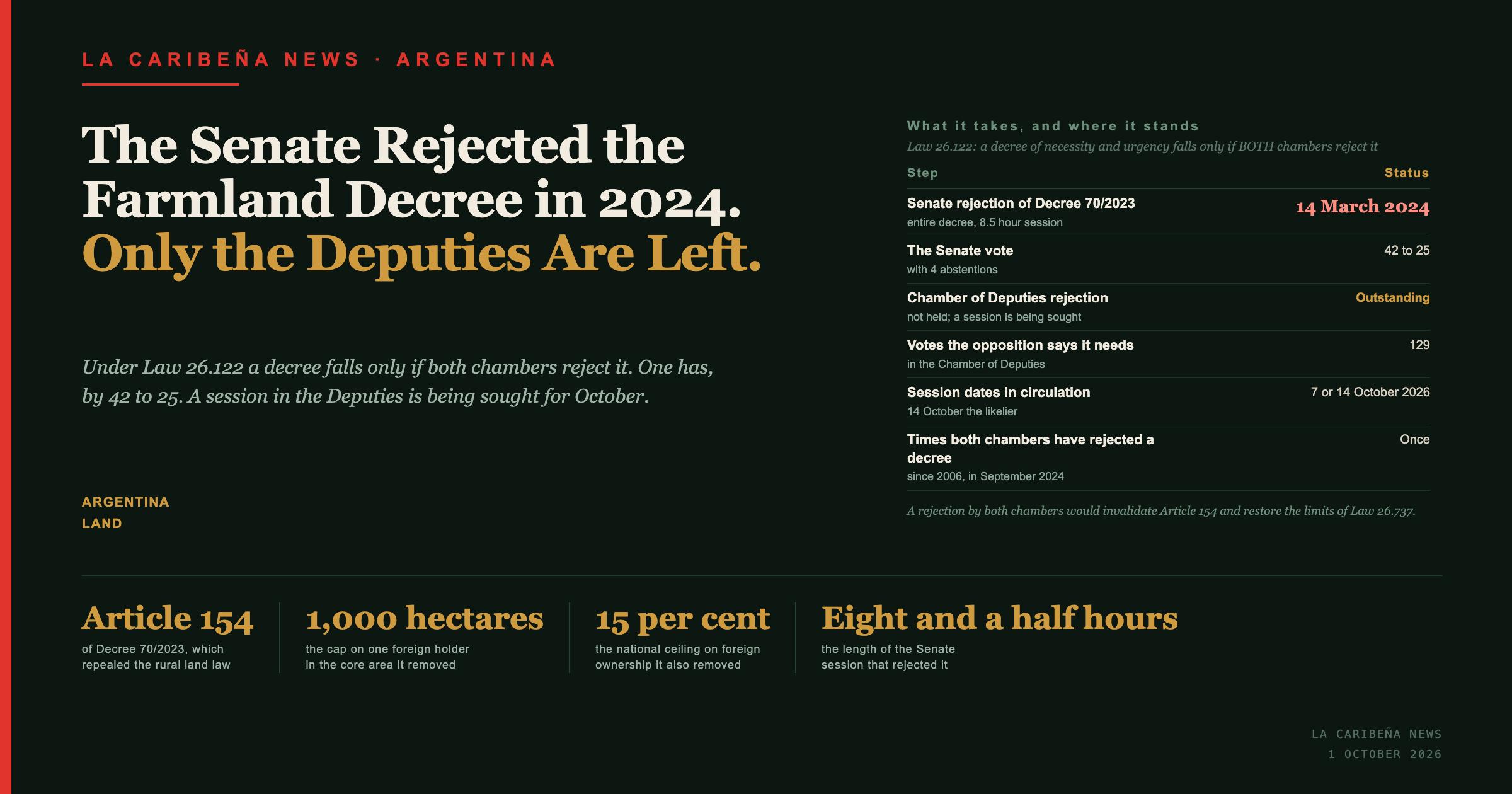
Every data point on the article's title card, in text.
The panel, "What it takes, and where it stands":
- 14 March 2024. The date the Senate rejected Decree 70/2023. Source: Senate of the Argentine Nation.
- 42 to 25. The Senate vote, with 4 abstentions. Source: Senate of the Argentine Nation.
- Both chambers. What Law 26.122 requires before a decree of necessity and urgency ceases to have effect.
- 129. The votes the opposition puts at what it needs in the Chamber of Deputies. Source: MDZ.
- 7 or 14 October 2026. The session dates in circulation, with 14 October the likelier.
- Once. The number of times since 2006 that both chambers have rejected a decree, in September 2024.
The footer strip:
- Article 154. The provision of Decree 70/2023 that repealed the rural land law.
- 1,000 hectares. The cap on any one foreign holder in the core area that Article 154 removed.
- 15 per cent. The national ceiling on foreign ownership of rural land that it also removed.
- Eight and a half hours. The length of the Senate session that rejected the decree.
What would it mean for a buyer?
The limits return, and what happens to a completed purchase is not on the public record.
Article 154 of Decree 70/2023 repealed Law 26.737 and with it four limits: a 15 per cent national ceiling on foreign ownership of rural land, a 30 per cent sub-ceiling per nationality, a cap of 1,000 hectares on any one foreign holder in the core area, and a prohibition on land containing or adjacent to large permanent bodies of water. A rejection by both chambers would invalidate Article 154.
On the public record this newspaper can find, no account has been given of what would happen to a purchase already completed while the decree was in force. The Government's statements, the opposition's statements and the reporting of both are silent on it. That is the question a foreign buyer has, and it is unanswered.
The border rule is unaffected either way. Decree-Law 15385/1944 was never repealed, so land within 150 kilometres of a land border or 50 kilometres of a maritime one still requires prior approval from the Ministry of the Interior, with the Province of Buenos Aires the only exemption.
Caribbean capital has been moving outward for some time. Demerara Distillers backed a St Kitts development with thirteen times that unit's annual revenue, in DDL Is Backing St Kitts With Thirteen Times That Unit's Annual Revenue, and the hemisphere's first trade corridor runs through Argentina, set out in America Built Its First Trade Corridor in This Hemisphere.
Frequently Asked Questions
Has Argentina's Congress rejected the farmland decree?
One chamber has. The Senate rejected Decree 70/2023 in its entirety on 14 March 2024 by 42 votes to 25 with 4 abstentions. The Chamber of Deputies has not voted, and under Law 26.122 a decree ceases to have effect only when both chambers reject it explicitly.
What is Law 26.122?
The 2006 law regulating Article 99 of Argentina's National Constitution, which governs decrees of necessity and urgency. It provides that such a decree falls only on the explicit rejection of both chambers. Silence by either chamber, or ratification by one, leaves the decree in force. Both chambers have rejected a decree once, in September 2024.
When might the Chamber of Deputies vote?
Opposition blocs are seeking a special session. Wednesday 7 October and Wednesday 14 October 2026 are the dates in circulation, with 14 October considered more likely because a number of legislators are abroad. The opposition puts the votes it needs at 129.
What happens to farmland a foreigner has already bought?
It is not on the public record. A rejection by both chambers would invalidate Article 154 and restore the limits of Law 26.737, but no account has been given by the Government, the opposition or the reporting of either of the position of a purchase already completed while the decree was in force.
Does any restriction on foreign buyers remain in force today?
Yes. Decree-Law 15385/1944 was not repealed. A foreign buyer of land within 150 kilometres of a land border, or 50 kilometres of a maritime one, requires prior approval from Argentina's Ministry of the Interior. Only the Province of Buenos Aires is exempt.