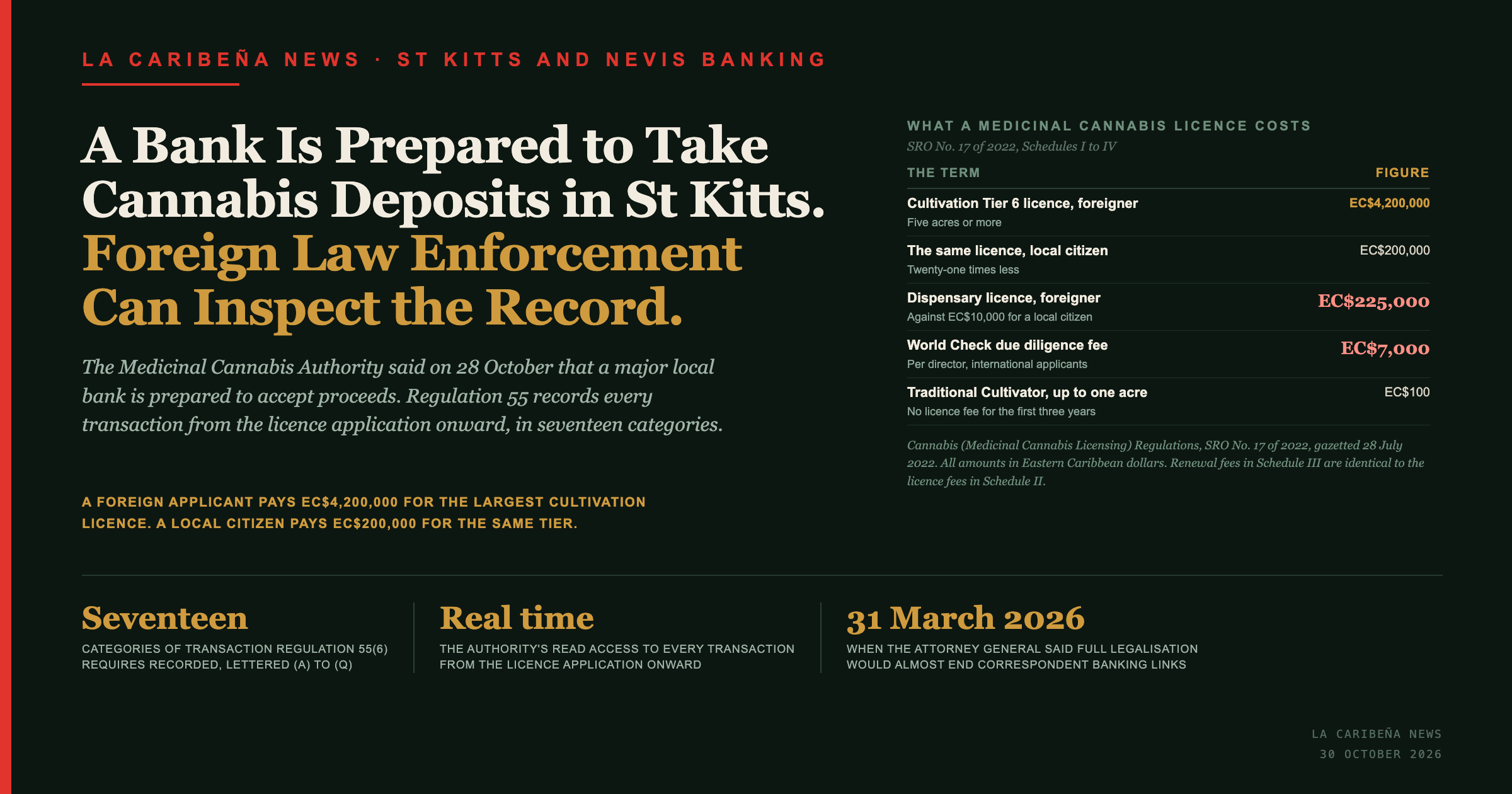
--- title: "A Bank Is Prepared to Take Cannabis Deposits in St Kitts. Foreign Law Enforcement Can Inspect the Record." slug: st-kitts-cannabis-banking-access-regulation-55-real-time-transaction-record-2026 canonical: https://www.lacaribenanews.com/st-kitts-cannabis-banking-access-regulation-55-real-time-transaction-record-2026/ date: 2026-10-30 desk: Business tags: ['Business', 'St Kitts and Nevis', 'Banking', 'Regulation', 'Agriculture'] feature_image: st-kitts-cannabis-banking-access-regulation-55-real-time-transaction-record-2026-title.png description: "The St Kitts and Nevis Medicinal Cannabis Authority announced on 28 October 2026 that a major local bank is prepared to accept proceeds from licensed cannabis businesses. Regulation 55 of SRO No. 17 of 2022 records every transaction from the application onward and lets a foreign law enforcement authority inspect the database." ---
By LCN Business Desk
Seven months after the Federation's Attorney General said full legalisation would almost end its banking relationships abroad, the regulator of its medicinal cannabis sector says a bank will hold that sector's money. What sits between the two statements is a regulation written in 2022.
What did the Authority announce?
That a bank is prepared to take the money, and that the access covers ordinary business banking rather than a single account.
In a release dated 28 October 2026, the St Kitts and Nevis Medicinal Cannabis Authority said "a major local bank is prepared to accept proceeds and conduct banking services" for businesses licensed under its regulatory framework. The services named are deposits, business accounts and payroll management.
Nadiv Mills, the Authority's chief executive, called the integration "a defining moment for our industry". The release thanks Hon. Samal Duggins, the minister responsible, and records that Saboto Caesar, a banking and finance lawyer, was retained as legal strategic consultant.
Why did banking access need announcing at all?
Because seven months earlier the government's own law officer said the banking relationships would not survive it.
On 31 March 2026, Hon. Garth Wilkin, the Attorney General and Minister of Justice and Legal Affairs, explained why cannabis could not be fully legalised in the Federation. His reasoning was entirely about the banks.
"What that means is that if we were to legalize, our corresponding banking relationships would almost come to an end," he said. He warned that foreign institutions, on learning that people in St Kitts and Nevis could legally profit from cannabis, "would cut off our banking system from the International Finance System", and that the result would be "irreparable harm to our banking system".
So the Federation holds two positions that have to be read together. Full legalisation remains off the table on the stated ground that it would sever the country's correspondent links. A licensed, regulated medicinal sector has just been told a local bank will hold its deposits.
What made a bank willing?
A financial audit trail written into law as a condition of operating, rather than offered afterwards as reassurance.
The Authority was established by the Cannabis Act, No. 8 of 2020, and licensing runs under the Cannabis (Medicinal Cannabis Licensing) Regulations, SRO No. 17 of 2022, gazetted on 28 July 2022. Regulation 55 is headed "Tracking funds and money".
Its operative sentence is 55(5): "Every financial transaction conducted, beginning from the licence application process, covering each and every transaction related to the medicinal cannabis business operation, shall be recorded through the St. Kitts and Nevis Tracking System and all information shall be available in read access format to the Authority in real time."
| What Regulation 55 requires | The provision |
|---|---|
| Categories of transaction recorded, (a) to (q) | Seventeen, from investments and capital expenditure through rent, salaries and taxes to banking and dividends |
| When the record starts | At the licence application, not at first sale |
| The Authority's access | Read access in real time, with 24-hour access to the database |
| Who else may inspect it | A foreign law enforcement authority, which "may access the database and inspect information related to licensees" |
| What an applicant files first | Source of funds documentation for all monies to be invested |
| Training the licensee must complete | An anti-money laundering and counter-terrorist financing course, run with the office of National Drug and Money Laundering Control Policy |
| What tampering with the system is | An offence under section 57 of the Cannabis Act, 2020 |
Source: Cannabis (Medicinal Cannabis Licensing) Regulations, SRO No. 17 of 2022, regulation 55.
Regulation 55(3) reaches outside the Federation. It designs the database to flag irregularities, and it provides that a foreign law enforcement authority may access it and inspect information related to licensees. A bank's exposure on a cannabis customer is that it cannot show an authority abroad what that authority would want to see, and that authority has been given the window directly.
Salaries, rent and dividends are the categories through which a cash-intensive business normally becomes opaque, and they appear at 55(6)(g), (j) and (q). The Authority credits GrowerIQ and Steve Maximay with building the system to that standard.
Regulation 55(1) ties the requirement to the Federation's anti-money laundering and counter-terrorist financing obligations, and 55(13) makes an anti-money laundering course part of the training a licensee must complete. The hemisphere's compliance bodies do not all take in the Caribbean. The World Compliance Association's tenth anniversary congress in Lima on 23 and 24 September drew more than 500 professionals from over 20 countries, and the anti-money-laundering body on its programme, GAFILAT, has eighteen members and no CARICOM state among them.
Andrew Wilson, GrowerIQ's chief executive, put the division of labour as: "The Authority set the standard. Our job is to meet it."
Which bank is it?
The release does not say, and the one bank it names is named for a different reason.
The sentence about a provider says "a major local bank". Separately, the release records that the Authority and its legal consultant "met with the St. Kitts-Nevis-Anguilla National Bank for a successful meeting". The release does not state that the institution it met is the institution that will provide the services, and the two sentences are not joined.
It also says discussions with other banks and credit unions will continue. One unnamed institution prepared to act, with the rest of the system still in conversation, is a narrower position than the words "full banking access" in the release's own headline carry.
How many businesses can use it?
The release gives no number, and on the public record this newspaper can find, the first commercial licence had still not been issued as at early August 2026.
CannaCarib reported in August that the Authority had not issued a commercial licence and that none had been announced. Times Caribbean reported on 4 August 2026 that the Federation had yet to issue a single medicinal cannabis licence, more than a year after the Authority was launched in April 2025. GrowerIQ's August release said the tracking system would be in place before the first commercial licence was issued, which is consistent with none having been granted at that point.
The Authority's release carries no licence count. What has been secured, therefore, is the banking arrangement for a licensed population whose size the government has not published.
What does a licence cost?
On the main schedule, between EC$1,000 and EC$4.2 million for the licence itself, and the figure turns on nationality and scale.
The fees sit in Schedules I to IV of the regulations, all amounts in Eastern Caribbean dollars. A licence is valid for three years, and the schedule permits a licensee to pay annually instead.
| Licence fee, Schedule II | Foreigners and non-local citizens | Local citizens |
|---|---|---|
| Cultivation Tier 1, up to 11,000 square feet | $30,000 | $1,000 |
| Cultivation Tier 3, 22,001 to 33,001 square feet | $50,000 | $2,000 |
| Cultivation Tier 5, 1 to 5 acres or more | $170,000 | $5,000 |
| Cultivation Tier 6, 5 acres or more | $4,200,000 | $200,000 |
| Research and development | $120,000 | $60,000 |
| Testing facility | $120,000 | $60,000 |
| Manufacturer | $200,000 | $100,000 |
| Dispensary | $225,000 | $10,000 |
| Transport | $50,000 | $25,000 |
| Lounge | $60,000 | $30,000 |
Source: SRO No. 17 of 2022, Schedule II. The renewal fees in Schedule III are identical to these.
At the largest cultivation tier a foreign applicant pays twenty-one times the local figure, and for a dispensary twenty-two and a half times, on this newspaper's arithmetic from the two published columns. Schedule I sets application fees separately, from $3,000 for a cultivator, import, export or transport licence to $15,000 for a laboratory, and records that residents "are expected to pay half or special waiver can be granted".
A separate class sits outside that structure altogether. The Traditional Cultivator licence, up to one acre on a three-year renewal, carries a non-refundable application fee of EC$100 and no licence fee for the first three years.
Schedule IV charges for compliance separately. A World Check due diligence fee of EC$7,000 per director applies to international applicants, so a four-director foreign venture pays EC$28,000 in screening before it reaches a licence fee. The tracking system carries a one-time sign-on fee of EC$300 for tier one cultivation and processors, and EC$700 for every other licence class.
One figure in public circulation belongs to a different statute. An annual fee of EC$100 attaches to a licence under the Freedom of Conscience (Cannabis) Act, a religious and personal-use licence with no fee for applicants before 22 December 2026. It sits under a different Act from the commercial medicinal regime and does not read across. The Authority has separately said the licensing fee is waived for Rastafarians, citing the Rastafari Rights Recognition Act 2023.
Does the schedule say clearly what a given operator owes?
Not at the top of the range, where two tiers appear to describe the same acreage at a twenty-five-fold difference.
Schedule II prices cultivation Tier 5 at "1 to 5 acres or more" and Tier 6 at "5 acres or more", charging a foreign applicant EC$170,000 and EC$4,200,000, and the word tier appears only in the fee schedules. Regulation 16(1) has the applicant produce the licence fee after approval, so the figure arrives once capital is committed.
The traceability platform was contracted in August, the banking access followed in October, and the licence is still ahead. Capital committed in the expectation of a quick start is capital exposed to a timetable the Authority has not dated. Money is going into the Federation on other terms: Demerara Distillers Limited broke ground on a US$14 million expansion in St Kitts and Nevis on 6 August 2026, committing thirteen times that subsidiary's 2025 revenue of about US$1.07 million.
Is the banking problem solved?
Not the layer the Attorney General was describing.
A local bank taking local deposits and running payroll is a domestic arrangement. The risk Wilkin set out in March sits above it, in the relationships Caribbean banks hold with institutions abroad, and nothing in the October release addresses that layer or mentions correspondent banking at all.
That distinction has a published precedent in how the standard is actually applied. One regulation, 31 C.F.R. 1010.610, governs every correspondent account a United States bank holds for a foreign financial institution, and the Bank of America order of 13 October 2026 finds the bank carved its own foreign branches out of that standard, applying "reduced requirements" to their accounts until December 2024. What Wilkin described as being cut off also has a recent sector-based form. The State Department designated Banco Internacional de Comercio S.A. on 15 October 2026 under a clause of Executive Order 14404 that requires only that a firm operate in Cuba's financial services sector, and four other sectors carry the same clause. A Caribbean bank seeking a United States correspondent account must document its business, the markets it serves and the expected activity on the account. A customer base whose every transaction is already recorded in a regulator-readable system is an easier thing to document than one whose is not.
The region is also building rails that do not run through those institutions at all. The central banks of Trinidad and Tobago, Barbados, the Eastern Caribbean and The Bahamas met a Pan-African Payment and Settlement System team in Port of Spain on CAPSS, CARICOM's planned system for instant payments between member states in local currencies. St Kitts and Nevis sits inside the Eastern Caribbean Currency Union, whose central bank was at that table. Trinidad and Tobago is building a national payment system with India's NPCI International and chairs the committee building a cross-border one on Africa's model, while Guyana signed with the same Indian body in November 2024 and is not in the regional system's pilot group.
What the enforcement record shows about where laundering risk is actually found is a separate matter, and it is not where institutions have tended to look. American Express National Bank's anti-money laundering risk assessment focused on its relatively narrow deposit products and insufficiently on its dominant card products, and the Office of the Comptroller of the Currency fined it US$350 million on 8 October 2026 over approximately US$13 billion in suspected trade-based money laundering.
What is settled, and what is not?
The announcement, the law and the Attorney General's position are settled. The provider, the licence count and the correspondent layer are not.
The release and its contents are the Authority's own, published by the St Kitts and Nevis Information Service. The Attorney General's statement of 31 March 2026 is published on the same service. Every provision and every fee quoted here has been read in the gazetted instrument, the Cannabis (Medicinal Cannabis Licensing) Regulations, SRO No. 17 of 2022, made under the Cannabis Act, No. 8 of 2020 and published on 28 July 2022 in Extra-Ordinary Gazette No. 39 of 2022.
Not established: which bank will provide the services; whether the St. Kitts-Nevis-Anguilla National Bank is that bank; how many licences have been issued, which the release does not state and which no more recent source than early August addresses; when the first commercial licence will be granted; whether any correspondent institution has been consulted; whether the regulations have been amended since 2022, since the version read here is the instrument as originally gazetted; and which tier governs a five-acre cultivation, where the schedule describes it twice. Independent confirmation of the release's contents, beyond the Authority's own account of them, is thin.
The route on this record runs through the statute book rather than the boardroom, and it was finished before anyone held a licence to use it.
The entities
- St Kitts and Nevis Medicinal Cannabis Authority is the regulator established by the Cannabis Act, No. 8 of 2020, launched in April 2025.
- Cannabis Act, No. 8 of 2020 is the statute that created the Authority.
- Cannabis (Medicinal Cannabis Licensing) Regulations, SRO No. 17 of 2022 are the licensing regulations, of which Regulation 55 governs financial transaction recording.
- Nadiv Mills is the chief executive of the Authority.
- Hon. Garth Wilkin is the Attorney General and Minister of Justice and Legal Affairs of St Kitts and Nevis.
- Hon. Samal Duggins is the minister thanked in the Authority's release.
- Saboto Caesar is the banking and finance lawyer retained as the Authority's legal strategic consultant.
- Freedom of Conscience (Cannabis) Act is the separate statute under which a religious and personal-use cannabis licence carries an annual fee of EC$100.
- Rastafari Rights Recognition Act 2023 is the Act the Authority cites in waiving the licensing fee for Rastafarians.
- St. Kitts-Nevis-Anguilla National Bank is the institution the Authority records meeting.
- St. Kitts and Nevis Tracking System is the national seed-to-sale and financial record the regulations require every licensee to use.
- World Check is the due diligence screening for which Schedule IV charges international applicants EC$7,000 per director.
- Traditional Cultivator is the separate licence class for up to one acre, with an EC$100 application fee and no licence fee for three years.
- Office of National Drug and Money Laundering Control Policy co-delivers the anti-money laundering training the regulations require of licensees.
- GrowerIQ is the vendor contracted to supply the national seed-to-sale and financial tracking system.
- St Kitts and Nevis Information Service (SKNIS) is the government service that published both releases.
What the title card shows
Every data point on the article's title card, in text.
- EC$4,200,000. The Schedule II licence fee for a foreign applicant at cultivation Tier 6, five acres or more.
- EC$200,000. The same licence for a local citizen, twenty-one times less on this newspaper's arithmetic.
- Seventeen. Categories of transaction Regulation 55(6) requires to be recorded, lettered (a) to (q).
- A foreign law enforcement authority. Who regulation 55(3) permits to access the database and inspect information related to licensees.
- EC$7,000 per director. The Schedule IV World Check due diligence fee for international applicants.
- 28 October 2026. The date of the Authority's release announcing banking access.
- 31 March 2026. The date the Attorney General said full legalisation would almost end the country's correspondent banking relationships.
Frequently Asked Questions
What did St Kitts and Nevis announce about cannabis banking?
The St Kitts and Nevis Medicinal Cannabis Authority said on 28 October 2026 that a major local bank is prepared to accept proceeds and conduct banking services for businesses licensed under its framework, covering deposits, business accounts and payroll management. The release does not name the bank.
Which bank will provide the services?
The release does not say. It describes "a major local bank" in the sentence about a provider, and separately records that the Authority met with the St. Kitts-Nevis-Anguilla National Bank. It does not state that the bank it met is the bank that will provide the services, and it says discussions with other banks and credit unions will continue.
Why was cannabis banking difficult in the first place?
Attorney General Garth Wilkin explained on 31 March 2026 why cannabis could not be fully legalised, saying that if the Federation legalised, "our corresponding banking relationships would almost come to an end" and that foreign institutions "would cut off our banking system from the International Finance System", causing "irreparable harm".
What is Regulation 55?
A provision of the Cannabis (Medicinal Cannabis Licensing) Regulations, SRO No. 17 of 2022, requiring licensed businesses to record financial transactions in a national tracking system across seventeen categories, including investments, loans, rent, salaries, taxes, dividends and banking, with the Authority holding real-time read access.
How many cannabis licences has St Kitts and Nevis issued?
The 28 October release gives no number. CannaCarib reported in August 2026 that no commercial licence had been issued or announced, and Times Caribbean reported on 4 August 2026 that the Federation had yet to issue a single medicinal cannabis licence, more than a year after the Authority was launched in April 2025.
What does a medicinal cannabis licence cost in St Kitts and Nevis?
Schedule II of SRO No. 17 of 2022 sets licence fees in Eastern Caribbean dollars, from $1,000 for a local citizen at cultivation Tier 1 to $4,200,000 for a foreign applicant at Tier 6. A dispensary is $225,000 for a foreign applicant and $10,000 for a local citizen. Application fees in Schedule I run from $3,000 to $15,000, and Schedule IV adds a World Check due diligence fee of $7,000 per director for international applicants.
Does this resolve the correspondent banking issue?
Nothing in the release addresses it. A local bank accepting local deposits and running payroll is a domestic arrangement, while the risk the Attorney General described in March sits in the relationships Caribbean banks hold with institutions abroad. The October release does not mention correspondent banking.