By LCN Business Desk
Regional central banks are "making significant progress" toward the CARICOM Payment and Settlement System (CAPSS), a proposed platform for instant retail and commercial payments between member states in their own currencies, the Central Bank of Trinidad and Tobago said on Friday, 18 September. Cairo-based representatives of the Pan-African Payment and Settlement System (PAPSS) visited Port of Spain to share how the African system was built and run. What the two rails mean for a Guyanese firm was set out in Guyana's Fast Pay and CAPSS.
"The PAPSS experience offers valuable practical insights for the Caribbean as we continue to explore better options for regional payments that are less reliant on our foreign reserve currencies," said Dr Dorian Noel, deputy governor of the Central Bank of Trinidad and Tobago and chair of the CAPSS Steering Committee, according to the release.
Who took part in the Port of Spain meeting?
Governor Larry Howai of the Central Bank of Trinidad and Tobago hosted. The release names Dr Kevin Greenidge, Governor of the Central Bank of Barbados; Timothy Antoine, Governor of the Eastern Caribbean Central Bank; John Rolle, Governor of the Central Bank of The Bahamas; Dr Noel; PAPSS representatives; and members of the CAPSS working committees, according to the Central Bank of Trinidad and Tobago. The release names no representative of the Bank of Guyana.
"A modern and efficient cross-border payments infrastructure is critical to deepening regional integration and supporting greater trade and investment within CARICOM," Dr Noel said. "While considerable work remains ahead, this collaboration represents meaningful progress." Consultations and technical evaluations will continue in the coming months toward a CAPSS pilot, the bank said.
How did CARICOM's central banks come to PAPSS?
On 26 October 2023 the governors of eleven Caribbean central banks unanimously adopted PAPSS as the preferred system for settling intra-regional trade transactions, and the African Export-Import Bank (Afreximbank), which developed PAPSS, agreed to guide implementation, PAPSS announced. PAPSS was then operating in the six countries of the West African Monetary Zone.
From 19 to 21 February 2025, at the Central Bank of The Bahamas, the central banks of The Bahamas, Barbados, Suriname and Trinidad and Tobago tested a proof of concept for CAPSS with Afreximbank, PAPSS and the technology firm Montran, processing instant cross-border payments without intermediaries, including live tests between The Bahamas and Barbados, according to an Afreximbank statement reported by Nairametrics and posted by Afreximbank.
| Date | Step | Source |
|---|---|---|
| 26 October 2023 | Eleven Caribbean central banks adopt PAPSS for intra-regional trade settlement | PAPSS |
| 19 to 21 February 2025 | CAPSS proof of concept at the Central Bank of The Bahamas; live tests between The Bahamas and Barbados | Afreximbank via Nairametrics |
| 18 September 2026 | PAPSS team meets four governors in Port of Spain; work continues toward a CAPSS pilot | Central Bank of Trinidad and Tobago |
What would CAPSS change for Caribbean businesses?
CAPSS is intended to cut transaction costs and speed payments between member states, and to settle in local currencies rather than through foreign reserve currencies, according to the Central Bank of Trinidad and Tobago. La Caribeña News has reported how payments between Caribbean firms that route through correspondent banks carry the region's de-risking costs, in A Designation Is Not a Conviction, and how CARICOM's small businesses wait on payment, in The 90-Day Wait.
Afreximbank's ties to the region run beyond payments: it approved a US$1.5 billion facility for CARICOM states in December 2022, opened a CARICOM office in Barbados in August 2023, and broke ground on an African Trade Centre in Bridgetown in March 2025, as La Caribeña News reported in The Mothers Built the Lane.
Guyana is building its own real-time payments rail with India. Its Ministry of Foreign Affairs signed an agreement with NPCI International Payments to deploy a real-time payments system modelled on India's Unified Payments Interface, as La Caribeña News reported in Guyana's Fast Pay and UPI Integration. La Caribeña News urged attention to PAPSS in its coverage of Guyana's new banking licences on 19 May 2026.
Why should Guyana be at the CAPSS table? An LCN analysis
At the level of the state, Guyana is already inside Afreximbank's Caribbean programme. It is a signatory to the bank's Partnership Agreement with CARICOM, according to Afreximbank; it co-hosted the AfriCaribbean Trade and Investment Forum in Georgetown in October 2023, according to Afreximbank; Afreximbank announced a US$1 billion oil-services financing facility for Guyana in February 2025, according to Afreximbank; and it signed a US$100 million facility in November 2024 to finance the sale of Guyana's own crude, according to Afreximbank. At a roadshow in Georgetown in May 2025, Afreximbank presented PAPSS itself to Guyanese companies and bankers, and Finance Minister Ashni Singh said the opportunities between Africa and the Caribbean had "remained untapped and under tapped for far too long", according to the roadshow release.
That is macro-level access. In this newspaper's assessment, Afreximbank, the government and Guyana's banks have not yet found a feasible way for most Guyanese businesses to reach that money. The oil-services facility is deployed to qualifying corporate clients or through a factoring line via local banks, according to Afreximbank, which is a route built for firms with the scale to qualify. A payment rail works differently. It asks no one to qualify for a loan: a trader at a participating bank pays a counterpart in another member state in local currency, and the central banks settle between themselves. CAPSS would remove the scale barrier that a credit facility cannot, and give Guyanese firms of any size a connection to the region, and through PAPSS to Africa, that does not begin with buying US dollars.
US dollars are what the business community says it cannot get. The Georgetown Chamber of Commerce and Industry said in March 2023 that its members had complained of a lack of US dollars since 2019, Kaieteur News reported. At his press conference on 14 September, President Irfaan Ali said credit card settlements had reached US$356 million so far in 2026, after US$430 million in 2025 and US$140 million in 2024, and put projected foreign-currency demand from 10 September to the end of the year at US$1.575 billion, Guyana Times reported. Commercial banks bought US$2.279 billion in foreign currency in the first half of 2026, against US$1.798 billion a year earlier, and the President said the government would discuss the structure of that demand with the banks, Kaieteur News reported. A year earlier his office had ordered banks to keep personal credit cards to personal transactions, as part of measures against foreign-currency outflows, according to the Office of the President.
CAPSS would not replace a card payment to an American website. What it would do is take regional trade, and through PAPSS trade with Africa, out of the queue for the same US dollars: every Guyanese import from a CARICOM or African supplier settled in local currencies is demand that no longer draws on the dollars that card settlements, importers and profit repatriation all compete for. With 29.2 per cent of Guyanese recording African heritage in the 2012 census and a further 19.9 per cent mixed, according to the Bureau of Statistics, the ties exist to be traded on.
Yet on the public record of the February 2025 test and the September 2026 meeting, the Bank of Guyana was absent, and Guyana has pursued its real-time payments system through an agreement with India's NPCI International, as La Caribeña News reported. A domestic rail built with India and a regional rail built with Africa are not rivals. Why, then, is Guyana's banking policy not boldly building the rails that would let Guyanese with lineage to Africa turn that heritage into trade and investment? And why is Guyana not at the CAPSS table?
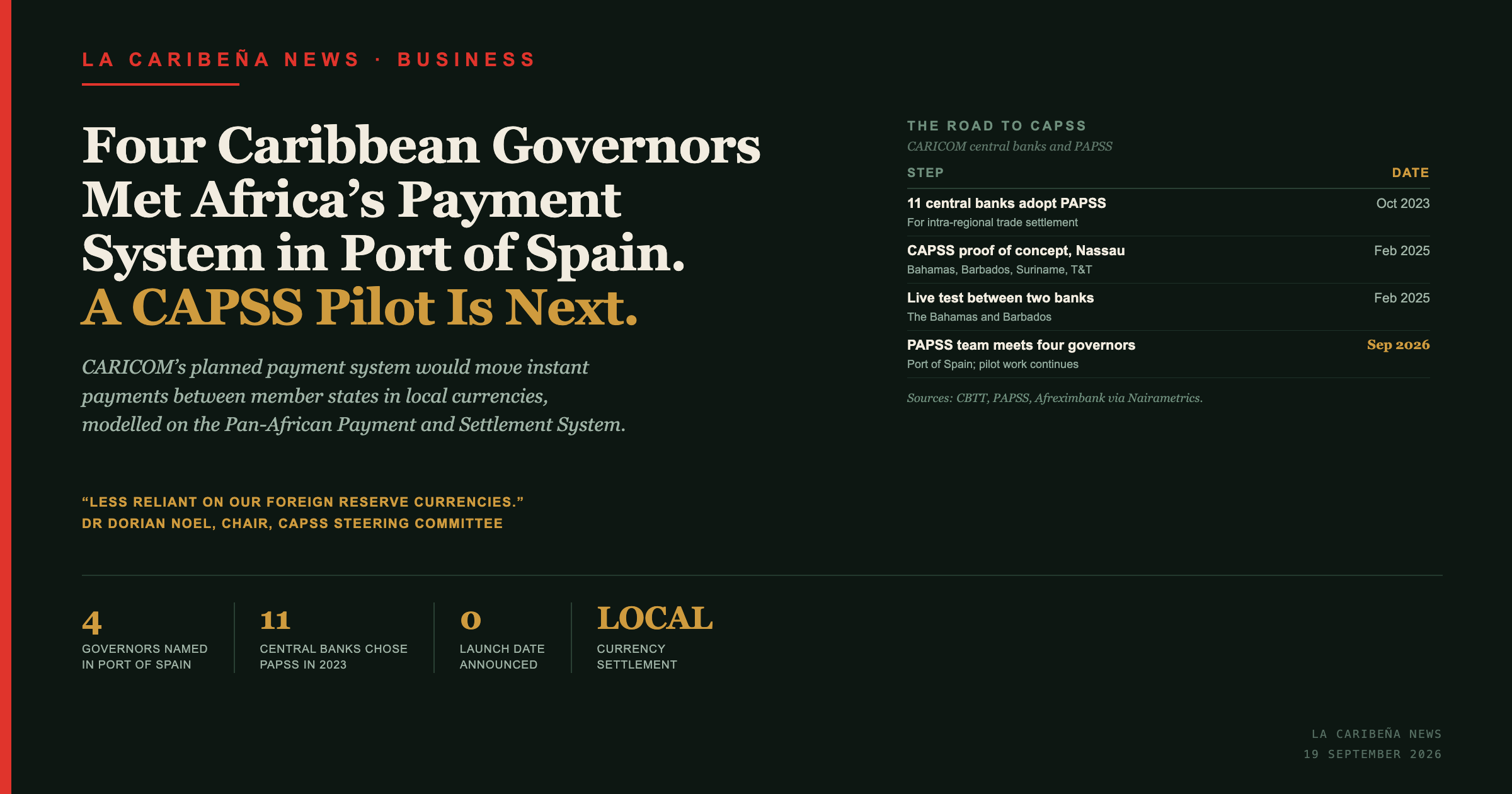
What the title card shows
- 18 September 2026: Central Bank of Trinidad and Tobago release on CAPSS and the PAPSS visit. Source: CBTT.
- Four governors named: Trinidad and Tobago (host), Barbados, the Eastern Caribbean Central Bank and The Bahamas. Source: CBTT.
- 11 central banks: adopted PAPSS for intra-regional trade settlement on 26 October 2023. Source: PAPSS.
- February 2025: CAPSS proof of concept in Nassau with four central banks. Source: Nairametrics.
- Launch date: none announced; the next step is a CAPSS pilot. Settlement is planned in local currencies. Source: CBTT.
- Quotation: payments "less reliant on our foreign reserve currencies", Dr Dorian Noel, CAPSS Steering Committee chair. Source: CBTT.
Frequently Asked Questions
What is CAPSS?
The CARICOM Payment and Settlement System, a proposed regional platform for instant retail and commercial payments between CARICOM member states in local currencies, modelled on Africa's PAPSS.
What is PAPSS?
The Pan-African Payment and Settlement System, developed by the African Export-Import Bank, which settles instant cross-border payments in local currencies across African markets.
When will CAPSS launch?
No launch date has been announced. The Central Bank of Trinidad and Tobago said on 18 September 2026 that consultations and technical evaluations will continue in the coming months toward a CAPSS pilot.
Is Guyana part of CAPSS?
The 18 September release does not name the Bank of Guyana among the participants, and the February 2025 proof of concept involved The Bahamas, Barbados, Suriname and Trinidad and Tobago. The October 2023 PAPSS announcement does not list the eleven central banks by name.