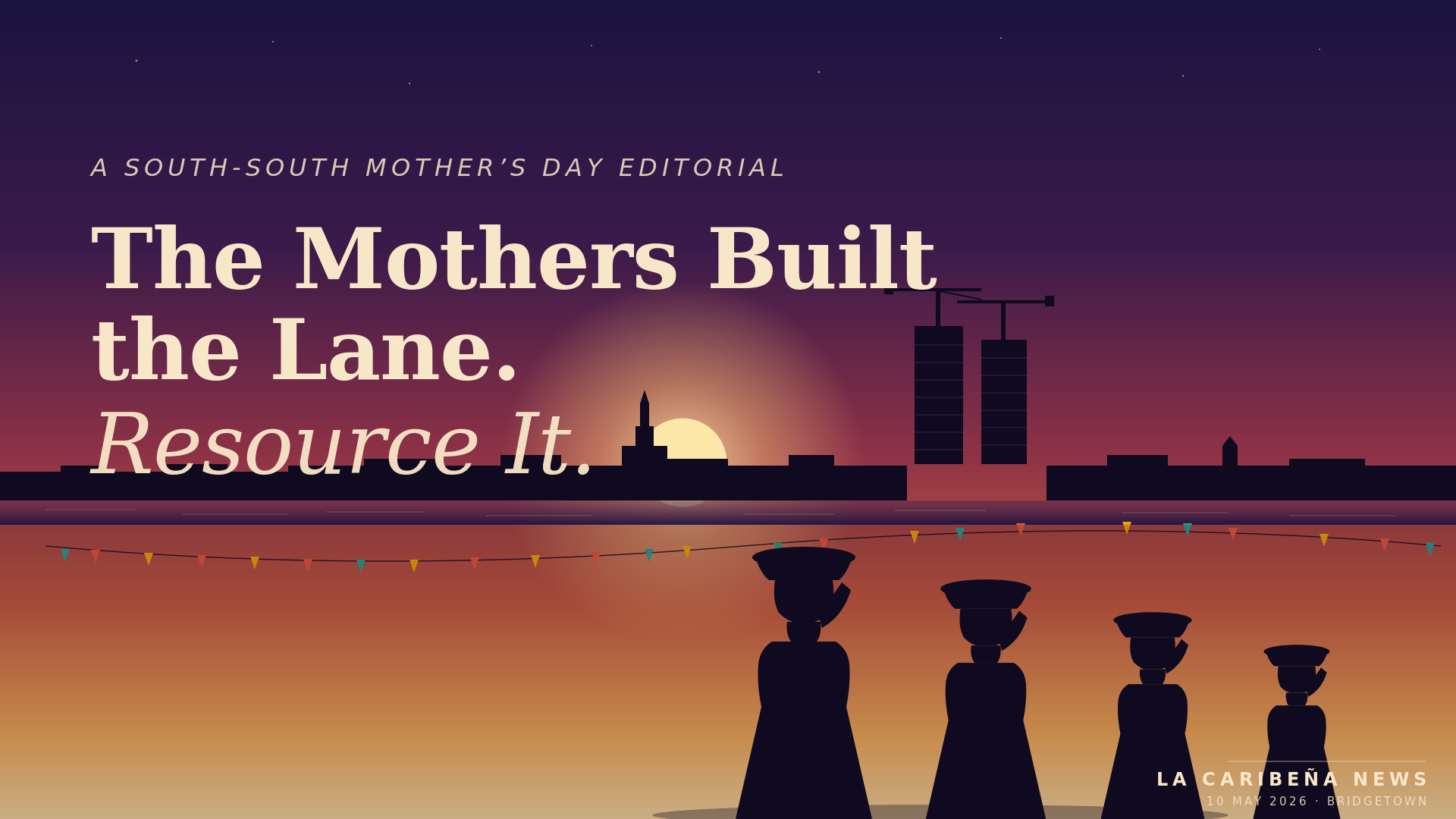
After almost fifty years of Buenos Aires Plan promises, formal South-South cooperation moves at the speed of communiqués. The Caribbean women who refused to wait have already begun building the institution that can deliver it. The question now is whether that institution will resource the women who built the lane in the first place.
Editorial · La Caribeña News · May 10, 2026
The Buenos Aires Plan of Action approaches its fiftieth year. Heads of state from across the Global South signed it in 1978 with the conviction that countries in the South could trade with each other, learn from each other, and finance each other without going through the old colonial intermediaries. Forty-eight years is long enough for a child to be born, raised, and put through university. It is not long enough, apparently, for the formal multilateral system to deliver the South-South promise in any form a Caribbean grandmother could measure.
The Caribbean has stopped waiting on the formal multilateral system.
What Mottley built while the multilateral system held meetings
In September 2022, Prime Minister Mia Mottley of Barbados opened the first AfriCaribbean Trade and Investment Forum in Bridgetown and told the room that Africa and the Caribbean could “forever remove the scars of the middle passage” by cooperating on the great issues of the two regions. Three months later, in December 2022, the Board of the African Export-Import Bank approved a US$1.5 billion facility for CARICOM countries that ratified its Partnership Agreement. By August 2023, Mottley and then-Afreximbank President Benedict Oramah opened the bank’s CARICOM office in Barbados. By March 2025, ground was broken on a US$180 million Afreximbank African Trade Centre in Bridgetown, the first Afreximbank Trade Centre outside Africa, projected to take thirty months to build and to create about a thousand construction jobs and three hundred permanent ones. By March 2026, the new Afreximbank President Dr. George Elombi raised the Caribbean financing cap from US$3 billion to US$5 billion, with more than US$750 million already disbursed in the region and a pipeline above US$2 billion, and announced an SME on-lending facility for development banks in Suriname, St Lucia, Grenada, and Dominica.
That is the speed of a Caribbean woman who stopped waiting. Compare it to the speed of any other South-South institution-building exercise of the last fifty years.
Where the institution still has a women-shaped gap
Now compare it to the speed at which the same machinery has moved on women.
The Afreximbank African Trade Centre in Bridgetown will house a CARICOM headquarters office, a conference facility, a digital trade gateway, a hundred-room hotel, an exhibition centre, and a technology and SME incubator. The SME incubator is in the building plan. There is no published women-MSME facility within the US$5 billion CARICOM cap. There is no announced ring-fenced allocation in the AATC incubator for women-owned businesses. Across more than US$750 million already disbursed and a pipeline above US$2 billion, the public Afreximbank record contains no Caribbean women’s MSME instrument with a name, a target, or a draw-down schedule. If one is in development, it has not been announced.
This is the structural part of the Mother’s Day argument. In every Caribbean economy, micro, small, and medium enterprises are operated in significant numbers by women, and in several sectors, market trade, catering, hairdressing, childcare, agro-processing, cottage manufacturing, women hold the majority share. The Caribbean Development Bank has been saying so in its own MSME assessments for years. The CARICOM Single Market and Economy depends on this sector. The flagship Africa-Caribbean institution being built in Bridgetown right now is the place to give it a name, a budget line, and a draw-down date.
Forty years of Caribbean feminist policy memo
The intellectual scaffolding for this has been in Caribbean hands for decades.
In 1978, the same year as the Buenos Aires Plan, Dr. Peggy Antrobus, born in Grenada, citizen of St. Vincent and the Grenadines, resident of Barbados, helped found the Women and Development Unit at the University of the West Indies. In 1984, she joined Devaki Jain in Bangalore and other women from across the Global South to launch DAWN, Development Alternatives with Women for a New Era. In 1985, with other Caribbean activists and scholars, she helped found the Caribbean Association for Feminist Research and Action. She would later argue, in her 2004 book The Global Women’s Movement, that the global women’s movement was never one movement. It was a network of women already in motion, doing work the formal economy never bothered to count.
In Georgetown, the Guyanese activist Andaiye, who co-founded Red Thread in 1986, spent decades insisting that the unwaged labour of women, the cooking, the caring, the holding-up of the house, was the economy. Not adjacent to it. Not below it. The thing itself. After the great Guyana flood of 2005, she helped Red Thread compile time-use diaries with poor women that turned the invisible economy into a measurable one. The lesson she left the region was that you do not have to wait for permission to count what you already know is real.
Forty-eight years after Antrobus helped found WAND, forty years after CAFRA, forty years after Andaiye and Red Thread began the hard accounting of unpaid work, the Caribbean has, for the first time in its history, an Africa-Caribbean trade and investment institution being built on its own soil with its own US$5 billion facility and a Prime Minister of Barbados as a co-author. The institution exists because a Caribbean woman moved while the formal multilateral system held meetings.
The men have not moved fast enough. Not because the men are unwilling. Because the men keep treating South-South cooperation as a state-to-state question, a heads-of-government question, a foreign-ministry question.
South-South cooperation that is about who signs which memorandum at which summit has produced what such cooperation has produced for half a century. PDFs.
Mottley moved a building. The next move belongs to the institution she helped bring into being.
The Caribbean woman who stir-fries breakfast at five in the morning, sells fruit by ten, waits tables by two, sends a remittance to a niece in Lagos by six and tutors her grandchild’s homework by nine is the South-South agenda the Buenos Aires Plan said it wanted. She is the reason a Caribbean Women’s MSME facility within the Afreximbank CARICOM cap is overdue. She is the test of whether the AATC incubator is for the people who already move goods between the regions, or for the people who already had a desk.
If the institution wants a head start on the answer, it could start with the Caribbean women who have been writing the policy memo for forty years.
What the next move looks like
The Mother’s Day argument, then, is structural. If South-South cooperation is going to mean anything in the next decade, the lane the women have built has to be resourced as the main lane. Not as a side initiative. Not as a gender mainstreaming line item. The main lane.
It looks like a Caribbean Women’s MSME Facility carved out of the US$5 billion CARICOM-Afreximbank cap, with a name, a published target, and a draw-down schedule. It looks like the Bridgetown AATC’s SME incubator declaring a women-led majority of its first cohort, on day one. It looks like CARICOM treating remittance corridors as financial infrastructure rather than as a private matter between aunties. It looks like the Caribbean Development Bank and the African Export-Import Bank sitting down with the people who already move goods between the regions, who are, in the main, women.
It looks like every Mother’s Day arriving with a policy commitment in hand, not just flowers and a card.
The lyrics in the companion piece were written this week as a Mother’s Day anthem for the South. Watch and listen to the song on YouTube. The chorus calls the mother of the yard the compass. That is correct, as far as it goes, but the song is also a quiet political document. It names the auntie-mama, the sister-mama, the granny, the great-granny. It names the grandfather and the brother and the uncle who learned to do the caring too. It names a region that has carried itself through five centuries of being told to wait.
The mothers of the South are not waiting any more. The lane is built. One Caribbean woman in office helped build the institution. The instruction this Mother’s Day is the simplest one available.
Resource it.