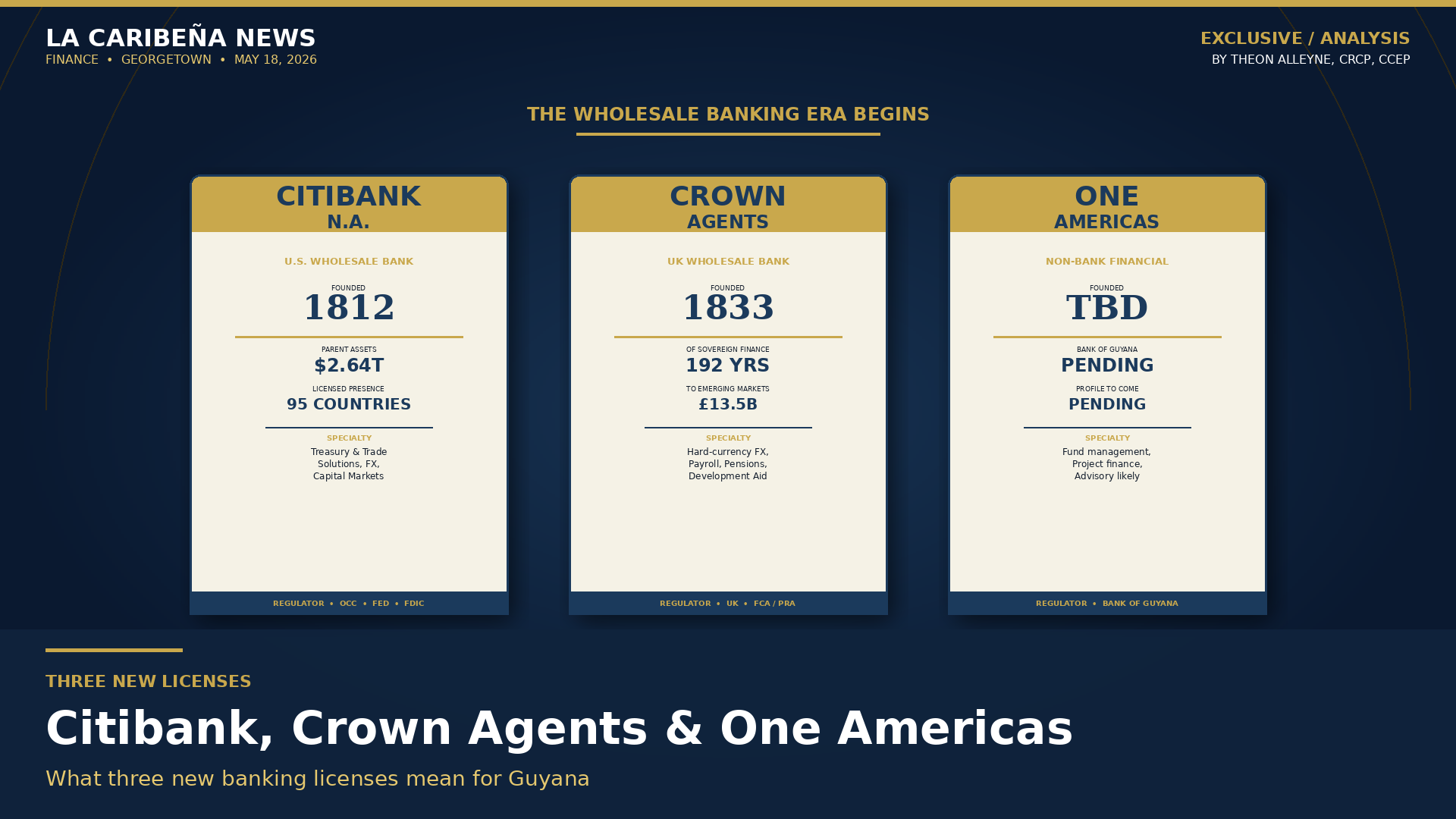
On May 16, 2026, Guyana licensed three new wholesale financial institutions: Citibank N.A., Crown Agents Bank, and One Americas. None will offer retail banking. All three will reshape trade finance, cross-border payments, and capital-markets access for corporates and the State.
President Dr. Mohamed Irfaan Ali read three names out at the GBTI 190th Anniversary Gala on Saturday night that most people in the room could not have predicted hearing together in the same sentence. Citibank N.A. Crown Agents. One Americas. The Bank of Guyana has licensed all three to operate in the country.
None of them will take retail deposits. None of them will compete for your salary account. Yet in a financial sector that has been served by the same six commercial banks for most of the past two decades, these three names will quietly reshape what Guyanese companies, the State, and large institutional clients can do with money. Read against the Fast Pay and UPI launch coming on June 2, this is the other half of the same announcement.
What “wholesale only” actually means
The President was specific. These institutions “will not engage in retail deposit-taking,” but their presence “will significantly expand the country’s access to international capital markets, trade finance, corporate advisory services, and development financing” (Office of the President, May 17, 2026).
In plain language, this is the layer of banking that sits between domestic banks and the rest of the world. It is the layer that lets ExxonMobil, or a similarly situated company, pay a Guyanese contractor in U.S. dollars without the transfer being held up for three days. Of course, this is after the usual back and forth (submit and re-submit) on the invoice that would have already delayed actual cash receipt by more than two and a half months. It is the layer that lets the Government of Guyana borrow on international capital markets on terms similar to a mid-sized European country. It is the layer that lets a Berbice rice exporter open a letter of credit against a Senegalese buyer.
We have lived without this layer for a long time. We are about to find out what we have been missing.
Citibank N.A.: the size argument
Citibank N.A. is the principal U.S. banking subsidiary of Citigroup Inc., the third-largest U.S. bank holding company. As of September 30, 2025, Citigroup reported total assets of approximately $2.64 trillion. Citibank N.A. itself is chartered and supervised by the Office of the Comptroller of the Currency in Washington, with additional oversight from the Federal Reserve, the FDIC, and the SEC. The bank has a licensed presence in roughly 95 countries and serves clients in 180.
Two customer-facing features matter most for Guyana.
The first is Treasury and Trade Solutions (TTS) on the CitiDirect platform. TTS serves public-sector clients, corporates, and financial institutions in more than 120 countries. In Q1 2025 alone, Citi’s cross-border transaction flows ran to $95.1 billion. For Guyana, this means an oil-sector contractor, the Natural Resource Fund, or a ministry can move multi-currency payments, manage liquidity across subsidiaries, and access 24/7 cross-border rails from a single digital channel. That is not a marginal upgrade. That is the difference between paying a Singapore supplier in three hours and waiting three days.
The second is trade finance and supplier finance at correspondent-bank scale. Letters of credit, supply-chain finance, working-capital lines, export receivables programs, the full kit. Guyana imports machinery, refined fuel, and food. Guyana exports crude, gold, rice, and bauxite. Both directions of that trade have been priced for years on the country limits of regional correspondent banks. With Citi present locally, the country limit becomes Citi’s, not a Trinidad-based correspondent’s. The price of trade finance in Guyana will drop.
The strategic logic is clear. ECLAC projects Guyana at 16.3 percent growth in 2026. National output from the Stabroek Block hit 926,550 barrels per day by late February 2026, and ExxonMobil has stated production is targeted to exceed one million barrels per day by the end of 2026. Given the pace at which capacity has been added, some industry watchers suspect the milestone has already quietly been crossed and that disclosure is timing-dependent. Either way, the country is on track for roughly $2.79 billion in oil revenue this year. ExxonMobil, Hess, and CNOOC are Citi clients globally. A licensed Guyana presence lets Citi book the trade finance, FX, and cash-management revenue inside the country, instead of routing it through Trinidad or New York. The play tracks Guyana’s oil boom and the local-content push it is forcing.
I am optimistic that the next time we hear of approvals, the names will be ones like JP Morgan Chase, MUFG, and Bank of China. Each of those was once a consulting client of mine, and I know what they bring to the table. Many of them have participated in trade missions to Guyana over the last twelve months. The pattern is recognisable: the institutions that ran the diligence early are usually the ones that file paperwork once the licensing window opens.
Crown Agents: the history that makes the present make sense
Crown Agents Bank Limited traces its origins to 1833, when the British Crown consolidated the financial agency of its colonies under a single body called the Joint Agents General for Crown Colonies. That was 33 years before Guyana’s own Demerara, Berbice, and Essequibo were unified into British Guiana. The institution has been moving sovereign and development money around the world for 192 years.
The modern Crown Agents Bank was incorporated in 1989 and was acquired by Helios Investment Partners, an Africa-focused private equity firm, in April 2016. The holding company, CAB Payments Holdings Plc, is listed on the London Stock Exchange. Crown Agents Bank is a UK-regulated wholesale bank specialising in frontier and emerging-market FX, cross-border payments, trade finance, pensions, and payroll. It is a certified B Corporation.
Two customer-focused features are particularly relevant to Guyana.
The first is hard-currency FX into hard-to-reach corridors. Crown Agents Bank is one of the market leaders in B2B FX into illiquid and frontier currencies. For Guyanese exporters paying counterparties across Africa, Asia, or intra-CARICOM corridors where traditional correspondent banks have de-risked aggressively over the past decade, this is the exact rail they need. It is also the rail the Government of Guyana needs to keep development-aid flows landing in cedis, naira, or Trinidadian dollars without bleeding 6 percent of value to FX cost.
The second is pension, payroll, and social-impact disbursement at last-mile scale. Crown Agents Bank has moved £13.5 billion to emerging markets for humanitarian and development aid. It runs international pension payroll with proof-of-life verification, disburses funds via local settlement mechanisms, and is the operating backbone of multiple sovereign social-protection programs. For Guyana, this is plug-in infrastructure for diaspora pensions, government welfare disbursement, and aid-funded social transfers.
The “why now” is straightforward. Crown Agents Bank opened its first New York representative office in 2025 to deepen Americas central-bank relationships, and added an Abu Dhabi Global Markets license in early 2026. Guyana, the fastest-growing economy on earth this year, fits the same strategic arc.
One Americas: what we know, and what we don’t
Here is where editorial honesty matters. The President named One Americas as the third licensee and described it as a non-bank financial institution. As of the time of writing, the Bank of Guyana has not published the full licensee details. News outlets have rendered the name inconsistently. No public corporate registry has been identified that maps cleanly to “One Americas” in the wholesale financial-institution category. Until the Bank of Guyana publishes the licensee details, the profile of One Americas remains pending.
What the President did tell us is the category. A non-bank financial institution is typically active in fund management, project finance, fiduciary services, structured credit, M&A advisory, or specialty lending. It is the kind of institution that complements a wholesale bank like Citi or a payments-and-FX specialist like Crown Agents, without overlapping with either.
LCN will publish the full One Americas profile once the Bank of Guyana confirms the entity’s incorporation and remit. If you are reading this and you know who they are, send us a note.
How the three compare
Sources: Citigroup 10-Q Q3 2025; Crown Agents Bank Annual Report 2024; Office of the President of Guyana, May 17, 2026.
What this changes for the country
For Guyanese corporates, the cost of trade finance and FX should drop. With Citi and Crown Agents able to book transactions locally, country-limit pricing improves measurably inside the first twelve months.
For the State, this is access to international capital markets at scale. The Natural Resource Fund already has an advisory bench with fantastic local expertise. The banks add the even-better-if advisory component. Sovereign credit-rating preparation, debt-issuance advisory, and reserve management become in-country capabilities, complementing the work already being done, not replacing it. The phone call to Port of Spain or New York becomes a meeting at a Camp Street office.
While Guyana is wide open for business, one hopes the agreement the Bank of Guyana signed with these institutions gives Guyanese businesses and Guyanese nationals a priority lane. Charity begins at home. Let us be charitable.
For the broader Caribbean, this is a positioning event. Guyana has just added wholesale infrastructure most of the region does not have. Caribbean securities regulators are tightening disclosure rules, Caribbean corporate governance standards are converging, and Caribbean trade diplomacy is intensifying. Wholesale banking is the missing rail under all of it.
For ordinary Guyanese, the change is indirect but real. Cheaper trade finance means cheaper imports. Better FX rails mean diaspora remittances retain more value when they land. Sovereign access to capital markets means infrastructure funded without crowding out domestic credit. None of this shows up in a customer’s account on June 3. All of it shows up in the cost structure of the country over the next five years.
The closing read
Citibank N.A., Crown Agents, and One Americas are not coming to compete with GBTI, Demerara Bank, Citizens Bank, Republic Bank, or Bank of Baroda. They are coming to do what those banks were never built to do. Combined with Fast Pay going live on June 2 and the UPI partnership with India, the Bank of Guyana is in the middle of the most significant restructuring of the country’s financial sector since the 1970s. The President framed this as a “golden era” of banking. The phrase is the right scale.
Three licenses do not automatically translate into capability. The institutions have to be staffed. The mandates have to be written. The first deals have to close. That work starts now.
And if anyone with the ability to move the needle is reading this: PAPSS, PAPSS, PAPSS. The Pan-African Payment and Settlement System is a financial market infrastructure that enables instant, secure, cross-border transactions in local currencies across Africa. It simplifies trading, lowers cost, and eliminates the need for third-party currencies by connecting central banks, commercial banks, and fintechs directly. Developed by Afreximbank in collaboration with the AfCFTA Secretariat, PAPSS allows individuals and businesses to send and receive funds without leaving their existing bank accounts. For both economic and social reasons, it is the right play for Guyana, and for the wider CARICOM region. The Caribbean diaspora across West and Southern Africa is real. The trade corridor is real. The rails should be too.
FAQ
Who are the three new banks licensed in Guyana? Citibank N.A., Crown Agents Bank Limited, and One Americas. The Bank of Guyana approved all three as wholesale, non-retail financial institutions.
Will I be able to open an account at Citibank or Crown Agents in Guyana? No. The President was explicit: these institutions will not engage in retail deposit-taking. They serve corporates, the government, and other financial institutions.
What is Citibank’s specialty? Cross-border treasury and trade solutions, trade finance, FX, and capital markets services for corporates and governments. Citi is one of the largest wholesale banks in the world, with operations in roughly 95 countries.
What is Crown Agents Bank known for? Hard-currency FX into frontier markets, government and development-aid payments, and international pension and payroll disbursement. The bank was founded in 1833 as the financial agent of the British colonies and has specialised in emerging-market finance for nearly two centuries.
When does this take effect? The licenses are issued. The institutions can begin operations immediately. The full set of services typically rolls out over 6 to 18 months as local mandates are written and staffed.
By Theon Alleyne
About the Author
Theon Alleyne, CRCP, CCEP, is the Founder of EICCIO Advisors, a compliance advisory firm based in Georgetown, Guyana, providing compliance strategy and financial crime risk advisory services to financial institutions across the Caribbean. A former securities regulator with experience at NYSE American, NASDAQ and FINRA, he specialises in anti-financial crime compliance, fraud prevention and sales practice conduct risk. Alleyne is a member of the International Association of Financial Crimes Investigators (IAFCI). His book, Letters to a Compliance Officer: What They Never Told You About the Job That Protects Everyone, published by Team Shaw Caribbean Press, is available on Amazon, Apple Books, Barnes and Noble, Kobo and 10 additional platforms worldwide.