In January 2024, I posted on LinkedIn about digital payments, innovation, and what a properly designed national payments rail could do for this country. The tags were #digitalpayments, #innovation, and #digitaltransformation. The conversation in Guyana at that point was still about whether tap-to-pay would arrive at the supermarket counter.
Ten months later, on November 20, 2024, India’s Prime Minister Narendra Modi flew into Georgetown and signed ten Memoranda of Understanding with President Mohamed Irfaan Ali. The eighth one was the one the wires barely covered: an agreement between NPCI International Payments Ltd and Guyana’s Ministry of Foreign Affairs to enable deployment of a UPI-like real-time payments system. The seventh, equally important, was the INDIA STACK MoU on sharing the digital public infrastructure that has reshaped India (India News Network, November 21, 2024).
Saturday night at GBTI’s 190th Anniversary Gala, President Ali closed that distance (Office of the President, May 17, 2026).
Two decisions, one night
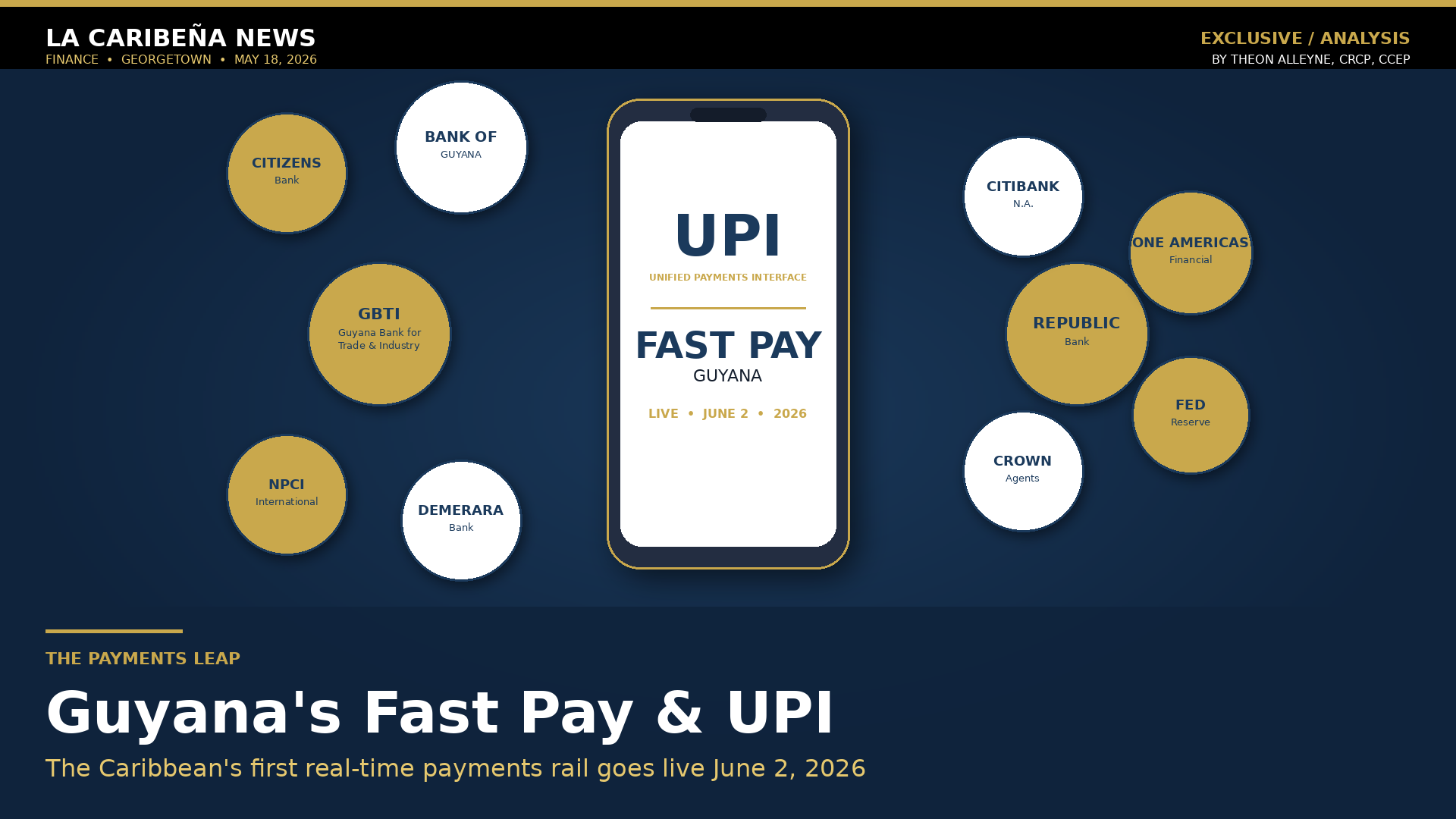
The first is Fast Pay, Guyana’s national real-time payments system, going live on June 2, 2026. Customers across every participating bank will be able to send and receive funds instantly, seven days a week, through mobile and internet banking. No clearing cycle. No branch processing. Seconds instead of days.
The second is the Unified Payments Interface, or UPI. Through Guyana’s partnership with the Government of India, the country will integrate the architecture that has reshaped Indian finance over the past decade. UPI lets multiple bank accounts run through a single mobile platform using a Virtual Payment Address, so you do not share your full bank details to send or receive money. The address itself is the routing rail.
Together they rebuild how money moves through Guyana.
Why UPI was the model worth importing
UPI is the largest real-time payments system in the world. In March 2026, India processed 22.64 billion UPI transactions in a single month. The International Monetary Fund credits UPI with 49 percent of all global real-time transactions. India routed roughly $3.6 trillion through UPI in 2025.
For scale, Guyana’s GDP is about $40 billion. UPI now moves roughly 90 times Guyana’s economy every year, on rails that cost almost nothing per transaction.
The question was never whether the technology worked. The question was whether the model could be exported.
It has been. Bhutan went first in 2021. Nepal followed. Singapore linked PayNow to UPI in 2023. Sri Lanka and Mauritius went live in February 2024. The UAE and France joined in 2024. Cyprus and Qatar signed on after. Israel begins rollout this year. Japan starts a trial in April.
In the Caribbean, Trinidad and Tobago signed a memorandum with NPCI International in September 2024 but has not gone live. As of June 2, 2026, Guyana becomes the first Caribbean country to have a UPI-linked real-time payments system actually operating.
The Pix comparison is the one to keep in mind
The cleanest parallel is Brazil. Pix launched in November 2020. By the end of 2024, 178 million Brazilians, roughly 91 percent of adults, were active users. Pix processed $4.6 trillion in transactions in 2024 alone. The Central Bank of Brazil estimates Pix will add R$280.7 billion to Brazilian GDP by 2028 and bring 2.8 million additional people into the formal financial system.
Those are not marketing numbers. Those are central-bank measurements of what happens when a country gets real-time payments right.
How Guyana’s Fast Pay measures against the global rails
Sources: NPCI International, Banco Central do Brasil, Federal Reserve, Bank of Guyana, Office of the President of Guyana.
What I learned working on FedNow
During Covid, I spent long days and nights on the Federal Reserve’s FedNow Service proposal (RFP) in August 2020, when the Fed was seeking industry feedback to build a 24/7/365 instant payment rail (1, 2, 3, 4, 5). The resulting service, built on ISO 20022 messaging, allows secure, immediate clearing and settlement for banks and credit unions across the United States.
Core features of the FedNow rail
- Immediate Settlement. Payments clear and settle in seconds, with funds immediately available to the payee.
- Request for Payment (RFP). A pull-style message where a business or individual can securely request an instant payment from a customer.
- Transaction Limits. The network transaction limit is $10 million, supporting both small peer-to-peer transfers and large commercial B2B payments.
- Zero-Dollar RFP. A pre-validation step that lets billers confirm a customer’s account can receive RFPs before sending the actual invoice (1, 2, 3, 4, 5, 6, 7).
Look how far Guyana has come. The next step is integrating with PAPSS, the Pan-African Payment and Settlement System, a cross-border financial market infrastructure enabling transactions across Africa that some CARICOM countries are already testing.
What changes on the ground in Guyana
For households, the change is everyday. Sending money to family, paying a bill, splitting a dinner, topping up a vendor at Bourda Market, all without cash and without the 3 percent merchant fee that bleeds quietly into the price of every transaction.
For micro and small businesses, the change is bigger. Right now, the Caribbean SME finance gap is held open partly by the cost of accepting digital payments. A market vendor in Bourda or a fisherman in Anna Regina cannot easily accept a card today. Both of them can accept a Fast Pay transfer on a phone they already own. That changes the unit economics of being a small business in this country.
For policy, the Bank of Guyana now has visibility into transaction flows it has never had before. Italy’s experience showed that a one percentage point increase in digital payments adoption correlates with measurable GDP growth. Brazil’s experience showed the welfare gain to ordinary consumers is roughly 15 percent of per-capita GDP. That is not a marginal improvement. That is a wage rise that no employer has to fund.
For the regional position, Guyana now leads on payments infrastructure. We have spent the last five years being asked when the rest of the country would catch up to the oil economy. This is one of the answers. UPI will reach Region Nine and Region One the same way it reaches Camp Street.
How this fits the rest of the story we have been telling
LCN has been tracking this curve. We covered the Bank of Guyana’s national tap-to-pay rollout and the ghost-tapping fraud risk that came with it. We covered regional fintech moves like WapiPay’s Jamaica launch and what they mean for Caribbean cross-border flows. We covered South-South digital cooperation in the Caribbean and what India and China are quietly building in this region. We covered financial inclusion for Caribbean MSMEs and why access to capital remains the choke point.
This story sits on top of all of those.
The closing read
I called for this kind of system on LinkedIn in January 2024. Ten months later, India and Guyana signed the MoU. On May 16, 2026, the President announced the launch. On June 2, 2026, the rails go live. For Guyana, 28 months from public argument to working national infrastructure is fast. For the rest of the Caribbean, it is faster than anyone else has moved.
On June 2, we will see whether the rails carry the traffic. The model has been proven at a scale 90 times the size of our economy. The next move is ours.
FAQ
When does Fast Pay launch in Guyana? Fast Pay goes live on June 2, 2026, across all participating commercial banks in Guyana.
What is UPI and which countries already use it? UPI is India’s Unified Payments Interface, built by the National Payments Corporation of India. It processes around 22.64 billion transactions a month and accounts for 49 percent of all real-time payments globally. It is live in Bhutan, Nepal, Singapore, Sri Lanka, Mauritius, the UAE, France, Cyprus, and Qatar, with Israel and Japan rolling out in 2026.
Will Fast Pay work across every bank in Guyana? Yes. The system is built so that customers of all participating banks can send and receive instantly, 24/7, through mobile and internet banking platforms.
Is Guyana the first Caribbean country to integrate UPI? As of the June 2, 2026 launch, Guyana is the first Caribbean country with a live UPI-linked real-time payments system. Trinidad and Tobago signed a memorandum with NPCI International in September 2024 but has not yet launched.
By Theon Alleyne
About the Author
Theon Alleyne, CRCP, CCEP, is the Founder of EICCIO Advisors, a compliance advisory firm based in Georgetown, Guyana, providing compliance strategy and financial crime risk advisory services to financial institutions across the Caribbean. A former securities regulator with experience at NYSE American, NASDAQ and FINRA, he specialises in anti-financial crime compliance, fraud prevention and sales practice conduct risk. Alleyne is a member of the International Association of Financial Crimes Investigators (IAFCI). His book, Letters to a Compliance Officer: What They Never Told You About the Job That Protects Everyone, published by Team Shaw Caribbean Press, is available on Amazon, Apple Books, Barnes and Noble, Kobo and 10 additional platforms worldwide.