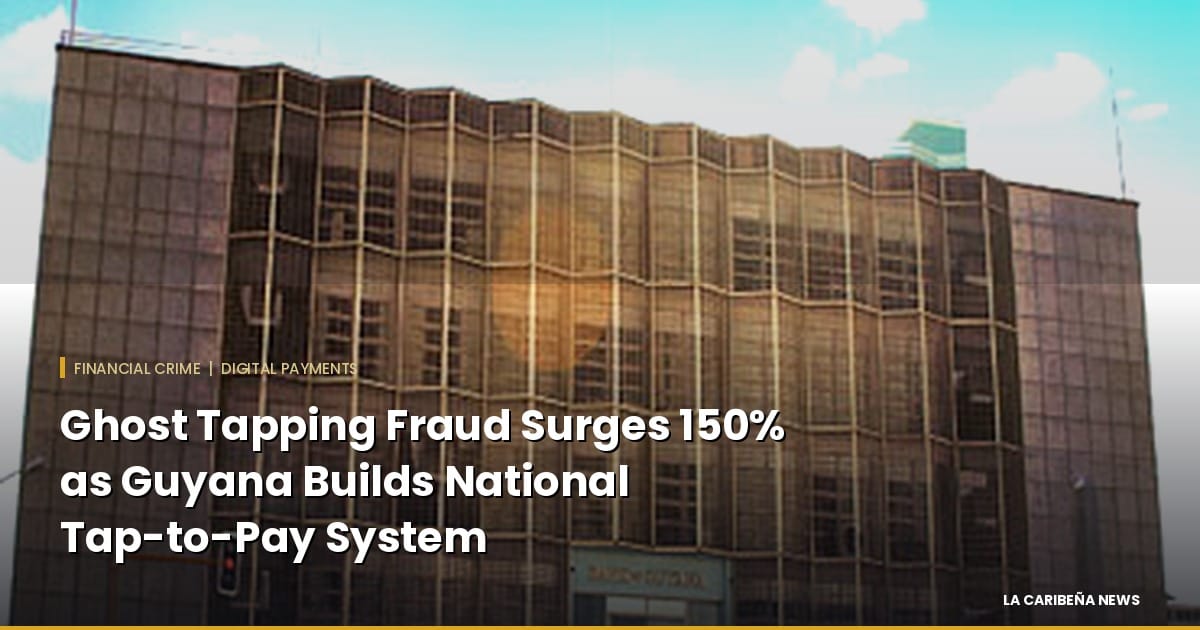
Cybersecurity firm GuidePoint Security reports a 150 per cent increase in ghost tapping claims over the past year, raising questions for Guyana as it races to launch a national digital payment platform with contactless capability by September 2026.
By Theon Alleyne
Ghost tapping is a proximity-based scam in which thieves use cheap, portable card readers to trigger small wireless transactions by getting close enough to a victim's wallet or phone. No swipe, no PIN, no notification. The charges are typically small, designed to test whether the card works before larger fraud follows. The Better Business Bureau in the United States has flagged it as a growing consumer threat.
The scam exploits Near-Field Communication technology, the same system behind every tap-to-pay terminal in a supermarket or coffee shop. Crowded spaces such as public transport, markets and concerts are the primary operating environments. Because NFC readers work within a few centimetres, a thief standing close enough in a queue can initiate a charge through a wallet, a bag or a trouser pocket.
Why should Guyanese consumers care about a scam reported in Boston?
Because Guyana is actively building the infrastructure that makes ghost tapping possible. In March 2026, President Irfaan Ali announced that he had instructed the Governor of the Bank of Guyana to develop a national payment platform operational by September 2026. The plan includes equipping supermarkets and retail outlets across the country with NFC-enabled terminals so that customers can tap to pay or use mobile devices.
That timeline is months away. The question is whether fraud prevention measures will be built into the rollout from the start, or retrofitted after losses begin.
Globally, contactless payment transactions are projected to reach US$18.1 trillion by 2030, according to Juniper Research, more than doubling from US$7.7 trillion in 2025. NFC ticketing alone is forecast to grow by 300 per cent over five years. The technology is not optional for any country modernising its payment infrastructure. But every country adopting it inherits the attack surface that comes with it.
How did Guyana's payment system get here?
The current push did not begin in 2026. The World Bank conducted a cost-of-cash study in Guyana that found nearly 99.9 per cent of all transactions were conducted in cash, costing consumers roughly 2.45 per cent of GDP. That study built the business case for the Payment System Modernization Program, which commenced in late 2016 with World Bank technical assistance and project financing.
The reform produced the National Payments System Act 2018 (Act No. 13 of 2018), which established the licensing framework for payment service providers (PSPs) and system operators under the oversight of the Bank of Guyana. Four supporting regulations covering electronic funds transfers, agents, electronic money and oversight were drafted alongside it. The Act gave the Bank of Guyana general power over the national payments system, including consumer protection provisions requiring transparency of fees, disclosure of terms and a formal complaint procedure.
On paper, the architecture exists. In practice, long queues remain visible at most commercial banks across Georgetown and regional towns. The gap between legislative readiness and consumer experience is real, and it explains why the September 2026 platform announcement carries urgency. If tap-to-pay terminals reduce the dependency on in-branch transactions, they also shift the fraud surface from physical queues to digital channels.
What fraud threats already exist in Guyana's digital payment space?
Ghost tapping is not Guyana's only exposure. The Financial Intelligence Unit published a Typology Report on Account Takeovers in Mobile Payment Services in September 2025, documenting fraud methods already active in the country. These include mobile application fraud, SIM swap attacks, account takeovers and social media scams targeting mobile payment users.
The FIU's 2024 Annual Report recorded 208 Suspicious Transaction Reports, a 15.6 per cent increase over 2023. General fraud cases more than doubled, rising from 28 in 2023 to 60 in 2024. The overall value of STRs declined by over 90 per cent, reflecting a shift toward lower-value digital and payment service fraud, precisely the pattern that ghost tapping exploits.
The pattern is clear: as Guyana's payment channels go digital, so do the criminals. NFC-based fraud would add a new layer on top of threats the FIU is already tracking.
What does ghost tapping actually look like in practice?
A cybersecurity advisor quoted in the Boston 25 News investigation described the typical pattern: attackers make a small test charge, then add the stolen card details to a digital wallet and buy gift cards or make rapid purchases before the cardholder notices. The transactions are often under US$10, designed to avoid triggering fraud alerts.
One consumer interviewed said she was shopping at a grocery store when a card buried inside her wallet, behind other cards, cash and coins, was charged wirelessly. She never removed it from her pocket.
The BBB and cybersecurity professionals recommend three defences: RFID-blocking sleeves or wallets (sleeves at roughly US$0.20 each proved effective in testing), disabling NFC on mobile devices when not actively paying, and setting transaction alerts for every charge regardless of amount.
What advantage does Guyana have?
Countries that adopted contactless payments early, including much of Europe and North America, are now retrofitting consumer protections. Guyana is building from scratch. A national platform designed in 2026 can incorporate transaction-level alerts, NFC-off defaults, tokenisation standards and low-value charge monitoring as baseline features rather than aftermarket patches.
The Caribbean already has precedent for fintech leapfrogging. WapiPay recently secured Bank of Jamaica approval to target the island's US$2.5 billion remittance market with digital-first payment rails. Guyana's payment platform, if it launches with security architecture that accounts for threats like ghost tapping, positions the country ahead of regional peers rather than behind North American markets that are learning these lessons the expensive way.
The gap between who benefits from Guyana's rapid economic modernisation and who bears the risk is a recurring question across sectors. In digital payments, the answer depends on whether the Bank of Guyana treats consumer protection as a launch requirement or a future update.
Key facts at a glance
| Detail | Value |
|---|---|
| Ghost tapping claim increase (past year) | 150 per cent (GuidePoint Security) |
| Global contactless payment value, 2025 | US$7.7 trillion (Juniper Research) |
| Projected contactless value, 2030 | US$18.1 trillion (Juniper Research) |
| NFC ticketing growth forecast (5-year) | 300 per cent (Juniper Research) |
| Guyana National Payments System Act | Act No. 13 of 2018 |
| World Bank NPS modernisation start | Late 2016 |
| Guyana cash transaction share (pre-reform) | 99.9 per cent (World Bank) |
| FIU suspicious transaction reports, 2024 | 208 (up 15.6 per cent from 2023) |
| Guyana general fraud cases, 2024 | 60 (up from 28 in 2023) |
| Guyana national payment platform target | September 2026 |
| Effective ghost tap defence cost | US$0.20 per RFID-blocking sleeve |
About the Author
Theon Alleyne, CRCP, CCEP, is the Founder of EICCIO Advisors, a compliance advisory firm based in Georgetown, Guyana, providing compliance strategy and financial crime risk advisory services to financial institutions across the Caribbean. A former securities regulator with experience at NYSE American, NASDAQ and FINRA, he specialises in anti-financial crime compliance, fraud prevention and sales practice conduct risk. Alleyne is a member of the International Association of Financial Crimes Investigators (IAFCI). His book, Letters to a Compliance Officer: What They Never Told You About the Job That Protects Everyone, published by Team Shaw Caribbean Press, is available on Amazon, Apple Books, Barnes and Noble, Kobo and 10 additional platforms worldwide.