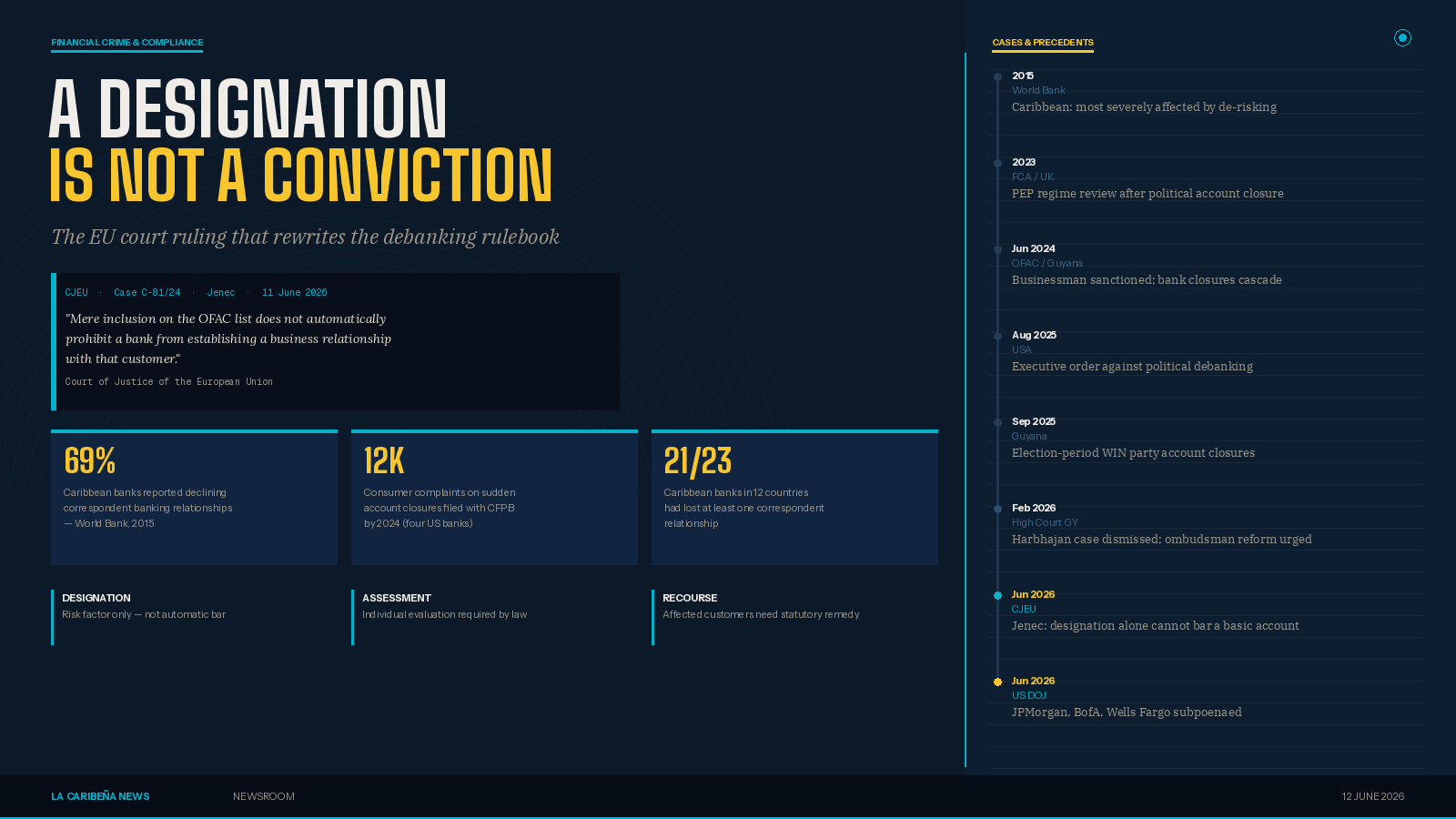
| The EU’s top court ruled on 11 June 2026 that appearing on a US sanctions list does not, by itself, justify a bank refusing to open an account — a principle with direct relevance to Caribbean debanking cases. |
FINANCIAL CRIME & COMPLIANCE
A landmark EU ruling draws a line between suspicion and exclusion. Caribbean courts and legislatures are next to answer the question.
LA CARIBEÑA NEWS NEWSROOM · 12 JUNE 2026 ·
On 11 June 2026, the Court of Justice of the European Union issued a judgment that compliance professionals across the world are still parsing. In Jenec (Case C-81/24), the court ruled that a Slovenian bank had no automatic right to refuse a basic payment account to a consumer solely because his name appeared on a sanctions list maintained by the United States Office of Foreign Assets Control. The consumer had never been convicted of the offence underlying that listing. No EU member state, the United Nations, nor Slovenia itself had sanctioned him. The court found that EU law does not permit automatic refusal on that basis alone.
The ruling is narrow in its geography — it applies directly to EU member states, not to Guyana or the broader Caribbean. But the legal principle it articulates is not. It draws a line that regulators, courts, and banking associations everywhere should be made to account for: that a third-country designation is a risk factor, not a verdict. It triggers enhanced due diligence. It does not authorise financial exclusion.
WHAT THE COURT ACTUALLY SAID
The CJEU’s Fourth Chamber was asked a specific question by the Local Court of Maribor, Slovenia: does EU law permit a bank to refuse a basic payment account solely on the basis that the applicant appears on an OFAC list? The answer was no.
The court acknowledged that every legal EU resident holds the right to open a basic payment account under Directive 2014/92/EU. That right is not unconditional — it must be reconciled with anti-money laundering and counter-terrorism financing obligations under Directive 2015/849. But those obligations require individual risk assessment, not blanket exclusion by list. The court was explicit: inclusion on an OFAC list, or any similar third-country list, may be one factor in that assessment. It cannot be the only one, and it cannot be treated as determinative.
“Mere inclusion on the OFAC list, or on any other list of that type drawn up by a third country, does not automatically prohibit a bank from establishing a business relationship with that customer.” COURT OF JUSTICE OF THE EUROPEAN UNION · CASE C-81/24 · 11 JUNE 2026 |
That logic matters. Banks across the region — and indeed globally — have for years treated the presence of a name on a watchlist as grounds for immediate account closure, with no obligation to investigate, explain, or provide recourse. The court’s ruling in Jenec challenges that posture directly.
GUYANA: WHEN ASSOCIATION BECAME JUSTIFICATION
The Caribbean’s own version of this story played out in Guyana in the months leading up to the September 2025 general election. Several commercial banks in Georgetown cancelled accounts held by customers linked to the We Invest in Nationhood party. The party’s leader had been sanctioned by OFAC in June 2024 over alleged tax evasion on gold exports. His personal designation prompted banks to review — and in multiple cases close — accounts belonging to party members who had not themselves been sanctioned, investigated, convicted, or even formally accused of wrongdoing.
One of those members, Gobin Harbhajan, a WIN candidate, challenged Scotiabank’s decision in the High Court. His account had been in good standing. He received a 30-day notice of termination with no stated reason. His case raised a question that the CJEU has now answered for the EU but that Caribbean courts have yet to answer definitively: can a bank close an account purely because of a customer’s political affiliation, when no sanction attaches to that customer personally?
Justice Nicola Pierre dismissed Harbhajan’s challenge in February 2026. The basis was contractual: the Personal Financial Services Agreement incorporated into the account application permitted Scotiabank to close accounts without giving reasons, subject to 30 days’ notice. The court found this to be an unqualified contractual right that did not engage public law principles of procedural fairness. Scotiabank’s affidavit denied any knowledge of Harbhajan’s WIN affiliation or that the bank had closed accounts of all WIN members.
| The purely contractual nature of the banker-customer relationship that insulates banks from liability at common law is undesirable given the centrality of access to banking services in modern life. JUSTICE NICOLA PIERRE · HIGH COURT OF GUYANA · FEBRUARY 2026 |
What is notable in Justice Pierre’s judgment is not the outcome — the applicant carried the evidential burden and could not meet it — but the remarks she made in closing. She observed that the purely contractual nature of the banker-customer relationship, which insulates banks from liability at common law, is “undesirable given the centrality of access to banking services in modern life.” She pointed to other jurisdictions where statutory financial services ombudspersons have been empowered to scrutinise account closures not by public law principles, but by a standard of whether the bank acted fairly and reasonably in all the circumstances. She urged the National Assembly to consider such legislation.
That is an unusual passage in a judgment that dismissed the case. A judge is not in the habit of recommending legislative reform unless the gap she identifies is real.
THE BROADER PATTERN: DEBANKING AS A GLOBAL CRISIS
Guyana’s experience is not isolated. In the United Kingdom, former Brexit Party leader Nigel Farage became a cause célèbre in 2023 when it emerged his account at Coutts, a private bank, had been closed. The incident triggered a formal review by the Financial Conduct Authority into the Politically Exposed Persons regime and whether banks were using it to exclude customers whose views they found objectionable. The UK’s Financial Services Minister wrote to the FCA that it would be a “serious concern” if financial services were being denied to those exercising lawful political rights.
In the United States, the Department of Justice subpoenaed JPMorgan Chase, Bank of America, and Wells Fargo in June 2026 as part of an investigation into whether accounts had been closed for political reasons. The probe follows years of complaints from conservative figures, crypto executives, and religious organisations who alleged that their banking relationships were terminated without explanation. By 2024, four US banks alone had accumulated 12,000 complaints with the Consumer Financial Protection Bureau about sudden account closures.
President Trump signed an executive order in August 2025 directing federal agencies to penalise financial institutions — retroactively, where applicable — for closing accounts on political or ideological grounds. Whether that order produces lasting structural change remains to be seen. What it confirmed is that the problem exists at a scale that forced the executive branch of the world’s largest economy to intervene.
THE DE-RISKING CONTEXT: THE CARIBBEAN HAS BEEN HERE BEFORE
For the Caribbean, the debanking debate has a longer history than most international commentators acknowledge. The region has spent more than a decade fighting the consequences of what is called de-risking — the practice by which major international correspondent banks exit relationships with regional institutions they classify as too risky or too small to justify compliance costs. A 2015 World Bank survey found the Caribbean to be the region most severely affected by this trend, with 69 per cent of surveyed local banks reporting a moderate or significant decline in correspondent banking relationships.
The Caribbean Financial Action Task Force has for years pointed out the paradox at the heart of this situation: countries that meet FATF compliance standards continue to lose correspondent banking relationships. Progress in regulation is not being recognised in practice. The result, documented by the Caribbean Development Bank and CFATF alike, is financial exclusion, reduced trade capacity, and the slow push of economic activity toward unregulated channels — the very outcome that the AML/CFT framework is meant to prevent.
The CJEU’s ruling in Jenec does not resolve that structural problem. But it does provide a legal principle that advocates in the region can use. If a designation alone does not justify exclusion in the EU, it is reasonable to ask why it should automatically justify exclusion anywhere else. That argument needs to be made — in courts, in legislatures, and in the negotiating rooms where correspondent banking agreements are written.
THE COMPLIANCE GAP THAT COURTS ARE EXPOSING
The clearest thread running through the CJEU ruling, the Harbhajan judgment, the FCA review, and the US DOJ probe is this: banks are relying on contractual rights and risk-based categorisation as substitutes for individualised assessment. The CJEU has now said, plainly, that this is not sufficient. Inclusion on a third-country sanctions list is a factor. It must be weighed. It does not decide the matter.
The Guyana Association of Bankers stated, in response to the WIN-related account closures, that all licensed commercial banks operate within a framework of national laws and international standards, guided by AML and CFT requirements. That is accurate as far as it goes. But compliance with a framework is not the same as compliance with its purpose. The FATF guidance itself is clear that de-risking — the blanket termination of relationships based on perceived category risk rather than actual assessed risk — is not in line with FATF recommendations and is a serious concern to the international community.
Justice Pierre pointed to financial services ombudspersons as a structural solution. The CJEU pointed to individual risk assessment as a legal requirement. The FCA pointed to the need for PEP regime reform. Each institution, in its own jurisdiction, is arriving at the same conclusion: the current framework gives banks too much discretion and affected customers too little recourse.
THE PRINCIPLE AT STAKE
The CJEU’s judgment in Jenec is, at its core, about the difference between suspicion and guilt, between categorisation and proof, between a list and a verdict. A consumer appeared on an OFAC list. He had not been convicted. He was not sanctioned under any framework to which Slovenia was a party. The court found that none of those facts, on their own, justified closing the door to basic financial services.
That principle has implications well beyond Slovenia. In the Caribbean, where de-risking has caused documented economic harm for over a decade, and where account closures have touched opposition politicians and party members whose only apparent connection to risk was an association, the question is whether regional institutions and legislatures will take it seriously.
The Guyanese High Court identified the gap. The CJEU named the standard. The compliance community now has both. What happens next depends on whether the region’s regulators and lawmakers choose to act on what the courts have already put on the table.