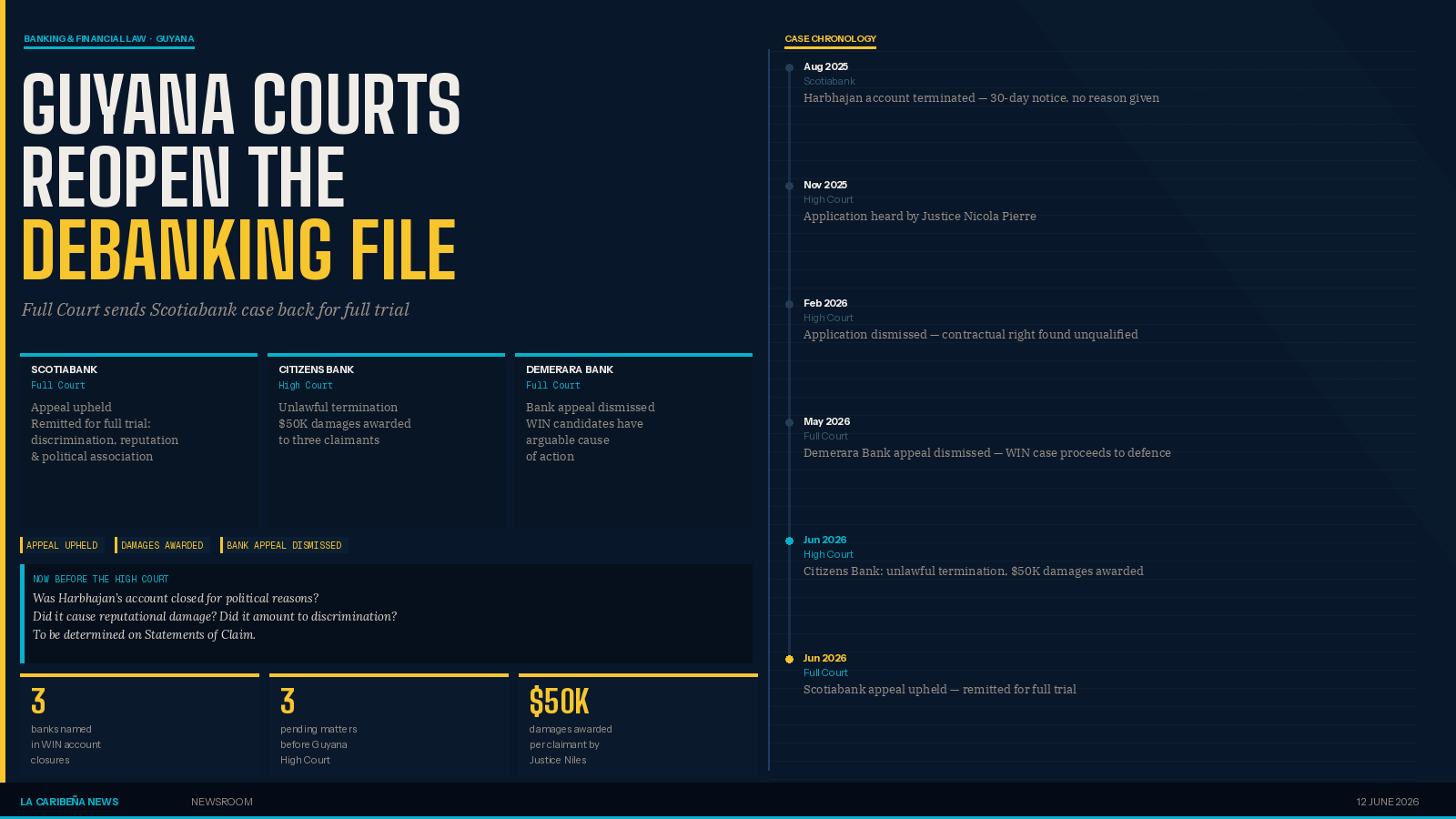
| Guyana’s Full Court has upheld WIN MP Gobin Harbhajan’s appeal against Scotiabank, remitting questions of discrimination, reputational damage, and political association to the High Court — the same day a Citizens Bank ruling found unlawful account terminations in a separate WIN case. |
BANKING & FINANCIAL LAW · GUYANA
Two rulings in the same week signal that Guyana’s judiciary is no longer prepared to let account closure cases die on contractual technicalities.
LA CARIBEÑA NEWS NEWSROOM · 11 JUNE 2026
Guyana’s Full Court has overturned the High Court dismissal of a legal challenge brought by We Invest in Nationhood Member of Parliament Gobin Harbhajan against Scotiabank over the closure of his bank account. Justices Simone Morris and Hessaun Yasin upheld Harbhajan’s appeal on Thursday and ordered the matter remitted to the High Court for substantive determination on three issues: whether the account closure amounted to discrimination, whether it caused reputational damage, and whether the termination was influenced by Harbhajan’s political association as a WIN candidate.
Harbhajan was also found to have been denied a proper opportunity to ventilate disputed facts, because of the manner in which the matter was previously considered. Proceedings will now continue by way of Statements of Claim.
That ruling marks a significant shift in the trajectory of a case that had appeared closed. In February 2026, High Court Justice Nicola Pierre dismissed Harbhajan’s original application on contractual grounds, finding that Scotiabank’s right to terminate accounts on 30 days’ notice without stating reasons was unqualified and not amenable to public law review. Those substantive questions, discrimination, reputation, and political association, have now been sent back to be heard on their merits. For background on the original decision and the broader international context, see A Designation Is Not a Conviction.
THE CITIZENS BANK RULING: UNLAWFUL TERMINATION, DAMAGES AWARDED
A separate ruling in a related matter this week added further weight to the emerging body of case law on bank account closures in Guyana. Justice Niles found that Citizens Bank terminated the accounts of claimants Amin Britton, Mark Goring, and Racquel King without the notice required under the legal principles governing the banker-customer relationship, and awarded $50,000 in damages to each claimant.
Attorney Darren Wade, who represented Harbhajan and acted in related proceedings, noted that the Citizens Bank court’s finding against the application of good faith differs from established legal authorities in other common law jurisdictions, including several Commonwealth countries and the United States, where courts have recognised that contractual discretion must be exercised in good faith and not arbitrarily.
“While banks generally possess the right to terminate customer accounts, such powers must be exercised in good faith and not in an arbitrary, irrational, or improper manner.” PRIOR GUYANA HIGH COURT RULINGS · GBTI AND DEMERARA BANK MATTERS |
Wade pointed to earlier Guyanese decisions in support of that standard: rulings by Justice Pierre in GBTI matters and decisions by Chief Justice (ag.) Navindra Singh in Demerara Bank proceedings, where courts recognised that while banks hold a right of termination, that right carries constraints. His argument is that the Citizens Bank decision departs from those authorities and raises questions about the consistent development of banking law in Guyana.
THE DEMERARA BANK PRECEDENT
Thursday’s Scotiabank ruling follows a May 2026 decision in which Chief Justice Navindra Singh, Justice Deborah Kumar-Chetty, and Justice Nigel Niles dismissed Demerara Bank’s appeal against an earlier High Court finding. At issue was whether WIN candidates had valid legal standing to challenge the closure of their accounts. The Full Court agreed they did, allowing proceedings involving Harbhajan, Denodra Park, Dexter George, Joel Ramesh, Lester Benjamina, and Denitta Parks to continue.
Demerara Bank had not filed a defence. Instead, it sought to have the case struck out on the basis that it disclosed no cause of action. Both courts disagreed. The bank was ordered to file a defence and the matter proceeded.
| WIN has alleged that its members are victims of a coordinated campaign of political discrimination and financial intimidation orchestrated to undermine a party viewed as a threat to the ruling party. KAIETEUR NEWS · MAY 2026 |
WIN has characterised the pattern of closures as coordinated political discrimination. Each of the banks has denied that characterisation. None of the substantive allegations has yet been determined on the merits. With the Full Court’s remittal order now in place, that determination is pending.
WHAT THE COURTS HAVE AND HAVE NOT DECIDED
Precision matters here. Justices Morris and Yasin did not find that Scotiabank discriminated against Harbhajan, nor that his account closed because of his political affiliation. They found that those questions were never properly heard and must now be heard. Justice Niles found a procedural breach in the Citizens Bank matter, failure to give required notice, and awarded limited damages. Neither ruling made findings on political motivation.
Collectively, what the rulings confirm is that Guyana’s courts are no longer prepared to dispose of these cases at the threshold on purely contractual grounds. Whether discrimination and political association can be proved as facts remains open. High Court proceedings now pending in the Scotiabank matter will be the first opportunity for those questions to be tested with full evidence.
Both decisions sit alongside a wider international development. On 11 June 2026, the Court of Justice of the European Union ruled in Jenec (Case C-81/24) that a sanctions designation alone does not automatically justify refusing a basic bank account, and that individual assessment is required. That ruling binds EU member states, not Guyana. But the principle, that categorisation is not a substitute for individualised assessment, is precisely what Guyana’s courts are now, through a different procedural route, being asked to apply. LCN’s full analysis is at A Designation Is Not a Conviction.
WHAT COMES NEXT
Scotiabank faces High Court proceedings on discrimination, reputational damage, and political association, to be determined on Statements of Claim. Demerara Bank must now file a defence in its pending matter. Damages have been awarded in the Citizens Bank case, though the broader questions about good faith in banking relationships raised by Justice Niles’ decision remain legally unresolved.
Justice Pierre observed in February that the contractual framework insulating banks from scrutiny was undesirable given how central banking access is to modern economic life, and she urged the National Assembly to act. Guyana’s Full Court has now found a way to reopen that space through existing law. Whether the substantive cases produce findings on the merits, and whether the legislature responds to Justice Pierre’s observation, are the two questions this file turns on.